
Optimizely Confirms Web Experimentation Breach Involving JavaScript Skimmer
Optimizely says an attacker exploited its Web Experimentation signup flow to impersonate customer administrators and inject malicious JavaScript targeting payment details and cryptocurrency transfers. The company has fixed the flaw and removed the injected code.
Xcademia Team
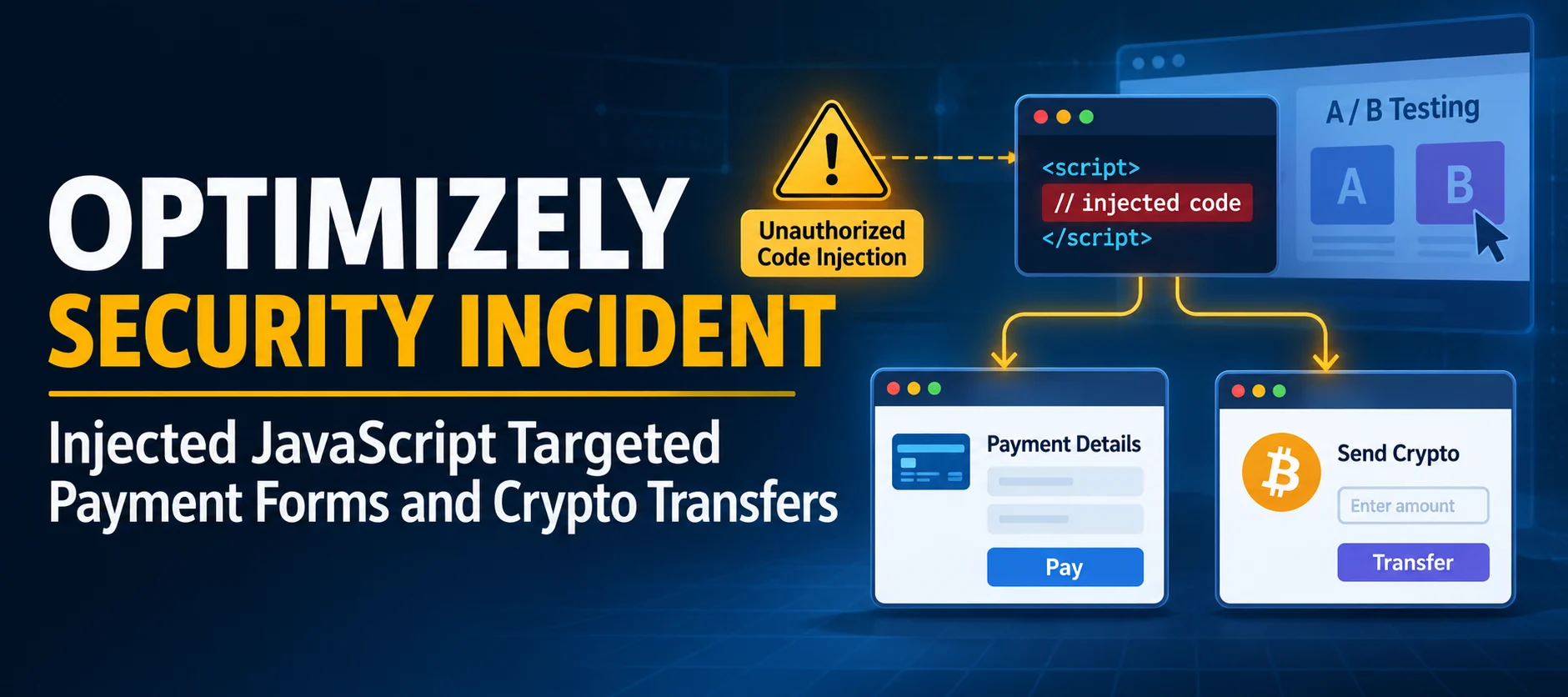
Optimizely has published additional details about a security incident in which an unauthorized third party exploited a vulnerability in its Web Experimentation account signup flow to modify customer-side JavaScript.
According to the company's November 17, 2026, incident report, the attacker used the flaw to impersonate administrator users on some customer accounts and insert malicious code into their Web Experimentation projects. The injected JavaScript was designed to target payment card information entered into website forms and cryptocurrency transactions.
Optimizely said the incident did not involve a compromised Optimizely administrator account or the theft of customer passwords. Instead, the vulnerability allowed the attacker to act as existing customer administrators without obtaining their credentials.
The company identified the first malicious code modification at 07:51 UTC on November 16. It detected the activity at 13:34 UTC, blocked malicious outbound code at Cloudflare at 16:06 UTC, and closed the vulnerable signup-flow path at 16:10 UTC.
Optimizely ended active sessions associated with impersonated users and revoked their tokens at 16:53 UTC. By 22:24 UTC, it had removed the injected code from all affected projects and confirmed that no malicious code remained in its systems.
The company has engaged Mandiant to conduct an independent forensic investigation alongside its security team. The investigation remains ongoing, and the published indicators of compromise are preliminary.
What Was Affected and What Was Not
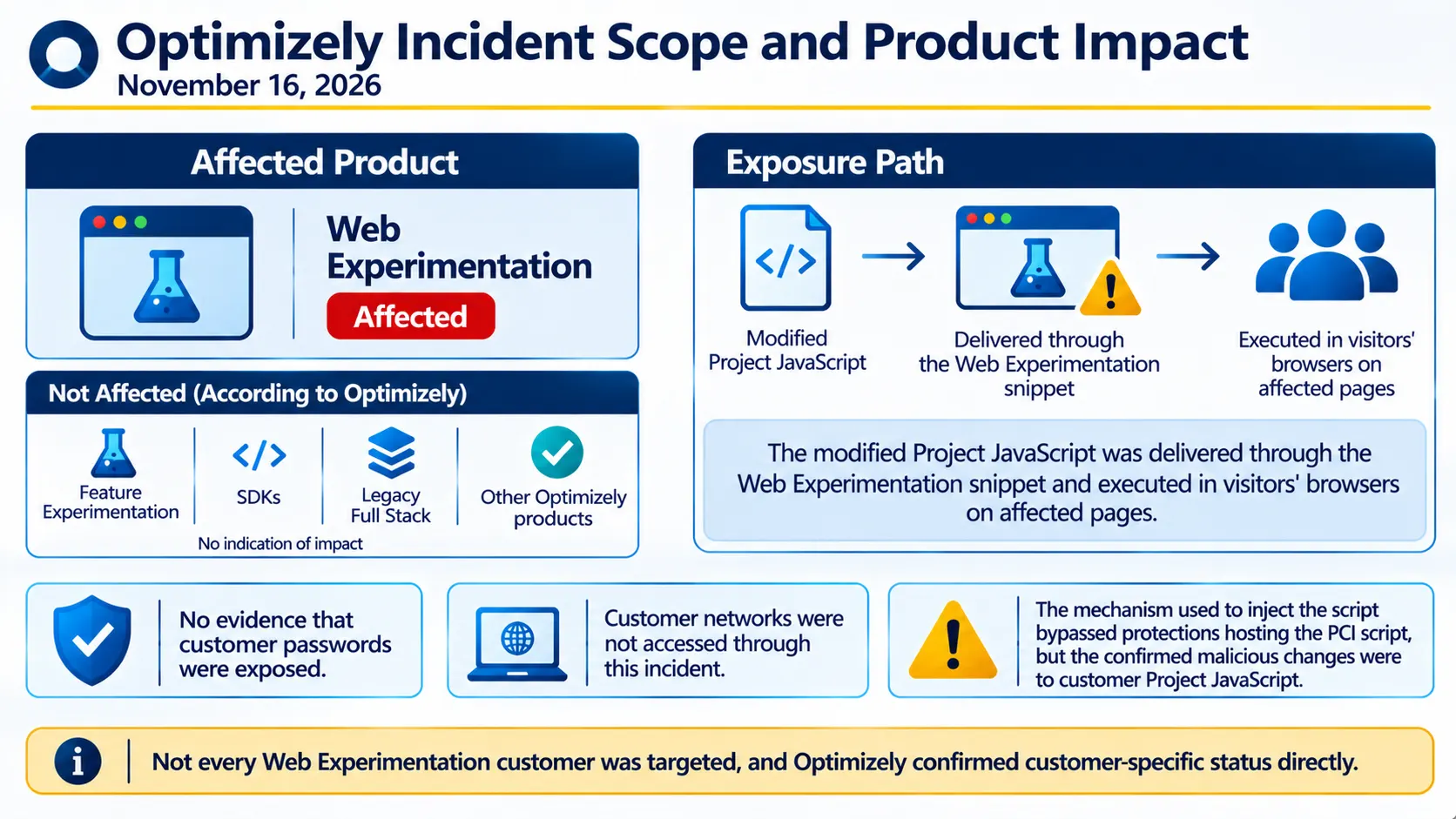
The incident was limited to Optimizely Web Experimentation, according to the report.
The company said Feature Experimentation, its SDKs, and legacy Full Stack were not affected. It also reported no indication that other Optimizely products were impacted.
The unauthorized changes involved customer Project JavaScript. Optimizely clarified that its CDN relayed the modified content but was not itself the source of the unauthorized changes.
The report also states that the incident did not give the attacker access to customer networks, VPNs, or internal systems. The malicious code ran in visitors' browsers when they loaded affected pages containing the Web Experimentation snippet.
The scope of information accessible within Optimizely depended on the privileges of the impersonated user. The attacker could access Experimentation Platform information available to that account, including relevant projects, experiments, and configuration. The company said there was no access beyond the Optimizely Experimentation product.
Optimizely also stated that it had no evidence that anything beyond Project JavaScript was modified.
Product and exposure scope
Area | Status reported by Optimizely |
|---|---|
Web Experimentation | Affected |
Feature Experimentation | Not affected |
SDKs | Not affected |
Legacy Full Stack | Not affected |
Other Optimizely products | No indication of impact |
Customer passwords | No evidence of exposure |
Customer networks and VPNs | Not accessed through this incident |
Project JavaScript | Malicious changes confirmed in affected projects |
Not every Web Experimentation customer was targeted. Optimizely said it confirmed each customer's status directly. Customers who have not received a customer-specific confirmation should contact their Customer Success Manager.
What happened to the PCI CDN?
The report includes an important clarification about cdn-pci.optimizely.com, which hosts Optimizely's high-security PCI script.
In its customer FAQ, Optimizely confirmed that the mechanism used to inject the malicious script bypassed the protections hosting this PCI script. However, the company said the confirmed malicious changes were made to customer Project JavaScript. Its CDN relayed that content and was not itself compromised.
How the Attacker Exploited the Signup Flow
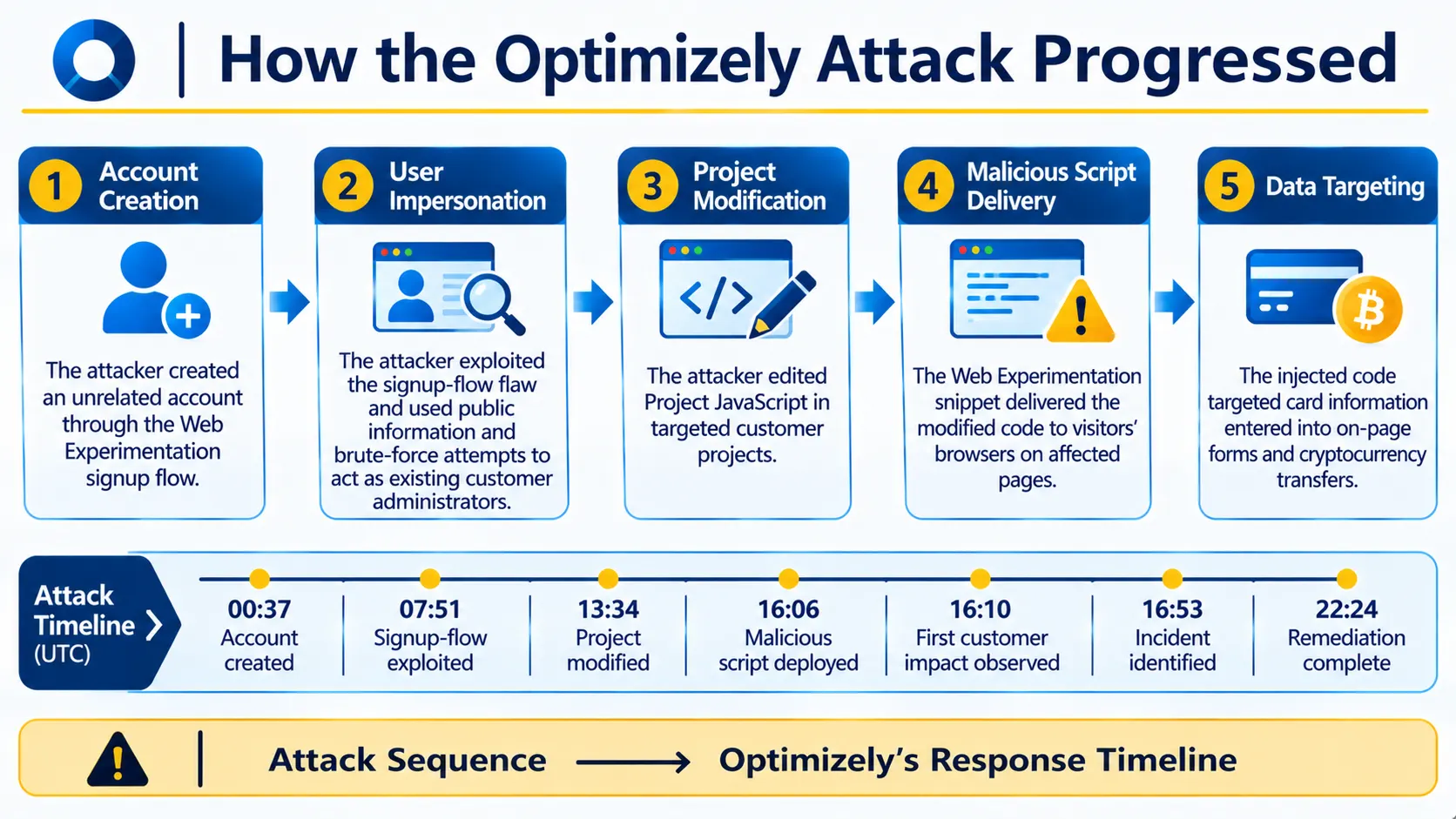
Optimizely's preliminary investigation describes a sequence involving account creation, user impersonation, unauthorized JavaScript modification, and execution in website visitors' browsers.
The first account associated with the impersonation activity was created at 00:37 UTC on November 16. Optimizely clarified that the attacker-created account was unrelated to the customer users being impersonated. It served as a mechanism for exploiting the signup-flow flaw.
The attacker used publicly available information and brute-force attempts to act as existing users on customer accounts. The activity included attempts to guess employee email addresses by trying variations of customer employee names.
The attacker repeated this pattern against each impacted customer, in some cases making thousands of attempts.
Account and Project IDs were available in the Optimizely snippet. The company clarified that these identifiers are references used by the snippet and are not account secrets.
Importantly, gaining access to one customer account did not automatically provide access to another. The attacker attempted to identify and impersonate users separately across targeted customers.
Once operating with administrator-level access to a targeted project, the attacker edited its Project JavaScript. The first malicious modification was recorded at 07:51 UTC.
The injected code loaded a card-skimming script from attacker-controlled infrastructure. Mandiant identified pay.pay-cloud[.]online as a host for the skimmer.
The Web Experimentation snippet then delivered the modified JavaScript to visitors who loaded affected pages.
Incident timeline
Time (UTC), November 16, 2026 | Event |
|---|---|
00:37 | First attacker-created account associated with the impersonation activity |
07:51 | First malicious code written to a customer project |
13:34 | Optimizely detected malicious activity |
16:06 | Cloudflare blocked malicious outbound code |
16:10 | Signup-flow vulnerability closed and fix deployed |
16:53 | Active sessions ended and tokens revoked for impersonated users |
22:24 | Injected code removed from all affected projects |
These are the preliminary milestones in Optimizely's report. The overall exposure window was 07:51 to 22:24 UTC. Exact exposure periods for individual customer sites are available through their Customer Success Managers.
Malicious JavaScript Targeted Payment Forms and Cryptocurrency Transfers
Optimizely's preliminary analysis found that the injected code loaded a card skimmer from an external domain. The recovered version targeted payment card information entered into forms on affected websites and cryptocurrency transfers.
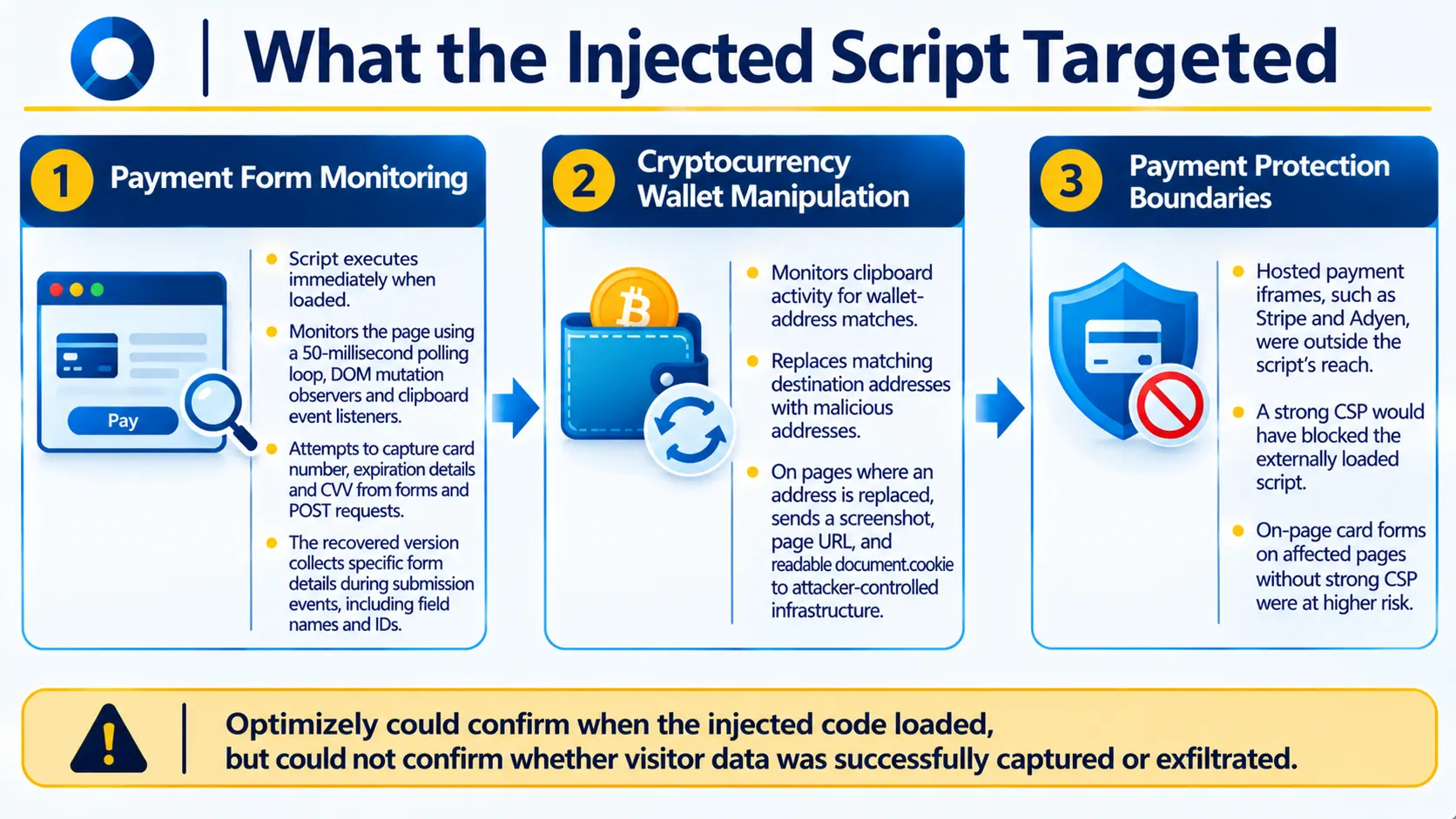
The company said the script executed immediately after loading, without page or URL restrictions. It continuously monitored the page through a combination of:
A 50-millisecond polling loop.
DOM mutation observers.
Clipboard event listeners.
The report says the script attempted to capture payment card numbers, expiration details, and CVV information from forms and POST requests on affected pages.
Its analysis of the recovered version also identified form information collected during submission events, specifically field names, IDs, card numbers, and expiration details.
The script monitored clipboard activity for cryptocurrency wallet addresses. When it detected a matching address, it could replace the destination with a malicious wallet address.
On pages where a wallet address was replaced, the script sent a screenshot, the page URL, and readable cookies through document.cookie to attacker-controlled infrastructure.
Optimizely said the recovered version did not send other form fields and did not read session storage or local storage. The company also stated that data was sent on form submissions.
The report notes that the same script was modified multiple times during the attack in attempts to add further functionality.
Hosted payment iframes were outside the skimmer's reach
The risk depended partly on how a customer website handled payment information.
Cards entered directly into forms on an affected page could have been exposed if the malicious script was able to run. In contrast, hosted payment iframes, including examples from Stripe and Adyen, were outside the script's reach because of the browser's Same-Origin policy.
Optimizely classified affected sites without strong Content Security Policy (CSP) protection and with on-page card entry as high risk. It assigned a lower risk level to sites using hosted payment iframes or a strong CSP.
The company also said that a separate second-stage script was loaded on iOS and iPadOS devices. This component targeted versions 18.6 and lower. The report describes this as an exploit-kit installation attempt, but does not provide further confirmed technical details about its outcome.
What is known about possible data exposure?
Optimizely said it could identify when the injected code was loaded, but could not determine from its own visibility whether the script successfully captured information or what data, if any, was exfiltrated.
The company reported no evidence that personal data had been exfiltrated. However, it has not confirmed whether payment information entered into vulnerable on-page forms was actually captured.
Its customer FAQ specifically states that cards entered into hosted payment iframes were outside the script's reach. Cards entered into on-page forms on affected sites may have been exposed, but whether any were actually captured remains unconfirmed.
This distinction matters: the presence of malicious code establishes a potential exposure, but does not by itself confirm that specific visitor information was successfully stolen.
Content Security Policy Played a Key Role in Limiting Exposure
The injected skimmer loaded its main code from an external attacker-controlled domain. Optimizely said websites with a strong Content Security Policy blocked the script from running.
This made CSP an important factor in the incident's customer risk assessment.
The report classifies risk according to whether a customer was affected, whether a strong CSP was in place, and how the website processed payment information.
Customer situation | Risk level reported | Reason |
|---|---|---|
Confirmed affected, no strong CSP, card details entered into on-page forms | High | The injected script could read and exfiltrate card details typed into those forms |
Confirmed affected, no strong CSP, cryptocurrency transfers handled on affected pages | High | The script targeted transfers by replacing destination wallet addresses |
Confirmed affected, payments handled only through hosted iframes | Lower | Hosted payment iframes were outside the script's reach |
Confirmed affected, strong CSP in place | Lower | CSP would have blocked the externally loaded script |
Confirmed unaffected by Optimizely | Low | No malicious code was found in the customer's projects |
Not a Web Experimentation customer | None identified | No indication of impact to other Optimizely products |
Customers should validate CSP protection through their own violation reports rather than assuming that a policy was effective simply because it was configured.
The report also advises reviewing browser requests to unfamiliar domains during the incident window. A request from a customer site to pay-relay.wordpressadmin001.workers[.]dev is identified by Optimizely as a strong sign that the skimmer ran.
Optimizely Fixed the Signup-Flow Vulnerability and Removed Injected Code
Optimizely said it closed the vulnerable signup-flow path at 16:10 UTC on November 16 and deployed a fix that prevents Project JavaScript from being changed through the exploited method.
The company also ended active sessions, revoked tokens, and reset access for impersonated users at 16:53 UTC.
By 22:24 UTC, it had removed the injected code from all affected projects, blocked its delivery through Cloudflare, and confirmed that no malicious code remained in Optimizely systems.
Where the attacker had replaced existing customer-injected JavaScript rather than adding to it, Optimizely said its team restored the original code. Customers who need help restoring replaced code should contact Support.
The company withdrew its earlier recommendation to disable Web Experimentation. Its November 17 report says customers can safely re-enable the snippet.
Feature Experimentation, SDK, and legacy Full Stack integrations do not require changes related to this incident.
Optimizely also said customers do not need to reset passwords or regenerate API tokens because the incident was not a credentials breach. Its report states that sessions associated with impersonated users had already been purged.
Actions Optimizely Recommends to Customers
Although Optimizely has remediated the vulnerability and removed the injected code, it advises every Web Experimentation customer to review possible exposure on their own websites.
The recommended actions apply to both affected and unaffected customers.
1. Identify pages that loaded the Web Experimentation snippet
Confirm which website pages used the snippet during the overall exposure window of 07:51 to 22:24 UTC on November 16, 2026.
Give particular attention to pages that accepted credit card information, including CVV details, or supported cryptocurrency transfers.
If the snippet ran on pages handling these activities, Optimizely recommends treating the risk as high where strong CSP protection was absent.
Individual customer exposure periods may differ. Contact the Customer Success Manager for the precise timeline associated with your projects.
2. Review browser requests and CSP reports
Examine CSP violation reports and outbound browser requests for unfamiliar domains during the incident window.
Pay particular attention to the preliminary indicators listed later in this article. Check web server, CDN, web application firewall, proxy, and browser-related records where available.
3. Review payment and cryptocurrency activity
Where applicable, examine card transactions and cryptocurrency transfers made through affected pages during the exposure period.
Customers should coordinate with their payment and fraud-monitoring teams to assess suspicious activity.
4. Preserve investigation records
Retain logs covering at least November 16, 2026. Optimizely specifically recommends preserving:
Web server logs.
CDN records.
Web application firewall logs.
CSP violation reports.
Payment records.
Fraud-monitoring data.
Optimizely can provide customer-specific project timelines and relevant records through Customer Success Managers or Support. However, the company notes that it can see when injected code loaded, not whether the code successfully captured or transmitted visitor data. Customers should therefore retain their own browser, web, and security logs.
5. Review CSP protection
Check that a strong Content Security Policy is configured on pages that load the Web Experimentation snippet.
Optimizely's findings indicate that a strong CSP protected sites in this incident by blocking the externally loaded malicious script.
6. Review pages that do not need experimentation
Optimizely recommends removing the Web Experimentation snippet from pages that handle sensitive input, including payment or cryptocurrency transfers, when those pages are not being used for experiments.
Customers who prefer to keep Web Experimentation disabled while completing their review can remove or comment out the snippet loaded from cdn.optimizely.com in page templates or their tag manager. The report identifies this as the most complete option for sites without CSP protection.
The company has withdrawn its earlier recommendation to disable Web Experimentation and says customers can now safely re-enable the snippet.
7. Review user access and authentication controls
Optimizely recommends reviewing user accounts and the permissions assigned to them.
The company says multi-factor authentication is available for both Experimentation local login and OptiID. It also encourages customers to integrate authentication with their corporate identity provider.
Customers should assess their own legal advisers' guidance on any notification or reporting obligations to visitors, customers, or regulators.
Preliminary Indicators of Compromise
Optimizely published preliminary indicators to help customers investigate possible exposure. The company said the list may change when the independent forensic investigation is complete.
Domains
Indicator | Reported purpose |
|---|---|
| Exfiltration endpoint used by the skimmer |
| Attacker-controlled infrastructure associated with the campaign |
| Host identified for the card skimmer |
Optimizely recommends blocking the identified domains and searching web, CDN, CSP, and proxy logs for related activity.
The company identifies any browser request from a customer site to pay-relay.wordpressadmin001.workers[.]dev as a strong sign that the skimmer ran.
IP addresses associated with the activity
The report also identifies two IP addresses associated with commercial VPN services:
193.176.211[.]170193.176.211[.]203
Optimizely says these addresses are provided for reference only. VPN addresses can change and should not be treated as reliable indicators of compromise.
Attribution remains unresolved
Optimizely has not named the actor behind the incident. Attribution remains pending.
Its preliminary research found that the actor controls pay-cloud[.]online and has operated two command-and-control frameworks, ADAPTAGENT and CUPCAKE C2, from that infrastructure since at least September.
The same infrastructure has also hosted JavaScript card skimmers used in campaigns involving other victims. However, Optimizely has not attributed the incident to a named threat group.
Mandiant Investigation Is Ongoing
Optimizely has engaged Mandiant to independently investigate the incident alongside its internal security team.
The November 17 document is an initial customer report, not the final forensic assessment. Optimizely said it will provide further information about the root cause and final indicators of compromise after the investigation is complete.
Customers requiring incident-specific records, including project timelines and relevant logs, can contact their Customer Success Manager or email support@optimizely.com.
The company said it expects to provide daily updates to customers and partners until the incident is closed. It also noted that the final forensic report could be delayed by the current workload of forensic investigation firms.
Optimizely said its longer-term security hardening work will be informed by the findings of the third-party investigation. The report does not yet provide a complete list of planned changes.
A customer request to require approval before publishing Project JavaScript or restrict editing to selected users is listed as a feature request, not an implemented control.
Why the Incident Matters for Websites Using Third-Party Scripts
The Optimizely incident highlights a security concern for websites that rely on externally managed JavaScript to deliver experimentation and other customer-facing functionality.
In this case, the attack did not require stealing customer passwords or gaining direct access to a customer's internal network. The attacker exploited an application-level flaw to modify project code, which was then delivered to visitors through the normal Web Experimentation snippet.
For website operators, the incident reinforces the importance of controlling who can modify third-party scripts, monitoring changes to customer-side code, and applying restrictive Content Security Policies.
It also demonstrates why incident investigations should distinguish between code being delivered, code executing in a browser, and information being successfully exfiltrated. Optimizely confirmed that the injected code loaded, but said it could not establish whether visitor data was successfully captured or transmitted.
The forensic investigation remains important to clarify the root cause and confirm the final indicators. Until then, customers should use the preliminary findings to review their own exposure and preserve the records needed to assess any potential impact.
Source: Optimizely
About the Author