
Google Strengthens Enterprise AI Security With New Controls for Autonomous Agents
Google introduces new security controls across Workspace and Google Cloud to help enterprises deploy AI agents safely, with dedicated identities, permission checks, human approvals, monitoring and data protection.
Xcademia Team
Google is expanding its enterprise security framework to address the growing risks associated with autonomous artificial intelligence (AI) agents. The company has introduced new agent-focused interfaces and security controls across Google Workspace and Google Cloud, giving organisations greater visibility and control over how AI agents access information and perform actions.
Announced on November 24, 2026, the updates include generally available Workspace Model Context Protocol (MCP) servers, Workspace Command Line Interface (CLI), and Google Cloud Agent Gateway.
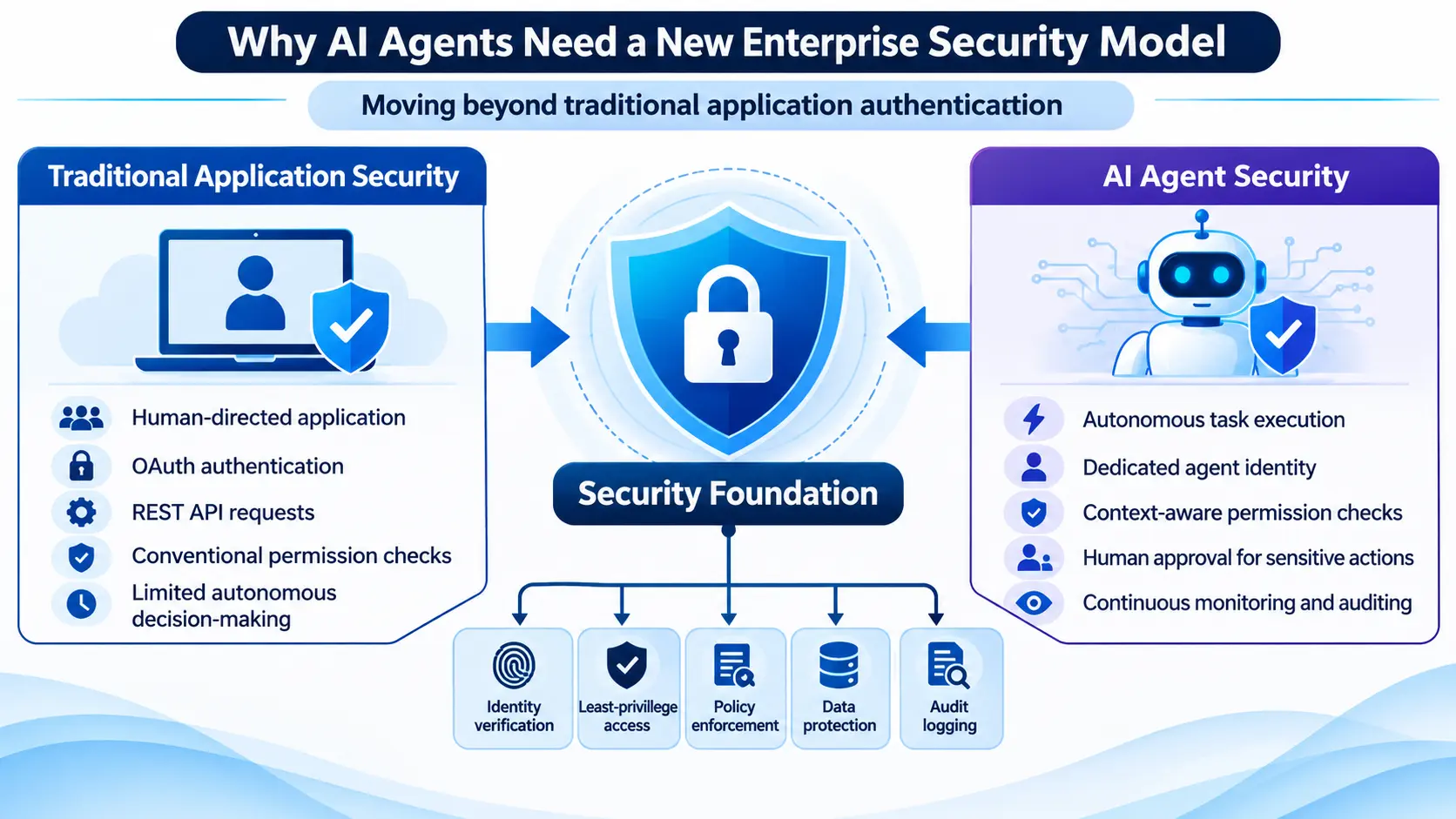
The announcement addresses an important challenge in enterprise AI adoption: traditional application security models were designed for software operating with human direction, while AI agents can independently interact with emails, documents, datasets and cloud infrastructure.
Google's approach introduces dedicated agent identities, policy enforcement, human approval requirements, activity monitoring and data protection measures to help organisations manage these interactions.
Why Traditional Application Security Is Not Enough for AI Agents
For more than two decades, Google has developed security protections for Workspace and Google Cloud customers. Its announcement highlights the scale of this infrastructure, including services used by billions of users and millions of organisations.
Traditional REST APIs were designed around applications that operate at human speed. In many cases, a valid OAuth access token was treated as sufficient evidence that an application had permission to perform an operation.
However, AI agents introduce a different security challenge.
Unlike conventional applications, autonomous agents can process information and execute multiple actions without requiring a person to approve every individual step. They may interact with Gmail, Google Drive, documents, spreadsheets and cloud infrastructure as part of a single workflow.
This creates several security concerns:
Excessive permissions: An agent could receive broader access than its assigned task requires.
Unauthorised actions: An agent might send emails, modify files or change access permissions without appropriate confirmation.
Prompt injection: Malicious instructions embedded in content could influence an agent's behaviour.
Limited visibility: Administrators need to understand which agents are accessing organisational resources.
Data exposure: Sensitive information could be accessed or processed outside approved organisational boundaries.
Google's position is that a valid authentication token alone is no longer sufficient for agent-based workflows. Security policies, data boundaries and human confirmation must become part of the request process.
Google Introduces Three Agent-Focused Interfaces
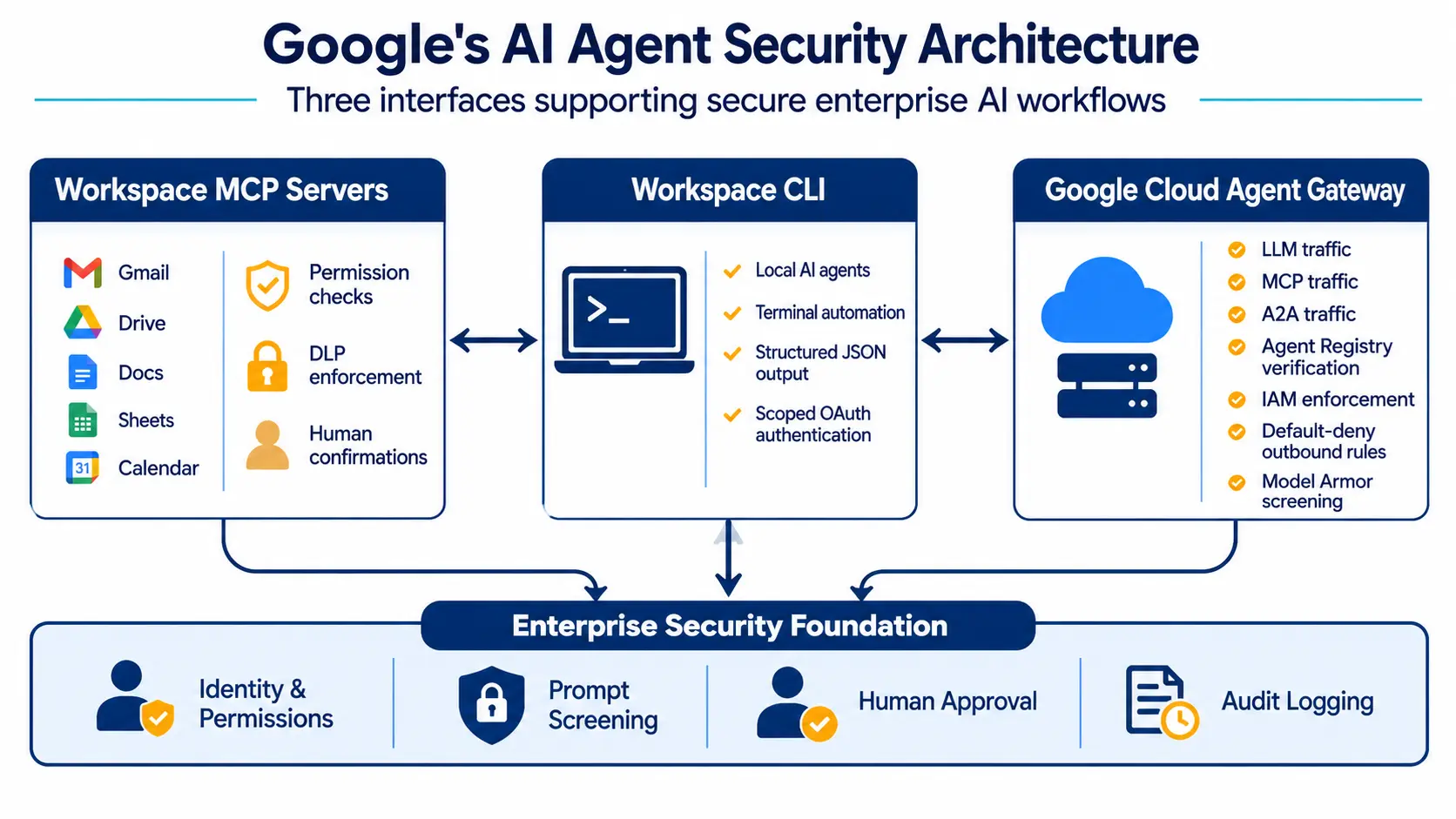
Google is introducing three important interfaces to help developers build AI agents while maintaining enterprise security controls.
These interfaces are designed to support modern agent communication standards and reduce the need for developers to build security mechanisms independently.
Google Workspace MCP Servers
Google Workspace MCP servers are now generally available.
MCP, or Model Context Protocol, provides a standardised way for AI agents to connect with external tools and services.
Google's dedicated Workspace MCP servers support:
Gmail
Google Drive
Google Docs
Google Sheets
Google Slides
Google Calendar
Google Chat
Google Tasks
The servers include built-in permission and Data Loss Prevention (DLP) checks. They also support human-in-the-loop confirmations for sensitive operations.
Another important feature is their integration with Model Armor, Google's prompt-injection screening service.
The servers reject non-agent OAuth clients, helping distinguish agent-based access from conventional application access.
Google Workspace CLI
The Workspace CLI is also generally available. It is designed for local AI agents, terminal-based workflows and automation.
Its capabilities include:
Structured JSON outputs.
Scoped OAuth sign-in.
Access to supported Workspace services.
Structured outputs can help developers build workflows that process information consistently rather than relying entirely on unstructured responses.
Google Cloud Agent Gateway
Google Cloud Agent Gateway provides a protocol-native gateway for handling:
Large Language Model (LLM) traffic.
Model Context Protocol (MCP) traffic.
Agent2Agent (A2A) communication.
The gateway verifies agent identities through Agent Registry, enforces Identity and Access Management (IAM) policies and applies default-deny outbound rules.
It also integrates with Model Armor to screen requests.
Together, these three interfaces provide developers with agent-ready connectivity while allowing organisations to apply security policies and maintain oversight.
Six Security Controls Designed for Enterprise AI Agents
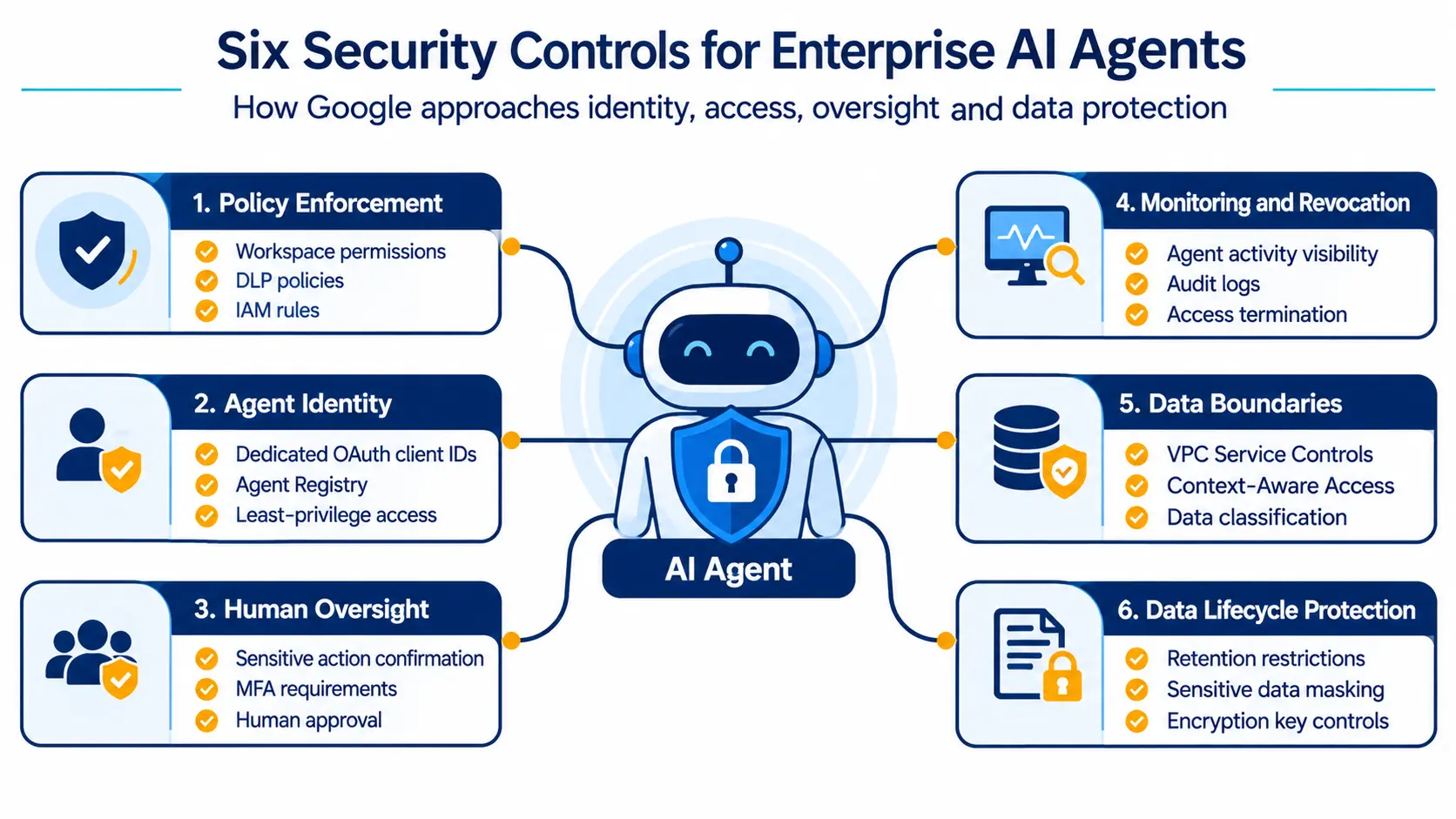
Google's announcement outlines six security principles that apply across Workspace and Google Cloud. These controls are intended to make agent activity more accountable and restrict access to sensitive resources.
Policy Checks on Every Request
The first control focuses on enforcing organisational policies whenever an AI agent requests access to Workspace resources.
Under Google's new Workspace AI Tools Addendum, AI agents must use Workspace MCP servers or the Workspace CLI instead of existing REST APIs.
Technical enforcement is scheduled to begin on February 1, 2027, giving developers time to transition.
Every request will be checked against relevant organisational controls, including:
Workspace permissions.
Data Loss Prevention policies.
Data classification labels.
On Google Cloud, Agent Gateway enforces IAM policies and default-deny outbound rules at the protocol layer.
It also supports custom policy checks through Service Extensions, which can connect to Identity-Aware Proxy, an organisation's own policy engine or third-party security tools.
This approach places security enforcement directly into agent communication rather than relying only on application-level authentication.
Dedicated Agent Identities and Usage Limits
A second important control involves giving AI agents separate identities.
Traditional applications and human users have established identity mechanisms. However, organisations also need to identify which operations are being performed by autonomous agents.
Google is introducing dedicated OAuth client IDs for agents connecting to Workspace.
These identities work alongside:
Least-privilege OAuth scopes.
Time-limited approvals, which are coming soon.
Usage quotas.
Google states that billing for Workspace usage quotas begins on April 1, 2027.
On Google Cloud, Agent Registry provides dedicated Agent Identities. These identities avoid shared or long-lived keys and operate within IAM policies and organisation, folder and project quotas.
They can also carry user-delegated authorisation when accessing Workspace emails and files.
Separating agent identities from conventional application identities can help security teams understand which systems are performing actions and apply appropriate access restrictions.
Human Approval for Sensitive Operations
Google is also maintaining human oversight for operations that could have significant consequences.
Not every AI agent action requires manual approval. Routine activities, such as creating drafts or summarising documents, can run autonomously.
However, more sensitive operations require explicit confirmation.
In Workspace, MCP servers and the CLI enforce user confirmation before agents can:
Send emails.
Change Google Drive sharing permissions.
Perform bulk edits.
On Google Cloud, organisations can configure policies requiring multi-factor authentication or human approval before agents perform sensitive operations.
Examples include accessing sensitive Cloud Storage buckets, changing IAM permissions and modifying production infrastructure.
This creates a distinction between routine automation and actions that require additional human oversight.
Continuous Visibility, Monitoring and Access Revocation
Google emphasises that a one-time consent screen is not sufficient for agents that operate continuously.
Organisations need ongoing visibility into agent activity and the ability to revoke access when necessary.
For Workspace, administrators can view, audit and revoke AI agents through the admin console.
Google also states that users will soon be able to view agent activity and revoke access to their emails and files.
For Google Cloud, several security and monitoring services support visibility into agent behaviour:
Security Command Center: Provides security visibility across cloud environments.
Agent Observability: Helps monitor agent activity.
Cloud Audit Logs: Records relevant cloud operations.
Wiz: Provides additional security visibility.
Google states that revoking a Cloud Agent Identity or OAuth grant immediately stops the associated access.
This is particularly important when an agent behaves unexpectedly or an organisation needs to terminate its access quickly.
Protection for Sensitive Enterprise Data
The fifth control focuses on restricting which information AI agents can access.
Google plans to extend Workspace Data Loss Prevention and client-side encryption protections to AI agents.
These capabilities are coming soon and will allow administrators and users to block agents from accessing Gmail messages and specific Drive files and folders.
For Google Cloud, the announcement highlights three existing security mechanisms:
VPC Service Controls: Help establish security perimeters around cloud resources and data.
Principal Access Boundaries: Help restrict the resources that principals can access.
Context-Aware Access: Applies access conditions based on context, including device-related requirements.
These controls are intended to keep sensitive information within designated security boundaries.
Clear Rules for Data Retention and Usage
The final control addresses what happens to organisational information after an AI agent accesses it.
Google's new Workspace AI Tools Addendum establishes restrictions on how AI tools use data through Workspace APIs.
According to the announcement, the addendum does not permit:
Permanent storage of raw data.
Model training using the covered Workspace API data.
Extended retention of derived data.
API scraping.
Google also states that derived and user data must be removed within a defined window and when a user disconnects.
On Google Cloud, Sensitive Data Protection can mask sensitive fields before information leaves its original environment.
Customer-managed or external encryption keys can also be used to cut off access to Cloud agent memory stores immediately.
These measures address an important aspect of AI security: protecting information not only while an agent accesses it, but also after processing takes place.
What Google's Security Changes Mean for Enterprise Developers
The introduction of agent-specific security interfaces reflects a shift in how organisations need to approach AI deployment.
Developers are no longer dealing only with applications that respond to direct user instructions. They are increasingly building systems capable of independently accessing information, coordinating tools and completing multi-step tasks.
This creates a need to incorporate security into the agent architecture from the beginning.
Google's announcement highlights several practical considerations for developers.
Use agent-native interfaces: Developers building Workspace-connected agents need to prepare for the transition to MCP servers and Workspace CLI rather than relying on traditional REST APIs for agent access.
Implement least-privilege access: Agents should receive permissions appropriate to their assigned tasks rather than unrestricted access to organisational resources.
Protect sensitive operations: Workflows involving email delivery, permission changes and production infrastructure should include appropriate confirmation or approval requirements.
Monitor agent activity: Developers and security teams need mechanisms to understand which agents are accessing resources and what actions they are performing.
Establish data boundaries: AI workflows should operate within the organisation's data protection and access policies.
These considerations are relevant to organisations deploying AI assistants, automated business workflows and multi-agent systems.
How Organisations Can Start Implementing Google's Approach
Google has also provided separate recommendations for developers, Workspace administrators and Google Cloud customers.
The recommended starting points differ depending on the responsibilities of each group.
For Workspace Developers
Developers should:
Start with the Workspace MCP and CLI configuration guide.
Implement user confirmations through MCP.
Add prompt-injection protection using Model Armor.
Review the Workspace AI Tools Addendum.
Prepare agent integrations for the upcoming API enforcement requirements.
For Workspace Administrators
Administrators should:
Review connected applications and AI agents.
Configure DLP policies for users.
Monitor OAuth activity logs through the admin console.
Review which agents have access to organisational information.
Prepare for the transition to agent-native interfaces.
For Google Cloud Customers
Google recommends that cloud customers:
Register Agent Identities in Agent Registry.
Deploy Agent Gateway and Model Armor in front of agents and MCP servers.
Configure MFA or human approval for sensitive operations.
Review IAM permissions.
Configure VPC Service Controls.
Establish appropriate usage quota limits.
These recommendations provide a starting point for integrating agent security into existing enterprise infrastructure.
Important Dates and Availability
Google's announcement includes several availability details and upcoming enforcement milestones.
Capability or change | Status / date |
|---|---|
Workspace MCP servers | Generally available |
Workspace CLI | Generally available |
Google Cloud Agent Gateway | Announced with the new agent security framework |
Technical enforcement of Workspace agent interface requirements | February 1, 2027 |
Workspace usage quota billing | April 1, 2027 |
Time-limited approvals | Coming soon |
User-facing agent activity and revocation | Coming soon |
Workspace agent DLP and encryption restrictions | Coming soon |
Organisations should distinguish between capabilities available today and those still planned for future availability. The announcement does not provide specific release dates for every upcoming feature.
Broader Industry Implications: AI Agent Security Becomes an Enterprise Priority
Google's announcement highlights a broader industry shift toward securing AI agents as independent digital identities rather than treating them as ordinary software applications.
As organisations introduce agents into business operations, security teams must consider more than authentication and access permissions. They also need to understand what agents can do, which information they can access, how their actions are monitored and when human intervention is required.
For enterprises, this could mean moving towards security architectures where identity verification, permission enforcement, monitoring and data protection are integrated directly into AI workflows.
The emphasis on human confirmation is also significant. Autonomous systems can improve workflow efficiency, but organisations may still need people to approve operations involving sensitive information, access permissions or production infrastructure.
Google's approach demonstrates how established cloud security controls can be adapted for agent-based systems.
However, implementation details, operational performance improvements and independent security validation were not disclosed in this announcement.
The development reflects growing demand for enterprise AI systems that combine automation with accountability and organisational control.
Conclusion
Google's new AI agent security framework introduces a more structured approach to enterprise AI deployment across Workspace and Google Cloud.
With Workspace MCP servers, Workspace CLI and Google Cloud Agent Gateway, developers gain agent-focused interfaces supported by identity verification, policy enforcement and security monitoring.
The six security controls further address important concerns around permissions, human approvals, data boundaries, visibility and information retention.
For enterprises exploring autonomous AI workflows, the announcement provides a useful direction: AI agents need clearly defined identities, restricted permissions and continuous oversight.
As agent-based automation becomes more integrated into business operations, building security into the architecture will remain an important requirement for responsible enterprise AI adoption.
Source: Google Cloud Blog
About the Author