
Google Named a Leader in 2026 Gartner SIEM Magic Quadrant as AI Transforms Security Operations
Google has been named a Leader in the 2026 Gartner Magic Quadrant for SIEM, highlighting its AI-powered security operations, autonomous threat detection, and faster incident response capabilities.
Xcademia Team
Google has been recognised as a Leader in the 2026 Gartner Magic Quadrant for Security Information and Event Management (SIEM), marking a significant development in the company's enterprise cybersecurity strategy.
Announced on November 23, 2026, by Google Cloud, the recognition places Google furthest on the Completeness of Vision axis among the 15 vendors evaluated in this year's report.
The announcement reflects Google's continued investment in Google Security Operations, particularly its integration of artificial intelligence (AI) and autonomous agents into security operations workflows.
According to Google, the modern threat landscape requires security teams to move beyond traditional monitoring and manual investigation processes. Increasingly sophisticated attacks demand faster detection, investigation, and response capabilities.
Google's approach focuses on using AI-powered agents to support security analysts, automate repetitive activities, and improve the efficiency of Security Operations Centers (SOCs).
Moving Beyond Traditional SIEM with Agentic AI
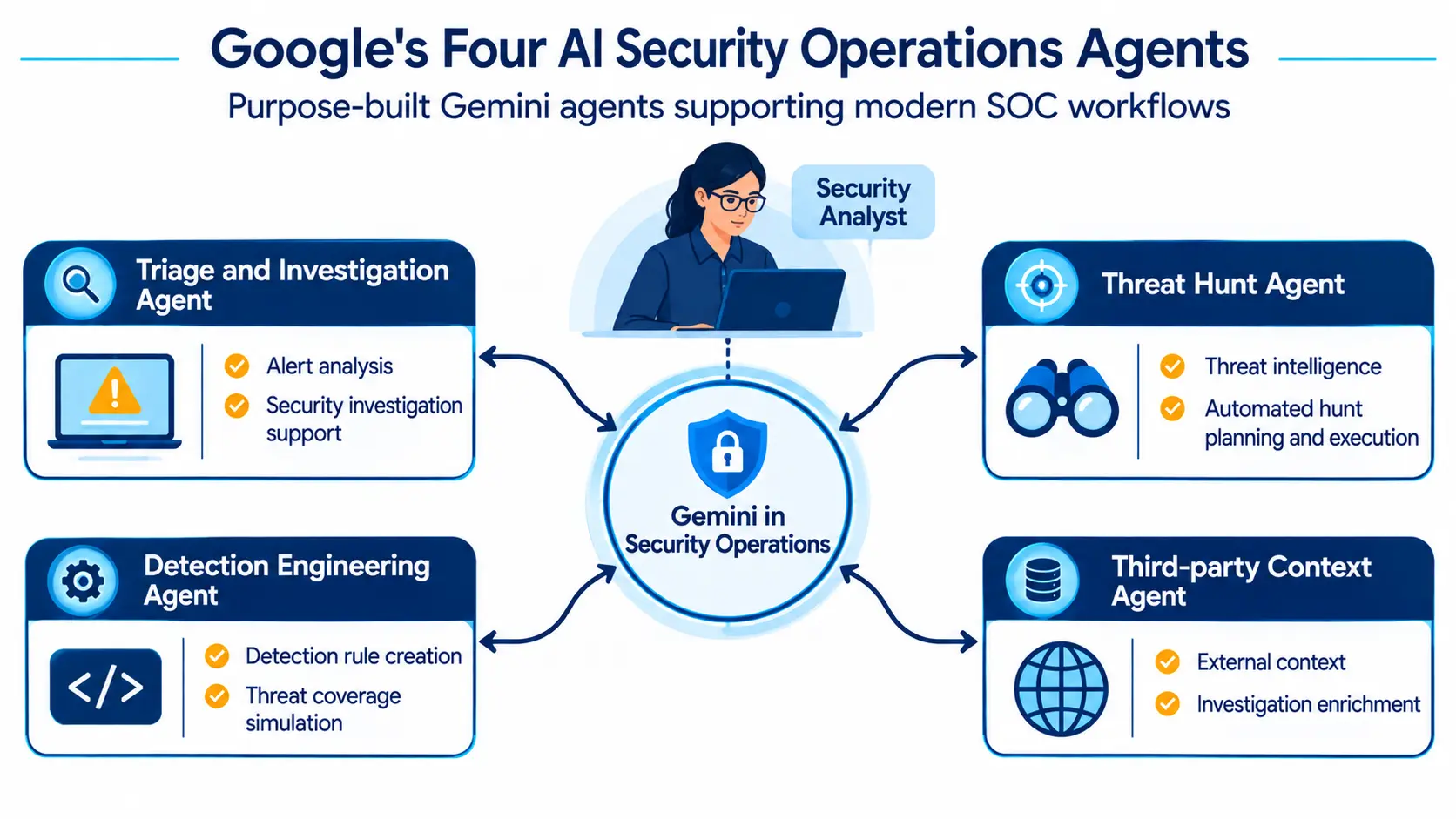
Traditional SIEM platforms primarily centralise security logs, alerts, and event data from different enterprise systems.
Although these platforms provide visibility into security events, analysts often need to manually connect information, develop detection rules, investigate suspicious activities, and prepare incident response procedures.
Google believes this approach needs to evolve as cyber threats become more sophisticated and automated.
Its agentic Security Operations approach introduces autonomous AI agents that work alongside human analysts. These agents can reason over enterprise context and use threat intelligence to support security investigations and response activities.
The objective is to reduce the time required to identify potential threats and coordinate appropriate responses.
Rather than replacing security professionals, Google's approach positions AI agents as additional operational support for security teams.
Google's Four Purpose-Built AI Security Agents
One of the major developments highlighted in Google's announcement is the expansion of Gemini in Security Operations.
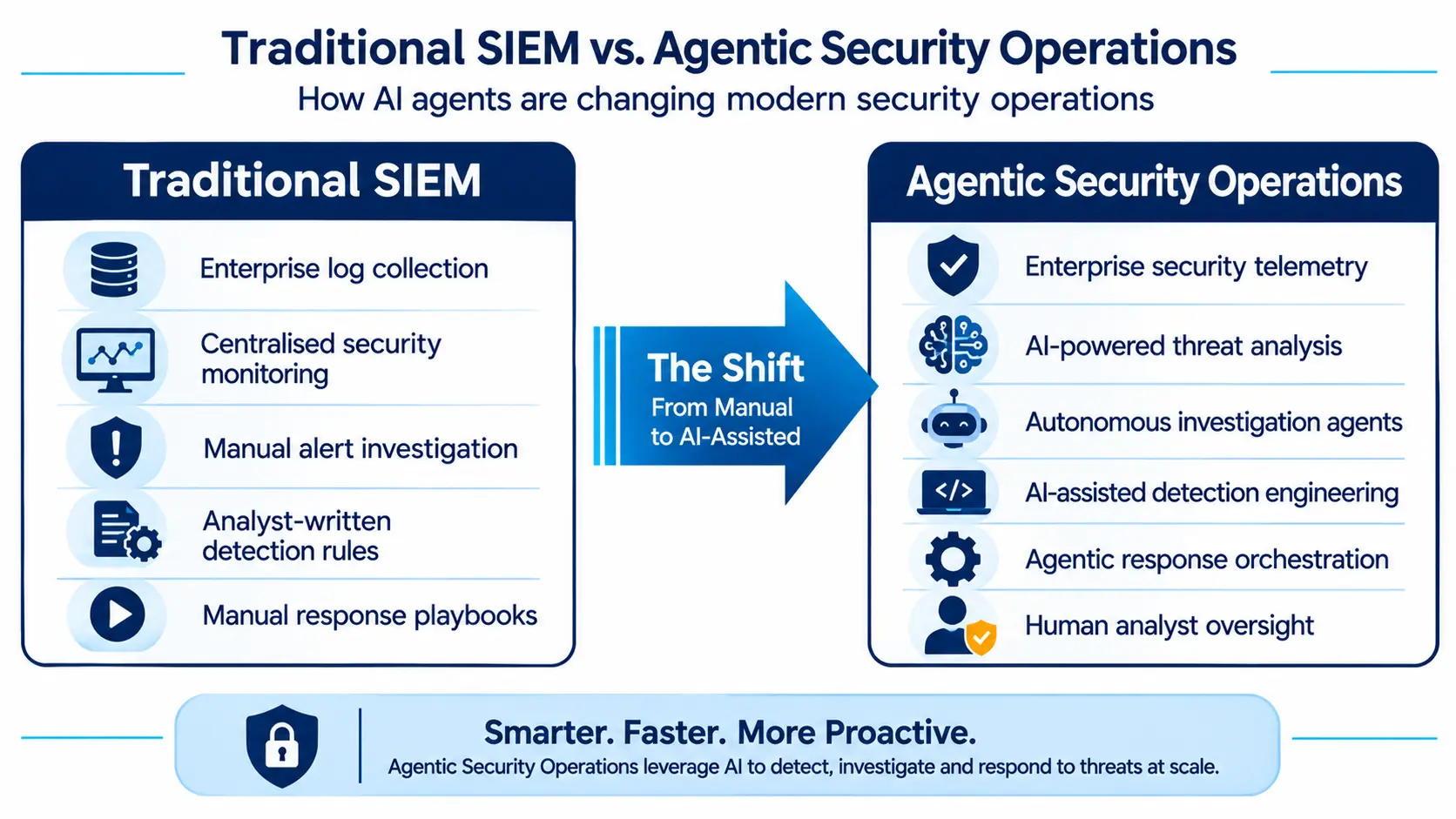
Google has evolved Gemini from a security assistant into a collection of purpose-built agents designed to support different SOC responsibilities.
The four agents highlighted in the announcement include:
Triage and Investigation Agent
This agent supports the investigation of security alerts and helps analysts understand suspicious activities within their enterprise environments.
Threat Hunt Agent
The Threat Hunt agent generates and executes threat-hunting plans using threat intelligence. It helps security teams investigate potential adversaries and identify emerging attack techniques.
Detection Engineering Agent
Detection engineering traditionally involves analysing attacks, writing detection rules, and validating whether those rules identify relevant threats.
Google's agent helps automate rule creation and simulate threat coverage, reducing the manual effort involved in developing and testing detections.
Third-party Context Agent
This agent brings third-party context into security operations workflows, supporting analysts with additional information during investigations.
Google has also introduced agentic automation to coordinate automated actions within security playbooks.
Together, these capabilities aim to support more efficient threat investigation, detection development, and security response.
Google Highlights Improvements in Threat Detection and Investigation
Google's announcement also highlights several developments designed to improve day-to-day security operations.
These include:
Emerging Threats Centers for assessing exposure to breaking threats.
Mandiant rule packs and other curated detections.
GoogleSQL support in Search for threat hunting and analysis.
Native Data Processing Pipelines.
Health Hub for operational management.
A unified investigation and case management experience.
These capabilities are intended to help security teams identify threats, investigate suspicious activities, and manage operational workflows through a more integrated environment.
Google's announcement also highlights the importance of threat intelligence in identifying emerging attack techniques and improving detection coverage.
By combining security telemetry, curated detections, and AI-powered investigation, the company aims to reduce the operational burden on security analysts.
Reported Time Savings in Security Operations
Google also shared customer feedback and research findings to demonstrate the operational impact of its security platform.
According to David Nagel, Global CISO at Genuine Parts Company, the organisation reduced false positives by 42% after implementing Google Security Operations.
This allowed its analysts to spend less time validating alerts and more time addressing complex security problems.
Google also highlighted improvements in detection engineering and threat hunting.
Detection Engineering
According to Google, its Detection Engineering agent can automate rule creation and simulate threat coverage on demand.
The company states that this can reduce the complete testing and deployment lifecycle to under 30 minutes.
Threat Hunting
Google says its Threat Hunting agent can generate and execute comprehensive hunting plans using threat intelligence.
According to the announcement, activities that previously required up to a full day of dedicated effort can now be completed in less than an hour.
These examples illustrate Google's focus on reducing repetitive investigation work and helping security teams use their expertise more effectively.
IDC Research Highlights the Potential Business Impact
Beyond individual customer experiences, Google referenced a Business Value report from IDC examining organisations using Gemini in Security Operations.
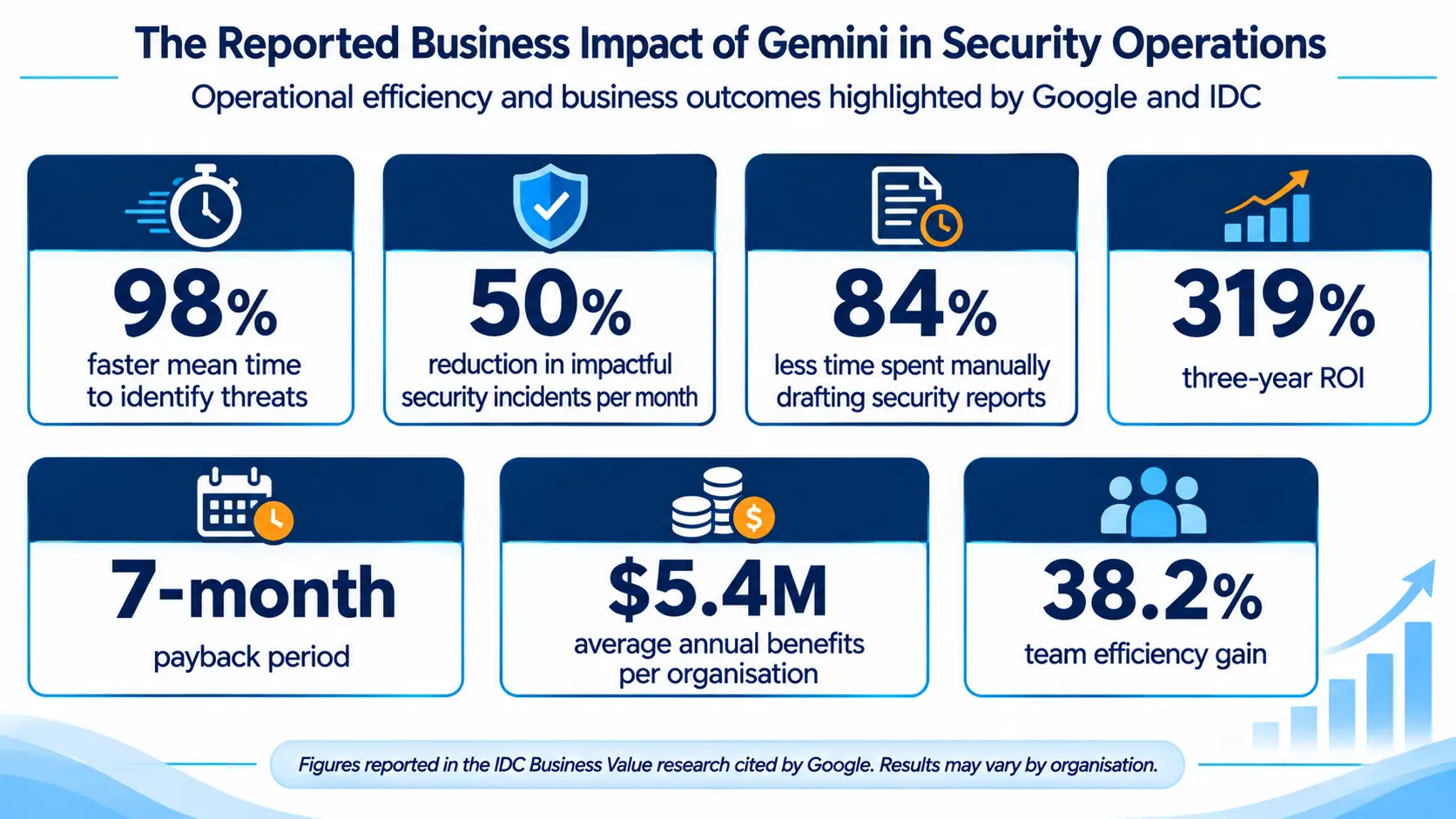
According to the figures shared in Google's announcement, the research identified the following outcomes:
98% faster mean time to identify threats.
50% reduction in impactful security incidents per month.
84% reduction in time spent manually preparing security reports and incident summaries.
319% three-year return on investment (ROI).
Seven-month payback period.
$5.4 million in average annual benefits per organisation.
38.2% improvement in team efficiency.
These figures are attributed to the IDC Business Value research cited by Google. They should be understood as reported research outcomes rather than guaranteed results for every organisation.
The findings suggest that AI-assisted security operations could provide benefits beyond technical threat detection, including operational efficiency and resource management.
What Google's Gartner Recognition Means for Enterprise Security
Google's recognition in the 2026 Gartner Magic Quadrant highlights its position in the competitive SIEM market.
However, the announcement is not limited to market recognition. It also reflects a broader shift in how enterprise security operations are evolving.
Security teams increasingly need to manage large volumes of alerts, investigate complex threats, and respond to attacks without relying entirely on manual processes.
AI agents could help address some of these challenges by supporting investigation, automating detection development, and coordinating security workflows.
For enterprises, this could mean more efficient use of security resources and greater opportunities to focus experienced analysts on complex investigations and strategic security priorities.
At the same time, organisations evaluating AI-powered security platforms should consider factors such as integration requirements, operational oversight, data governance, detection accuracy, and the appropriate level of human involvement.
The announcement does not provide detailed comparative information about all 15 evaluated vendors or their individual technical capabilities.
Conclusion: AI Is Becoming an Important Part of Modern Security Operations
Google's recognition as a Leader in the 2026 Gartner Magic Quadrant for SIEM highlights its continued investment in AI-powered cybersecurity.
Through Gemini in Security Operations, purpose-built AI agents, threat intelligence integration, and agentic automation, Google is working to reduce manual workloads across security investigation, detection engineering, and threat hunting.
The development also reflects a broader industry shift toward AI-assisted security operations, where autonomous agents support human analysts in responding to increasingly complex cyber threats.
For enterprises, the next challenge will be integrating these capabilities into existing security environments while maintaining appropriate human oversight, governance, and accountability.
As AI becomes more deeply integrated into cybersecurity workflows, the relationship between human expertise and autonomous security systems will remain an important area of industry development.
Source: Google Cloud Blog
About the Author