
Microsoft Warns: Threat Actors Are Abusing ARTEX AI Agents to Automate Cyberattacks
Microsoft warns that threat actors are abusing ARTEX, an AI-powered penetration testing framework, to automate cyberattacks, exploit vulnerabilities and steal credentials, highlighting the growing security risks of autonomous AI agents.
Xcademia Team

Microsoft Threat Intelligence has warned that cybercriminal groups and state-sponsored threat actors are increasingly using ARTEX, an AI-powered penetration testing framework, to accelerate cyberattacks.
Released publicly in July 2026, ARTEX uses multiple AI agents to automate activities across different stages of an attack, including network reconnaissance, vulnerability discovery, credential attacks and web application exploitation.
According to Microsoft's November 25 report, several threat actors have incorporated ARTEX into their operations. These include Storm-0940, Storm-3358, Onyx Sleet, Pearl Sleet, Crystal Typhoon and Salt Typhoon.
Microsoft has also observed campaigns using ARTEX to search public code repositories for exposed credentials, investigate internet-facing systems and support software supply chain compromise.
The development highlights a growing cybersecurity concern: attackers can now combine established offensive security tools with AI-driven coordination to execute attack workflows at machine speed.
Microsoft emphasizes that ARTEX does not introduce entirely new attack techniques. Instead, it brings existing tools and methods together through autonomous AI agents, allowing attackers to perform familiar activities faster and with less manual involvement.
What Is ARTEX and Why Is It a Security Concern?
ARTEX, whose Chinese name translates to AI Autonomous Penetration Testing System, is an AI-driven platform designed to automate penetration testing activities.
Its architecture combines a Go-based backend with multiple large language model (LLM) agents. It also includes a Next.js web interface and PostgreSQL for data storage.
Unlike conventional security tools that generally perform specific scanning or testing tasks, ARTEX coordinates multiple agents to work through a broader attack process.
The framework can move from identifying exposed systems to testing vulnerabilities, verifying successful exploitation and generating reports.
Microsoft explains that ARTEX focuses primarily on web application and API security weaknesses, including:
SQL injection
Server-side template injection
XML external entity (XXE) injection
Authentication bypass
Insecure direct object references (IDOR)
File upload vulnerabilities
It can also perform network reconnaissance, credential attacks and activities intended to establish persistent access.
The original ARTEX source code was published on GitHub in July 2026 by a user identified as Autumn-27. Although the original developer removed the repository in October, other developers continued publishing forked versions.
In November 2026, China-based cybersecurity company ThreatBook claimed ownership of ARTEX and began offering commercial access to ARTEX Pro.
Microsoft's findings demonstrate how publicly available offensive security frameworks can become part of broader threat actor operations.
How ARTEX Uses Multiple AI Agents to Coordinate Attacks
One of the most important aspects of ARTEX is its multi-agent architecture.
Instead of relying on a single AI model to execute an entire operation, the framework assigns different responsibilities to specialized agents.
The process begins when a threat actor defines the target scope and objectives. ARTEX then coordinates the agents responsible for planning, execution and reporting.
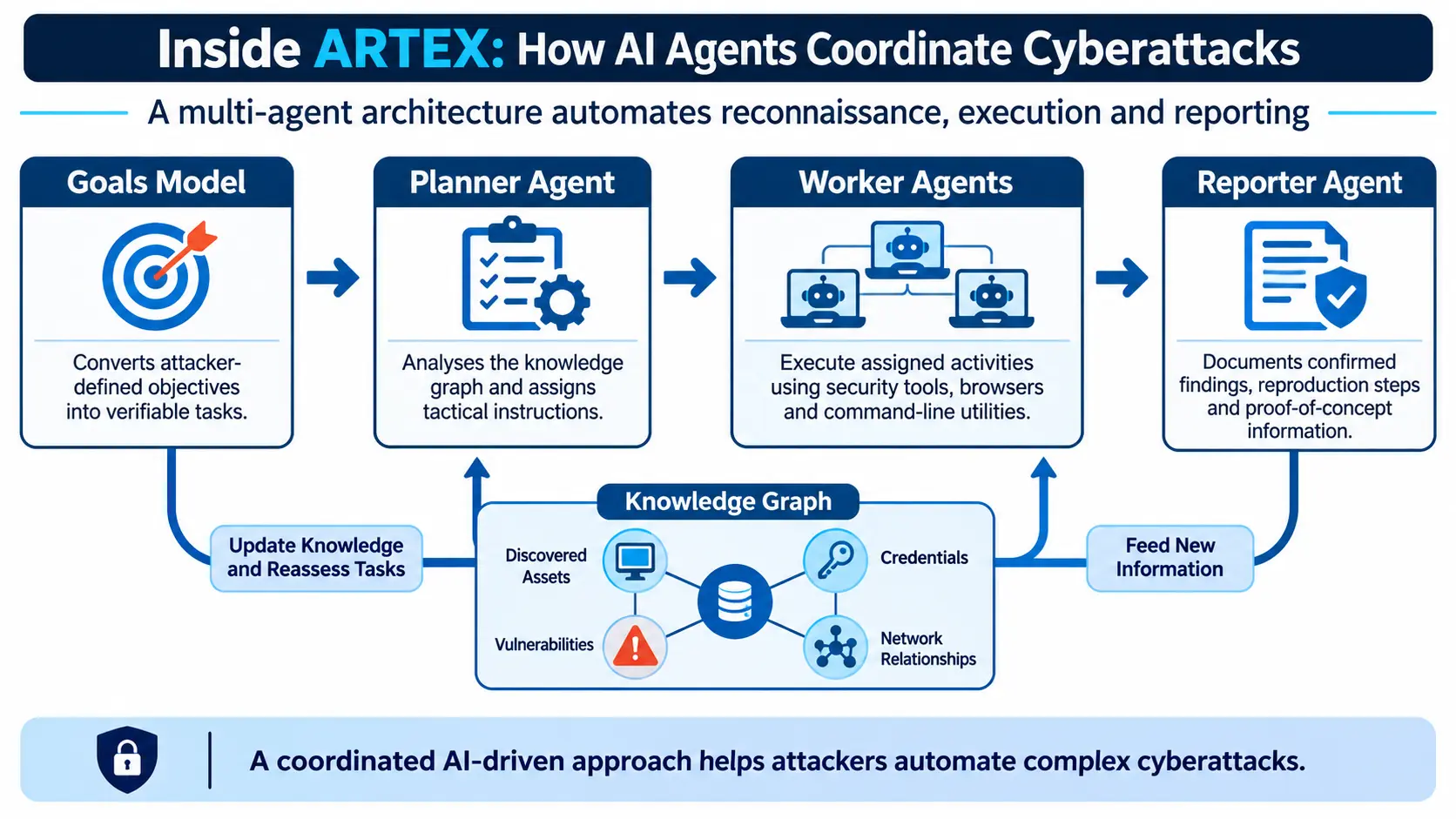
The architecture consists of four primary components:
Goals model: Breaks the attacker's objectives into smaller tasks that can be verified.
Planner agent: Reviews discovered assets and vulnerabilities through a knowledge graph, then assigns tactical instructions to worker agents.
Worker agents: Execute assigned tasks using command-line tools, shells, browsers and other offensive security utilities. They also update the knowledge graph with discovered information.
Reporter agent: Collects confirmed findings and generates reports containing reproduction steps and proof-of-concept information.
The process operates continuously. When worker agents discover new information, they update the knowledge graph. The planner then evaluates the findings and decides what should happen next.
This creates an automated cycle of discovery, planning, execution and reporting.
Microsoft also notes that ARTEX can use different large language models, including frontier models, open-weight models and modified models. An optional model-pooling function allows it to switch between providers when a model encounters errors, rate limits or exhausted quotas.
As a result, ARTEX activity is not necessarily limited by one AI provider's safety controls or visible within one provider's telemetry.
What Can ARTEX Do? Key Attack Capabilities
ARTEX combines conventional penetration testing utilities with AI-driven task coordination. Microsoft has identified several categories of activity performed by its agents.
Attack category | Observed activities |
|---|---|
Network reconnaissance | Port scanning, DNS enumeration and service discovery |
Web application discovery | API mapping, endpoint enumeration and browser-based crawling |
Vulnerability exploitation | SQL injection, authentication bypass, XXE and file upload exploitation |
Credential attacks | Password spraying, brute-force attempts and account recovery abuse |
Persistence | Uploading web shells to maintain access |
Credential theft | Extracting secrets, private keys and configuration files |
Lateral movement | Reusing stolen credentials across connected systems |
Cloud identity abuse | Accessing cloud resources and modifying application permissions |
Microsoft identified several commonly used tools within the framework, including Nmap, Netcat, curl, Playwright, Chromium, sqlmap, Hydra, Nuclei and Metasploit.
These tools are not new. The security concern comes from how ARTEX coordinates them through autonomous agents.
An agent can identify a target, test different access methods, examine the results and move to another task without waiting for a human operator to manually initiate every step.
Why this matters for enterprise security
Traditional security monitoring often looks for individual suspicious events, such as unusual login attempts, port scans or unexpected file creation.
ARTEX introduces a coordination challenge. Several activities that might appear unrelated individually can form part of one automated attack sequence.
For example, an operation could begin with web application discovery, continue with vulnerability exploitation, retrieve exposed credentials and then attempt to access cloud resources.
The ability to connect these activities makes behavioural monitoring particularly important.
Why Detecting ARTEX Requires Behaviour-Based Monitoring
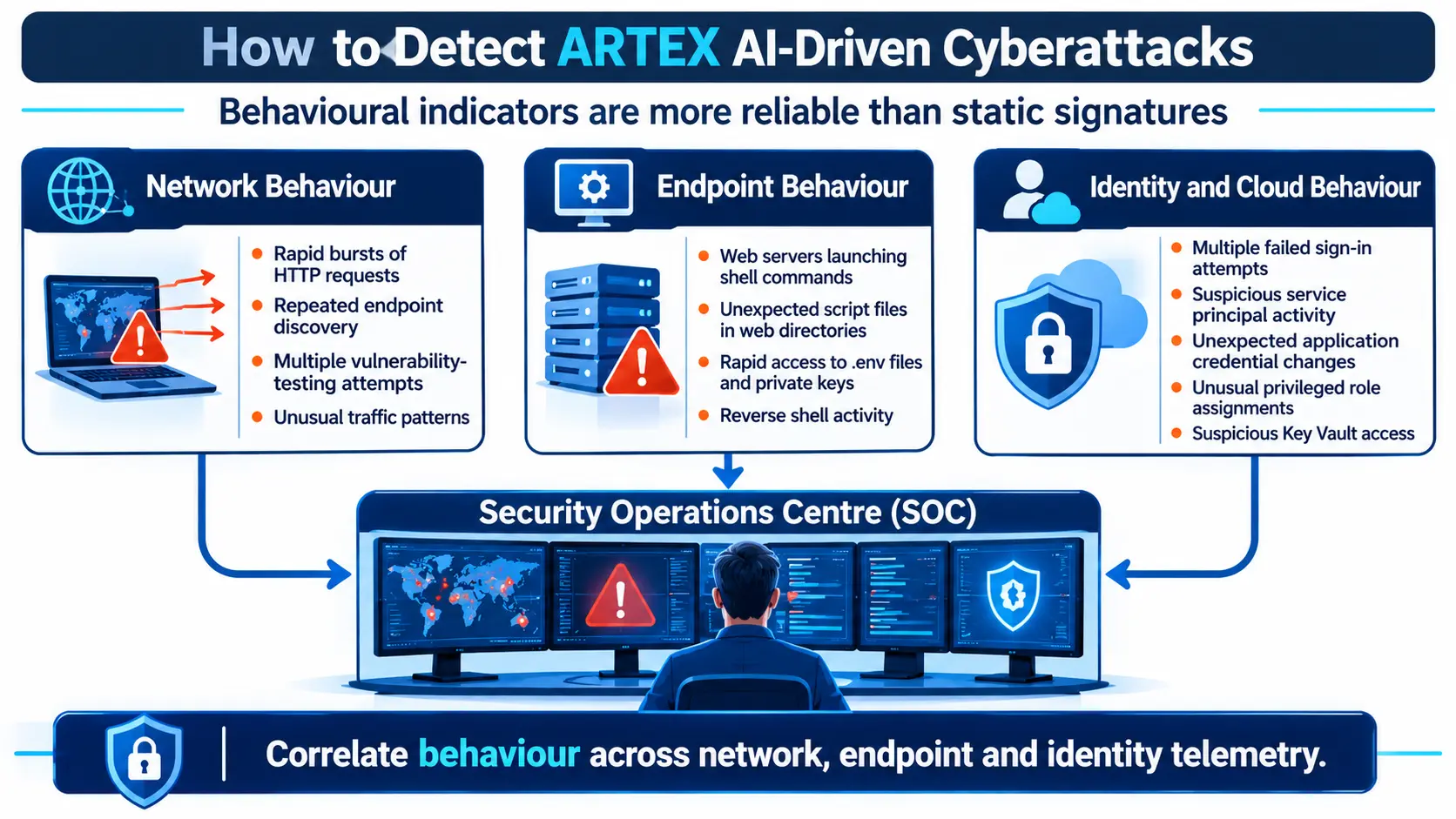
Microsoft identifies behavioural patterns as the most reliable way to recognize ARTEX-related activity.
The framework can change network indicators, including source IP addresses and user-agent strings. This makes detection based only on static signatures less dependable.
Microsoft highlights three important indicators.
1. Rapid bursts of activity
ARTEX agents can send numerous requests within a short period. They may repeatedly test different methods, retry unsuccessful techniques and move between attack stages at machine speed.
2. Unusual automated traffic
A large volume of requests from a single source, particularly when combined with repeated access attempts and unusual endpoint discovery, can indicate automated reconnaissance.
3. Distinctive user-agent strings
Microsoft identifies two user-agent strings associated with ARTEX:
artex-enrich/*norma/*
However, these indicators should not be treated as definitive evidence. Threat actors can change them, and other legitimate tools may generate similar traffic patterns.
Microsoft therefore recommends correlating network activity with endpoint, identity and cloud telemetry.
Microsoft Recommends Stronger Security Controls Against ARTEX
Microsoft's report provides several recommendations for organizations seeking to reduce exposure to ARTEX-enabled attacks.
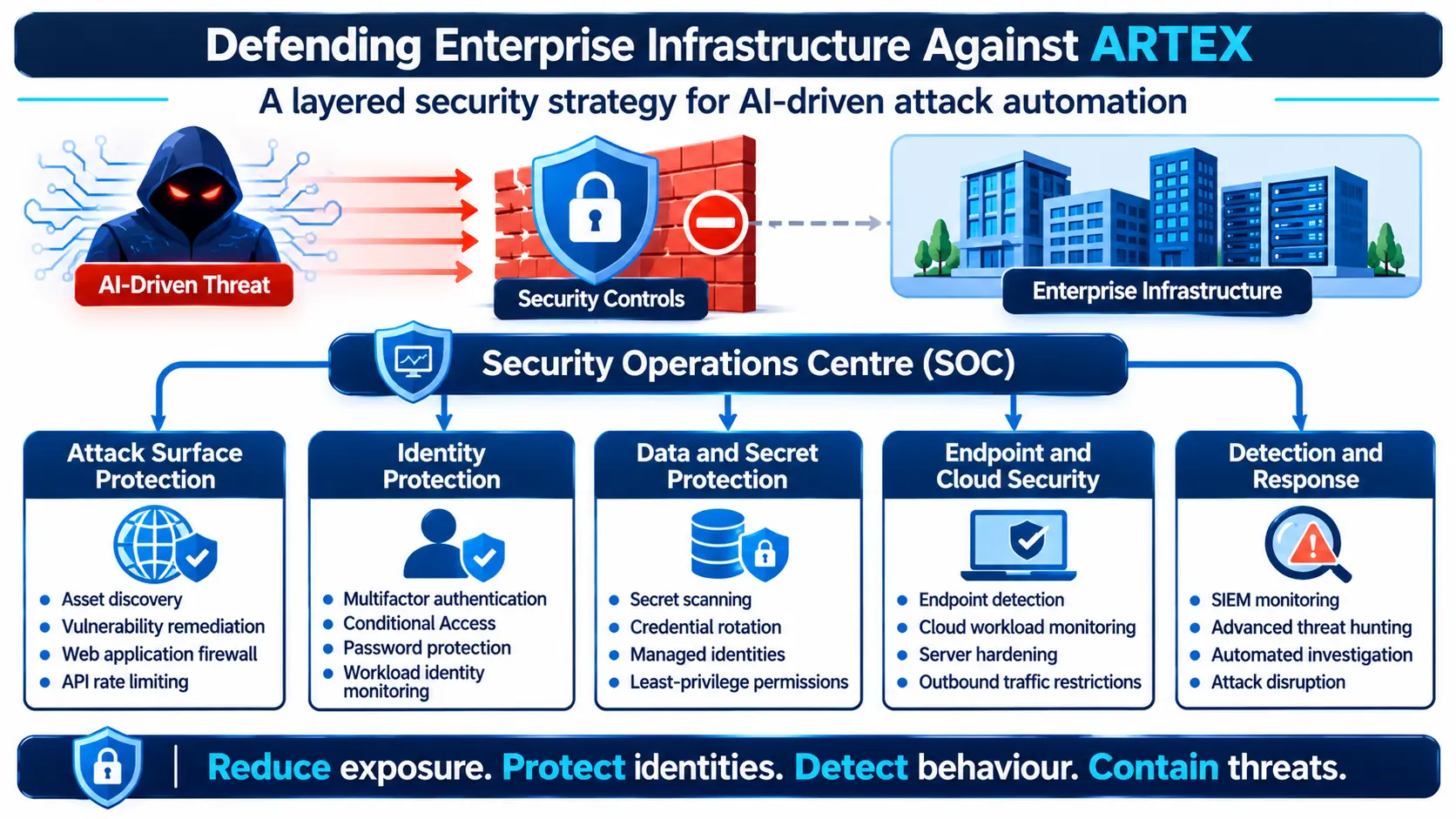
The guidance focuses on reducing internet-facing vulnerabilities, protecting credentials, strengthening identity security and limiting an attacker's ability to move between systems.
A. Reduce internet-facing attack surfaces
Organizations should maintain an accurate inventory of internet-facing websites, servers, APIs and services.
Microsoft recommends identifying exposed assets and prioritizing vulnerabilities that could provide access to sensitive information or privileged identities.
Additional recommendations include:
Use web application firewalls to block common attacks.
Apply rate limiting to reduce excessive automated requests.
Enable bot protection.
Enforce authentication and object-level authorization for APIs.
Regularly review exposed services and remove unnecessary access points.
B. Strengthen identity and account security
Credential attacks are an important part of ARTEX activity.
Microsoft recommends applying multifactor authentication (MFA), particularly phishing-resistant MFA for administrators.
Organizations should also:
Block legacy authentication.
Apply Conditional Access policies.
Monitor risky sign-ins.
Use strong password policies.
Configure smart account lockout.
Protect workload identities and service principals.
Microsoft reported that one Storm-0940 campaign using ARTEX generated more than 151,000 failed sign-in attempts, reaching a peak of 2,900 failures per minute.
This illustrates how automated credential attacks can generate substantial authentication activity in a short period.
C. Protect application secrets and privileged permissions
ARTEX agents can search code repositories and configuration files for exposed credentials.
Microsoft described an investigation in which an AI agent moved from searching GitHub for client secrets to accessing data in Azure Key Vault within five minutes.
Organizations should therefore:
Avoid storing credentials directly in source code.
Enable secret scanning and push protection.
Rotate compromised credentials immediately.
Use managed identities where appropriate.
Restrict application registration permissions.
Monitor changes to application credentials.
Apply time-bound privileged role activation.
Microsoft also reported that ARTEX agents added credentials to applications during Storm-0940 activity. In one instance, an application assigned itself the Global Administrator role.
D. Protect cloud infrastructure and sensitive data
Stolen credentials can provide access to more than the initially compromised system.
Microsoft recommends restricting cloud permissions according to operational requirements and monitoring services that store sensitive information.
Important defensive measures include:
Apply least-privilege Azure role assignments.
Restrict access to cloud storage.
Harden Azure Key Vault.
Monitor cloud resource administration.
Protect database services.
Review access to AI-related cloud resources.
Monitor application identities and OAuth permissions.
The objective is to reduce what an attacker can access even after obtaining valid credentials.
E. Limit lateral movement and contain attacks
Lateral movement allows attackers to use access obtained from one system to reach other parts of an organization.
Microsoft recommends using managed service accounts, rotating local administrator passwords and restricting administrative access through just-in-time access controls.
It also recommends enabling automatic attack disruption and automated investigation and response through Microsoft Defender.
In multiple Storm-0940 intrusions involving ARTEX, Microsoft observed privileged access being obtained less than three hours after initial targeting.
This reinforces the importance of early containment rather than relying exclusively on investigation after an attack has progressed.
Microsoft Defender Adds Detection and Investigation Guidance
Microsoft's report also provides security teams with detection information across its security products.
These detections can help organizations investigate suspicious activity associated with ARTEX.
Key detection areas include:
Security solution | Relevant detection focus |
|---|---|
Microsoft Defender Antivirus | ARTEX-related threat component detection, including Behavior:Win64/ArtexAI |
Defender for Endpoint | Suspicious shell execution, web server compromise and sensitive file access |
Defender for Identity | Password spraying, Kerberoasting and directory reconnaissance |
Microsoft Entra ID Protection | Leaked credentials, suspicious sign-ins and threat actor IP addresses |
Defender XDR | Compromised OAuth applications and suspicious privileged role assignments |
Defender for Cloud Apps | Suspicious application permissions and OAuth activity |
Defender for Cloud | Unusual Key Vault access, storage activity and cloud resource operations |
Microsoft Sentinel | Analytics rules for suspicious network traffic and authentication activity |
Microsoft cautions that these alerts are not exclusive to ARTEX. Other unrelated malicious or legitimate activities can trigger similar detections.
Therefore, security teams should investigate the surrounding evidence before attributing an incident to this framework.
Advanced Hunting: How Security Teams Can Investigate ARTEX
Beyond detection alerts, Microsoft provides hunting guidance and example queries for identifying suspicious activity.
These queries help security analysts investigate behaviour across endpoints, web servers, cloud identities and application activity.
Four particularly relevant investigation areas include:
Web server processes launching suspicious commands
Security teams can investigate web and application server processes that unexpectedly launch shells or download utilities such as curl, wget and Netcat.
Unexpected script files in web directories
New or modified PHP, JSP and ASPX files created by web server or database processes can indicate possible web shell activity.
Rapid access to sensitive files
Repeated access to .env files, private keys, cloud credentials and other sensitive configuration files can indicate credential harvesting.
Suspicious service principal activity
Security teams should investigate application identities that perform multiple sign-ins, experience repeated authentication failures or make unexpected credential and permission changes.
Microsoft also recommends collecting the appropriate logs before beginning an investigation.
These include Microsoft Entra sign-in and audit logs, Microsoft Graph activity logs, web server logs and web application firewall logs.
An important warning from Microsoft is that an empty hunting-query result does not prove that an attack did not occur if the required logs were never collected.
What This Development Means for the Cybersecurity Industry
Microsoft's ARTEX findings highlight a broader industry shift toward AI-assisted cyber operations.
AI agents can coordinate multiple tools, process information and perform sequential tasks without requiring continuous human intervention.
For defenders, this creates a challenge that goes beyond identifying individual malware files or suspicious IP addresses.
Security teams need to understand how different activities connect across infrastructure, applications, identities and cloud environments.
Three broader implications stand out.
Faster attack progression
Automated agents can reduce the time between reconnaissance, exploitation and credential access. Organizations may have less time to identify and contain an intrusion.
Greater importance of identity security
Exposed credentials and excessive application permissions can provide opportunities for attackers to move beyond an initially compromised system.
Behavioural detection becomes increasingly important
Static indicators remain useful, but they may not be sufficient when attackers can modify network characteristics or use different tools and AI models.
For enterprises, this could mean greater investment in continuous monitoring, comprehensive logging, identity protection and automated incident response.
It also reinforces the importance of treating AI-driven offensive tools as part of the existing cybersecurity threat landscape rather than as entirely new categories of attack.
Key Takeaways for Security Teams
Microsoft's report offers several practical lessons for cybersecurity professionals:
Monitor unusual bursts of network and application requests.
Identify unexpected shell execution by web server processes.
Regularly scan public repositories for exposed credentials.
Secure application identities and service principal permissions.
Apply phishing-resistant MFA to administrative accounts.
Maintain complete endpoint, identity and cloud audit logs.
Investigate suspicious credential changes and privileged role assignments.
Reduce lateral movement through least-privilege access.
Enable automated containment where appropriate.
Correlate network, endpoint and identity activity during investigations.
The central message is that organizations should prepare for attacks that combine traditional exploitation methods with increasingly autonomous AI-driven coordination.
Microsoft's findings do not suggest that conventional security controls have become obsolete. Instead, they demonstrate why established defensive practices need to operate together and respond quickly to coordinated activity.
Conclusion: AI Is Changing the Speed of Cyberattacks
The ARTEX investigation demonstrates how AI-powered frameworks can make existing cyberattack techniques more coordinated and faster to execute.
Rather than introducing completely new vulnerabilities, ARTEX combines established penetration testing tools with autonomous agents that can identify targets, test weaknesses, retrieve credentials and explore additional access opportunities.
Microsoft's findings also show why organizations need to rethink how they monitor security events. Detecting individual suspicious activities is important, but understanding the sequence and relationship between those activities is equally critical.
For cybersecurity professionals, the priority should be to strengthen identity controls, secure exposed applications, protect sensitive credentials and improve the speed of incident response.
As AI adoption expands across both defensive and offensive security operations, the ability to detect and contain automated attacks will remain an important part of enterprise cybersecurity.
Source: Microsoft Security Blog
About the Author