
JFrog Warns Brotli2Shell Vulnerability Extends Beyond Node.js to Native Applications
JFrog researchers show how CVE-2026-111497, a flaw in Google's Brotli decoder, can affect HTTP services, media processing, .NET applications and Apache Arrow. The findings highlight why vulnerability detection must go beyond package versions.
Xcademia Team
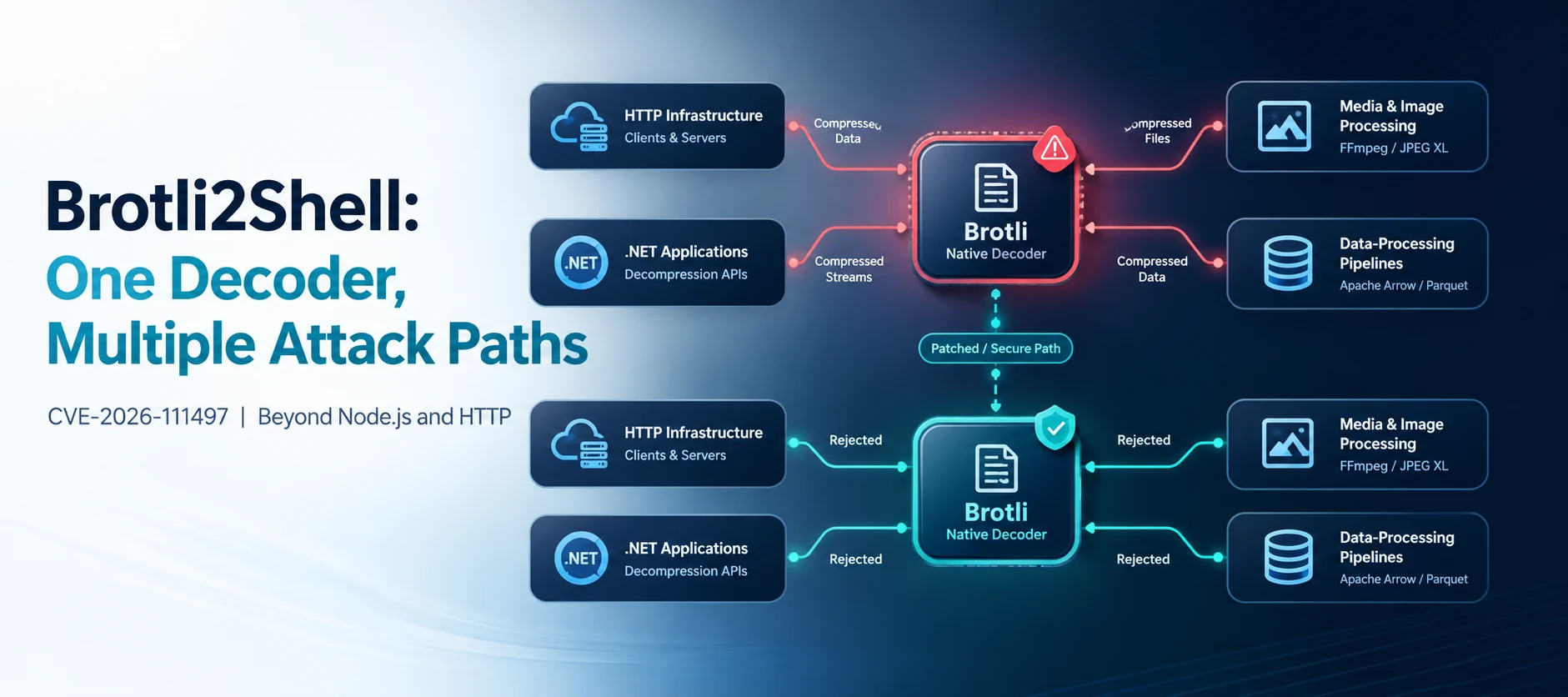
A security vulnerability initially associated with Node.js is now drawing attention to a much wider software ecosystem. In a security research report published on 25 October 2026, JFrog researchers detailed how CVE-2026-111497, a memory-corruption vulnerability in Google's Brotli decoder, can affect applications well beyond the JavaScript runtime where the issue first gained attention.
The research, titled Brotli2Shell: Beyond Node(2Shell) and HTTP(2Shell), demonstrates that the vulnerability can be reached through HTTP request processing, native media applications, .NET decompression APIs and Apache Arrow data-processing workflows.
The central finding is that the vulnerability resides in a shared compression decoder, not exclusively in Node.js or HTTP infrastructure. Applications may inherit the flaw through bundled libraries, native dependencies or language runtimes, even when their own code does not directly call Brotli functions.
For security teams, this creates a practical challenge: identifying an affected dependency is important, but understanding whether untrusted data can reach the vulnerable decoder is equally necessary.
What Is Brotli2Shell?
Brotli is a data compression format used to reduce the size of information transferred or processed by applications. Its decoder reconstructs the original data from a compressed stream.
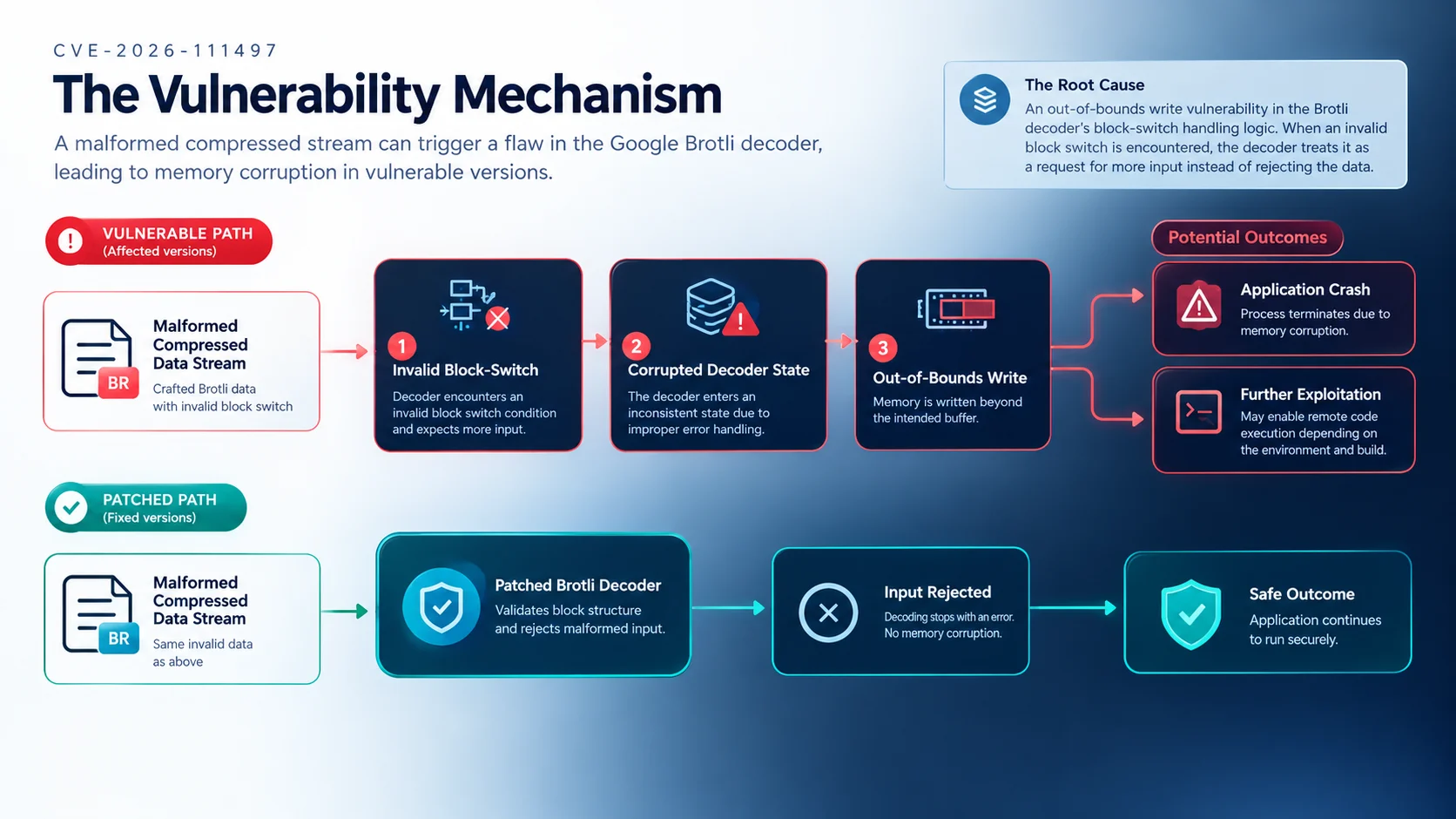
CVE-2026-111497 is an out-of-bounds write vulnerability in Google's Brotli decoder. According to JFrog, the underlying problem involves error handling during block-switch processing. When the decoder encounters an invalid block switch, vulnerable versions can treat the condition as though additional input is needed instead of properly rejecting the malformed stream.
This can leave the decoder in an inconsistent state and allow it to write beyond the intended buffer.
Depending on the application and execution environment, the resulting memory corruption can cause a crash or create conditions that may support more serious exploitation. JFrog's demonstrations include instruction-pointer control in additional native applications, while remote code execution was separately demonstrated against a vulnerable Node.js build by Imperva.
The vulnerability is tracked as CVE-2026-111497. Its original disclosure appeared in the Node.js security release on 21 October 2026.
Which Brotli versions are affected?
JFrog identifies these affected upstream version ranges:
Brotli 1.0.3 before 1.0.10
Brotli 1.1.0 before 1.1.1
Brotli 1.2.0 before 1.2.1
The upstream correction is available in Google's Brotli repository through commit 0ed4268, and Brotli 1.2.1 includes the fix.
These version ranges refer to the upstream project. Downstream vendors may backport security fixes without changing the version number in the same way, so organisations should also consult the relevant vendor advisory.
How the Vulnerability Became a Cross-Ecosystem Concern
The vulnerability attracted attention under several research names as its potential reach became clearer.
On 21 October 2026, Node.js publicly disclosed the issue in its security release. On 22 October, Imperva demonstrated remote code execution against a vulnerable official Node.js build and used the name Node2Shell. On 23 October, researchers began using HTTP2Shell to describe the wider implications for HTTP clients and servers.
JFrog argues that neither name captures the full scope because the vulnerable decoder is also used in software that processes files and data outside HTTP workflows.
This distinction matters. A shared native library can be incorporated into different products, runtimes and dependency chains. Each integration can expose a different entry point, even though the underlying defect remains the same.
The issue is therefore not limited to applications that explicitly advertise Brotli support. The decoder may be embedded in a runtime or invoked indirectly by another library.
Four Attack Paths Identified by JFrog
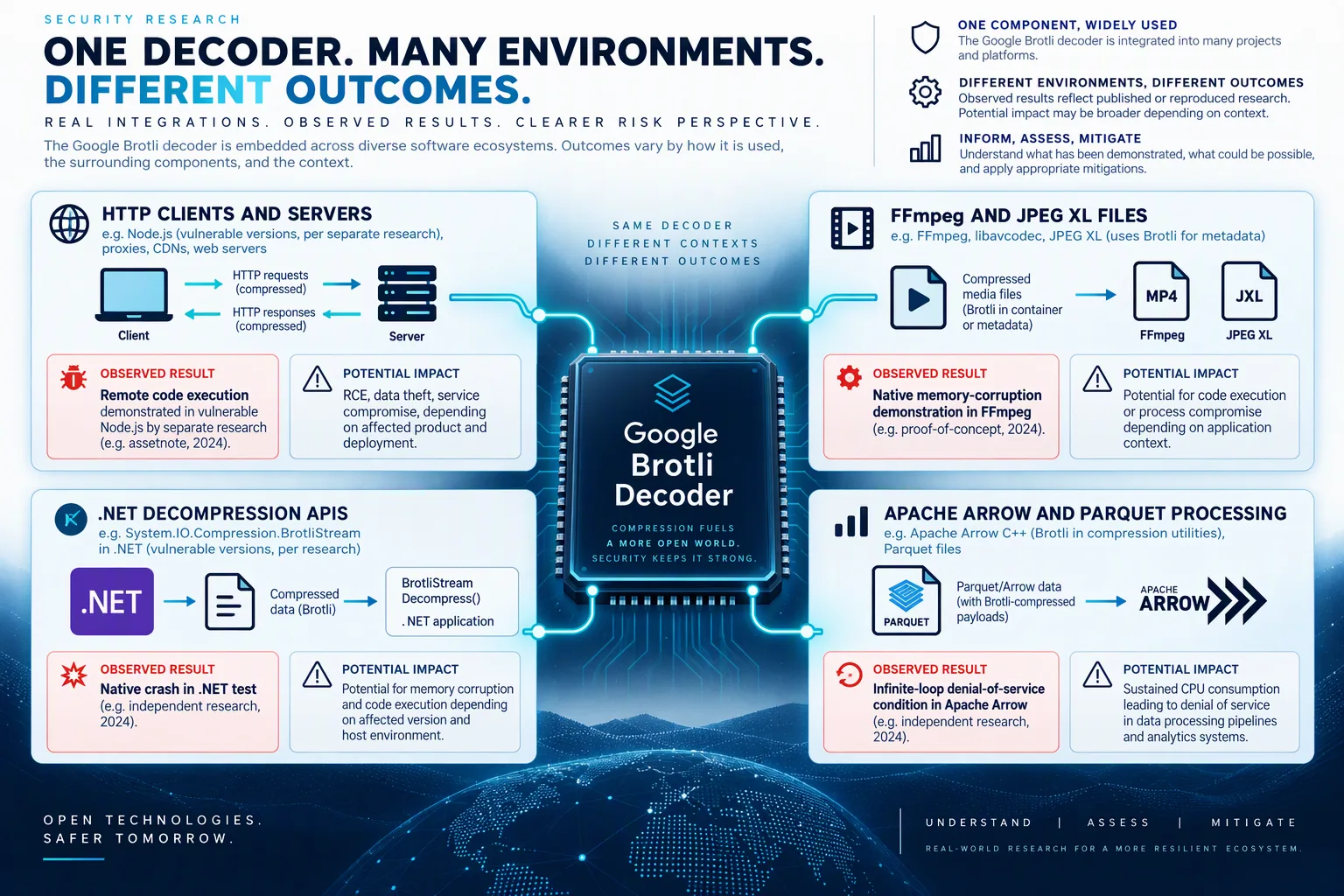
JFrog's investigation demonstrates how the same underlying decoder flaw can appear in different application environments. The researchers examined HTTP services, native media processing, .NET decompression and Apache Arrow.
1. HTTP clients and servers
HTTP remains an important exposure path.
Applications may decompress incoming request bodies or automatically decode compressed responses received from external services. If the vulnerable decoder processes attacker-controlled Brotli data, the application may encounter the underlying memory-corruption issue.
Imperva demonstrated remote code execution against a vulnerable Node.js build through two workflows:
Decompression of Brotli-compressed responses consumed through
fetch().Decompression of incoming request bodies processed by server-side middleware.
JFrog also reproduced a denial-of-service condition in ClickHouse. A crafted HTTP request containing a 23 MB body caused the tested server to crash with a segmentation fault.
The researchers reported that a fix had been merged into ClickHouse's source code, but a patched release had not yet shipped when their article was published.
This example highlights the difference between a source-code fix and a fix that is available in a released version deployed by customers.
2. FFmpeg and JPEG XL image processing
The research also traced the vulnerability into FFmpeg, a widely used open-source multimedia framework.
The connection runs through libjxl, a library FFmpeg uses to decode JPEG XL images. Within JPEG XL containers, libjxl uses Brotli to decompress metadata stored in brob boxes.
JFrog developed a proof of concept that triggered the vulnerability through a crafted JPEG XL file. Its outer file structure contained a valid image, while malformed compressed data was embedded in the metadata.
The demonstrated processing path was:
Crafted JPEG XL file → FFmpeg → libjxl → Brotli decoder → memory corruption
The researchers reported instruction-pointer control and a segmentation fault during their testing. This demonstrates that a file-processing workflow can reach the vulnerable decoder without requiring an HTTP request.
However, instruction-pointer control is not equivalent to a demonstrated remote code execution exploit. JFrog noted that further exploitation would depend on the target build and its security mitigations.
For organisations processing images or other uploaded files, the finding reinforces the need to examine native libraries and transitive dependencies rather than focusing exclusively on web frameworks.
3. .NET applications and decompression APIs
JFrog also examined the .NET runtime, where System.IO.Compression.Brotli uses a native Brotli decoder.
Relevant integration points include BrotliStream, automatic response decompression in HttpClient and request-decompression middleware in ASP.NET Core.
In a local console application demonstration, researchers supplied a malformed two-stage Brotli stream. The decoder entered an inconsistent state and eventually triggered a native segmentation fault.
Unlike an ordinary managed exception, this type of native crash can terminate the affected process.
The demonstration used a local application, but JFrog noted that the same decoding functionality can be reached by network-facing .NET applications when they decompress attacker-controlled data.
The issue is tracked in the public dotnet/runtime repository as issue #136422. JFrog reported on 25 October that Microsoft had announced updates rolling out for supported .NET runtimes and SDKs through normal distribution channels. Organisations should check Microsoft's current servicing guidance to confirm the status of their own deployments.
4. Apache Arrow and Parquet processing
Apache Arrow presents a different failure mode.
JFrog found that its pyarrow package includes Brotli decoding functionality used when processing Brotli-compressed Parquet data pages. The decoder can also be reached through a buffer-decompression API without any network connection.
In the reported test, a 534-byte input caused the vulnerable decoder to enter an infinite loop. Instead of rejecting the malformed stream, its retry logic continued processing as though more input might resolve the error.
The result was sustained CPU consumption that prevented the data-processing task from completing.
JFrog reported that the same input was rejected in under a second by Brotli 1.2.1. The Apache Arrow issue was tracked as #55166 and remained open when the research article was published.
This example shows why vulnerability impact can vary by integration. The same underlying defect may cause memory corruption in one application and an availability problem in another.
Why Dependency Scanning Alone Is Not Enough
A key conclusion in JFrog's report is that software inventory and application-level exposure analysis answer different questions.
A dependency scanner may identify an affected Brotli version. That is useful, but it does not necessarily establish whether the vulnerable decoder is reachable from an untrusted input source.
A more complete investigation needs to consider two separate questions.
First, is a vulnerable implementation present?
An application may bundle Brotli source code, link against a system library or inherit the decoder through another dependency. The vulnerable code may therefore be absent from the application's direct dependency list while remaining present in the final software artifact.
Second, can untrusted data reach the decoder?
The application may accept compressed HTTP responses, process uploaded files, decode Parquet data or invoke native libraries that handle compressed buffers. These paths determine whether the vulnerable functionality is reachable in a particular deployment.
Neither question alone proves that an application is remotely exploitable. The implementation, available input paths, runtime configuration and security mitigations all influence practical risk.
Existing detection tools have different scopes
JFrog discusses two tools that can help identify potential exposure:
node2shell-detect: Primarily inventories installed and running Node.js and Bun runtimes and compares their versions with known fixed releases. According to JFrog, it does not inspect application source code for Brotli usage and may miss embedded runtimes or separately bundled copies.
Trail of Bits Brotli Checker: Examines potentially vulnerable Brotli code in source files and binaries and investigates selected decoder calls and application paths. Its results depend on the available code and evidence, and it does not guarantee detection of every decompression path.
These tools can provide valuable evidence, but their findings should be interpreted according to their scope. An outdated runtime, a vulnerable library copy and a reachable attack path are related findings, not interchangeable conclusions.
JFrog's Approach to Contextual Vulnerability Detection
JFrog describes an approach that combines component identification with analysis of how applications use the affected decoder.
Its Xray product identifies vulnerable components and versions. JFrog's contextual scanner then checks for application-level patterns that may indicate relevant Brotli decoding paths. The company has also published an open-source scanner covering these patterns.
The reported checks include:
JavaScript: Direct Brotli decompression APIs, streaming decompression,
DecompressionStream, HTTP response decompression throughfetch()and related APIs, TLS certificate compression, and request-body decompression through Express andbody-parser.Python: Direct use of
brotliandbrotlicffi, alongside HTTP clients such as Requests, HTTPX, aiohttp and urllib3 that may automatically decompress Brotli responses when the appropriate backend is installed.Native binaries: References to decoder functions such as
BrotliDecoderDecompressandBrotliDecoderDecompressStreamin ELF binaries.Command-line utilities: Brotli command-line invocations using decompression options such as
-dand--decompress.
The broader purpose is to find cases where the decoder is invoked indirectly rather than through an obvious application-level function call.
JFrog's report also makes an important qualification: a scanner match does not automatically establish remote exploitability. Security teams still need to verify the implementation and patch status, understand the input source, and determine whether the relevant code path is reachable in the deployed application.
This is a useful distinction for vulnerability management programmes. Better context can help teams prioritise investigation, but automated findings should support rather than replace technical validation.
What Security Teams Should Do Now
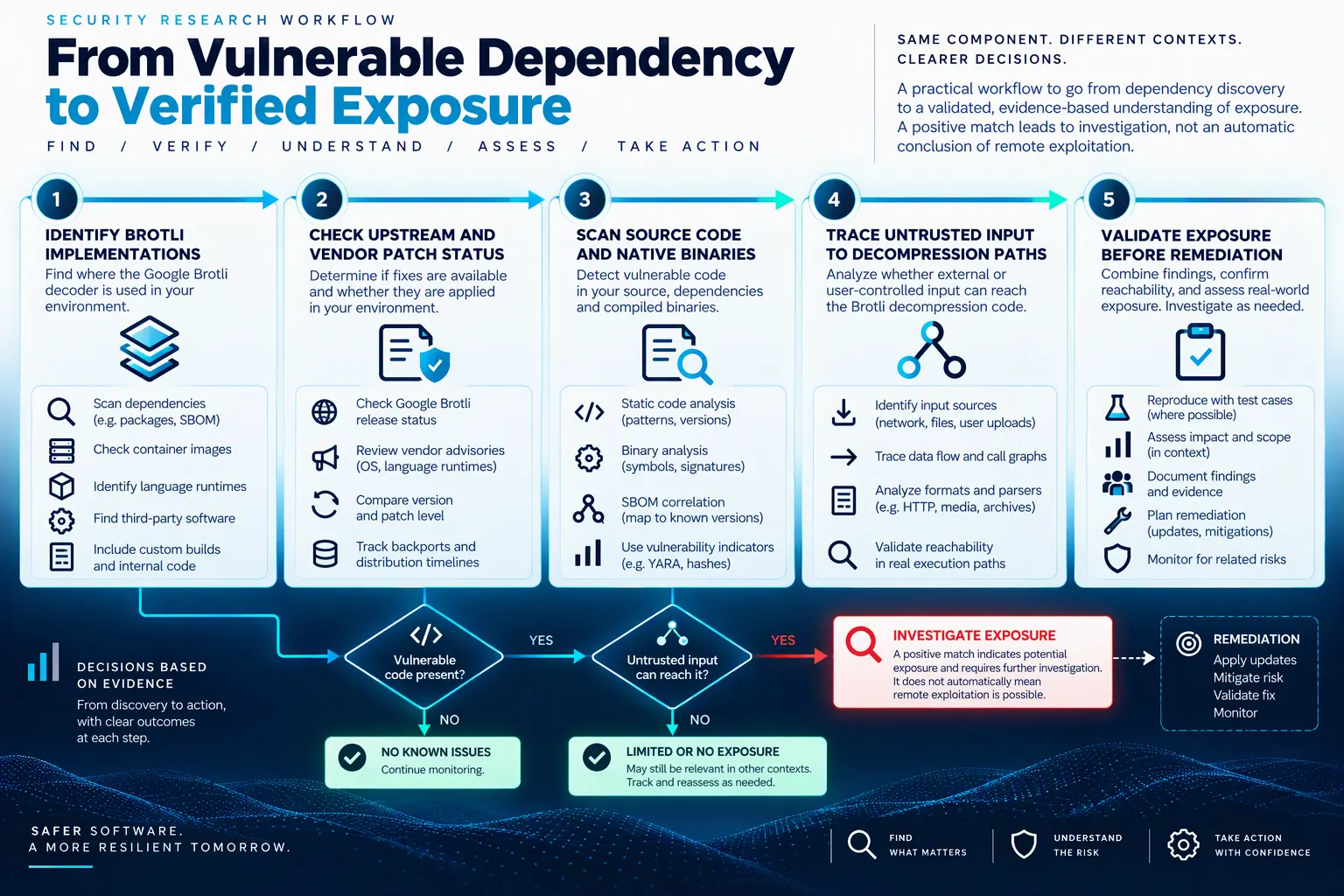
JFrog's findings support a practical review of applications that use Brotli, especially those that process externally supplied data.
1. Inventory all relevant implementations
Identify Brotli across direct dependencies, transitive packages, language runtimes, operating-system libraries and bundled native binaries.
Do not assume that checking an application's package manifest will reveal every copy of the decoder.
2. Verify the fix in each affected component
Start with Google's upstream correction and the relevant vendor advisories. Check whether the fix has reached the specific runtime, package or application release used in production.
For Node.js, JFrog identifies fixed releases 22.23.4, 24.22.1 and 26.12.1. For the upstream Brotli library, the correction is included in 1.2.1, with earlier maintained branches also receiving fixes in 1.0.10 and 1.1.1.
These are source-reported versions from the October 2026 research and should be checked against current vendor guidance before deployment.
3. Trace externally controlled data
Review application features that decompress HTTP requests or responses, accept uploaded media, process compressed data files or call native decoding APIs.
Pay particular attention to indirect paths through HTTP clients and middleware. An application does not need to call the native Brotli decoder explicitly for the decoder to process its input.
4. Confirm release and deployment status
A patch merged into a public repository is not necessarily available in a production release. Confirm that the fixed package or runtime has been released, deployed and loaded by the affected application.
Where a vendor provides a backported fix, validate its advisory rather than relying solely on the visible upstream version number.
5. Use scanners as evidence, not as a final verdict
Combine software inventory, source and binary analysis, dependency information and application testing where appropriate. Investigate findings in the context of the actual deployment and prioritise remediation based on confirmed exposure and business impact.
If an affected component cannot be updated immediately, consult the vendor's mitigation guidance and assess whether the relevant decompression path can be safely restricted. Do not assume that a generic workaround applies to every application.
What Brotli2Shell Means for Software Supply Chain Security
The wider significance of CVE-2026-111497 lies in the way shared software components connect otherwise unrelated applications.
A compression decoder may sit several layers beneath an application, incorporated through a runtime or a native library. A vulnerability in that shared component can therefore require investigation across multiple software categories and teams.
The findings also illustrate why patch management is not simply a matter of updating a top-level dependency. Security teams need to understand which implementation is actually running, whether the relevant fix has been incorporated, and how potentially untrusted data reaches the affected code.
For enterprises, this could mean closer coordination between application developers, infrastructure teams, software supply chain specialists and vulnerability management teams. It may also increase the value of combining software composition analysis with code-level investigation and binary inspection.
These are broader industry implications drawn from the research, rather than additional claims made about specific customer outcomes.
Conclusion
JFrog's Brotli2Shell research demonstrates that CVE-2026-111497 extends beyond the Node.js and HTTP environments associated with its early disclosure.
The researchers traced the vulnerable decoder into FFmpeg's JPEG XL processing, .NET decompression APIs and Apache Arrow data-processing workflows. Their findings include memory-corruption demonstrations, a native process crash, an infinite-loop denial-of-service condition and, in separate research by Imperva, remote code execution against a vulnerable Node.js build.
The practical lesson is clear: identifying vulnerable versions is necessary, but it is not the whole investigation. Organisations also need to trace bundled and transitive dependencies, verify the availability of fixes, and establish whether untrusted input can reach the affected decoder.
As shared libraries continue to underpin diverse applications, vulnerability management increasingly depends on understanding how code is used, not just where it appears in a software inventory.
Source: JFrog Security Research
About the Author