
Java4Shell: Critical Oracle Java Vulnerability Could Enable Remote Code Execution Without Authentication
A critical Java vulnerability, CVE-2026-114938 (Java4Shell), could allow unauthenticated remote attackers to execute arbitrary code through a Base64 decoding flaw. Canada's Cyber Centre urges organisations to identify affected systems and apply security updates.
Xcademia Team
A critical security vulnerability affecting Oracle Java and GraalVM environments has prompted a security warning from the Canadian Centre for Cyber Security. Tracked as CVE-2026-114938 and known as Java4Shell, the vulnerability could allow remote attackers to execute arbitrary code by exploiting a memory corruption flaw in Java's standard Base64 decoding functionality.
Published on 17 November 2026 under alert AL26-029, the advisory warns that successful exploitation could result in sensitive information disclosure, application crashes, memory corruption or arbitrary code execution.
The vulnerability specifically affects Java processes running on x86-64 processors equipped with AVX-512 Vector Byte Manipulation Instructions (VBMI). Attackers could exploit the weakness without authentication by supplying specially crafted Base64 data to vulnerable applications.
The Cyber Centre recommends that organisations identify affected Java environments, prioritise internet-facing applications and apply appropriate vendor security updates.
Understanding CVE-2026-114938 (Java4Shell)
Java4Shell is classified as a heap-based buffer overflow (CWE-122) affecting the Base64 functionality within Java's standard library.
A heap-based buffer overflow occurs when a program writes more data into an allocated memory area than the available space can accommodate. This can corrupt neighbouring memory and potentially allow an attacker to influence application execution.
In this case, the vulnerability affects Java's Base64 processing functionality. Base64 is a widely used encoding mechanism that converts binary data into an ASCII-compatible representation.
Java applications frequently use Base64 decoding when processing encoded information. Consequently, the vulnerability becomes relevant when applications process specially crafted, attacker-controlled
Base64 input through the affected functionality.
The Cyber Centre warns that successful exploitation could lead to:
Arbitrary code execution: Attackers could execute unauthorised code within affected applications or services.
Sensitive information disclosure: Memory corruption could expose confidential information.
Application crashes: Exploitation could disrupt application availability.
Memory corruption: Malformed input could interfere with the memory used by the Java process.
The possibility of remote exploitation without authentication makes this vulnerability particularly important for organisations operating internet-facing Java applications.
How the Java4Shell Vulnerability Works
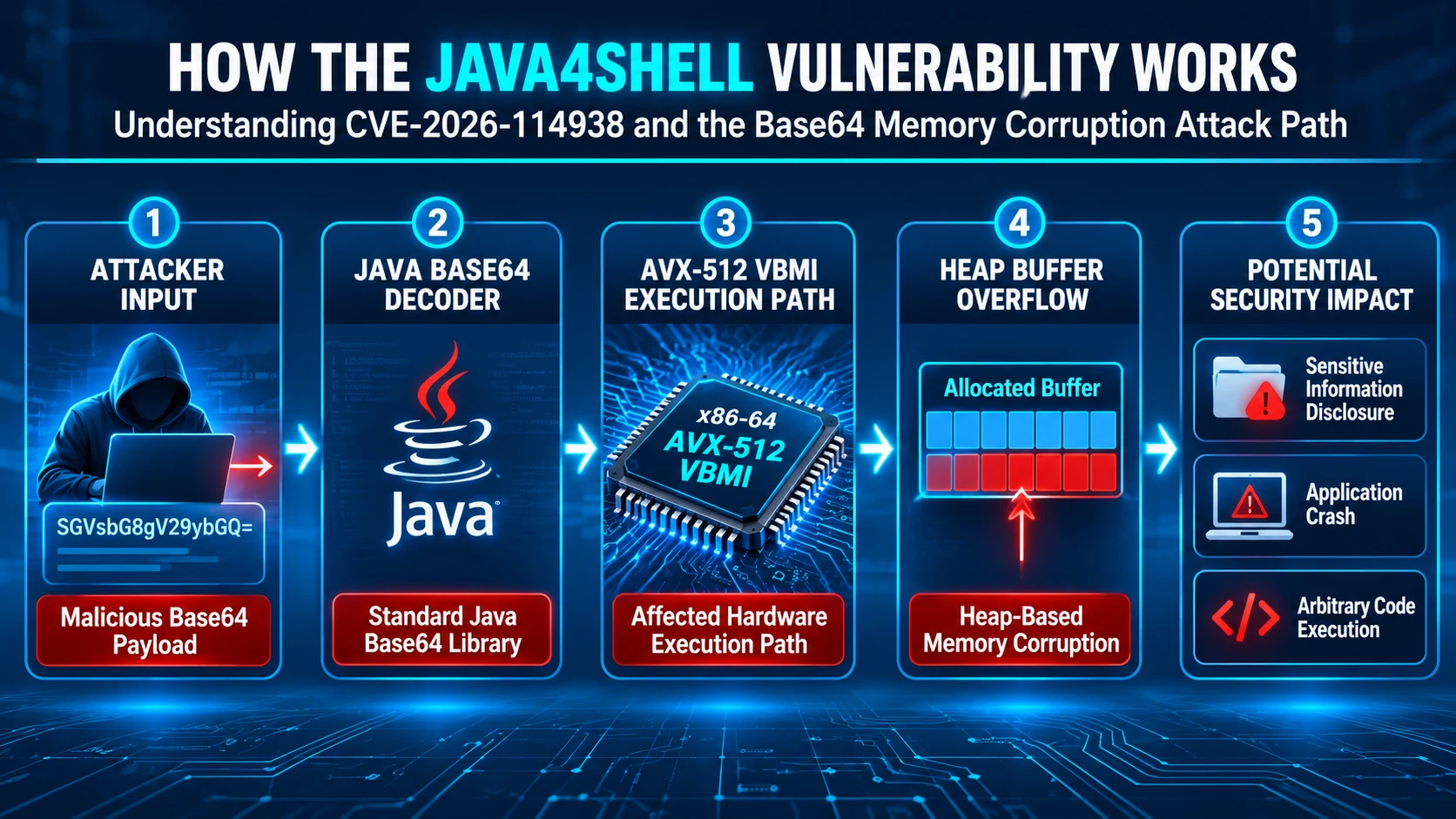
The vulnerability involves the interaction between Java's Base64 decoding functionality and specific processor capabilities.
The affected Java processes run on x86-64 systems equipped with AVX-512 VBMI instructions. Attackers can supply specially crafted Base64 data that triggers the vulnerable memory-handling behaviour.
If exploitation succeeds, the resulting memory corruption could affect the execution of the application.
The attack scenario can be understood through the following stages:
Target identification: An attacker identifies a Java application running in a potentially affected environment.
Malicious input delivery: Specially crafted Base64 data is supplied to the application.
Vulnerable decoding: The Java Base64 functionality processes the supplied data through the affected execution path.
Memory corruption: The vulnerability causes a heap-based buffer overflow.
Potential compromise: Successful exploitation could result in information disclosure, service disruption or arbitrary code execution.
The Cyber Centre confirms that the vulnerability can be exploited remotely without authentication under the specified hardware conditions.
Affected Oracle Java and GraalVM Versions
The Canadian Centre for Cyber Security identifies multiple Oracle Java and GraalVM builds affected by CVE-2026-114938.
The advisory lists the following affected versions:
Product | Affected version |
|---|---|
Oracle Java SE 8 | 8u511b33-perf |
Oracle Java SE 17 | 17.0.21.0.3 |
Oracle Java SE 21 | 21.0.13.0.3 |
Oracle Java SE 25 | 25.0.5.0.3 |
Oracle Java SE 27 | 27.0.1.0.3 |
Oracle GraalVM for JDK | 17.0.21.0.3, 21.0.13.0.3 |
Oracle GraalVM Enterprise Edition | 21.3.20.0.3 |
Oracle's November 2026 security advisory also identifies CVE-2026-114938 in its Java SE risk matrix.
Oracle assigns the vulnerability a CVSS 3.1 base score of 8.1, with a network attack vector, high attack complexity, no required privileges and no required user interaction.
Organisations should consult Oracle's official advisory for patch availability and installation instructions.
The versions listed above are identified as affected versions, not as confirmation of fixed releases.
Recommended Mitigation and Security Actions
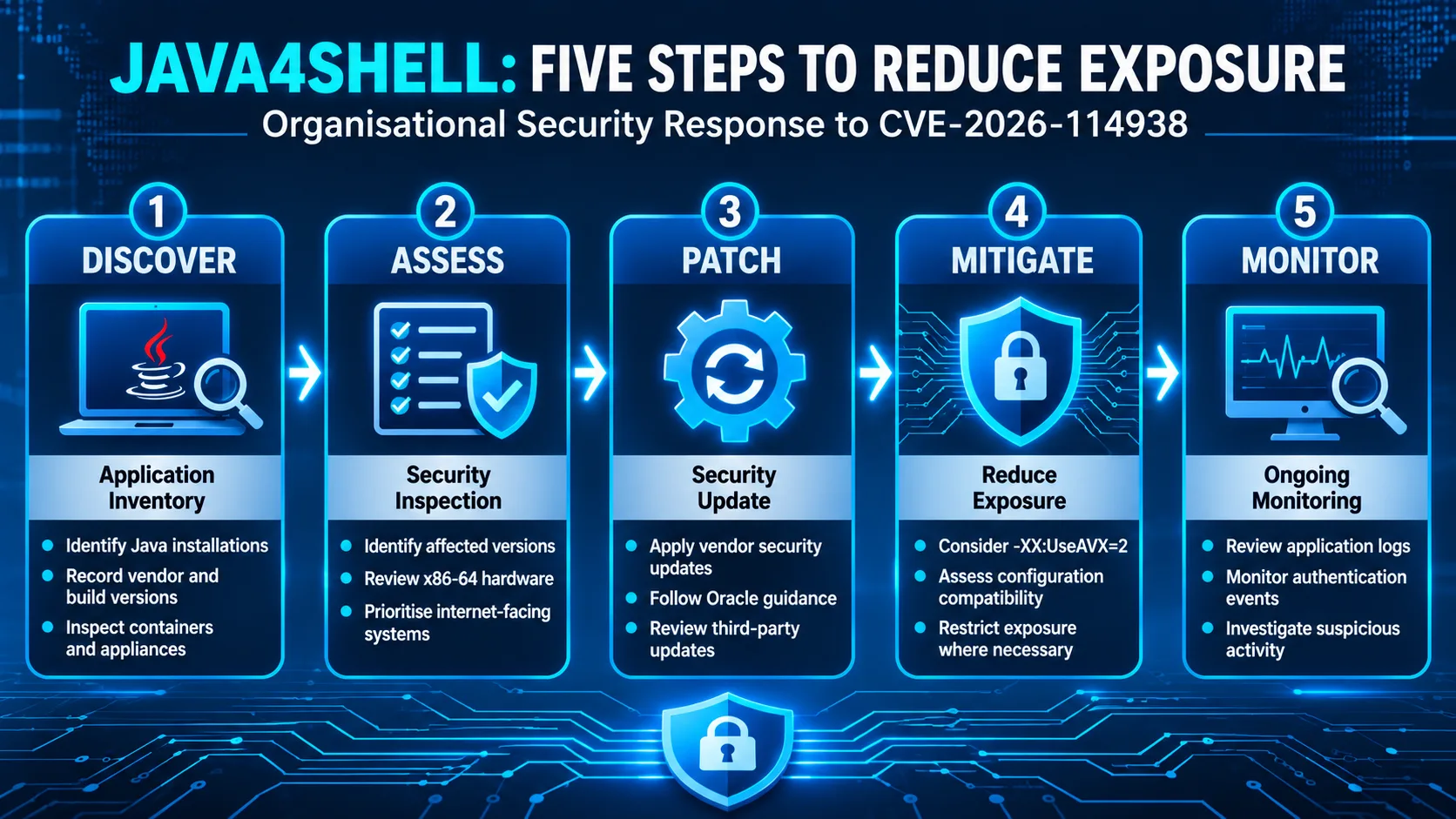
The Canadian Centre for Cyber Security strongly recommends that organisations identify potentially affected Java environments and apply appropriate vendor updates.
The advisory outlines several practical security measures.
1. Inventory Java Environments
Organisations should audit their applications and infrastructure to identify active Java runtimes.
The inventory should include:
Java vendor information.
Full Java build versions.
Applications using Java runtimes.
Java components included in containers.
Third-party applications and appliances containing Java.
This helps security teams identify potentially vulnerable installations, including Java environments that may not be directly managed by the organisation.
2. Apply Available Security Updates
Organisations should update affected Java installations to an appropriate fixed and supported release.
Security teams should consult Oracle's November 2026 Critical Security Patch Update and follow the applicable vendor installation instructions.
Third-party products that bundle Java components should also be reviewed for relevant security updates.
3. Prioritise Internet-Facing Applications
Internet-facing applications should receive particular attention because the vulnerability can potentially be exploited remotely.
Organisations should identify exposed Java services and prioritise remediation based on their exposure and operational importance.
4. Consider Temporary AVX-512 Restrictions
Where immediate patching is not feasible, the Cyber Centre recommends considering the JVM configuration flag:
-XX:UseAVX=2
This disables JVM support for AVX-512 instructions and can serve as an interim mitigation.
Organisations should assess the compatibility and operational impact of this configuration before applying it.
This workaround should not replace the application of permanent vendor security updates.
5. Monitor Systems for Suspicious Activity
Security teams should review relevant logs to identify potentially suspicious activity.
The Cyber Centre specifically recommends monitoring:
Web server logs.
Application logs.
Authentication logs.
Endpoint security logs.
Organisations should also continuously monitor third-party vendors for security updates affecting Java components integrated into their products and services.
No Active Exploitation Reported at the Time of the Alert
One important detail in the Cyber Centre's announcement is its assessment of the current threat landscape.
As of 17 November 2026, the organisation stated that it was not aware of active exploitation of CVE-2026-114938.
However, it also cautioned that this situation could change quickly.
The absence of known active exploitation does not remove the need for immediate security assessment.
Organisations should identify potentially affected environments and follow vendor remediation guidance rather than waiting for confirmed attacks.
What This Means for Enterprise Security Teams
The Java4Shell vulnerability highlights the security implications of weaknesses in widely used software libraries.
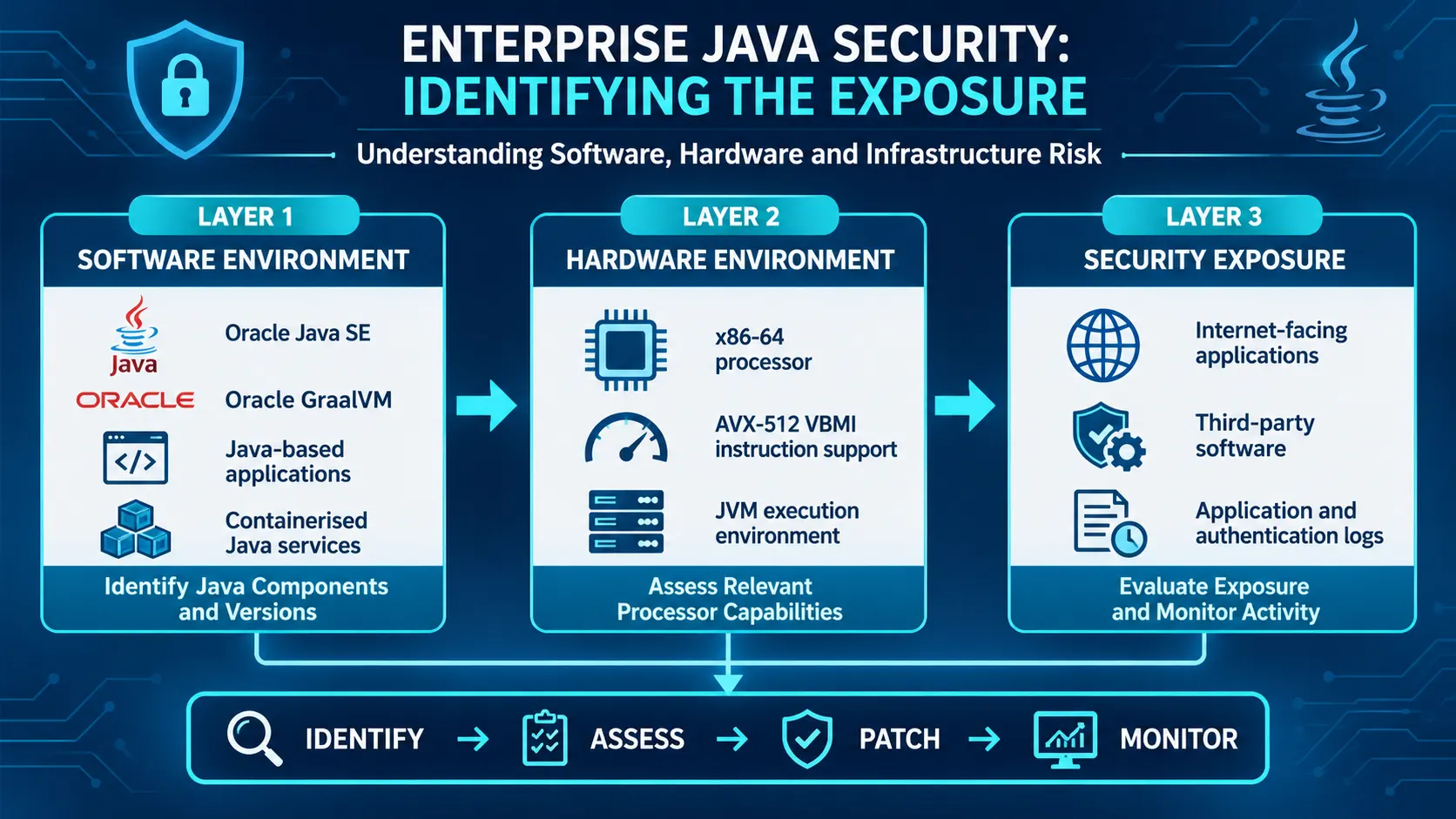
Java is commonly integrated into enterprise applications, backend services and third-party software. As a result, identifying vulnerable components can require more than checking directly installed Java Development Kits.
Organisations may also need to investigate Java runtimes embedded within application packages, containers, appliances and externally supplied software.
For enterprise security teams, this development reinforces the importance of software inventory management, dependency visibility and coordinated patch management.
It also demonstrates why hardware configurations matter during vulnerability assessments. In this case, the advisory specifically identifies x86-64 systems with AVX-512 VBMI support as relevant to the affected execution path.
Analysis: The announcement highlights a broader industry shift towards more comprehensive software supply chain security. Organisations need visibility into both the software components they deploy and the underlying infrastructure on which those components execute.
A structured vulnerability management process can help security teams identify exposure, coordinate remediation and monitor systems for suspicious activity.
Conclusion
CVE-2026-114938, known as Java4Shell, represents a critical security concern for organisations operating affected Oracle Java and GraalVM environments.
The heap-based buffer overflow in Java's Base64 functionality could allow remote attackers to cause memory corruption, disclose sensitive information, crash applications or execute arbitrary code under the specified hardware conditions.
The Canadian Centre for Cyber Security recommends identifying affected Java installations, applying appropriate vendor updates, prioritising internet-facing applications and monitoring systems for suspicious activity.
Although the Cyber Centre had not identified active exploitation when it published its 17 November 2026 alert, organisations should treat the vulnerability as a priority for assessment and remediation.
For IT administrators and security professionals, the immediate priority is clear: identify affected Java environments, assess hardware exposure and apply the appropriate security updates.
About the Author