
Google Warns AI-Powered Cyberattacks Have Reached a New Threshold as Autonomous Agents Automate Exploitation
Google warns that cybercriminals are moving beyond basic AI prompts to autonomous attack frameworks capable of automating reconnaissance, vulnerability exploitation and multi-stage intrusions, creating new challenges for cybersecurity teams.
Xcademia Team

Artificial intelligence is changing how organisations approach cybersecurity, but it is also giving cybercriminals new ways to automate attacks. Google has reported a significant shift in malicious AI activity, with threat actors increasingly using autonomous AI agents and multi-agent frameworks to conduct complex cyber operations.
In a report published on November 16, 2026, the Google Threat Intelligence Group (GTIG), working alongside Mandiant, detailed how cybercriminals, espionage groups and influence operations are incorporating generative AI into their activities.
The findings indicate that attackers are moving beyond manually prompting large language models (LLMs). They are increasingly deploying autonomous systems that can perform reconnaissance, identify vulnerabilities, generate exploit code and execute different stages of an intrusion with limited human involvement.
One particularly important development is Google's identification of a multi-agent vulnerability research framework capable of automatically analysing software patches, identifying potential security weaknesses, developing exploits and executing them without human intervention.
The report also highlights the growing misuse of AI infrastructure through LLMJacking, the adoption of agentic penetration-testing tools and the use of generative AI in espionage and information operations.
According to Google, these developments are changing the speed, scale and operational complexity of cyber threats.
Cybercriminals Are Moving Towards Autonomous AI Attack Frameworks
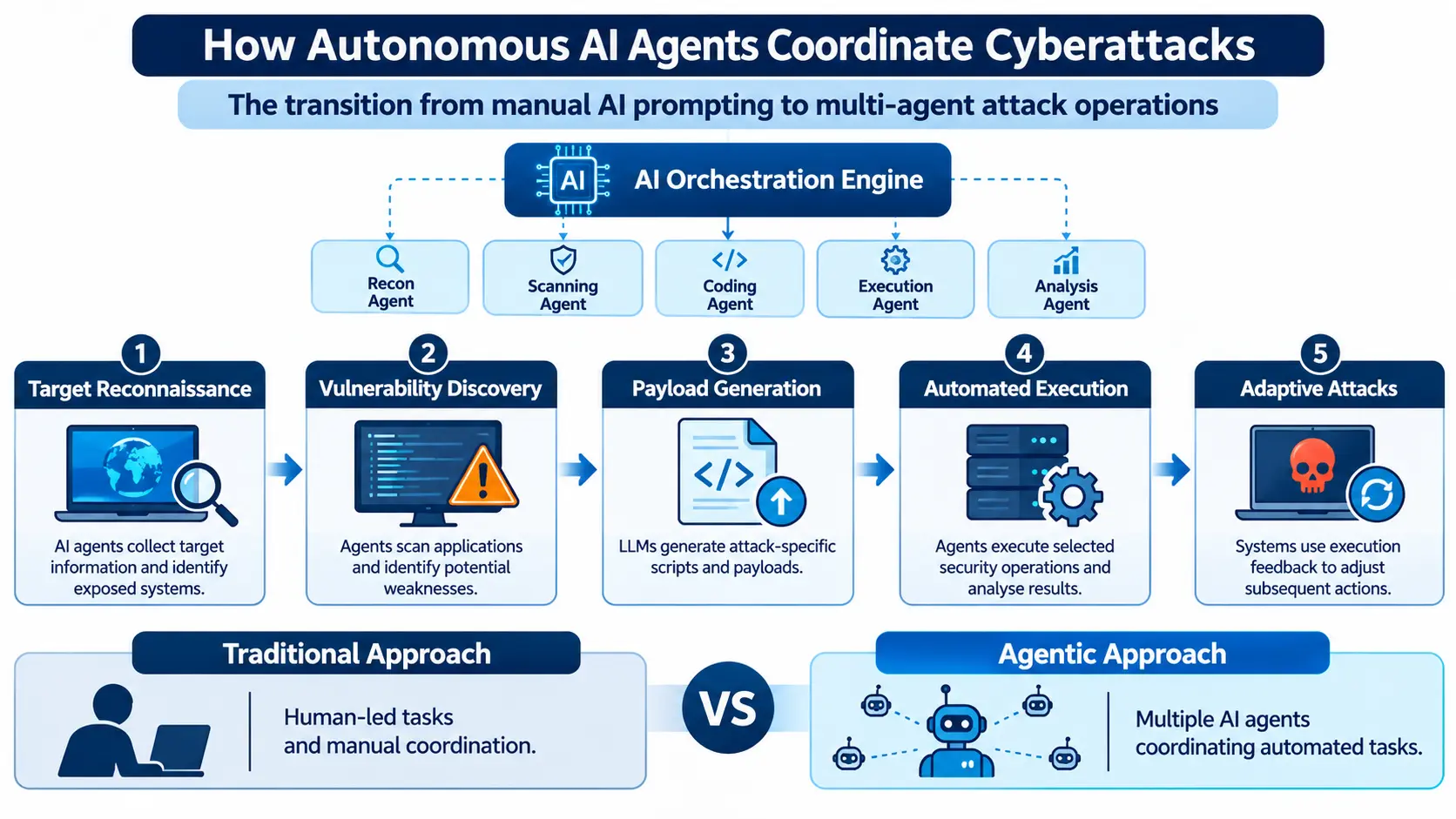
One of the most significant findings in Google's report is the growing adoption of autonomous, multi-agent frameworks in real-world cyber intrusions.
Previously, many threat actors used generative AI primarily as an assistant. They relied on prompts to generate scripts, research targets, analyse information or support individual stages of an attack.
The latest observations indicate a shift towards systems in which multiple specialised AI agents work together to complete different operational tasks.
These frameworks can support activities such as:
Reconnaissance and target discovery.
Identifying and exploiting low-complexity vulnerabilities.
Generating attack payloads when required.
Executing security tools and scripts.
Analysing execution feedback.
Adjusting attack techniques based on results.
Google identified several frameworks being used or tested by threat actors, including ARTEX, CAIRN, CyberStrikeAI, PentAGI and HexStrike AI.
These tools differ in their architecture and capabilities, but share a common objective: reducing the amount of manual work required to coordinate cyber operations.
Examples of AI-powered offensive frameworks
CAIRN: An open-source, multi-agent penetration-testing framework that uses an Observe, Orient, Decide and Act (OODA) loop. Its specialised agents collaborate through a shared workspace to move towards an operational objective. Google observed its use in intrusion activity involving targets in the US aerospace sector.
CyberStrikeAI: An open-source framework designed to coordinate AI-assisted cyber operations. Its architecture connects commercial and open-weight language models with security tools, attack recipes and custom scripts.
HexStrike AI: An offensive security framework integrated with the Model Context Protocol (MCP). It allows AI clients to interact with security tools covering reconnaissance, web application testing, exploitation and binary analysis.
PentAGI: An autonomous offensive framework designed to make complex penetration-testing operations more accessible. Between late August and early October 2026, Google tracked a threat actor using a customised platform based on its open-source version to conduct reconnaissance and vulnerability scanning against organisations across Asia.
Google also observed experimentation with custom-built frameworks, including activity linked to financially motivated actors and suspected espionage groups with connections to China.
Importantly, Google notes that these tools currently trade stealth for speed. Their automated activity can generate identifiable forensic traffic and code-level traces, giving defenders opportunities to detect and investigate intrusions.
However, the report suggests that increasing sophistication could reduce these visible indicators over time.
AI Agents Are Automating Vulnerability Discovery and Exploitation
Another major development highlighted in the report is the use of autonomous AI agents to identify software vulnerabilities and develop exploits.
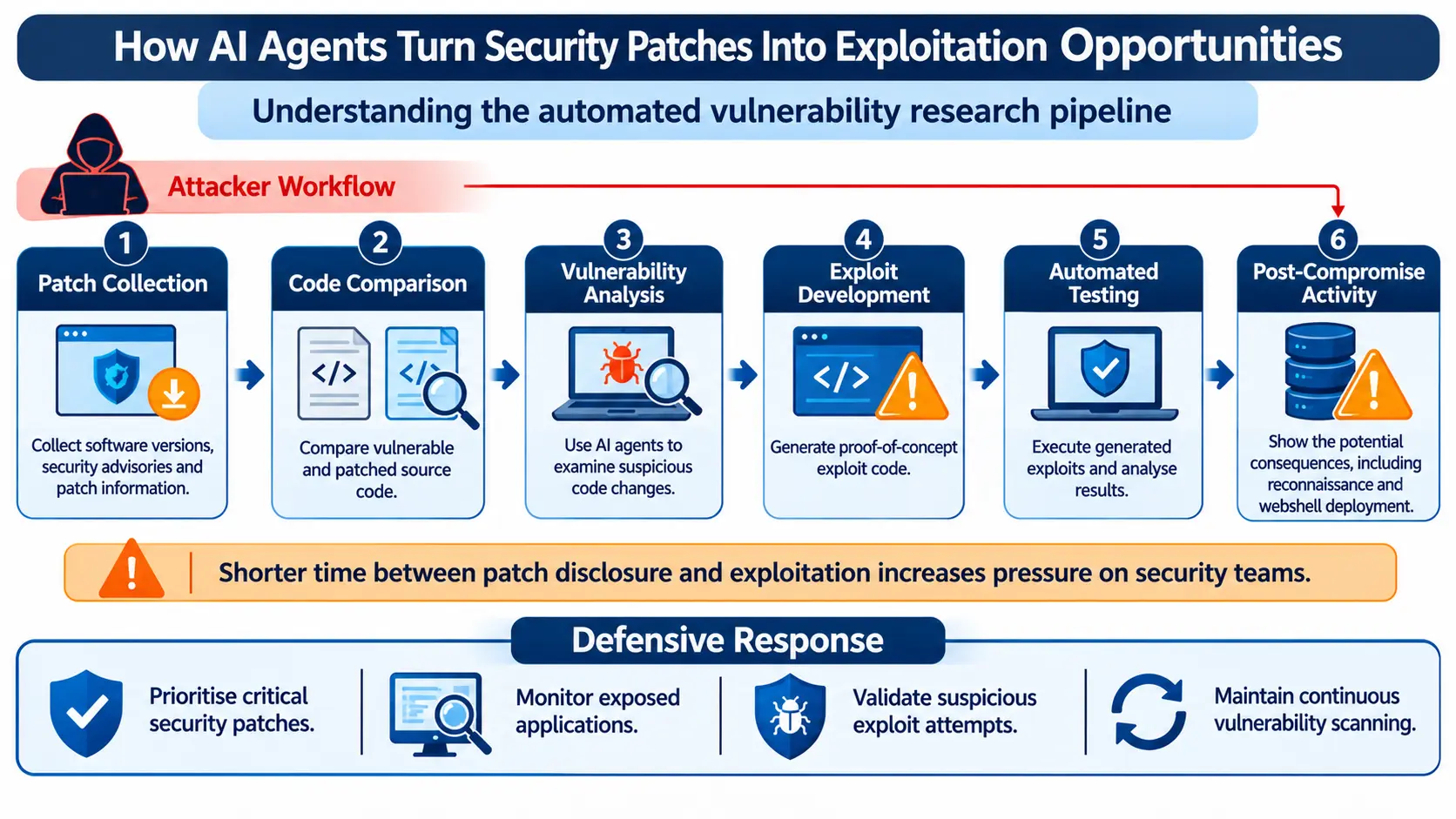
Security researchers have traditionally needed to examine application code, compare software versions, investigate security patches and manually develop proof-of-concept exploits.
Threat actors are now using LLM-powered systems to automate several of these activities.
Google reported identifying a previously exposed staging server hosting a multi-agent framework called exploit_agent. The framework integrates multiple frontier and locally hosted language models to perform vulnerability research and exploitation.
Its workflow includes:
Continuously analysing popular web application software.
Comparing source code before and after security patches.
Identifying potentially vulnerable code changes.
Drafting proof-of-concept exploit code.
Automatically executing generated exploits without human intervention.
This finding is particularly significant because Google identified this as the first observed instance in its reporting of threat actors fully automating vulnerability discovery and exploitation through LLM frameworks without a human in the loop.
Investigators also found scripts associated with post-compromise operations, including internal reconnaissance, brute-force activity, webshell installation and removal of competing attackers' webshells.
According to victim telemetry, the operator appeared particularly interested in French websites associated with media, entertainment and education.
The growing risk of faster vulnerability exploitation
The report also highlights two vulnerabilities affecting PaperCut print management servers:
CVE-2026-81578: An authentication bypass vulnerability.
CVE-2026-82078: An unsafe dynamic class loading vulnerability.
When chained together, the vulnerabilities enabled unauthenticated remote code execution.
Security researchers and Huntress generated working exploits within a day of disclosure. GreyNoise subsequently reported a campaign occurring four days after the initial disclosure, in which an attacker likely used LLMs to develop and test exploits, identify targets and launch a widespread campaign against hundreds of organisations.
Google also highlighted vulnerabilities CVE-2026-109618 and CVE-2026-109619 affecting PHP. LLM-assisted analysis helped identify the vulnerabilities, while publicly available proof-of-concept material and early patched code provided additional material for researchers and attackers to examine.
Following the official patches on October 21, 2026, hundreds of purported proof-of-concept exploits appeared. Many were reportedly non-functional, creating additional verification work for security researchers.
The distinction is important: AI can accelerate vulnerability research, but AI-generated exploit code is not automatically reliable or functional.
Generative AI Is Becoming a Core Part of Information Operations
Google's report also examines how generative AI is being integrated into information operations (IO).
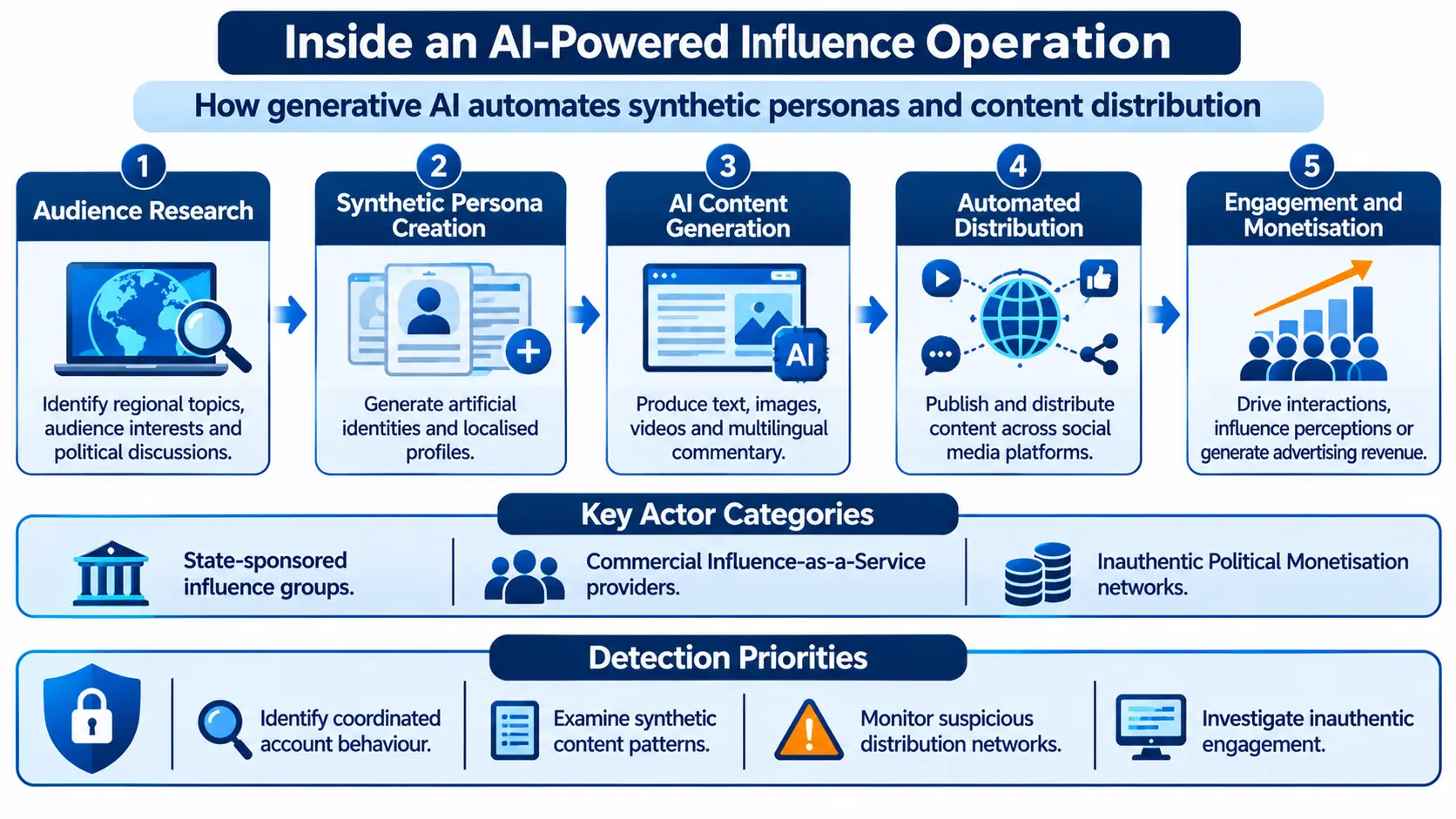
Information operations involve coordinated activities designed to influence public perception, manipulate discussions or distribute misleading narratives.
According to GTIG, state-sponsored groups, commercial influence-service providers and inauthentic political monetisation networks have moved beyond experimental AI usage.
These actors are increasingly incorporating LLMs into their regular operational workflows.
The reported activities include:
Generating synthetic media and artificial personas.
Producing localised content in different languages.
Creating political commentary and misleading narratives.
Automating article editing and publishing.
Manipulating search engine optimisation activities.
Distributing content across multiple social media platforms.
The growing use of AI allows operators to produce more content while reducing the manual effort involved in writing, translation and distribution.
However, Google makes an important distinction: improved content quality does not necessarily mean that an influence campaign has achieved greater reach or effectiveness.
Three categories of AI-assisted influence operations
Google identifies three broad categories of actors involved in these activities.
State-sponsored groups
These groups have direct links to government structures and use influence campaigns to support political or strategic objectives. Some rely on external contractors to conduct operations while maintaining distance from the activity.
Influence-as-a-Service providers
Commercial organisations and contractors offer services ranging from targeted influence campaigns to complete platforms for managing synthetic personas and distributing content.
Inauthentic Political Monetisation networks
These networks primarily operate for financial gain. They generate political clickbait and controversial content to increase engagement, attract traffic and generate advertising revenue.
The report highlights how these categories can overlap in their techniques, making it difficult to determine whether a particular campaign is politically motivated or financially driven.
AI-powered influence platforms are becoming more sophisticated
In August 2026, GTIG investigated activity involving the Gemini API and tools from other AI providers.
The investigation identified a platform designed to automate the influence campaign lifecycle, including persona creation, multimedia generation, content distribution and interactive posting.
The platform was designed to create content that appeared to originate from genuine local communities.
Google also identified a separate commercial contractor developing a platform designed to manage more than 100,000 accounts across major global platforms.
Its planned architecture included automated agents, device-identity spoofing tools and cloud-based virtual smartphones.
The investigation also found prompts designed to make synthetic content appear more natural, including the use of local dialects, informal language and simulated smartphone photography characteristics.
These findings demonstrate how AI-generated content, automated account management and distribution infrastructure can be combined into larger influence operations.
LLMJacking: Cybercriminals Are Stealing AI Resources and Cloud Compute
Beyond using AI to improve their attacks, cybercriminals are increasingly targeting AI infrastructure itself.
Google identifies this activity as LLMJacking, a form of resource abuse in which attackers compromise an organisation's cloud environment, steal credentials or hijack access to AI services.
Instead of simply stealing conventional computing resources, attackers use compromised accounts to access large language models, consume API quotas and exploit cloud infrastructure.
The financial consequences can be substantial.
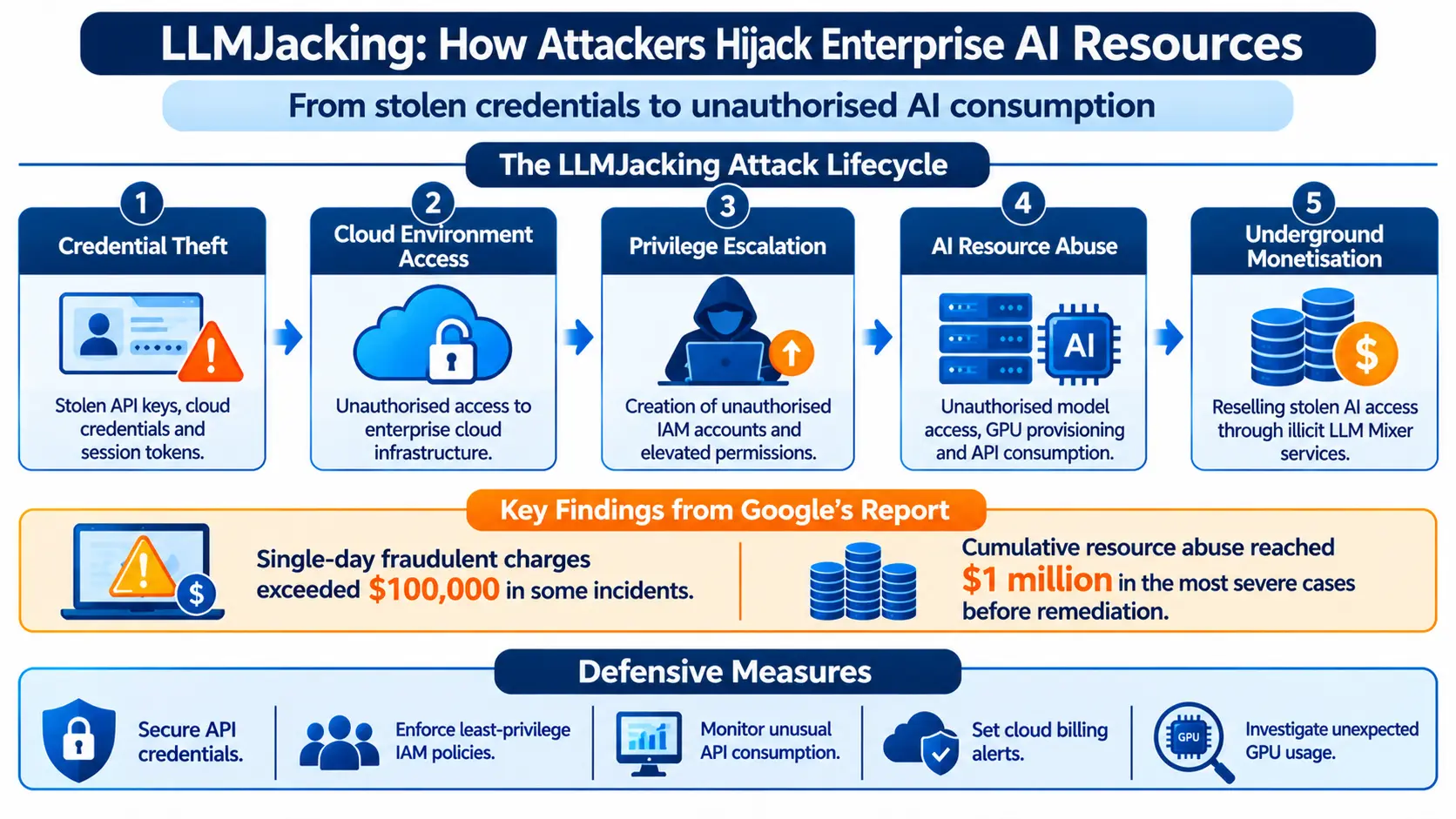
According to Mandiant's incident response investigations during 2026:
Some individual days generated fraudulent charges exceeding $100,000.
In the most severe cases, cumulative resource abuse reached $1 million before remediation.
These figures demonstrate that unauthorised AI resource consumption can become a serious financial and operational security problem.
How LLMJacking attacks happen
Google identified several recurring stages in these incidents.
1. Initial access through stolen credentials
Attackers obtain valid credentials through compromised repositories, stolen session tokens or deceptive websites designed to capture authentication information.
2. Internal reconnaissance
After gaining access, attackers examine internal code repositories, cloud services, containers, data stores and access logs to identify valuable resources.
3. Privilege escalation
Attackers may create unauthorised identity and access management (IAM) accounts, modify service permissions or exploit vulnerabilities to obtain greater privileges.
4. Unauthorised AI resource consumption
Once access is established, attackers activate AI services, consume available quotas and provision computing resources for their own operations.
Google also identified cases involving the abuse of powerful GPU instances and requests for increased computing quotas.
Millions of AI API requests in approximately 24 hours
One investigation described by Google illustrates the scale of the problem.
At least two separate attackers accessed a targeted environment using the same legitimate credentials.
One actor examined the available LLM services and account usage information. Meanwhile, another set of IP addresses, potentially associated with a botnet or proxy service, used the same credentials to generate millions of LLM API requests in approximately 24 hours.
The credentials were eventually revoked.
This incident demonstrates why organisations need to monitor AI service usage alongside traditional cloud security activity.
The emergence of underground LLM Mixers
Google also identified an underground marketplace model known as LLM Mixers.
These services sell unauthorised access to AI models and cloud resources obtained through compromised environments.
Rather than relying on a single stolen account, the services can route customer requests through multiple compromised credentials and computing resources.
This approach allows operators to distribute usage across different environments.
GTIG analysed advertisements across Russian- and Chinese-language underground marketplaces and found services offering access to multiple AI models, including frontier and jailbroken models.
The report identified advertised prices ranging from $0.10 to $25 per million tokens.
One vendor, APIMart, reportedly applies a fivefold price increase to input and output pricing when prompts exceed 100,000 tokens.
These figures describe advertised underground marketplace pricing, not legitimate AI service prices.
Government-Backed Threat Actors Are Integrating AI Into Espionage
Google's investigation also shows that state-sponsored cyber operations are increasingly incorporating generative AI.
The report identifies activity associated with Iranian, Chinese and North Korean threat actors.
These groups are using LLMs to support different stages of their operations, including target research, reconnaissance, social engineering, exploit development and post-compromise data analysis.
Iranian threat activity
Google reported continued activity from CALANQUE ION, an Iranian government-backed threat actor previously tracked as APT42.
The group has used LLMs, including Gemini, to support reconnaissance and targeted social engineering.
Chinese-linked espionage activity
During the third quarter of 2026, China-linked cyber espionage actors used LLM tools for:
Reconnaissance and front-end scanning.
Researching organisations across different sectors.
Investigating potential targets.
Supporting exploit development.
Analysing information obtained after compromises.
Google also described a contractor tracked as LEAKY CASTLE, which was associated with using LLMs to analyse, translate and interpret stolen information.
The resulting analysis included insights into organisational structures that could be incorporated into intelligence reports.
Another observed development involved the misuse of AI platform file-hosting infrastructure and backend APIs to stage malicious files and transfer stolen information.
North Korean threat activity and AI-assisted recruitment
The report also identifies North Korean threat actors using AI tools to support fraudulent IT worker activities.
These operations include generating resumes, preparing interview responses and using public-facing AI tools during job screening processes.
The objective is to make fraudulent applicants appear more credible when applying for remote positions at Western organisations.
Google also described a campaign targeting cryptocurrency organisations in North America and Europe.
The suspected MIDNIGHT NEPTUNE threat cluster used fraudulent recruiter profiles and AI-generated identities to approach potential victims.
Targets were directed to fake meeting platforms containing ClickFix social engineering instructions.
Following initial compromise, attackers modified configuration files in internal code repositories so that launching Claude Code could trigger the download of a backdoor named SOMBERMEME.
The attackers also generated GitHub Personal Access Tokens using names associated with Microsoft Copilot to disguise their activity.
This example demonstrates a particularly concerning development: AI development tools and their configuration mechanisms can become potential supply chain attack vectors when organisations fail to secure them properly.
AI Is Lowering the Barrier to Entry for Phishing Operations
Google's research also identifies the increasing use of LLMs by Phishing-as-a-Service (PhaaS) operators.
These services provide ready-made phishing infrastructure to cybercriminals, allowing individuals with limited technical skills to launch campaigns.
One example is Jieyou, a Chinese-language phishing service first observed in March 2026.
The platform introduced an LLM chatbot assistant in a backend update in June 2026.
According to Google, the chatbot allows affiliates to configure phishing panels and modify existing templates using natural language commands.
Its architecture supports multiple commercial and open-source AI models through APIs.
This development reduces the need for affiliates to manually edit phishing templates or understand complex technical configurations.
Instead, they can use conversational instructions to customise phishing interfaces and deceptive messages.
Google also reported that Gemini safety responses were triggered by identified activities. The company subsequently disabled associated assets and updated its models and classifiers to prevent further misuse.
Google's Defensive Strategy Against AI-Powered Cyber Threats
While the report highlights how threat actors are exploiting generative AI, it also outlines Google's approach to defending its models, platforms and enterprise customers.
The strategy combines model-level safeguards, threat intelligence, automated security systems and proactive disruption of malicious activity.
Model-level safeguards and misuse prevention
Google continuously updates its safety classifiers and model guardrails using information gathered through active threat monitoring.
The company also takes action against malicious projects and accounts identified during investigations.
These measures are intended to reduce the ability of threat actors to misuse Google's AI services.
Google AI Threat Defense
Google has developed Google AI Threat Defense (AITD) to extend its security approach to enterprise environments.
The architecture brings together:
Reasoning capabilities from Gemini and other frontier models.
Risk prioritisation capabilities from Wiz.
Automated remediation capabilities involving Gemini and CodeMender.
Threat intelligence from Mandiant.
Google describes AITD as a multi-model architecture that balances cost and security coverage.
It uses lighter models for continuous scanning and specialised frontier models for higher-risk vulnerabilities.
Gemini 4 Carbon and cybersecurity safeguards
The report also introduces Google's Gemini 4 Carbon as its strongest model with advanced cybersecurity and long-horizon capabilities.
Google says it incorporates multiple layers of protection against cyber misuse, including:
Safety training.
Input and output classifiers.
Activation-based introspection probes.
Chain-of-thought monitoring.
Agentic trajectory monitoring.
These safeguards are designed to prevent the generation of functional weaponised exploits and malware tooling.
Google reports that the protections have been tested by internal red teams and external partners, including Gray Swan and Trajectory Labs.
The company also monitors production activity and can restrict or disable access for accounts involved in prohibited activities.
For vetted defenders, researchers and government partners, Google describes the Fairwind Program as a way to provide access to advanced dual-use cybersecurity capabilities.
Building AI securely through SAIF
Google also highlights its Secure AI Framework (SAIF), a conceptual framework designed to support the secure development and deployment of AI systems.
The company says it incorporates threat intelligence and findings from investigations into its AI development and safety processes.
Google also references two AI-powered security initiatives:
Big Sleep: Introduced in 2024 by Google DeepMind and Google Project Zero to identify previously unknown software vulnerabilities.
CodeMender: An AI agent used in Google's automated vulnerability discovery and remediation efforts.
These initiatives reflect Google's approach to using AI defensively while strengthening safeguards against malicious use.
What These Developments Mean for Enterprise Cybersecurity
Google's findings highlight a broader industry shift towards AI-assisted and increasingly autonomous cyber operations.
The traditional distinction between human-operated attacks and automated attacks is becoming less clear.
Threat actors can now combine language models, security tools, compromised credentials and autonomous agents to automate multiple stages of an intrusion.
For organisations, this creates several important security considerations.
Faster vulnerability exploitation requires faster patch management.
Organisations may have less time to respond when attackers use AI to analyse patches and develop exploits. Security teams should prioritise internet-facing applications, critical vulnerabilities and exposed infrastructure.
AI infrastructure needs the same security attention as other enterprise systems.
API keys, model credentials, cloud permissions and AI service quotas are valuable resources. Organisations should monitor access and apply least-privilege permissions.
AI development tools introduce additional supply chain risks.
Coding assistants, agent configurations and automated execution hooks should be reviewed as part of software security processes.
Security monitoring must account for automated activity.
Traditional detection strategies may need to evolve to identify unusual API consumption, automated reconnaissance, suspicious service-account creation and coordinated agent activity.
Synthetic content creates additional trust challenges.
Organisations and platforms need to consider how coordinated synthetic personas and automated content distribution can influence public discussions and compromise information integrity.
Analysis: The growing importance of securing autonomous AI systems
The announcement highlights a broader industry shift towards security systems that must account for both human attackers and autonomous software agents.
For enterprises, this could mean expanding traditional cybersecurity programmes to include AI-specific identity management, model access monitoring, agent permissions and supply chain controls.
It also reinforces the importance of treating AI security as an ongoing operational responsibility rather than a one-time implementation exercise.
As AI becomes more deeply integrated into business applications and development workflows, organisations will need to understand not only what their AI systems can do, but also what happens when those capabilities are misused.
Conclusion: AI Is Reshaping Both Cyberattacks and Cyber Defence
Google's latest threat intelligence report highlights a significant development in the cybersecurity landscape.
Threat actors are increasingly using autonomous AI agents to automate reconnaissance, vulnerability research, exploitation, espionage and influence operations.
The discovery of exploit_agent, which could analyse software patches and execute generated exploits without human intervention, represents an important milestone in the operational use of agentic AI for cybercrime.
Meanwhile, LLMJacking demonstrates that AI infrastructure itself has become a target for financially motivated attackers.
Google's findings also show that the risks extend beyond conventional hacking. Synthetic personas, automated phishing services and AI-powered influence campaigns introduce additional challenges for organisations, platforms and security researchers.
At the same time, Google's defensive strategy highlights the growing role of AI in vulnerability discovery, threat intelligence and automated security operations.
The central takeaway is that AI is becoming part of both the attack surface and the defensive infrastructure. Organisations must secure their AI systems while preparing for adversaries that increasingly use automation to operate at machine speed.
About the Author