
Git Releases Security Updates for Six Vulnerabilities, Including Arbitrary Code Execution During Recursive Cloning
Git has released security updates addressing six vulnerabilities that could expose developers and code-hosting platforms to arbitrary code execution, path traversal, memory corruption and unauthorised file access. Users are urged to upgrade to patched versions.
Xcademia Team

Git Patches Six Security Vulnerabilities Affecting Developers and Code-Hosting Platforms
The Git project has announced security updates addressing six vulnerabilities across its distributed version control system. Disclosed on 10 November 2026, the vulnerabilities affect several Git operations, including recursive repository cloning, reference handling, merge processing, binary patch application and repository imports.
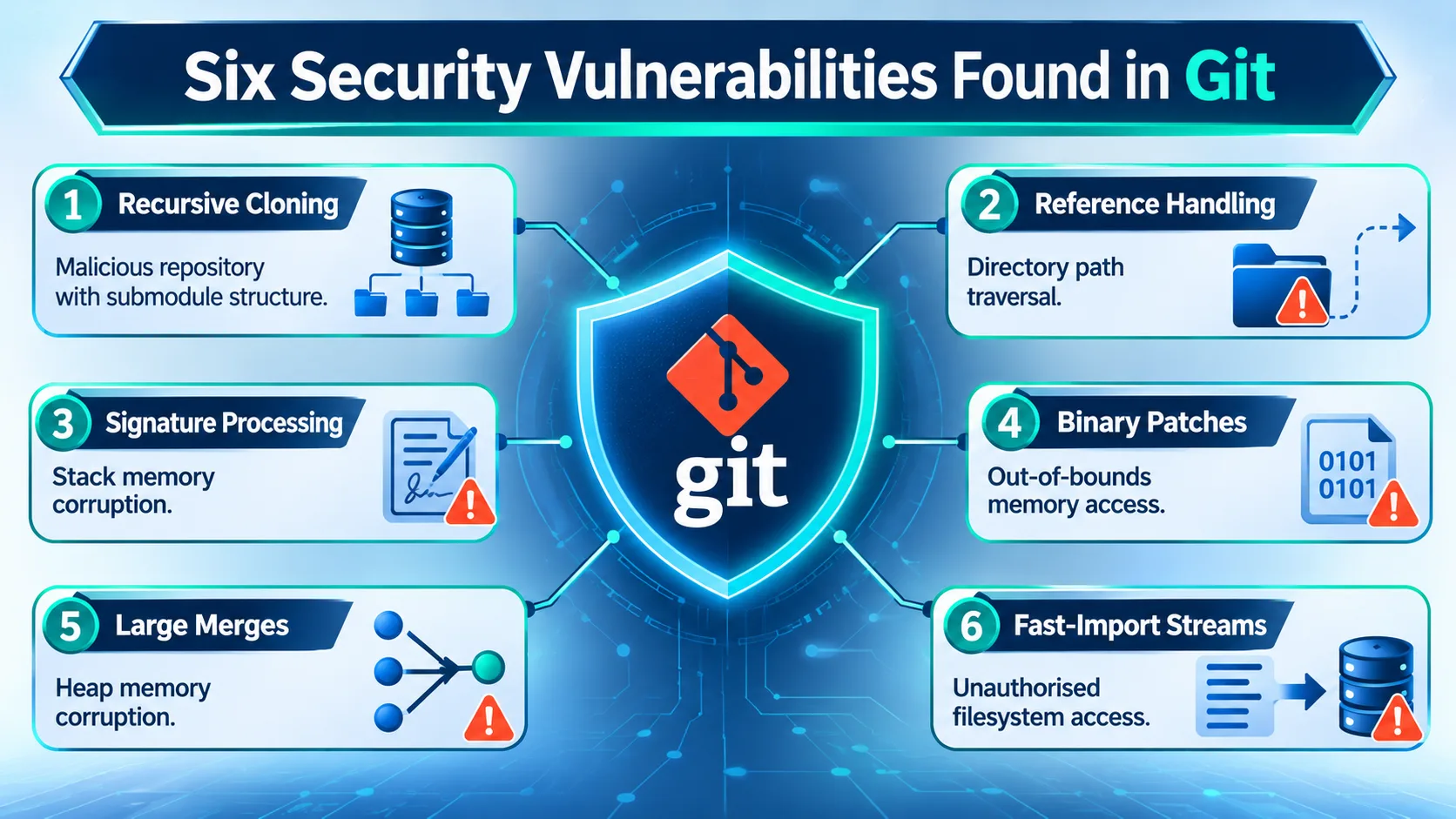
The most serious issue could allow arbitrary code execution when a user recursively clones a malicious repository containing specially crafted submodule content. Other vulnerabilities could enable writes outside intended directories, memory corruption, denial-of-service conditions and unauthorised filesystem access.
Git has addressed the vulnerabilities in Git 2.56.1, with security fixes backported to supported maintenance releases, including Git 2.55.1, 2.54.1, 2.53.1, 2.52.1, 2.51.3 and 2.50.2.
GitHub recommends that users upgrade to Git 2.56.1 or the corresponding patched release for their maintenance series. Organisations should also review applications and development environments that bundle their own Git versions.
The announcement is particularly relevant to software developers, DevOps teams, repository administrators and organisations operating code-hosting infrastructure that processes repositories or other content from untrusted sources.
Six Git Vulnerabilities: What Security Teams Need to Know
The vulnerabilities affect different parts of Git's internal processing. While some involve unsafe filesystem operations, others originate in memory management and insufficient validation of specially crafted repository data.
The six disclosed vulnerabilities are:
CVE ID | Vulnerability | Potential impact |
|---|---|---|
CVE-2026-111760 | Integer truncation during recursive cloning | Arbitrary code execution |
CVE-2026-113408 | Path traversal through advertised HEAD | Writes outside intended reference directory |
CVE-2026-114467 | Stack corruption when removing signatures | Memory corruption and denial of service |
CVE-2026-114469 | Out-of-bounds reads when applying binary patches | Application crash |
CVE-2026-105437 | Heap corruption during large merges | Memory corruption |
CVE-2026-114466 | Unsafe features in fast-import streams | Unauthorised file reads and writes |
These issues demonstrate how specially crafted repository data can expose weaknesses in version control operations, particularly when Git processes content supplied by external or untrusted sources.
1. CVE-2026-111760: Arbitrary Code Execution During Recursive Cloning
Highest-priority vulnerability
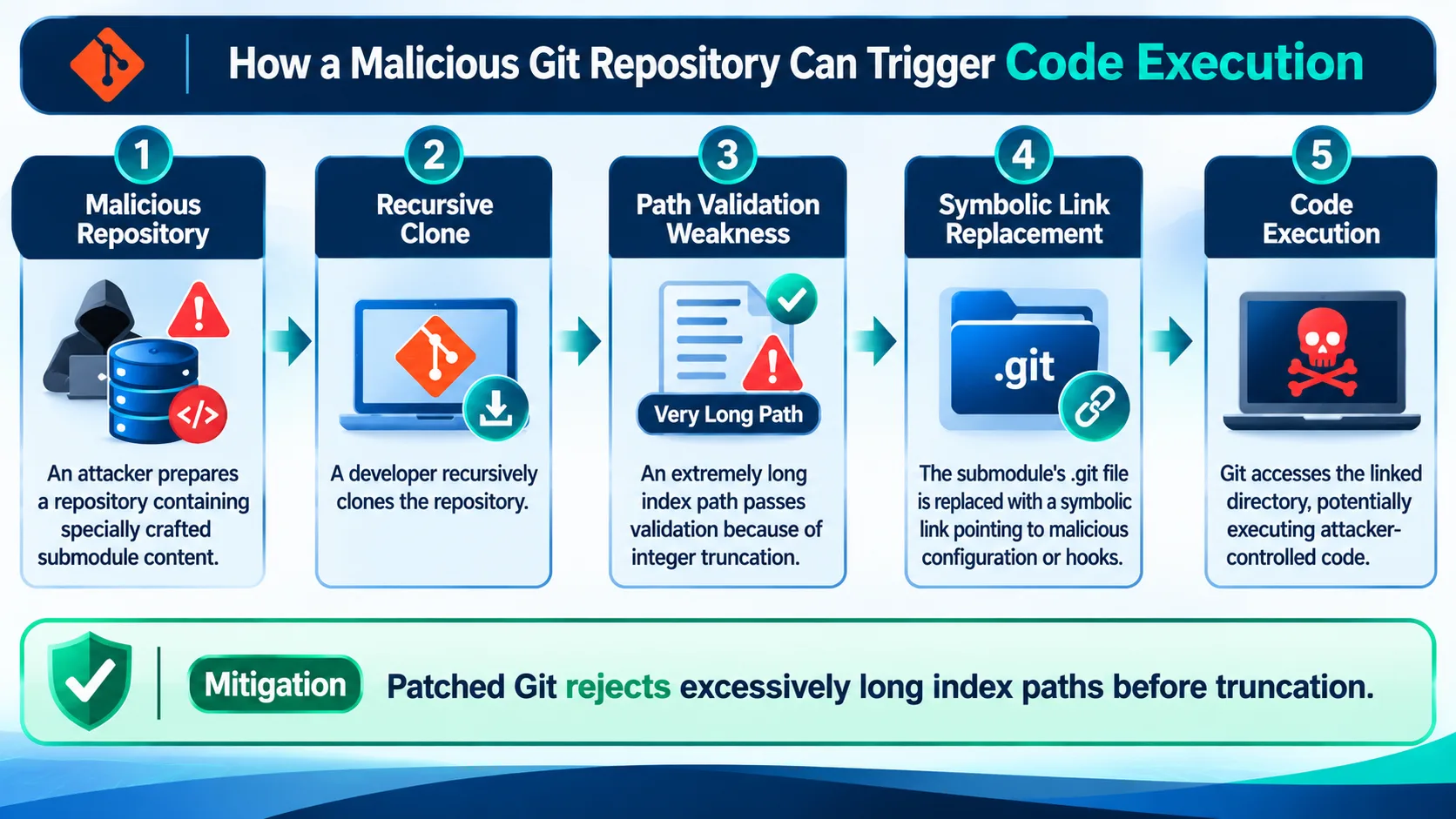
CVE-2026-111760 is one of the most significant vulnerabilities in the announcement because it could allow attacker-controlled code to execute during recursive cloning of a malicious repository.
The issue originates in how Git handles extremely long file paths in its index.
Git normally validates repository paths before writing files into a working tree. This validation includes preventing repository content from overwriting sensitive Git metadata.
However, an integer truncation issue can cause an extremely long path to pass validation under one name and subsequently be written using a shorter name.
An attacker can exploit this discrepancy to replace a submodule's .git file with a symbolic link pointing to a directory containing malicious Git configuration or hooks.
When Git subsequently accesses that directory, attacker-controlled code can execute.
The vulnerability is particularly relevant to developers who recursively clone repositories containing submodules from untrusted sources.
How Git addresses the issue
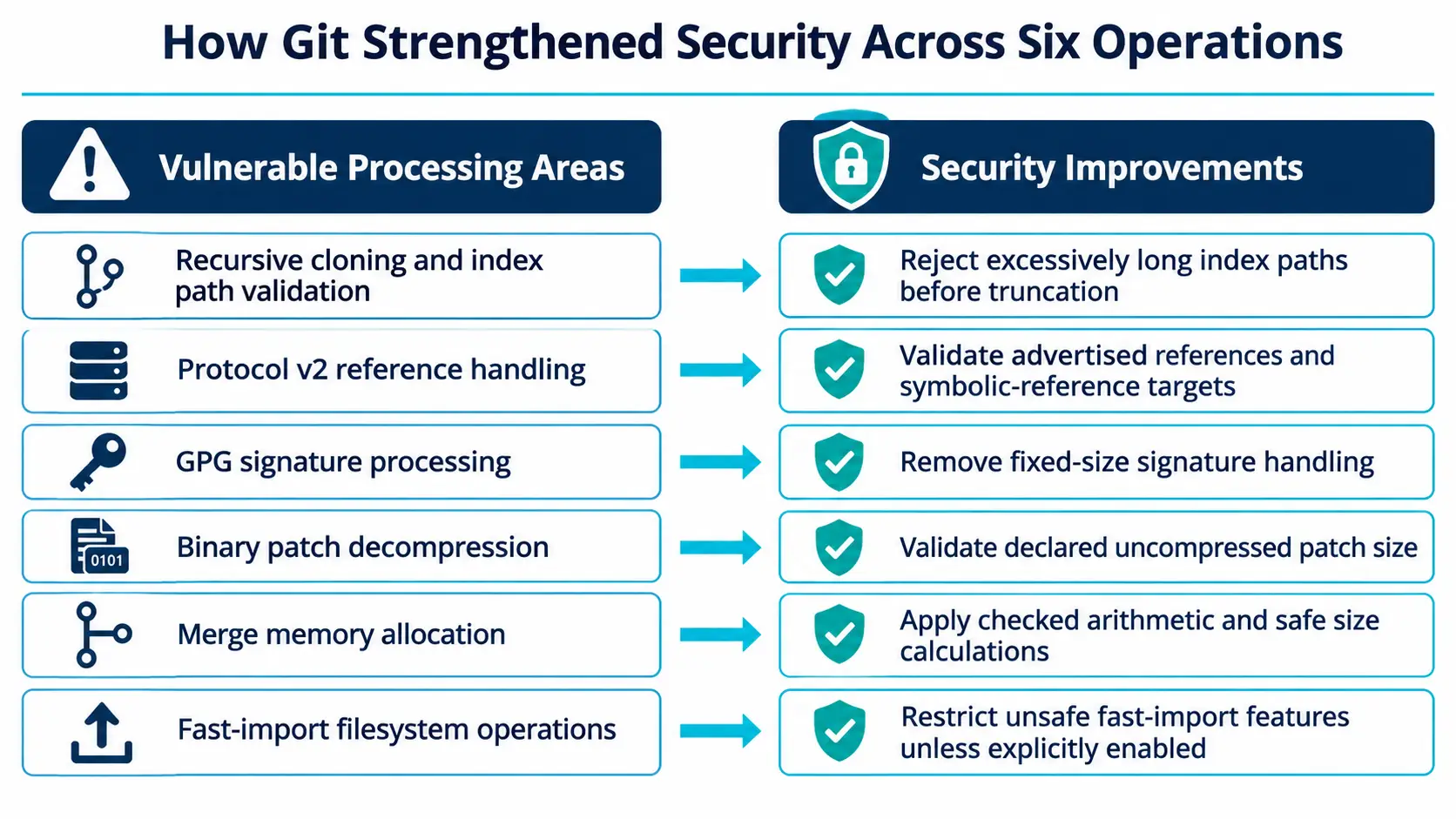
The security update rejects extremely long index entry paths before their lengths can be truncated.
This prevents the malicious path from bypassing the intended validation process.
2. CVE-2026-113408: Path Traversal Through an Advertised HEAD Reference
CVE-2026-113408 affects Git's handling of symbolic references when cloning empty repositories through Git protocol version 2.
An empty repository does not yet contain commits. However, a server can advertise a HEAD symbolic reference pointing to an unborn branch.
The vulnerability occurs because Git did not adequately validate the advertised symbolic reference target before storing it locally.
A malicious server could provide a branch name containing path-traversal components.
When Git later updates that branch, the vulnerable behaviour could allow files to be written outside the intended reference directory when using the files reference backend.
Security fix
Git now validates the advertised target before accepting it. The update also introduces validation for other reference names and symbolic-reference targets received through protocol version 2.
This addresses the underlying issue of accepting untrusted reference information without sufficient path validation.
3. CVE-2026-114467: Stack Corruption When Removing Signatures
CVE-2026-114467 involves Git's handling of GPG signatures when removing signatures from a message.
The affected implementation assumed that a message would contain no more than two signatures. It used a fixed-size stack array based on that assumption.
However, a specially crafted message containing more than two signatures could exceed the available array capacity and cause Git to write beyond its boundaries.
This can result in stack memory corruption and potentially cause a denial-of-service condition.
The issue is relevant to environments that process merges involving signed tags, including hosting services that perform these operations on behalf of users.
Security fix
Git removed the fixed-size array and changed the implementation to handle messages containing any number of signatures without relying on the previous assumption.
4. CVE-2026-114469: Out-of-Bounds Reads When Applying Binary Patches
CVE-2026-114469 affects Git's binary patch application functionality.
Git already rejects patches larger than approximately 1 GiB because its patch-processing implementation cannot safely handle inputs beyond that limit.
However, the original size validation considered the size of the supplied patch rather than adequately accounting for the size of its decompressed content.
Binary patches are compressed and encoded. Consequently, a relatively small input could expand into a much larger representation.
An attacker could exploit this discrepancy to bypass the original size check and trigger an out-of-bounds read during patch processing.
This could cause Git to crash when processing a specially crafted binary patch.
Security fix
Git now checks the declared uncompressed size before processing binary patches, addressing the gap in the previous validation mechanism.
5. CVE-2026-105437: Heap Corruption During Large Merges
CVE-2026-105437 affects Git's merge processing and memory allocation calculations.
Git estimates the memory required to generate a merge result before writing the output. However, this calculation could overflow when processing exceptionally large merge results.
One scenario involves a large number of conflicts combined with a large conflict-marker-size attribute.
When the calculation overflows, Git may allocate a buffer smaller than the actual output requires.
Subsequent writes can then extend beyond the allocated memory, corrupting the heap.
This issue is relevant to local development environments as well as applications and hosting services that process untrusted repository content.
Why code-hosting platforms should pay attention
A hosting service may process repository content through automated merge operations. If untrusted users can influence the content being processed, vulnerable merge functionality could create an additional security risk.
The Git announcement identifies applications and hosting services that use Git to merge untrusted content as potentially affected environments.
Security fix
Git now uses size-appropriate data types and checked arithmetic when calculating merge output sizes. It also rejects merge results whose required size cannot be represented safely.
6. CVE-2026-114466: Filesystem Access Through Fast-Import Streams
CVE-2026-114466 affects Git's fast-import functionality, which reads command streams to construct repository data.
Git already restricts certain operations when they are supplied through untrusted input streams because some commands can access files outside the repository.
However, three features did not previously receive equivalent protection:
rewrite-submodules-fromrewrite-submodules-toexport-pack-edges
The first two features can read arbitrary files. Depending on the processing behaviour, their contents could potentially be exposed through error messages.
The export-pack-edges option can create files or append data to existing files.
An attacker who supplies a specially crafted fast-import stream could potentially abuse these features to perform unauthorised filesystem operations.
Security fix
Git now rejects these features when they appear in an input stream unless the caller explicitly enables:
--allow-unsafe-features
Git's recommendation is to enable this option only when the program generating the input stream is trusted.
Git Releases Patched Versions Across Multiple Maintenance Branches
To address the vulnerabilities, the Git project has released updated versions across several maintenance branches.
The fixes are included in the following releases:
2.56.1
LATEST RELEASE IN THE ANNOUNCEMENT
Maintenance branch | Patched version |
|---|---|
Git 2.56 | 2.56.1 |
Git 2.55 | 2.55.1 |
Git 2.54 | 2.54.1 |
Git 2.53 | 2.53.1 |
Git 2.52 | 2.52.1 |
Git 2.51 | 2.51.3 |
Git 2.50 | 2.50.2 |
Git recommends upgrading to version 2.56.1 or the corresponding patched release within the maintenance series being used.
Organisations should not assume that updating their primary Git installation automatically updates every application that includes its own Git implementation.
GitHub's Response: Security Fixes Across Its Platform
GitHub has also outlined how the vulnerabilities are being addressed across its services and products.
According to the announcement:
GitHub.com: Fixes have been deployed.
GitHub Enterprise Cloud: Fixes have been deployed.
GitHub Enterprise Cloud with data residency: Fixes have been deployed.
GitHub Enterprise Server: Updates are available in versions 3.19.15, 3.20.11, 3.21.9 and 3.22.4.
GitHub Desktop: Updated releases containing patched Git versions are being coordinated.
GitHub Copilot app: Updated releases containing patched Git versions are being coordinated.
GitHub Codespaces and GitHub Actions: These environments will also receive patched Git versions.
The distinction between already deployed fixes and updates still being coordinated is important for administrators. Organisations should check the relevant product release information rather than assume that every component has already received the update.
Recommended Security Actions for Developers and Organisations
The announcement highlights the importance of updating Git installations and reviewing development environments that process external repository content.
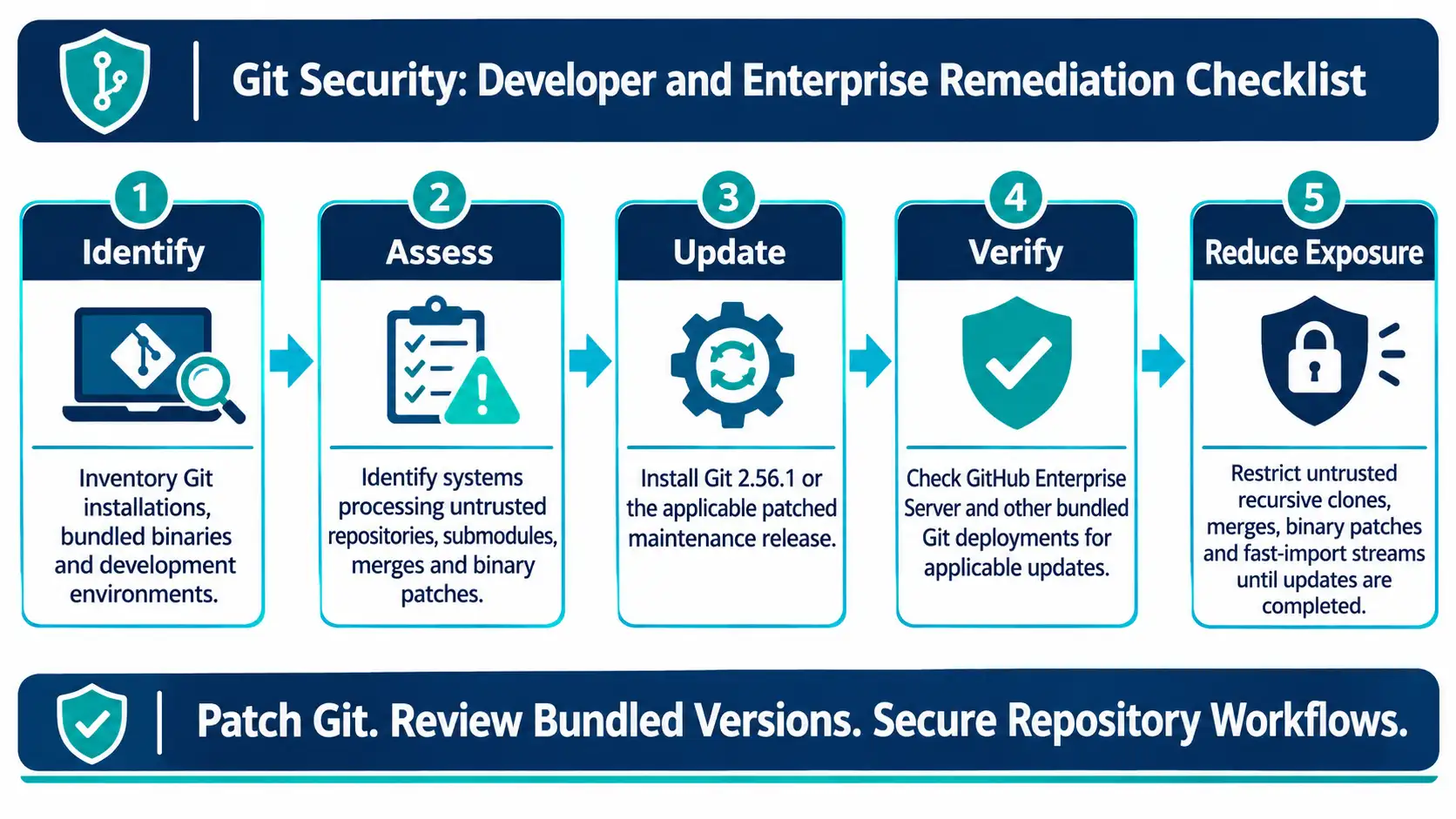
Security teams and developers should prioritise the following actions.
1. Upgrade Git to a Patched Version
Install Git 2.56.1 or the appropriate patched maintenance release.
Use the official distribution channel for your operating system or Git installation.
2. Review Applications That Bundle Git
Identify applications, development tools and automation environments that include their own Git binaries.
Updating the system-level installation alone may not address vulnerable bundled copies.
3. Review Automated Repository Processing
Inspect CI/CD pipelines, build systems and repository management services that automatically process external repositories.
Pay particular attention to recursive cloning, merge operations, binary patch processing and fast-import workflows.
4. Restrict Operations on Untrusted Repositories
If immediate patching is not possible, Git recommends temporary precautions:
Clone repositories only from trusted servers.
Avoid recursively cloning untrusted repositories.
Avoid merging untrusted content or tags.
Do not process binary patches or fast-import streams from untrusted sources.
These measures reduce exposure but do not replace installing the security updates.
5. Review GitHub Enterprise Server Versions
Administrators operating GitHub Enterprise Server should upgrade to the applicable patched versions:
3.19.15
3.20.11
3.21.9
3.22.4
These updates are particularly important for organisations managing internal source code repositories and development infrastructure.
What This Means for the Software Development and Cybersecurity Industry
The Git security announcement highlights a broader security challenge for modern software development: trusted development tools must safely process untrusted inputs.
Git is deeply integrated into developer workstations, CI/CD pipelines, automated build systems and code-hosting platforms. As a result, vulnerabilities in repository processing can have implications beyond individual developer machines.
For enterprises, this could mean reviewing not only the Git versions installed on employee devices but also the versions embedded in automated systems and services.
The recursive cloning vulnerability is particularly relevant because repositories frequently contain submodules that reference other repositories. Security teams should therefore consider how automated systems handle external repository dependencies.
The announcement also reinforces the importance of secure input validation and memory management in widely used developer infrastructure.
Industry analysis: Software supply chain security increasingly depends on the security of the tools used to build, test and distribute software. Git's latest security updates illustrate why organisations need consistent patch management across developer environments, automation platforms and code-hosting infrastructure.
Conclusion
The Git project has released updates addressing six security vulnerabilities affecting repository cloning, reference handling, signature processing, binary patches, merge operations and filesystem access.
CVE-2026-111760 deserves particular attention because it could allow arbitrary code execution during recursive cloning of a malicious repository.
With fixes available in Git 2.56.1 and multiple backported maintenance releases, developers and administrators should prioritise upgrading their installations and reviewing applications that bundle Git.
Organisations unable to update immediately should follow Git's recommended precautions when processing untrusted repositories and content. However, these temporary measures should not replace installing the patched releases.
For development teams, the announcement is a reminder that securing the software supply chain also means securing the tools and infrastructure used to manage source code.
Source: GitHub Blog
About the Author