
Cloudflare Uncovers Five New NGINX Vulnerabilities That Could Expose Web Servers to Root Access
Cloudflare details five newly discovered NGINX vulnerabilities, including risks that could allow attackers to compromise web servers. The research also explains how Cloudflare protects origin infrastructure against these threats.
Xcademia Team

Cloudflare has published a detailed security analysis of five newly disclosed NGINX vulnerabilities that could allow unauthenticated attackers to crash web server processes or potentially execute commands on affected systems.
The vulnerabilities, collectively described as nginx2root, were publicly disclosed on November 18, 2026, by F5 and the NGINX project. The research team Xint identified five independent memory corruption flaws in NGINX. These include vulnerabilities affecting HTTP/2, HTTP/3, DNS resolution and mail proxy functionality.
The research also uncovered a separate Linux kernel vulnerability that could allow an attacker who has already gained code execution inside an NGINX worker to escalate privileges to root, including in certain Docker container environments.
Cloudflare's November 20 security analysis explains how these vulnerabilities work, which configurations are affected, and why placing NGINX behind its HTTP proxy can prevent some of the most serious attack paths from reaching origin servers.
However, Cloudflare emphasises that proxy protection does not eliminate the need to install security updates.
Understanding the nginx2root Vulnerabilities
NGINX is widely used to serve websites and applications. Beyond functioning as a web server, it can also operate as a reverse proxy, content cache, load balancer, TCP/UDP proxy and mail proxy.
The newly disclosed vulnerabilities are particularly important because some can be triggered remotely without authentication when the affected server uses the relevant configuration.
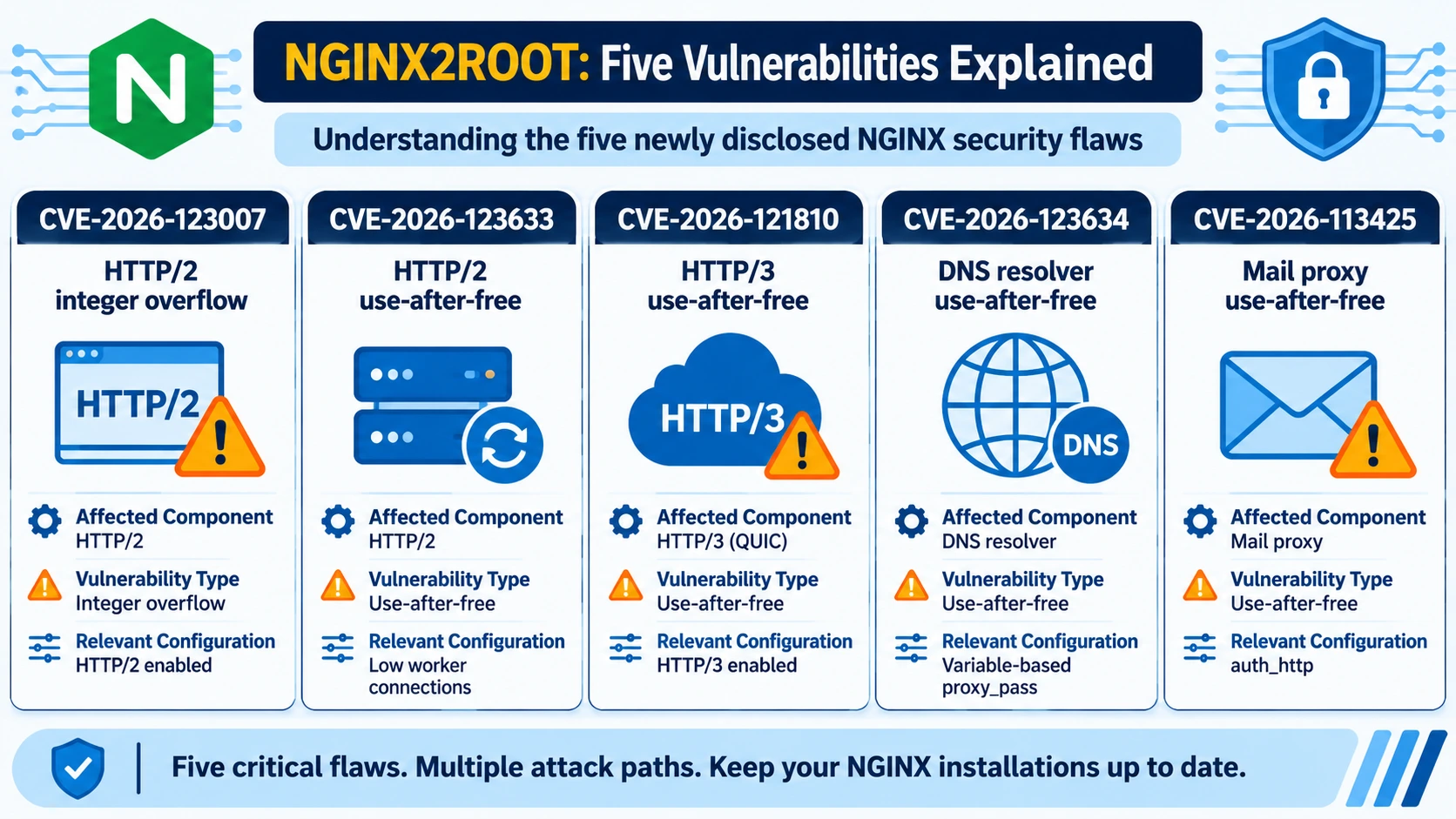
According to Cloudflare, the five vulnerabilities are independent. Each affects a different part of NGINX and requires specific configuration conditions.
The five disclosed vulnerabilities
CVE identifier | Vulnerability type | Affected configuration |
|---|---|---|
CVE-2026-123007 | Integer overflow and out-of-bounds heap read/write | HTTP/2 enabled |
CVE-2026-123633 | Use-after-free | HTTP/2, upstream proxying and low worker connection availability |
CVE-2026-121810 | Use-after-free | HTTP/3 (QUIC) with upstream proxying |
CVE-2026-123634 | Use-after-free | Resolver, variable-based proxy_pass and subrequests |
CVE-2026-113425 | Use-after-free | Mail proxy using proxy and auth_http configurations |
F5 assigned each vulnerability a High severity rating under CVSS 3.1, with a score of 8.1, and a Critical rating under CVSS 4.0, with a score of 9.2.
Cloudflare also explains that successful code execution depends on additional conditions, including disabling or bypassing Address Space Layout Randomization (ASLR).
Why these vulnerabilities matter
Memory corruption vulnerabilities can cause software to access memory incorrectly, potentially resulting in crashes or unintended execution.
Four of the five NGINX vulnerabilities involve a use-after-free condition. This occurs when a program continues using a memory object after another part of the program has already released it.
The remaining vulnerability involves an integer overflow in HTTP/2 flow-control accounting, which can lead to an out-of-bounds memory operation.
The Most Significant Risk: HTTP/2 Flow-Control Vulnerability
Among the five vulnerabilities, Cloudflare identifies CVE-2026-123007 as particularly concerning because it only requires HTTP/2 to be enabled.
HTTP/2 is commonly enabled on modern TLS-enabled web servers, making this vulnerability relevant to a broad range of NGINX deployments.
The flaw originates in how NGINX manages HTTP/2 flow-control windows.
HTTP/2 uses flow control to regulate how much response data a server can send. It maintains limits at both the connection and individual stream levels.
A client can send a WINDOW_UPDATE frame to increase the available sending window. NGINX checks that the window does not exceed the protocol's maximum permitted value.
However, Cloudflare discovered that another part of the code could increase the window when previously queued data frames were removed following stream cancellation.
This refund operation did not apply the same maximum-value check.
As a result, carefully timed requests could push the connection window beyond its permitted limit. Subsequent calculations could then interpret the value incorrectly, eventually creating an invalid memory buffer.
This condition can lead to an out-of-bounds memory operation.
Why the vulnerability remained unnoticed
The problematic code had existed since NGINX introduced HTTP/2 support in version 1.9.5 in 2015.
Cloudflare identifies two reasons why the issue was difficult to detect:
The individual code operations appeared correct when examined separately.
Traditional testing focused on detecting crashes could miss the invalid internal state because reaching the crash condition required substantial traffic.
The research explains that known attack demonstrations require a very large amount of HTTP/2 traffic over a single connection.
Rapid7 estimated approximately 128 GB of total HTTP/2 traffic for its demonstrated attack approach. This is an estimate for that specific method, not a confirmed minimum requirement for every possible exploit.
This unusual traffic pattern could also provide defenders with a potential detection signal.
How the Other Four NGINX Vulnerabilities Work
While CVE-2026-123007 involves HTTP/2 flow-control accounting, the remaining four vulnerabilities share a common memory-management problem.
CVE-2026-123633: HTTP/2 connection management
This vulnerability involves how NGINX manages connection slots when its available worker connections become limited.
NGINX can close reusable connections to free resources when connection availability becomes low.
However, under specific HTTP/2 conditions, a connection containing an active request could incorrectly remain marked as reusable.
When NGINX attempted to free a connection slot, it could close the connection that the active request still depended on.
The request-processing code could then continue using memory that had already been released.
CVE-2026-121810: HTTP/3 and QUIC connection handling
The HTTP/3 vulnerability follows a related pattern but affects NGINX's QUIC implementation.
The problem occurs during stream creation and connection-slot management.
Under specific conditions, NGINX could incorrectly treat a connection as reusable while a new stream was being created.
A subsequent connection-management operation could close the connection while the request was still active, resulting in a use-after-free condition.
CVE-2026-123634: DNS resolver memory management
This vulnerability affects configurations that combine:
The NGINX resolver.
Variable-based
proxy_passdestinations.Subrequests generated through features such as
mirroror Server Side Includes (SSI).
The problem occurs when multiple request contexts wait for the same DNS lookup.
When the DNS response arrives, NGINX processes the waiting contexts. Under specific timing conditions, one request can trigger cleanup that releases another context before the resolver attempts to process it.
The resolver then accesses memory that has already been freed.
Cloudflare notes that this vulnerability depends heavily on how the NGINX configuration handles upstream destinations and subrequests.
CVE-2026-113425: Mail proxy authentication handling
The fifth vulnerability affects NGINX mail proxy configurations using auth_http.
The mail proxy maintains connections to both the mail client and the authentication service while processing a login request.
Under specific conditions, a client connection can close while the authentication connection still references the associated session.
If the authentication process subsequently accesses that session, it can use memory that has already been released.
The issue does not require valid login credentials under the conditions described in the research.

A Separate Linux Kernel Vulnerability Raises the Risk
The nginx2root research also identifies a Linux kernel vulnerability beyond the five NGINX flaws.
Xint discovered a use-after-free issue in the kernel's SCTP (Stream Control Transmission Protocol) send path.
The vulnerability has reportedly existed since Linux kernel version 4.15, released in 2018.
The issue involves an SCTP association being moved to another socket while a send operation is waiting. Under the conditions described, the waiting operation can subsequently free the association.
Why does this matter for NGINX?
An attacker who has already gained code execution with the privileges of an NGINX worker could potentially exploit the kernel vulnerability to escalate privileges to root on the host.
Xint demonstrated this escalation from an NGINX instance running inside a Docker container.
This finding is particularly relevant to organisations using containers because containerisation alone should not be treated as protection against host-kernel vulnerabilities.
Cloudflare also notes that some Linux distributions automatically load the SCTP module when a program first opens an SCTP socket. Consequently, systems that do not actively use SCTP may still have the module available.
At the time of Cloudflare's November 20 publication, no kernel fix had been made available. Xint was withholding further technical details until a fix became available.
How Cloudflare Protects Origin Servers
One of the central findings in Cloudflare's analysis concerns the protection provided by its reverse proxy architecture.
Cloudflare explains that its HTTP proxy can shield origin NGINX servers from the most serious HTTP/2 and HTTP/3 vulnerabilities.
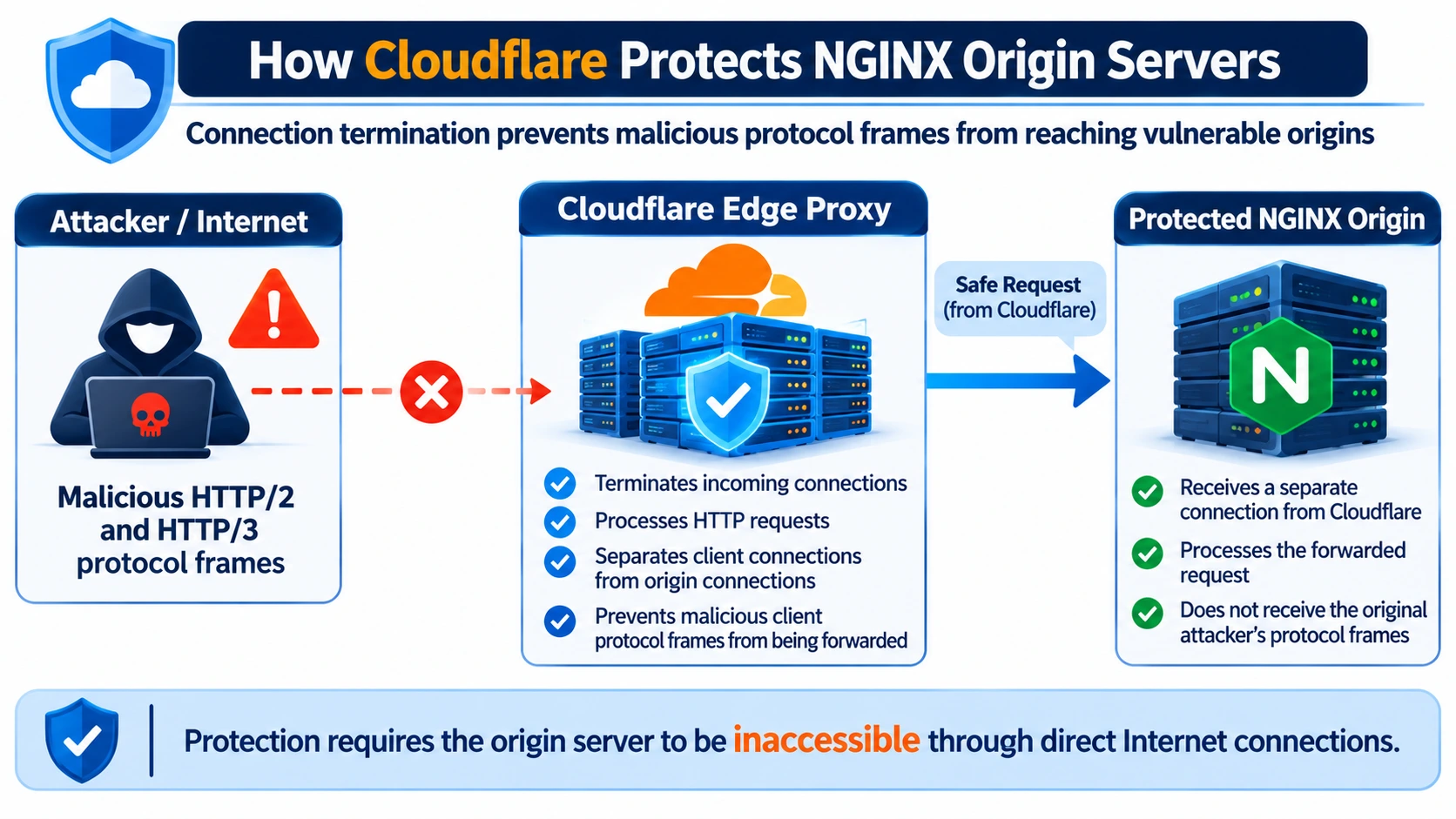
The key mechanism is connection termination.
When a website uses Cloudflare's proxy, the visitor's HTTP/2 or HTTP/3 connection terminates at Cloudflare's edge network.
Cloudflare then creates a separate connection to the origin server.
This means the original client does not communicate directly with the NGINX origin using the same protocol connection.
Instead, Cloudflare processes the incoming traffic and creates a separate request to retrieve the required content from the origin.
Why connection termination matters
The HTTP/2 and HTTP/3 vulnerabilities depend on carefully constructed protocol frames reaching the vulnerable NGINX process.
These include:
WINDOW_UPDATEframes.SETTINGSframes.PINGframes.Partial
HEADERSframes.RST_STREAMframes.
When Cloudflare terminates the visitor's connection at its edge, these client-generated protocol frames are consumed there rather than forwarded directly to the origin.
Cloudflare controls the separate connection to the origin and generates its own protocol traffic.
As a result, attackers cannot directly reproduce the required HTTP/2 and HTTP/3 frame sequences against an origin server protected by the proxy, provided that the origin cannot be accessed directly.
This protection comes from how Cloudflare handles protocol connections, rather than from a traditional Web Application Firewall rule.
Where Cloudflare Protection Does Not Apply
Cloudflare makes an important distinction: its HTTP proxy does not protect every NGINX configuration or deployment.
Some vulnerabilities require traffic types or access paths that do not pass through the HTTP proxy.
The company identifies four important limitations.
Configuration | Protection status |
|---|---|
HTTP/2 vulnerabilities behind Cloudflare's HTTP proxy | Protected when the origin is not directly accessible |
HTTP/3 vulnerability behind Cloudflare's HTTP proxy | Protected when the origin is not directly accessible |
DNS resolver vulnerability | Not fully protected |
NGINX mail proxy vulnerability | Not protected by the HTTP proxy |
Spectrum TCP/UDP applications | Traffic can pass through unmodified |
DNS-only or directly accessible NGINX servers | Not protected by the HTTP proxy |
Direct origin access remains a concern
Even when a website uses Cloudflare, attackers may still bypass the proxy if they discover the origin server's IP address and connect directly.
Cloudflare recommends three approaches to restrict direct origin access.
1. Cloudflare Tunnel
Cloudflare Tunnel allows the origin server to establish an outbound-only connection to Cloudflare without exposing inbound ports to the public Internet.
2. Firewall restrictions
Organisations can configure their network firewalls to accept inbound HTTP and HTTPS traffic only from Cloudflare's published IP ranges.
3. Authenticated Origin Pulls
This mechanism uses mutual TLS authentication. The origin server verifies the client certificate presented by Cloudflare before accepting the connection.
Cloudflare stresses that these protections depend on properly restricting direct access to origin infrastructure.
What Organisations Should Do Now
Despite the protection offered by Cloudflare's proxy, updating vulnerable NGINX installations remains essential.
Cloudflare provides a practical remediation checklist for administrators and security teams.
Step 1: Identify all NGINX installations
Organisations should identify every NGINX deployment, including:
NGINX Open Source installations.
NGINX Plus deployments.
Linux distribution packages.
Container images.
Network appliances running NGINX.
Administrators should inspect their installations and configurations using:
nginx -V
nginx -T
These commands help identify the installed build and active configuration.
Pay particular attention to HTTP/2, HTTP/3, variable-based proxy_pass configurations, resolver settings, subrequests and mail proxy blocks.
Step 2: Install the security updates
Cloudflare recommends updating to the following fixed versions:
Product | Recommended fixed version |
|---|---|
NGINX Open Source stable branch | 1.30.7 |
NGINX Open Source mainline branch | 1.31.9 |
NGINX Plus | 37.0.8.1 or 37.3.0.1 |
Organisations using distribution-provided packages should install the corresponding fixed release from their vendor.
Cloudflare also warns that a configuration reload alone does not replace the running NGINX binary. Administrators must restart NGINX or perform a complete binary upgrade.
Step 3: Verify distribution-specific patches
Some Linux distributions backport security fixes without changing the upstream NGINX version number.
Therefore, administrators should not rely exclusively on the output of nginx -v.
They should compare the complete package version against the relevant vendor security advisory.
Step 4: Restrict direct origin access
Ensure that origin servers can only receive public web traffic through the intended Cloudflare protection layer.
Cloudflare Tunnel, firewall restrictions and Authenticated Origin Pulls are the recommended approaches.
Step 5: Disable affected features if immediate patching is not possible
Cloudflare describes temporary configuration changes that can reduce exposure:
Disable HTTP/2 to address CVE-2026-123007 and CVE-2026-123633.
Remove QUIC listeners and disable HTTP/3 to address CVE-2026-121810.
Use fixed upstream groups rather than variable-based
proxy_passconfigurations to reduce exposure to CVE-2026-123634.Restrict mail proxy listeners to trusted networks to reduce exposure to CVE-2026-113425.
These are temporary mitigation measures, not substitutes for installing the security updates.
Step 6: Review Linux SCTP exposure
For systems that do not require SCTP, Cloudflare describes blocking the SCTP kernel module from loading by adding the following configuration to a file under /etc/modprobe.d/:
install sctp /bin/falseThis is a temporary measure. It does not unload an already loaded module or disable SCTP when it is built directly into the kernel.
Organisations should install the appropriate kernel update when their Linux distribution provides one.
Detection and Monitoring: What Security Teams Should Watch For
Patching is the primary response, but monitoring can also help identify suspicious activity.
Cloudflare highlights several log messages and behavioural indicators associated with the vulnerabilities.
Vulnerability | Potential warning signs |
|---|---|
CVE-2026-123007 | Long-lived HTTP/2 connections receiving unusually large amounts of data |
CVE-2026-123633 | Worker crashes and insufficient worker connection warnings |
CVE-2026-121810 | Worker crashes involving HTTP/3 and upstream proxying |
CVE-2026-123634 |
|
CVE-2026-113425 | Mail proxy worker crashes during client connection resets |
Cloudflare also identifies unexpected programs launched by an NGINX worker as a particularly important security signal.
Security teams can investigate process execution events using Linux auditing tools such as auditd.
However, these indicators are not definitive proof of exploitation. Some messages can also occur under other circumstances, and the absence of a particular log message does not establish that a server is unaffected.
Disclosure Timeline and Current Exploitation Status
The vulnerabilities followed a coordinated disclosure process involving Xint, F5 and the NGINX development team.
The published timeline is as follows:
Date | Event |
|---|---|
October 11, 2026 | Xint discovers the vulnerabilities |
October 16, 2026 | Vulnerabilities reported to F5 through HackerOne |
October 27, 2026 | Reports delivered to the NGINX development team |
November 10, 2026 | Xint completes patch validation |
November 18, 2026 | Public disclosure and release of NGINX 1.30.7 and 1.31.9 |
Cloudflare reported that, as of November 19, none of the five nginx2root vulnerabilities appeared in CISA's Known Exploited Vulnerabilities catalogue.
The company also stated that it had not seen reports of exploitation in the wild at the time of publication.
Xint and Wiz Research had not released their exploits. Rapid7 had published a proof of concept for CVE-2026-123007, which it described as suitable for demonstrating the issue against a freshly started local container.
Cloudflare also warned about fake exploit repositories circulating on GitHub.
What This Means for the Future of Web Server Security
The nginx2root disclosure highlights a broader challenge for organisations that rely on widely deployed open-source infrastructure.
NGINX has been extensively reviewed and used across the industry, yet the research uncovered a flow-control vulnerability that had remained in the codebase for more than a decade.
The findings also demonstrate how relatively small memory-management errors can create significant security consequences when they interact with connection handling, asynchronous operations and protocol implementations.
Cloudflare's analysis highlights the value of defence in depth. Reverse proxies can reduce direct exposure to protocol-level attacks, but they cannot replace software updates, secure configurations or host-level protections.
The separate Linux kernel vulnerability also reinforces the importance of examining the security boundaries between containers and their underlying host systems.
For enterprises, the practical priority is clear: identify affected deployments, apply the available NGINX updates, restrict direct origin access and monitor systems for unusual behaviour.
Cloudflare's research provides a detailed technical explanation of the vulnerabilities, but its central security recommendation remains straightforward: use proxy protection as an additional security layer, not as a replacement for patching.
Source: Cloudflare Blog
About the Author