
AWS Fixes Path Traversal Vulnerability in AutoGluon MultiModal Dataset Tool
AWS has fixed CVE-2026-130638, a path traversal vulnerability in AutoGluon MultiModal's object detection dataset preparation utility. The flaw could let an on-path attacker write files outside the intended extraction directory.
Xcademia Team
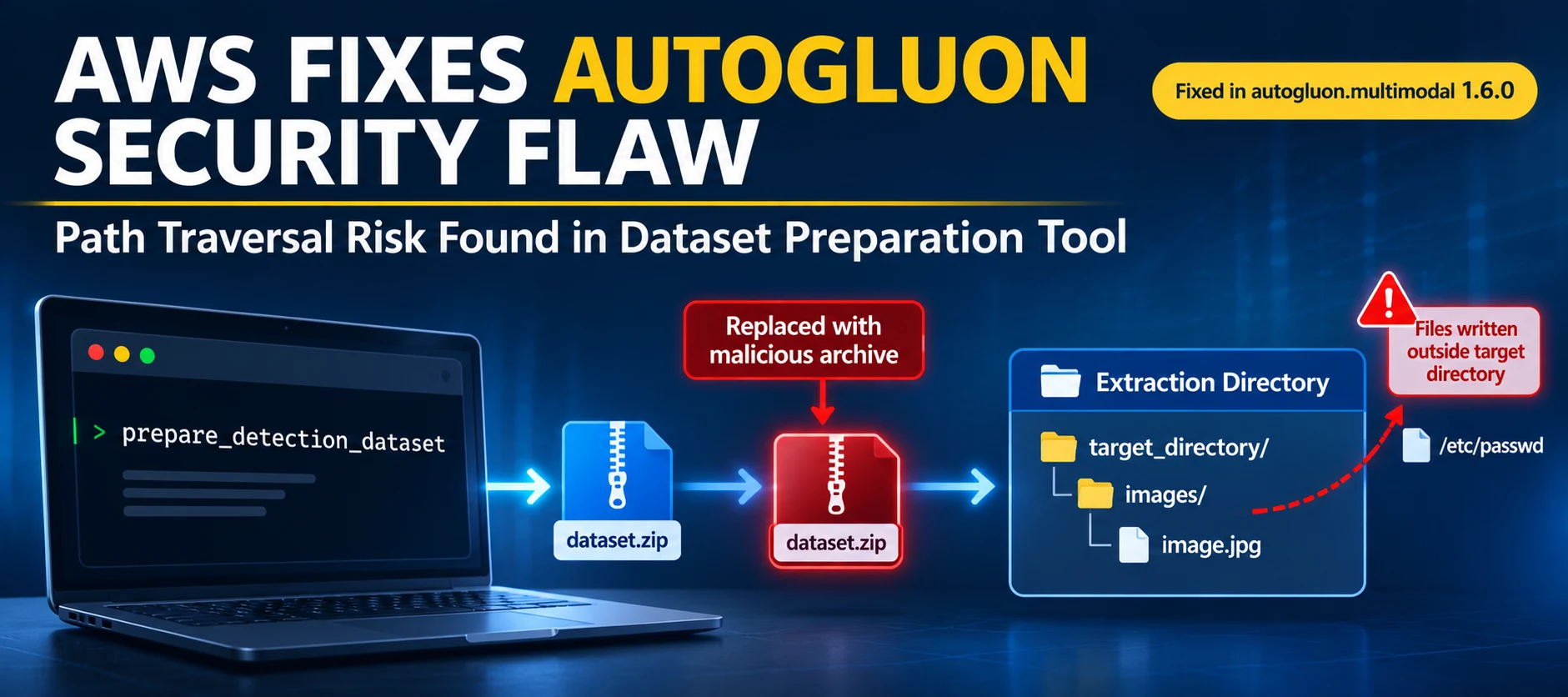
AWS has disclosed a path traversal vulnerability in the object detection dataset preparation tool included with AutoGluon MultiModal, its open-source machine learning framework.
Tracked as CVE-2026-130638, the issue affects versions earlier than 1.6.0. The vulnerable utility downloaded dataset archives over plaintext HTTP and extracted their contents without validating the archive members.
According to AWS, an attacker positioned on the network path could intercept or influence the download and substitute a specially crafted archive. When the utility extracted that archive, the malicious entries could write files outside the intended output directory, using the privileges of the user running the tool.
AWS published the disclosure on November 18, 2026, under security bulletin 2026-188-AWS, classifying it as Important (requires attention).
The company has addressed the issue in autogluon.multimodal version 1.6.0 and recommends upgrading to the latest version.
Which AutoGluon Component Is Affected?
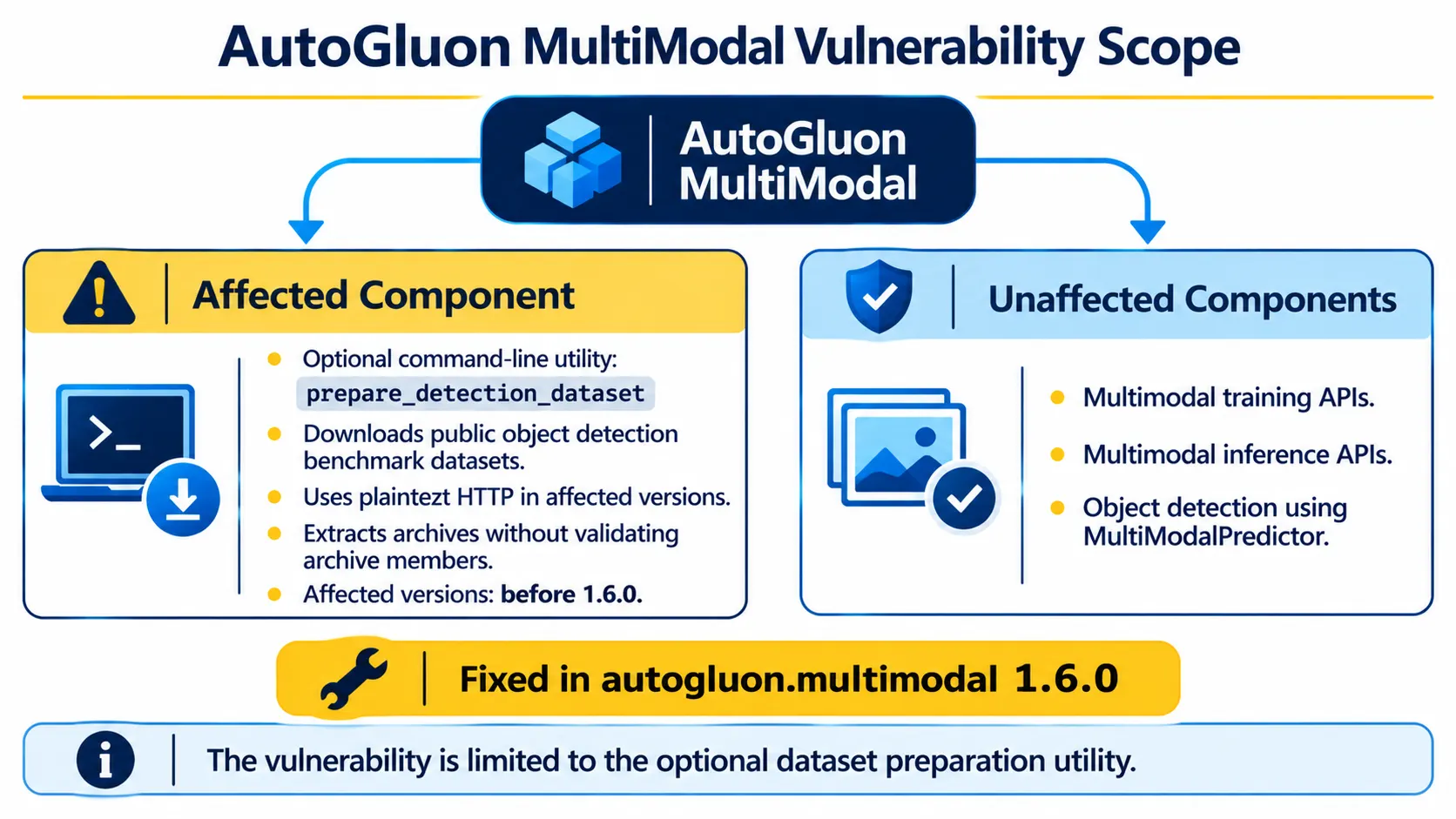
The vulnerability is limited to an optional command-line utility called:
prepare_detection_dataset
This utility downloads public benchmark datasets used for object detection tasks. The affected versions downloaded dataset archives over unencrypted HTTP and extracted them without checking whether archive members contained unsafe paths.
Importantly, AWS has clarified that the vulnerability does not affect the framework's main multimodal training and inference APIs.
The following components are not affected:
AutoGluon MultiModal training APIs.
AutoGluon MultiModal inference APIs.
Object detection through
MultiModalPredictor.
These APIs do not use the vulnerable dataset preparation utility.
This distinction matters for developers and organisations using AutoGluon. The bulletin does not identify the entire framework or its object detection capabilities as vulnerable. The issue concerns the separate utility used to download and prepare public benchmark datasets.
Affected version
Component | Version status |
|---|---|
| Affected |
| Fix available |
AutoGluon MultiModal training and inference APIs | Not affected by this issue |
How CVE-2026-130638 Could Allow Files to Be Written Outside the Output Directory
The vulnerability involves two weaknesses in the dataset preparation process.
First, the utility downloaded dataset archives over plaintext HTTP. Unlike HTTPS, plaintext HTTP does not provide transport encryption and server authentication. This can allow an attacker positioned along the network path to interfere with the download.
Second, the utility extracted archive contents without validating their member paths.
Archive files can contain directory and file paths that determine where their contents are written during extraction. If those paths are not checked, specially crafted archive entries can attempt to escape the directory intended for extraction.
In this case, AWS says an on-path attacker could substitute a crafted dataset archive. When the vulnerable utility extracted it, the archive could write files outside the intended output directory.
The resulting file writes would occur with the privileges of the user running the utility. Therefore, the potential impact depends on the permissions available to that user.
The attack sequence
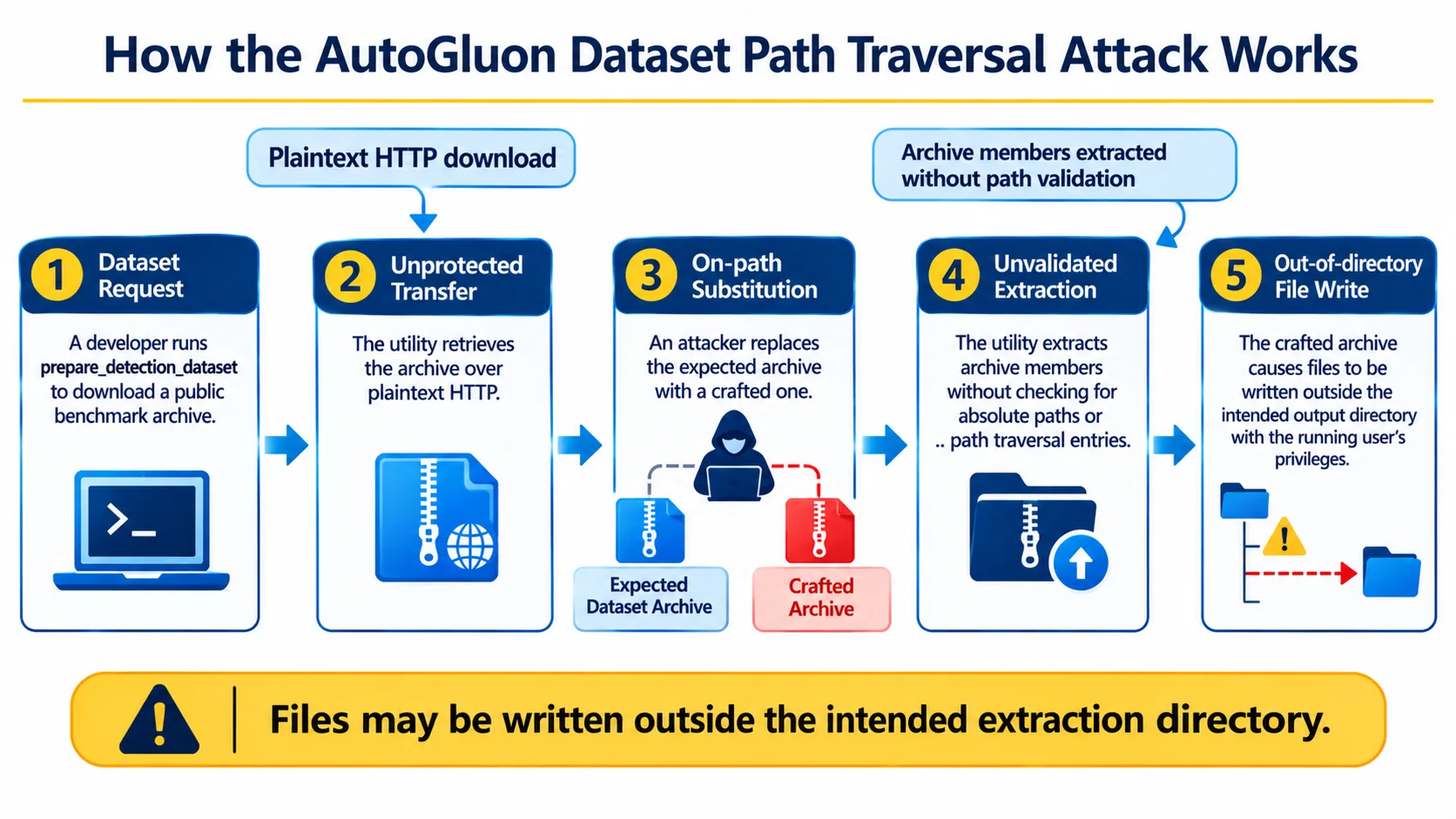
The process described in the AWS bulletin can be represented in five stages:
Dataset download begins: A user runs
prepare_detection_datasetto obtain a public object detection benchmark dataset.Plaintext HTTP request: The utility downloads the archive without HTTPS transport protection.
Network interception: An attacker with an on-path network position substitutes a crafted archive for the expected dataset.
Unsafe archive extraction: The utility extracts archive members without validating their paths.
Files written outside the target directory: Crafted archive paths can cause files to be written beyond the intended output location, with the privileges of the running user.
The vulnerability does not mean that every dataset download is malicious. The attack described by AWS requires an attacker with the ability to interfere with the network transfer and provide a crafted archive.
Why Archive Path Validation Matters
Archive extraction tools need to handle file paths carefully, particularly when archives originate from external sources.
A malicious archive can contain entries that use absolute paths or path traversal sequences such as .. to refer to locations outside the directory selected for extraction.
If an application extracts those entries without appropriate validation, the resulting files may be written to unintended locations.
AWS specifically identifies the absence of archive-member validation as part of the problem in prepare_detection_dataset.
The bulletin does not disclose specific malicious archive samples, filenames, or targeted file locations. The announcement did not disclose additional details.
The issue also highlights why secure download and extraction practices need to work together. Using a trusted source for a dataset does not remove the need to protect the download process and validate the archive before writing its contents to disk.
AWS Releases AutoGluon MultiModal 1.6.0 Fix
AWS states that the vulnerability has been addressed in:
autogluon.multimodal 1.6.0
The company recommends upgrading to the latest version. It also advises developers maintaining forked or derivative code to incorporate the new fixes.
For teams using the affected utility, the priority is to move away from versions earlier than 1.6.0 and ensure that any locally maintained implementation includes the relevant security changes.
The bulletin does not provide a separate patched version for each earlier release. Version 1.6.0 is the release explicitly identified as addressing the vulnerability.
Workaround for Users Who Cannot Upgrade
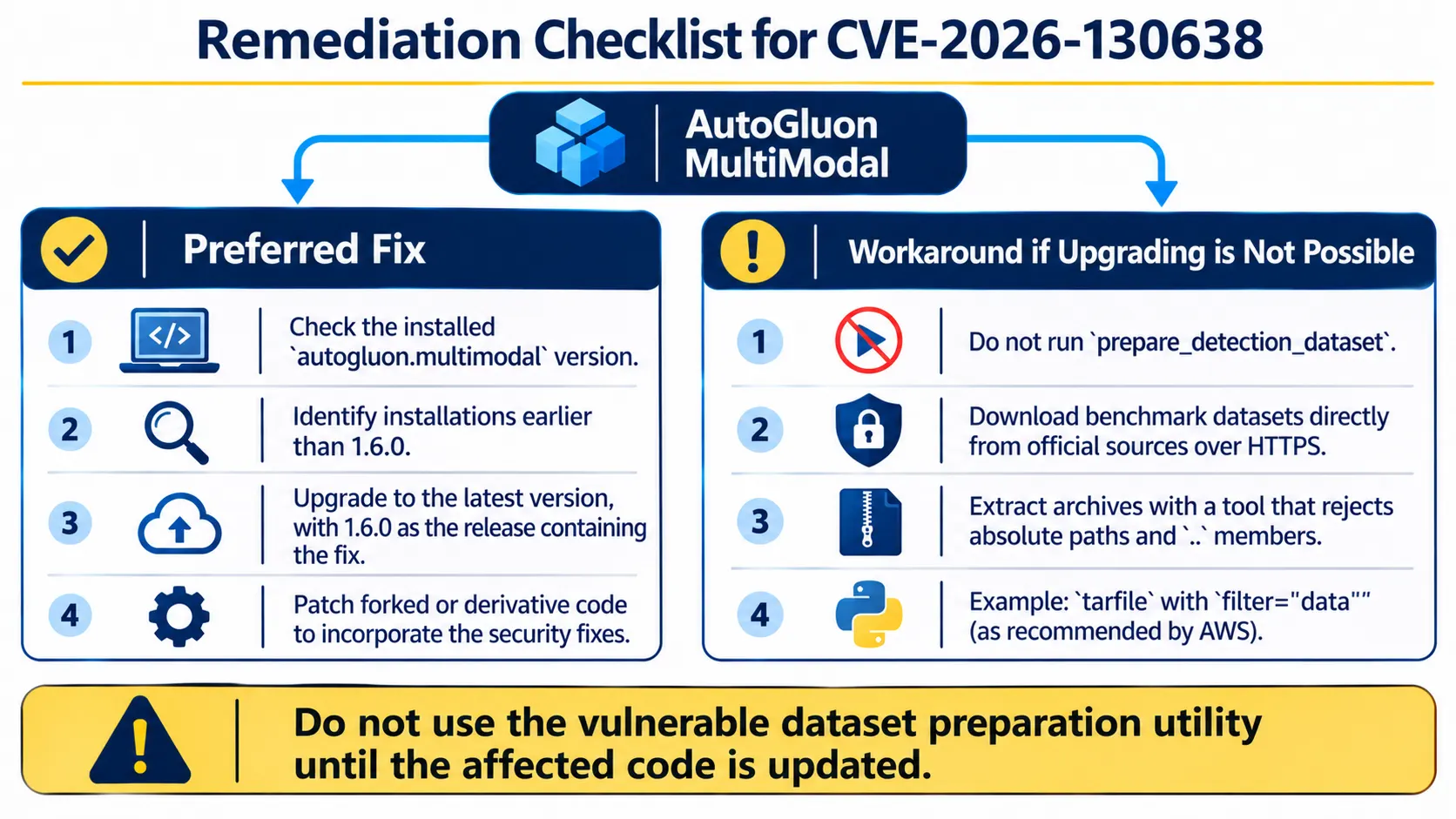
AWS provides an alternative for users who cannot immediately move to version 1.6.0.
The company recommends not running the prepare_detection_dataset utility until the affected code can be updated.
Instead, users should:
Download datasets directly from their official sources over HTTPS.
Extract the downloaded archives using a tool that rejects absolute paths and
..path traversal members.
AWS gives Python's tarfile module with filter="data" as an example of an extraction approach that applies these checks.
The workaround is:
Avoid the vulnerable dataset preparation utility.
Obtain the dataset through its official HTTPS source.
Use an extraction tool that rejects unsafe archive paths.
This is the workaround specified by AWS for users who cannot upgrade immediately.
What Developers and Machine Learning Teams Should Review
Organisations using AutoGluon MultiModal should determine whether their development environments or dataset preparation workflows rely on the affected utility.
The AWS bulletin supports several practical checks:
Review installed versions: Identify whether environments use
autogluon.multimodalversions earlier than1.6.0.Check dataset preparation workflows: Determine whether scripts or command-line processes invoke
prepare_detection_dataset.Upgrade affected installations: Move to the latest version and ensure the fix is included.
Review customised implementations: Check forks and derivative code for the same unsafe download and extraction behaviour.
Use the documented workaround where necessary: Avoid the affected utility and download datasets over HTTPS, extracting them with path validation.
The bulletin does not state that the vulnerability has been exploited in the wild or provide details about affected users or organisations. The announcement did not disclose additional details.
For teams that use only the AutoGluon MultiModal training and inference APIs, AWS explicitly states that those APIs do not use the vulnerable utility and are not affected by this issue.
The key remediation decision is therefore to identify whether the optional dataset preparation tool is being used, rather than treating every AutoGluon MultiModal workload as vulnerable.
What the Disclosure Means for AutoGluon Users
CVE-2026-130638 highlights a security risk in the handling of externally downloaded machine learning datasets.
The issue was not in the model training or inference process. It arose in an optional utility that downloaded public benchmark archives over plaintext HTTP and extracted them without validating their contents.
For developers, the immediate steps are to check the installed package version, update to 1.6.0 or later, and review any forked implementations. If an upgrade is not possible, AWS advises avoiding the affected utility and using HTTPS downloads with safe archive extraction instead.
The distinction between the vulnerable utility and the unaffected MultiModal APIs is central to understanding the disclosure and applying the fix appropriately.
Source: AWS Security Bulletins
About the Author