
US Justice Department Disrupts North Korea's Crypto Theft Network, Seizes $1.2 Billion in Stolen Assets
The US Department of Justice has disrupted North Korean cryptocurrency theft operations, seized FaceStealer infrastructure and secured court-authorised action against more than $1.2 billion in stolen Binance assets.
Xcademia Team

The US Department of Justice (DOJ) has announced coordinated law enforcement actions targeting North Korea's cryptocurrency theft operations, including the disruption of cloud-based infrastructure associated with a social engineering campaign known as FaceStealer.
The announcement, published on November 12, 2026, highlights two major developments. First, US authorities disrupted infrastructure used in FaceStealer attacks, a campaign responsible for stealing more than $400 million in cryptocurrency over the previous 18 months. Second, the department obtained court-authorised seizure and restraint of more than $1.2 billion in cryptocurrency stolen from the Binance exchange.
According to the DOJ, the operations involved North Korean cyber actors using deceptive video meetings, manipulated identities, deepfake technology and malware to compromise individuals and organisations.
The announcement also highlights an expanding threat to open-source software developers, suggesting that these operations are no longer limited to cryptocurrency theft. They may also provide attackers with opportunities to compromise software development environments and supply chains.
These developments demonstrate the growing connection between cryptocurrency crime, artificial intelligence-enabled deception and national security threats.
DOJ Disrupts the FaceStealer Cybercrime Campaign
One of the major actions announced by the DOJ concerns FaceStealer, a social engineering operation attributed to North Korean hackers.
The campaign uses deceptive online meetings to build trust with potential victims before delivering malicious software.
Rather than relying entirely on traditional phishing emails or suspicious attachments, attackers exploit familiar communication platforms and professional relationships.
According to the DOJ, the campaign has resulted in more than $400 million in cryptocurrency theft over the previous 18 months.
US authorities also disrupted cloud-based infrastructure used by the attackers. The FBI seized more than 900 webcam videos of FaceStealer victims under a federal warrant.
The investigation identified several names associated with the North Korean hacking activity, including:
Sapphire Sleet
UNC1069
Dangerous Password
CryptoCore
Advanced Persistent Threat 38 (APT38)
BlueNoroff
Stardust Chollima
The DOJ described the operation as targeting cryptocurrency and Web3 professionals, with increasing attention directed towards people involved in maintaining open-source software.
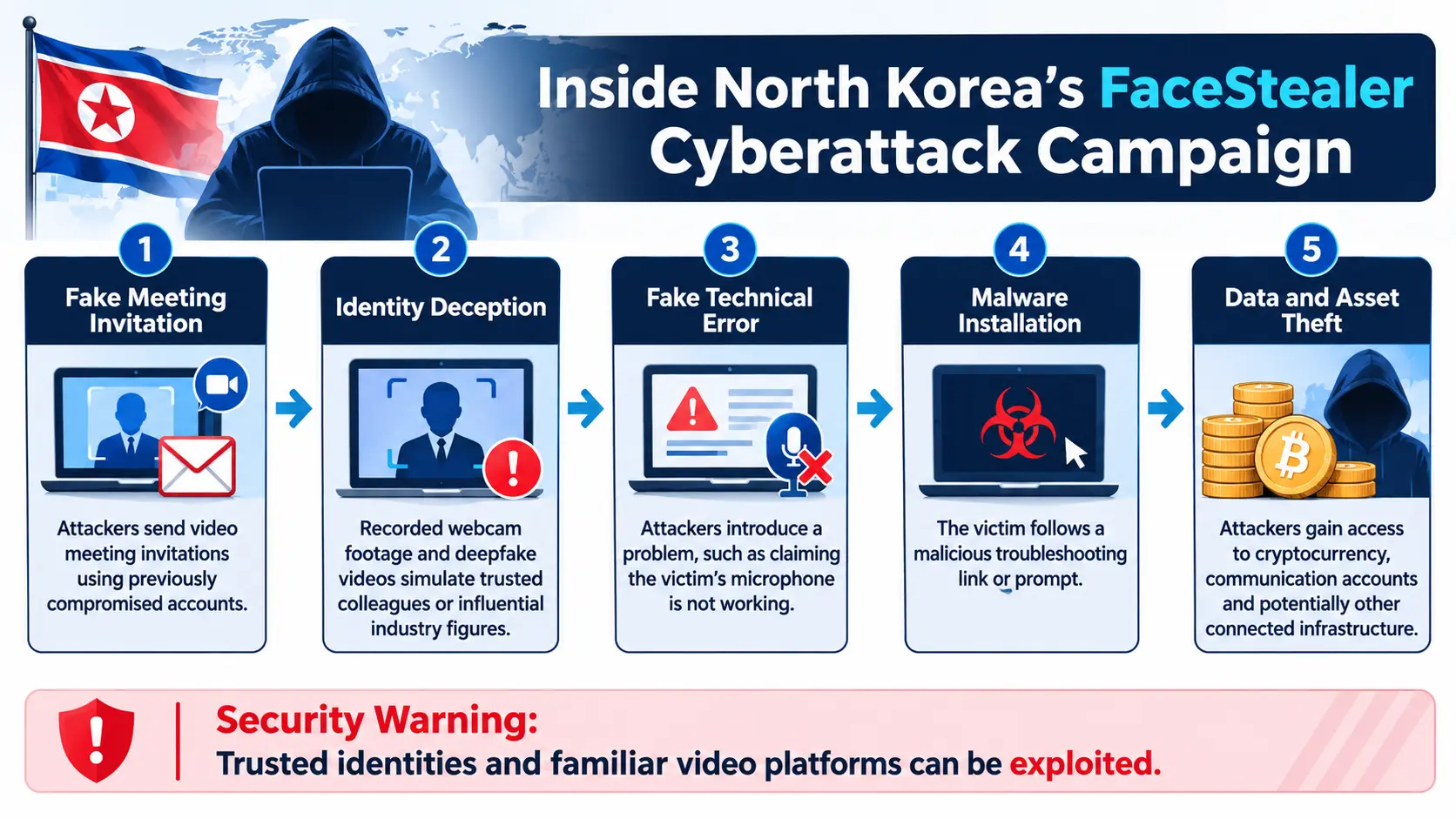
How the FaceStealer Attack Works
FaceStealer demonstrates how attackers can combine social engineering with deepfake technology to make fraudulent interactions appear legitimate.
The attack begins with a video meeting invitation sent through an account previously compromised by the attackers.
Once the target joins, hackers use recorded webcam footage of people already known to the victim. This creates the impression that trusted colleagues or professional contacts are participating in the meeting.
The attackers also use AI-generated deepfake videos featuring well-known and influential individuals, particularly those connected to cryptocurrency and Web3 industries.
This approach makes it more difficult for victims to recognise that they are interacting with fraudulent participants.
The Fake Technical Problem
After establishing trust, attackers introduce a fabricated technical issue.
For example, they might claim that the victim's microphone is not working or that other participants cannot hear them.
The attackers then provide a link or prompt that supposedly resolves the problem.
However, the proposed fix secretly installs malware on the victim's computer.
Once the device is compromised, attackers can potentially:
Steal cryptocurrency.
Access communication accounts.
Exploit the victim's access to other computer infrastructure.
Collect contact information and personal communications.
Target additional people through the compromised victim's professional and personal networks.
The DOJ also reported cases where cryptocurrency theft and communication account hijacking occurred several months to more than a year after the original compromise.
This delayed activity makes the campaign particularly concerning because victims may not immediately connect suspicious activity with an earlier video meeting.
Open-Source Software Developers Become a New Target
An important aspect of the FaceStealer campaign is its expansion beyond cryptocurrency holders.
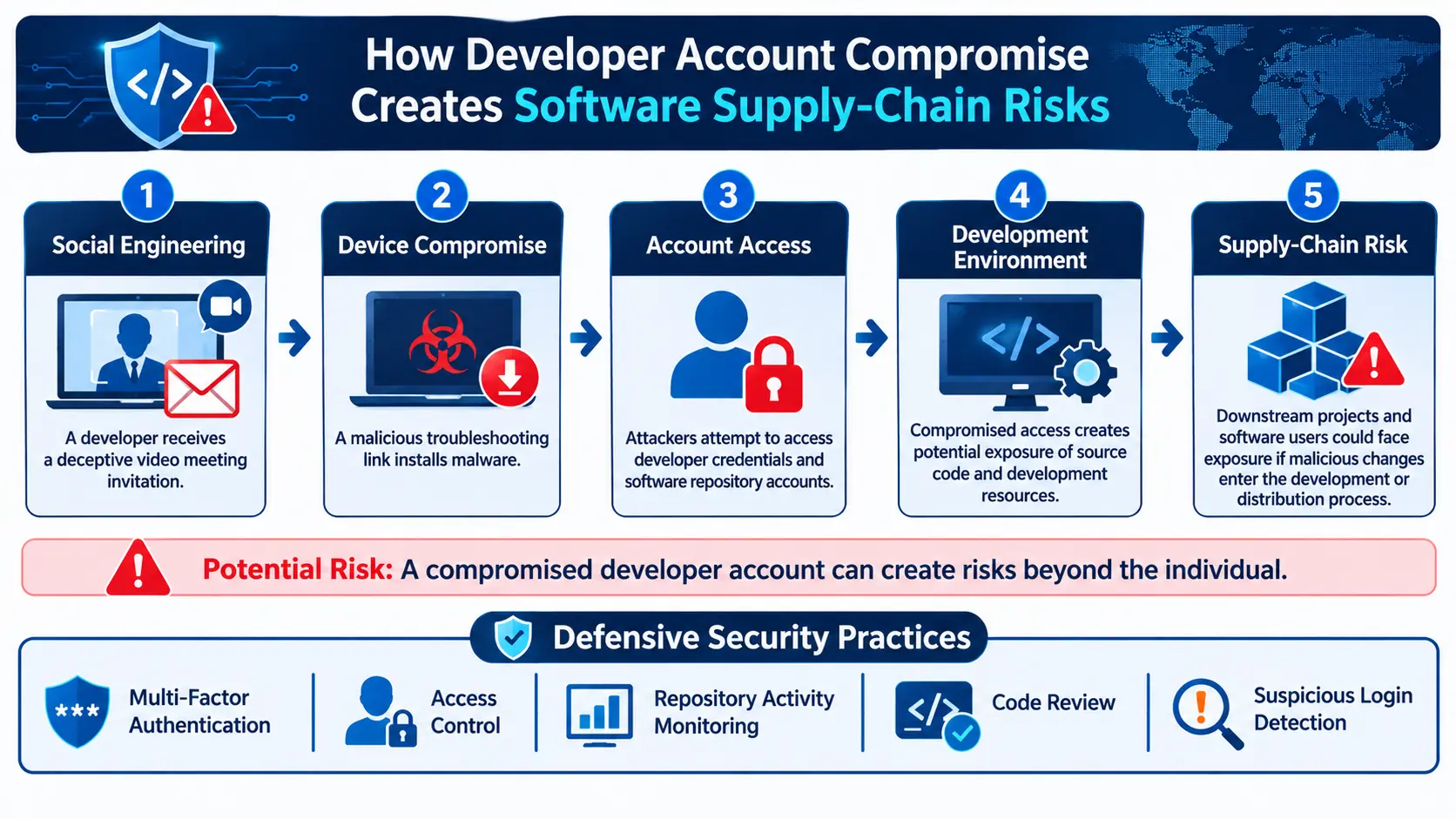
According to the DOJ, North Korean hackers have increasingly targeted individuals who develop and maintain open-source software.
These individuals may have access to valuable development resources, including software repositories, source code and project communication accounts.
By compromising a developer's device or repository account, attackers could potentially create opportunities for software supply-chain attacks.
A software supply-chain attack occurs when attackers compromise software development, distribution or update processes to affect downstream users and organisations.
This makes developers attractive targets because their access may extend beyond their personal devices to shared development environments and software projects.
The DOJ stated that the targeting appears calculated to enable software supply-chain attacks.
However, the announcement did not identify specific compromised repositories, software packages or downstream organisations.
The FBI's seizure of more than 900 webcam videos also highlights the extent of the surveillance and deception involved in the FaceStealer operation.
United States Department of Justice
Why This Matters for the Open-Source Ecosystem
Open-source projects depend on collaboration between developers, maintainers and contributors.
A compromised developer account could create risks beyond the individual victim.
For organisations that depend on external software packages, this development reinforces the importance of:
Securing developer accounts and repository access.
Verifying unexpected collaboration invitations.
Reviewing unusual changes to source code.
Treating unsolicited troubleshooting links with caution.
Monitoring access to development environments.
Investigating suspicious account activity.
These are general defensive recommendations based on the risks described in the announcement, not additional security measures specifically announced by the DOJ.
US Authorities Target More Than $1.2 Billion in Stolen Binance Cryptocurrency
The DOJ announcement also covers a separate cryptocurrency theft attributed to North Korean military members identified by the FBI as TraderTraitor.
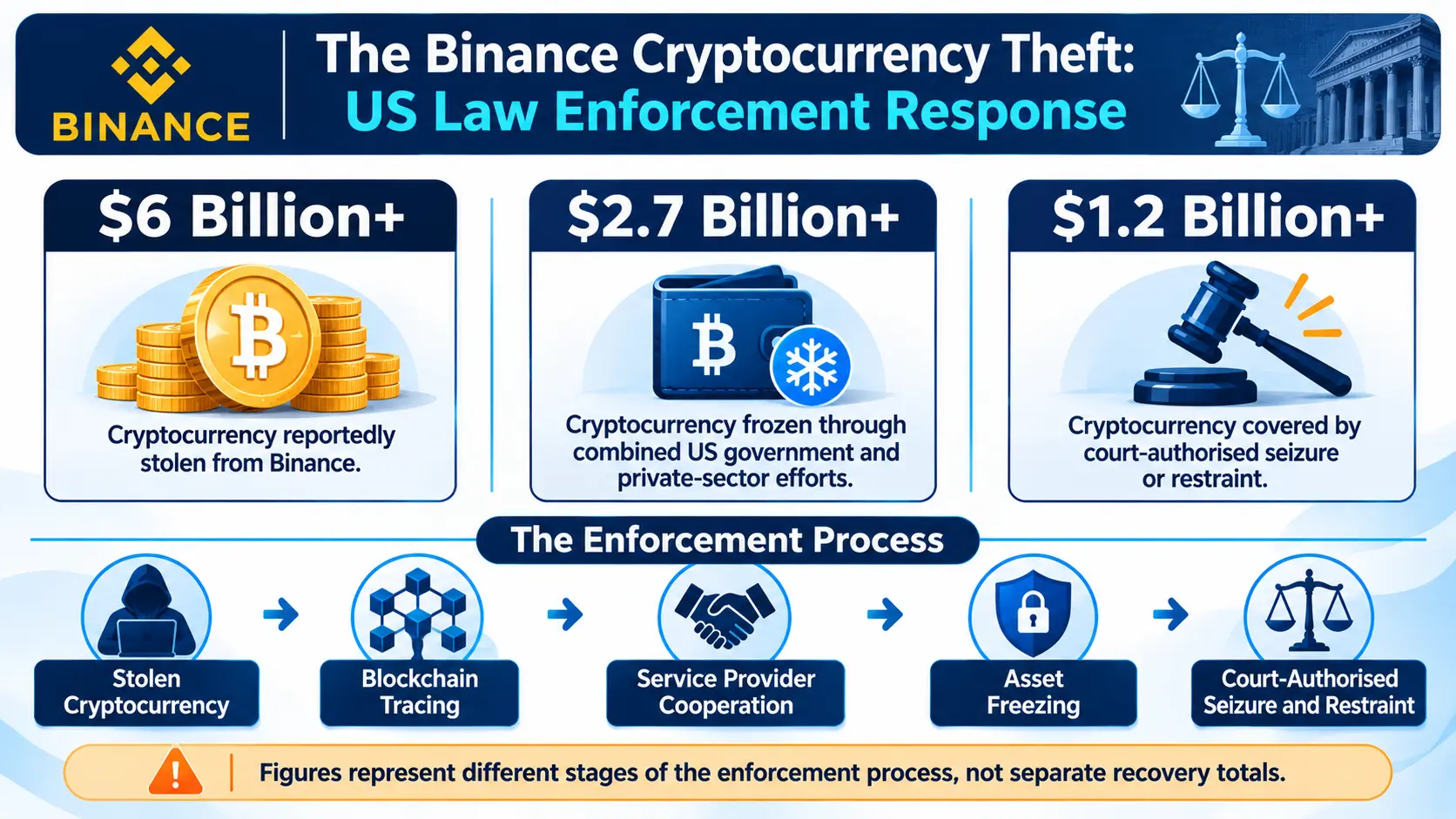
According to the department, the attackers stole more than $6 billion worth of virtual assets from Binance on or around October 29, 2026.
Following the theft, US authorities worked with cryptocurrency service providers and other law enforcement partners to trace and restrict the movement of the stolen assets.
The reported results include:
More than $6 billion: Cryptocurrency reportedly stolen from Binance.
More than $2.7 billion: Assets frozen through combined US government and private-sector efforts.
More than $1.2 billion: Assets covered by court-authorised seizure or restraint obtained by the DOJ.
These figures represent different stages of the recovery and enforcement process. They should not be interpreted as three separate amounts of recovered cryptocurrency.
The department's announcement confirms that the effort to trace, freeze, seize and forfeit the assets remains ongoing.
United States Department of Justice+1
How Authorities Are Tracking the Stolen Cryptocurrency
Cryptocurrency transactions can be traced through blockchain records, but tracing funds does not automatically mean authorities can recover them.
The DOJ reported that TraderTraitor actors continued attempting to launder stolen assets through several methods, including:
Cryptocurrency bridges
Cryptocurrency mixers
Digital asset exchanges
These services can complicate efforts to identify where stolen funds move and which entities ultimately control them.
To address this activity, the FBI, US Secret Service and Internal Revenue Service Criminal Investigation division have coordinated efforts to identify suspicious cryptocurrency addresses.
The FBI also issued a Cyber Alert urging virtual asset service providers to block transactions involving addresses associated with the stolen Binance assets.
This cooperation between government agencies and private-sector cryptocurrency providers is central to the ongoing investigation.
How AI and Deepfake Technology Are Changing Social Engineering
The FaceStealer campaign highlights an important development in modern cybercrime: the use of artificial intelligence to make impersonation more convincing.
Traditional social engineering often relies on fake emails, fraudulent websites and messages designed to create urgency.
FaceStealer adds another layer by exploiting the visual and social trust people place in video communication.
According to the DOJ, attackers used prerecorded footage and deepfake videos to simulate trusted individuals during online meetings.
This creates several challenges for organisations.
Identity verification becomes more difficult. Seeing a familiar face during a video call is not necessarily sufficient proof that the person is genuine.
Professional relationships can be exploited. Attackers can use compromised accounts and known contacts to make fraudulent invitations appear legitimate.
Technical troubleshooting can become an attack vector. A seemingly harmless request to fix an audio or video problem can become the entry point for malware.
The consequences can extend beyond the initial victim. Compromised communication accounts and contact lists can help attackers reach additional individuals.
The broader industry implication is that organisations need to consider identity verification across digital communication channels, rather than relying entirely on familiar names, faces or meeting invitations.
This is particularly relevant to cryptocurrency companies, Web3 organisations and open-source development communities.
The announcement does not disclose the specific AI models or tools used to generate the deepfakes.
What Businesses and Individuals Can Learn From the FaceStealer Campaign
The DOJ announcement provides an important reminder that cybersecurity risks can begin with seemingly ordinary professional interactions.
Businesses and individuals working in cryptocurrency, software development and technology should pay attention to several security practices.
Verify Unexpected Video Meeting Invitations
Do not automatically trust a meeting invitation simply because it comes from a familiar account.
Verify unexpected requests through another trusted communication channel, especially when the meeting involves sensitive work or account access.
Avoid Unverified Troubleshooting Links
Be cautious when someone asks you to install software, run commands or follow a link to resolve an unexpected video or audio problem.
Use official software support channels rather than instructions provided by an unverified meeting participant.
Protect Developer and Repository Accounts
Software developers should protect accounts that provide access to source code and development environments.
Use strong authentication, restrict unnecessary permissions and review unusual account activity.
Monitor Communication Accounts
A compromised account can expose more than the original victim's information.
Organisations should monitor unusual login activity, unexpected messages and suspicious changes to account settings.
Establish Incident Response Procedures
Businesses should have clear procedures for reporting suspected malware infections, compromised accounts and cryptocurrency theft.
Early reporting can help security teams investigate suspicious activity and limit further exposure.
These practices are general security recommendations. The DOJ announcement does not claim that implementing them guarantees protection against FaceStealer or similar attacks.
FBI Resources and the Ongoing Investigation
Alongside the infrastructure disruption, the FBI published a report explaining the FaceStealer operation in greater detail.
The report includes information about how the campaign works, recommended protective practices and steps victims can take following a potential compromise.
The FBI also established a dedicated resource website:
Meanwhile, investigations into the Binance cryptocurrency theft continue.
The DOJ, FBI, US Secret Service and IRS Criminal Investigation division are working with virtual asset service providers to trace and pursue the stolen funds.
The department has confirmed that the process of tracing, freezing, seizing and forfeiting the cryptocurrency remains ongoing.
Additional details about the full recovery of the stolen assets were not disclosed in the announcement.
What This Development Means for the Cybersecurity Industry
The DOJ's announcement highlights a broader industry shift towards more sophisticated cybercrime operations that combine social engineering, identity deception, malware and cryptocurrency laundering.
Three developments deserve particular attention.
First, digital trust is becoming a major security concern. Deepfake technology can make fraudulent video interactions more convincing, increasing the importance of independent identity verification.
Second, software developers are becoming important targets. Attacks against people who maintain open-source projects can create risks that extend beyond individual devices and accounts.
Third, cryptocurrency investigations increasingly require cross-sector cooperation. The reported Binance response demonstrates the role of law enforcement agencies and private-sector service providers in identifying and restricting suspicious digital assets.
For enterprises, this could mean giving greater attention to identity security, developer access management and incident response procedures.
For cryptocurrency platforms, the announcement reinforces the importance of cooperation with investigators when suspicious transactions are identified.
The case also demonstrates that disrupting cybercrime requires more than identifying attackers. Investigators must work to interrupt the infrastructure, financial channels and access methods that enable these operations.
Conclusion
The US Justice Department's latest actions against North Korean cryptocurrency theft operations highlight the growing complexity of financially motivated cybercrime.
The disruption of FaceStealer infrastructure addresses a campaign that reportedly stole more than $400 million through social engineering and deepfake-assisted deception.
Separately, the court-authorised seizure and restraint of more than $1.2 billion in stolen Binance assets represents a significant enforcement action, although the broader recovery effort remains ongoing.
Perhaps the most important development is the targeting of open-source software developers. It demonstrates how attacks initially associated with cryptocurrency theft can also create potential risks for the wider software ecosystem.
As AI-assisted impersonation and cryptocurrency-related cybercrime continue to develop, organisations will need to pay closer attention to digital identity, access security and the protection of software development environments.
Source: US Department of Justice
About the Author