
Oracle Releases 655 Security Patches, Including Critical CVSS 10.0 Vulnerabilities
Oracle's November 2026 Critical Security Patch Update delivers 655 security patches across enterprise products, addressing critical vulnerabilities in WebLogic Server, Access Manager, Fusion Middleware and other platforms.
Xcademia Team

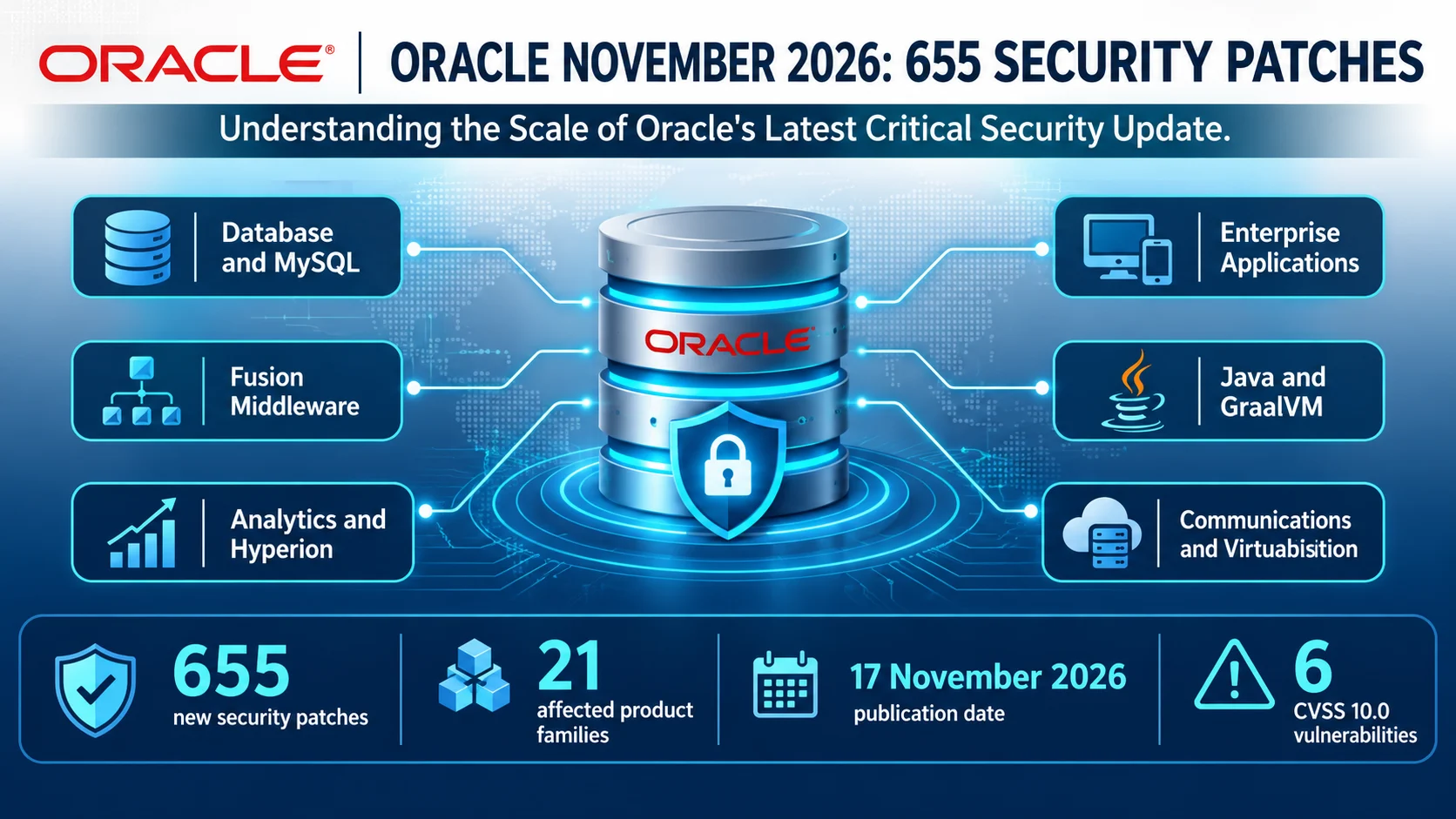
Oracle has released its November 2026 Critical Security Patch Update (CSPU), delivering 655 new security patches across its enterprise software portfolio. The update addresses vulnerabilities affecting Oracle Database, Fusion Middleware, WebLogic Server, Java SE, E-Business Suite, Hyperion, MySQL and several other product families.
Published on 17 November 2026, the advisory includes multiple critical vulnerabilities, with six receiving the maximum CVSS 3.1 base score of 10.0. Several of these flaws are remotely exploitable without authentication, increasing their significance for organisations operating exposed enterprise systems.
The update highlights the importance of maintaining supported Oracle software versions and applying security patches promptly, particularly across business-critical infrastructure.
What Is Included in Oracle's November 2026 Security Update?
Oracle's Critical Security Patch Update programme provides targeted security fixes that complement its regular quarterly cumulative Critical Patch Updates.
The November advisory contains 655 new security patches covering vulnerabilities in Oracle-developed software and third-party components included in Oracle products.
The affected product families span database platforms, enterprise applications, middleware, development environments, communications infrastructure and virtualisation technologies.
Some of the major product families covered include:
Oracle Database Server
Oracle Application Express (APEX)
Oracle Autonomous Health Framework
Oracle REST Data Services
Oracle E-Business Suite
Oracle Fusion Middleware
Oracle WebLogic Server
Oracle Access Manager
Oracle Analytics
Oracle Hyperion
Oracle Java SE
Oracle MySQL
Oracle PeopleSoft
Oracle Siebel CRM
Oracle Supply Chain
Oracle Virtualization
The breadth of this update makes it relevant to organisations using Oracle technologies across multiple business and infrastructure environments.
Six Vulnerabilities Receive the Maximum CVSS Score of 10.0
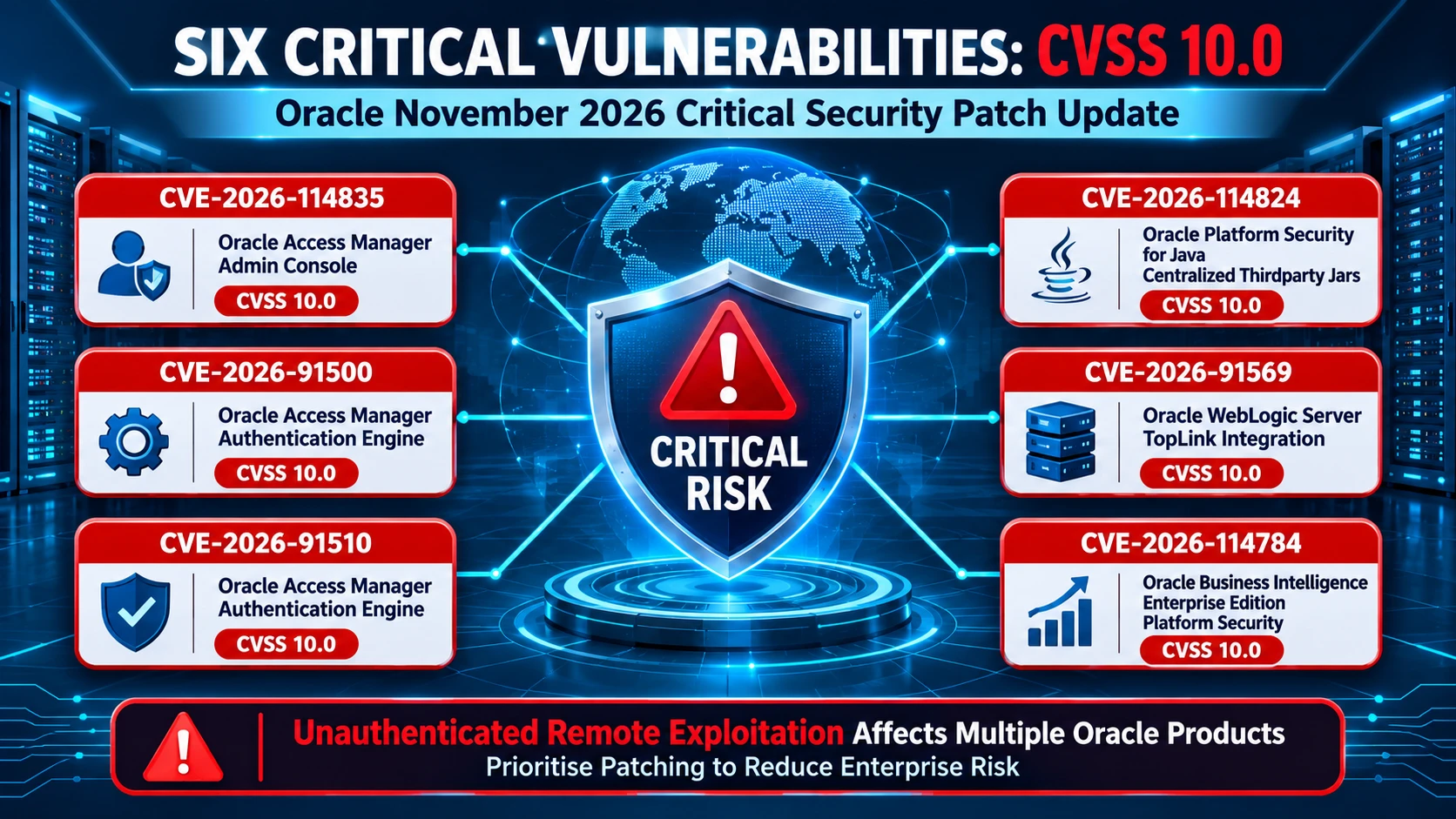
One of the most significant aspects of the November update is the presence of six vulnerabilities with CVSS 3.1 base scores of 10.0.
These vulnerabilities affect Oracle Access Manager, Oracle Platform Security for Java, Oracle WebLogic Server and Oracle Business Intelligence Enterprise Edition.
The six critical vulnerabilities include:
CVE ID | Affected product | Component | CVSS |
|---|---|---|---|
CVE-2026-114835 | Oracle Access Manager | Admin Console | 10.0 |
CVE-2026-91500 | Oracle Access Manager | Authentication Engine | 10.0 |
CVE-2026-91510 | Oracle Access Manager | Authentication Engine | 10.0 |
CVE-2026-114824 | Oracle Platform Security for Java | Centralized Thirdparty Jars | 10.0 |
CVE-2026-91569 | Oracle WebLogic Server | TopLink Integration | 10.0 |
CVE-2026-114784 | Oracle Business Intelligence Enterprise Edition | Platform Security | 10.0 |
These vulnerabilities are particularly important because Oracle identifies them as remotely exploitable without authentication.
The affected systems and versions include:
Oracle Access Manager: 12.2.1.4.0 and 14.1.2.1.0.
Oracle Platform Security for Java: 12.2.1.4.0 and 14.1.2.0.0.
Oracle WebLogic Server: 12.2.1.4.0, 14.1.1.0.0, 14.1.2.0.0 and 15.1.1.0.0.
Oracle Business Intelligence Enterprise Edition: 8.2.0.0.0 and 26.1.0.0.0.
For several of these vulnerabilities, Oracle describes the potential impact as a takeover of the affected product.
The presence of remotely exploitable vulnerabilities without authentication makes these products important priorities for security assessment and patch deployment.
Oracle Fusion Middleware and WebLogic Server Face Significant Security Attention
Oracle Fusion Middleware is one of the major areas covered by the November security update.
The advisory includes 71 new security patches for this product family, of which 53 address vulnerabilities that may be remotely exploitable without authentication.
Several affected components include:
Oracle Access Manager
Oracle WebLogic Server
Oracle Platform Security for Java
Oracle SOA Suite
Oracle HTTP Server
Oracle WebCenter Portal
Oracle WebCenter Sites
Oracle Business Process Management Suite
Oracle WebLogic Server has multiple critical vulnerabilities, including CVE-2026-91569, which carries a CVSS score of 10.0.
Other notable WebLogic vulnerabilities include:
CVE-2026-91570: CVSS 9.8
CVE-2026-91583: CVSS 9.8
CVE-2026-91456: CVSS 9.8
CVE-2026-91470: CVSS 9.8
CVE-2026-91469: CVSS 9.4
These vulnerabilities affect different WebLogic components and communication protocols, including HTTP, SOAP, T3 and IIOP.
For organisations operating WebLogic-based enterprise applications, reviewing the affected versions and applying the corresponding security updates should be an important part of the November patching process.
Oracle Hyperion Accounts for the Largest Share of Security Patches
Oracle Hyperion receives the largest number of new security patches in this release.
The advisory identifies 267 new security patches for Oracle Hyperion products. These include vulnerabilities affecting:
Hyperion Financial Management
Hyperion Planning
Hyperion Infrastructure Technology
Hyperion Workspace
Hyperion Financial Close Management
Hyperion Financial Data Quality Management
Of the 267 patches, 107 address vulnerabilities that may be remotely exploitable without authentication.
This makes Hyperion an important consideration for organisations using Oracle's enterprise performance management and financial planning platforms.
Oracle's risk matrices also identify vulnerabilities with high CVSS scores across several Hyperion components.
The update reinforces the importance of including enterprise financial management applications in routine vulnerability assessments rather than concentrating patching activities exclusively on database and infrastructure platforms.
Other Major Oracle Product Families Receiving Security Patches
Beyond Fusion Middleware and Hyperion, the November update covers several other important enterprise products.
Oracle E-Business Suite
Oracle E-Business Suite receives 71 new security patches, including 19 vulnerabilities that may be remotely exploitable without authentication.
Affected areas include Document Management and Collaboration, Oracle Application Object Library, Oracle Applications Framework and other application components.
Oracle Supply Chain
Oracle Supply Chain receives 74 new security patches, with 36 vulnerabilities potentially exploitable remotely without authentication.
The affected product family includes enterprise applications used in supply chain and business operations.
Oracle Communications
The advisory contains 31 new security patches for Oracle Communications, including 21 vulnerabilities that may be remotely exploitable without authentication.
Oracle Analytics
Oracle Analytics receives 29 new security patches, including nine vulnerabilities that may be remotely exploitable without authentication.
Oracle Java SE
Oracle Java SE receives 11 new security patches. All 11 vulnerabilities are identified as remotely exploitable without authentication in the advisory.
Affected Java versions include:
Java SE 8
Java SE 11
Java SE 17
Java SE 21
Java SE 25
Java SE 27
Oracle also identifies vulnerabilities affecting Oracle GraalVM and JavaFX.
Oracle MySQL and Database Server
Oracle's database product family receives 20 new security patches, distributed across Database Server, APEX, Autonomous Health Framework and REST Data Services.
For Oracle Database Server specifically, seven new security patches are included. Three vulnerabilities may be remotely exploitable without authentication.
Two Oracle Text vulnerabilities, CVE-2026-114819 and CVE-2026-114848, carry CVSS scores of 9.9. Both require the Create Session privilege and network access through Oracle Net.
Another vulnerability, CVE-2026-114822, affects the RDBMS component and also carries a CVSS score of 9.9.
Oracle clarifies that none of the seven Database Server patches applies to client-only installations without Oracle Database Server installed.
Why Organisations Should Prioritise This Security Update
The November advisory highlights a broad security maintenance challenge for organisations operating interconnected enterprise software environments.
A vulnerability in an enterprise application or middleware component can introduce security concerns beyond the individual software installation, particularly when that component supports business-critical services.
Three areas deserve particular attention.
1. Internet-accessible enterprise systems
Organisations should identify Oracle products that are accessible through external networks. Remotely exploitable vulnerabilities that do not require authentication deserve particular attention when prioritising remediation.
2. Identity and application infrastructure
Oracle Access Manager and WebLogic Server are important components in many enterprise application environments. Their inclusion in the highest-severity findings makes version identification and patch assessment particularly important.
3. Legacy and unsupported software
Oracle states that CSPU patches are provided for product versions covered by Premier Support or Extended Support.
Earlier versions outside these support phases are not tested for vulnerabilities addressed by the update.
Oracle recommends upgrading to supported versions to maintain access to security patches.
Oracle's Recommendations for Security Teams
Oracle strongly recommends applying the November 2026 Critical Security Patch Update patches as soon as possible.
The company also provides temporary risk-reduction recommendations for organisations that cannot immediately deploy the updates.
These include:
Blocking network protocols required to exploit particular vulnerabilities, where appropriate.
Removing unnecessary privileges from users who do not require them.
Restricting access to packages that are not needed by specific users.
Testing configuration changes in non-production environments before deployment.
Reviewing previous Critical Patch Update advisories if earlier releases were skipped.
Oracle cautions that these measures may affect application functionality and should not be considered permanent solutions. They do not correct the underlying vulnerabilities.
Organisations should obtain the relevant patch availability documents through My Oracle Support and follow the associated installation instructions.
The November advisory also reminds customers to apply patches associated with previously published October 2026 Security Alerts, including CVE-2026-91403, CVE-2026-114820, CVE-2026-109618 and CVE-2026-109619.
What This Means for Enterprise Cybersecurity
Oracle's November 2026 security update illustrates the continuing challenge of maintaining security across large enterprise software environments.
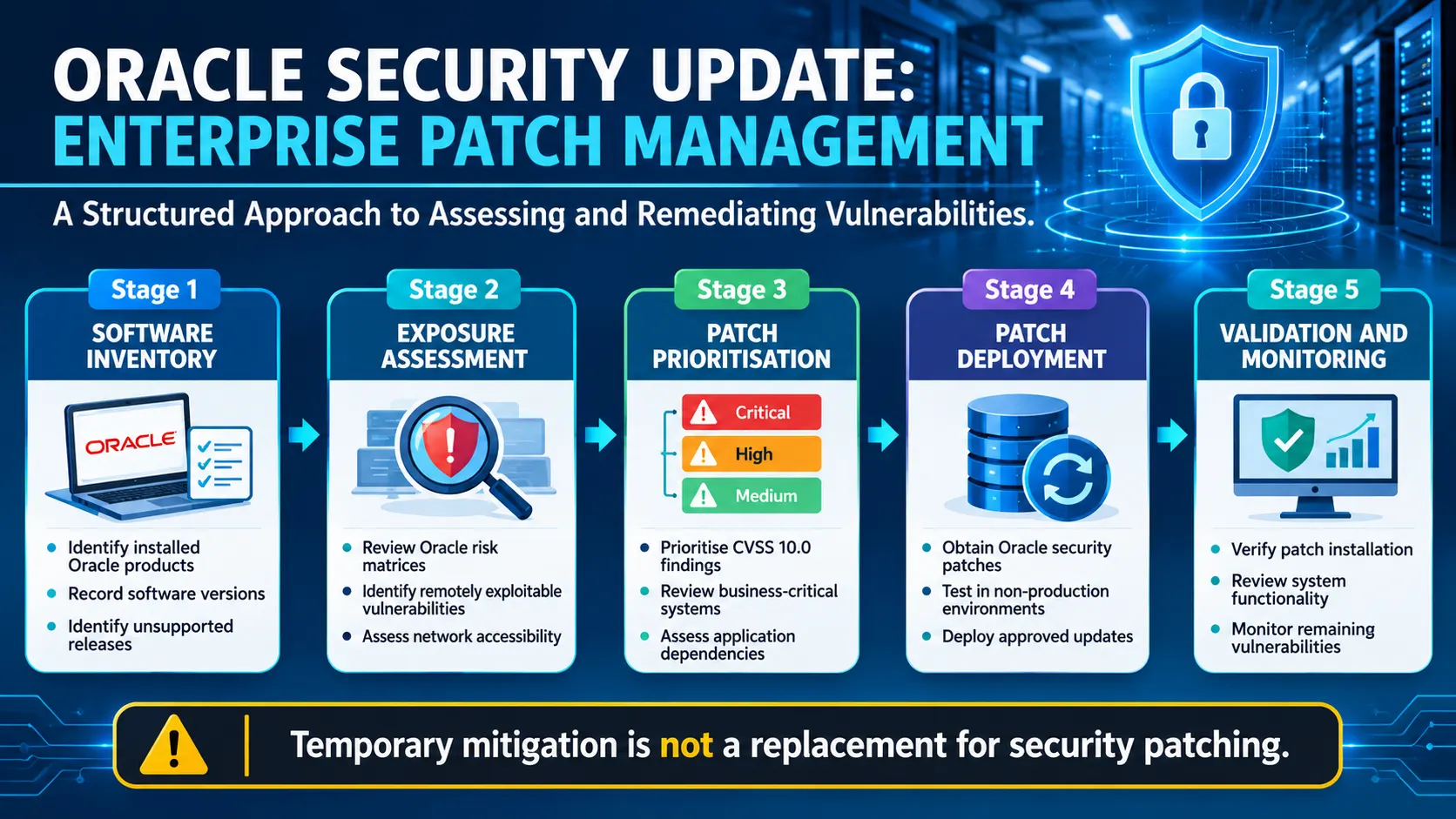
With 655 new patches distributed across 21 product families, organisations need a structured approach to identifying affected software, assessing exposure and planning remediation.
For security operations teams, the announcement highlights a broader industry shift towards continuous vulnerability management rather than relying exclusively on periodic security reviews.
For enterprises, this could mean placing greater emphasis on software inventory accuracy, supported-version management, exposure assessment and coordinated patch deployment.
The update also demonstrates why organisations should evaluate the security of middleware, identity platforms, financial applications and development environments alongside their core database infrastructure.
Oracle has provided the affected product information and risk matrices to help customers assess their environments and determine appropriate remediation priorities.
Organisations should review the official advisory and obtain the relevant patches through Oracle's support channels.
Conclusion
Oracle's November 2026 Critical Security Patch Update delivers 655 new security patches across a broad range of enterprise products.
The six CVSS 10.0 vulnerabilities, particularly those affecting Oracle Access Manager, WebLogic Server, Platform Security for Java and Business Intelligence Enterprise Edition, deserve close attention from security teams.
The scale of the update also makes it important for organisations to review their entire Oracle software inventory, identify affected versions and coordinate patch deployment across business-critical systems.
Applying the available security updates promptly, maintaining supported software versions and reviewing previous security advisories remain essential steps in reducing enterprise software exposure.
Source: Oracle Security Advisory
About the Author