
Termix-SSH Vulnerability Exposes File Manager to Critical Path Traversal Risk
A critical path traversal vulnerability in Termix-SSH affects versions up to 2.9.2. Research details show how improper destination-path handling could enable arbitrary file writes on the Termix server.
Xcademia Team
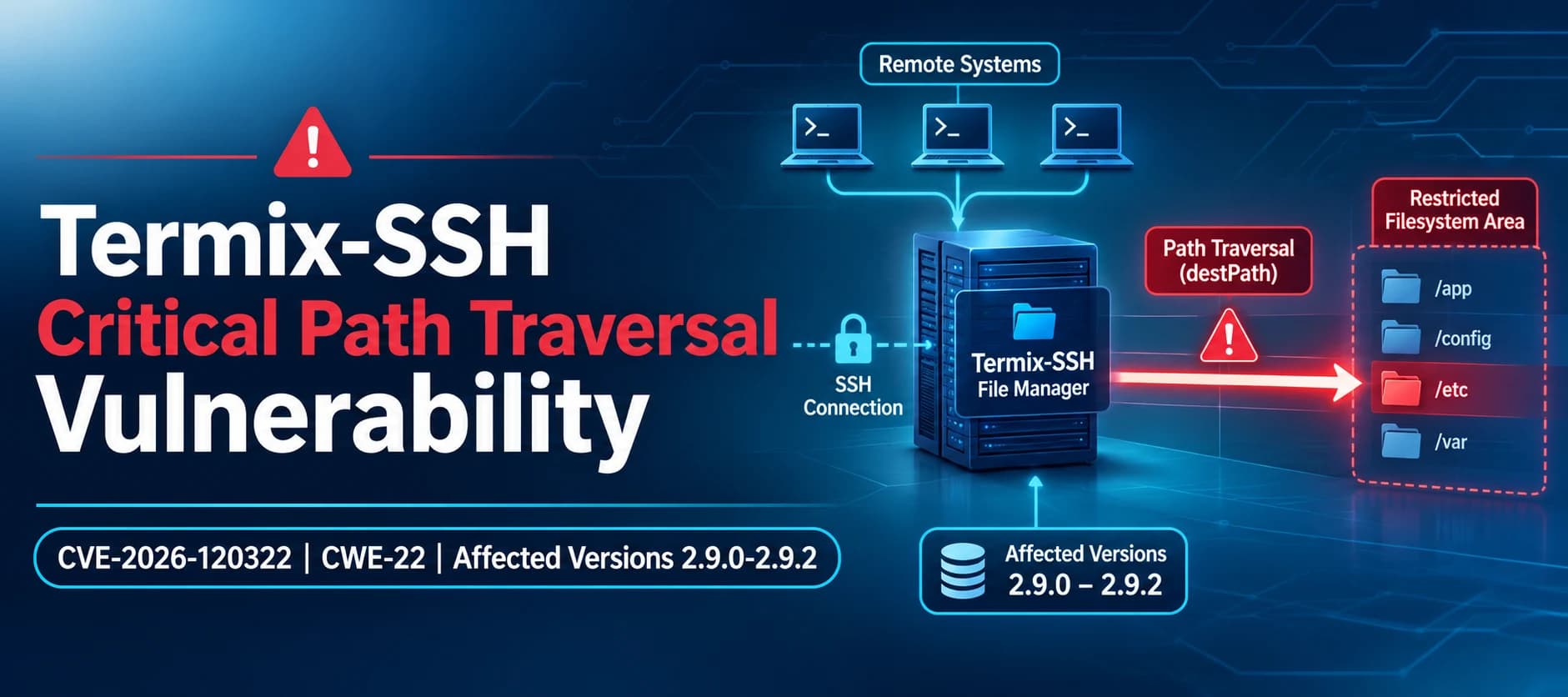
A critical security vulnerability has been disclosed in Termix-SSH Termix, a tool that provides SSH connectivity and file management capabilities. Tracked as CVE-2026-120322, the issue involves improper handling of destination paths in the File Manager's transfer functionality.
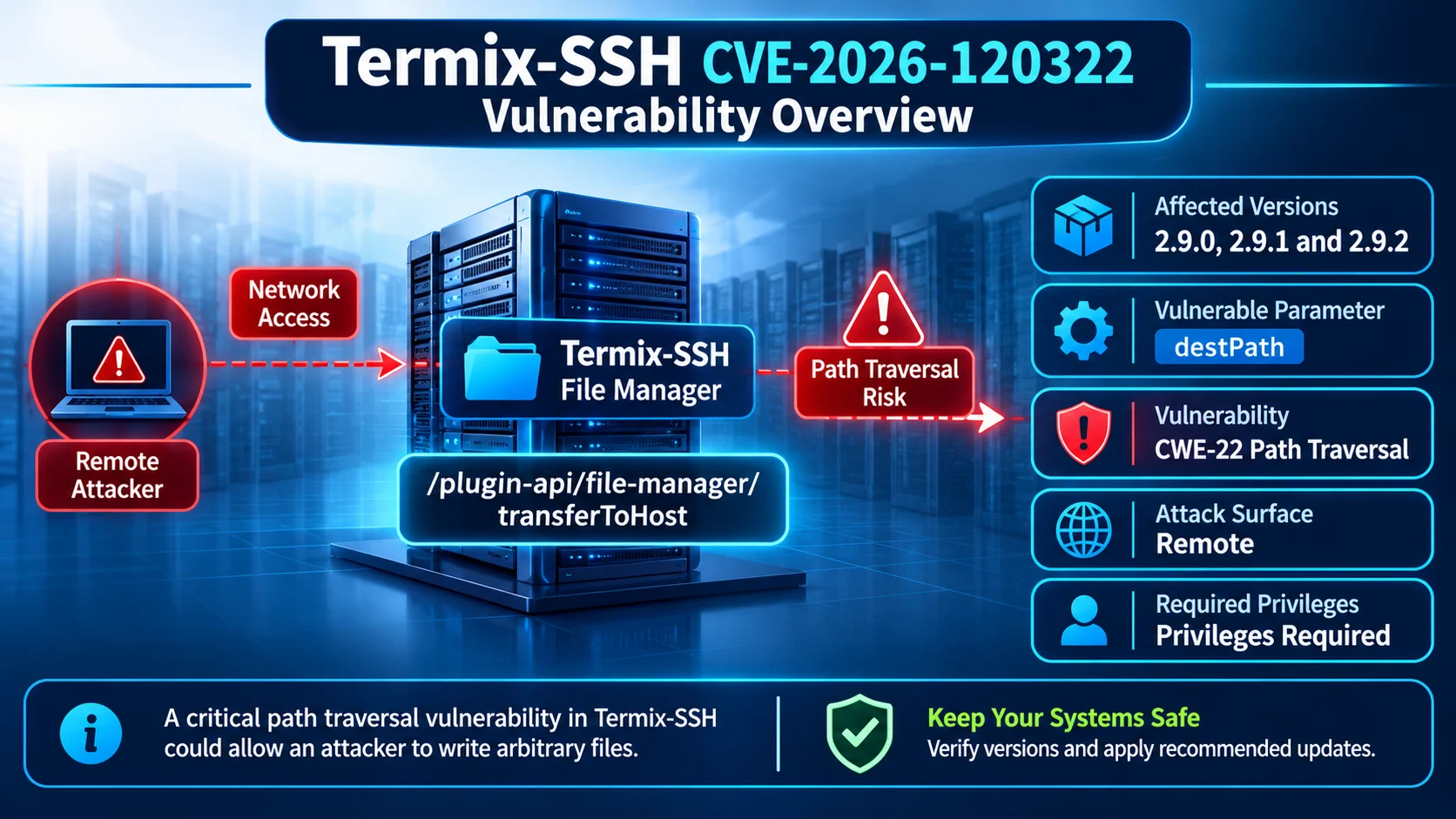
The vulnerability affects Termix versions 2.9.0, 2.9.1 and 2.9.2. According to the CVE description, attackers may remotely trigger path traversal through the /plugin-api/file-manager/transferToHost endpoint by manipulating the destPath argument.
The vulnerability has been classified under CWE-22, which covers improper limitation of a pathname to a restricted directory.
A separate technical investigation published on GitHub by researcher 0xGenesi describes how the issue could be leveraged to write arbitrary files to the Termix server filesystem. The researcher also documents potential escalation paths involving plugin loading and application configuration files.
These findings make the disclosure particularly relevant to organisations operating Termix instances with authenticated user access.
1. Understanding CVE-2026-120322
Path traversal vulnerabilities occur when applications fail to properly validate file paths supplied through user-controlled input.
Applications commonly restrict file operations to specific directories. However, inadequate validation can allow specially constructed paths to reference locations outside those intended boundaries.
In this case, the affected functionality is associated with the Termix File Manager's host-to-host transfer operation.
The CVE description identifies the following endpoint:
/plugin-api/file-manager/transferToHost
The destPath parameter controls the destination path used during file transfers. According to the disclosure, insufficient handling of this argument can result in path traversal.
The vulnerability is remotely reachable, but the published CVE description indicates that privileges are required. It should therefore not be characterised as an unauthenticated attack.
2. How the vulnerability could lead to arbitrary file writes
The independent GitHub investigation provides additional technical context beyond the initial CVE description.
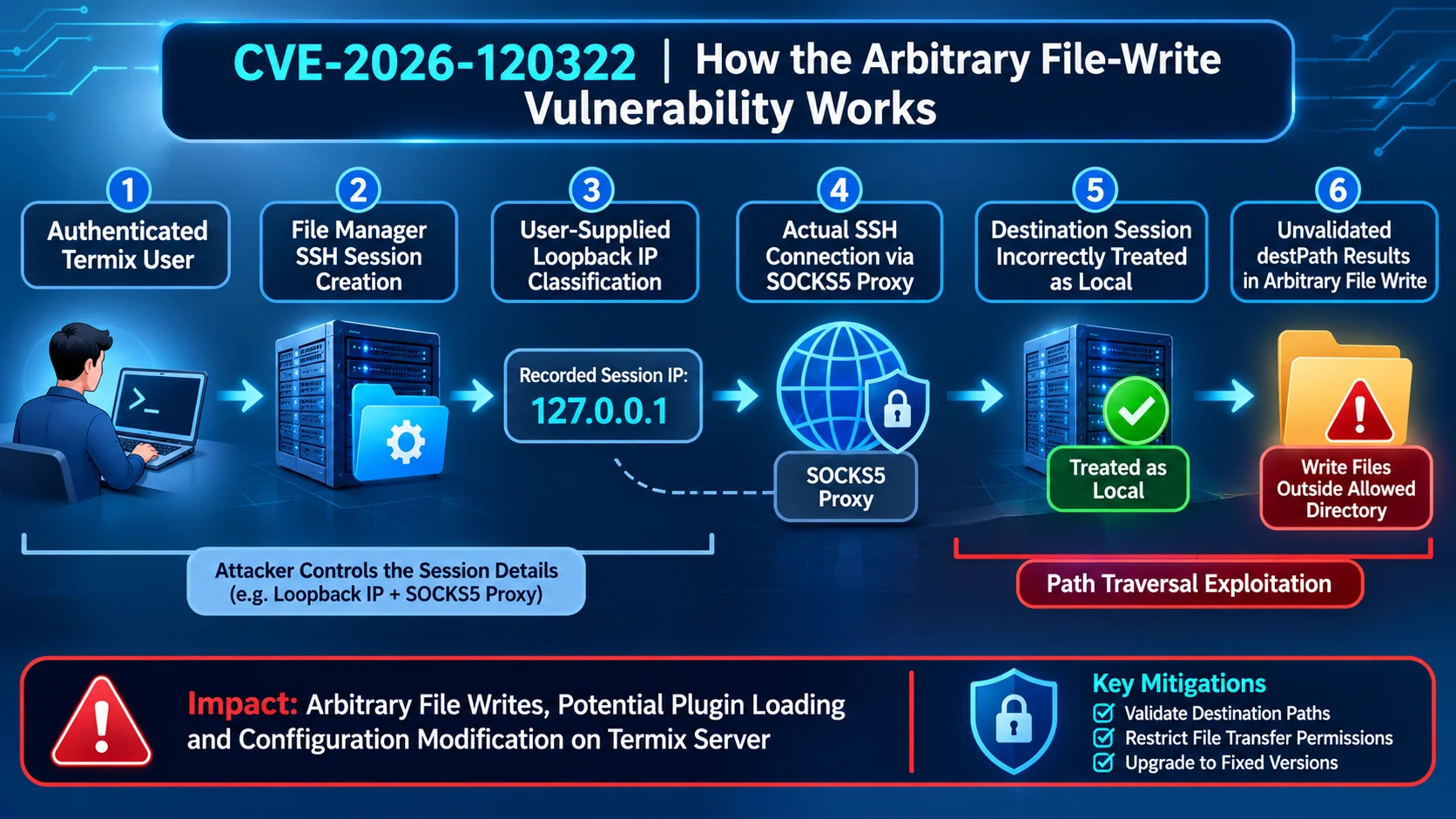
According to the researcher, the underlying problem involves how Termix identifies a destination as its own local server.
The investigation describes a sequence involving:
An authenticated Termix account.
File Manager SSH sessions.
A destination session using a manipulated IP address.
An optional SOCKS5 proxy.
Insufficient validation of the destination file path.
The researcher reports that the application relies on the recorded session IP when determining whether a destination is a local SSH endpoint.
This creates a potential trust-boundary problem when the recorded IP and the actual SSH connection destination do not match.
The researcher explains that a session can be made to appear as a loopback destination while the actual SSH connection is routed through an attacker-controlled proxy.
When the application treats that destination as the local Termix server, the transfer operation can use a local file-writing mechanism rather than a standard remote SFTP transfer.
The report identifies this behaviour as the basis for arbitrary file writing on the Termix server.
Importantly, these implementation details come from the independent research report and should be distinguished from the shorter official CVE description.
3. Potential impact on Termix deployments
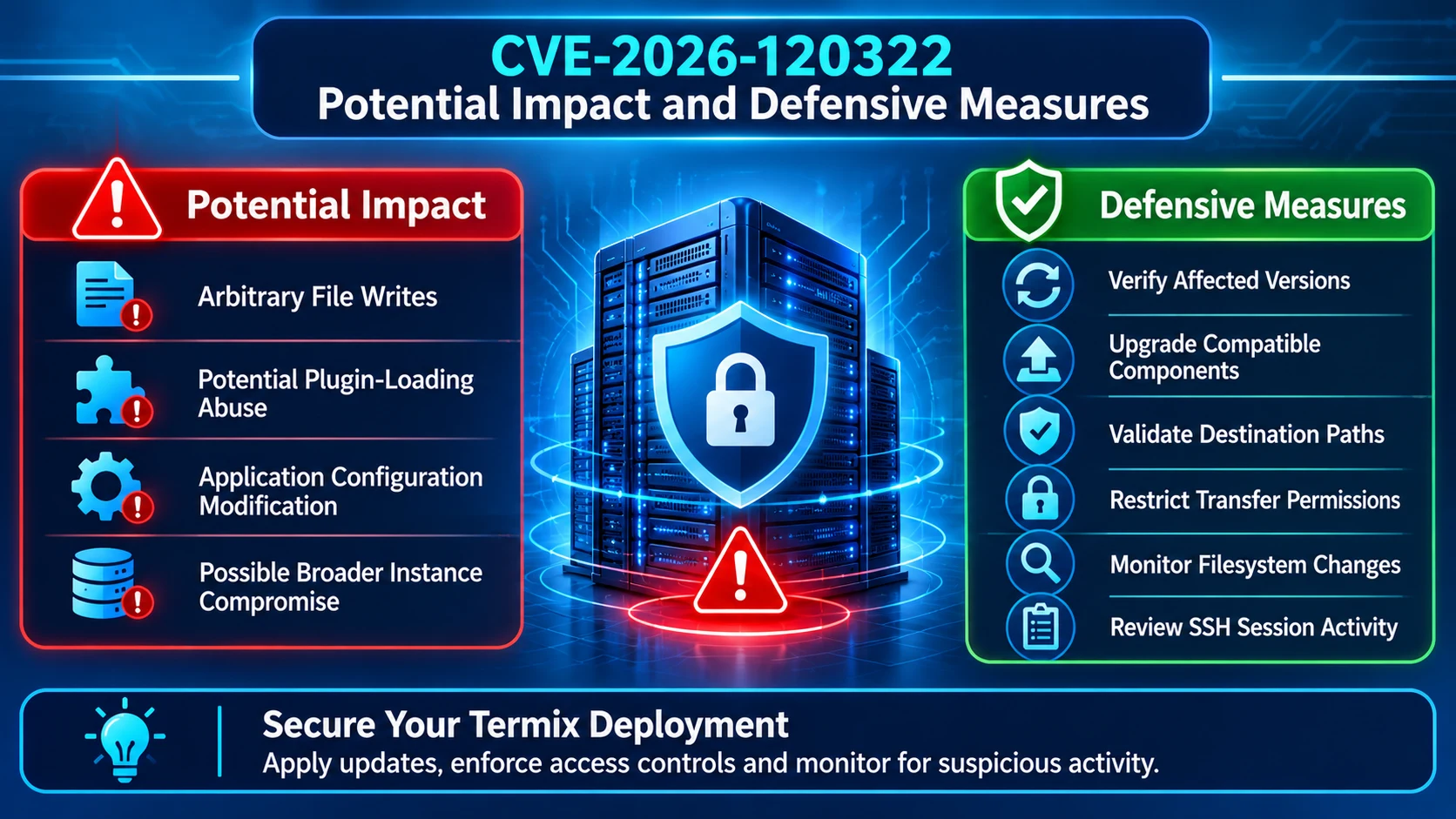
The GitHub investigation describes several potential consequences of exploiting the file-writing behaviour.
Unauthorised file modification
An attacker with the required access could potentially write files outside the intended transfer directory, depending on the application environment and process permissions.
Plugin-related execution risk
The researcher describes a potential escalation path involving the placement of an unsigned .tmxplug archive in the application's plugin directory.
According to the report, the plugin loader may load such archives during backend startup under the conditions described in the investigation.
Application configuration compromise
The report also identifies the application's .env file as a potential target. It discusses how modifying configuration values such as JWT_SECRET or ENCRYPTION_KEY could contribute to broader instance compromise.
These are researcher-documented exploitation scenarios. Their practical impact depends on the deployed configuration, application permissions and relevant security controls.
4. Affected versions and vulnerability classification
The CVE disclosure identifies the following affected releases:
Product | Affected versions |
|---|---|
Termix | 2.9.0 |
Termix | 2.9.1 |
Termix | 2.9.2 |
Vulnerability classification: CWE-22 - Path Traversal.
CVE identifier: CVE-2026-120322.
There is also a scoring discrepancy across the available material. The CVE data lists a CVSS 3.1 score of 9.9, while the independent GitHub investigation reports CVSS 3.1 at 8.8. The CVE data also contains a CVSS 4.0 score of 9.4.
Security teams should consult the current CVE record and its associated scoring information when assessing the issue.
5. Mitigation and remediation considerations
The CVE description states that the vulnerable transfer shortcut was removed in:
Standalone File Manager plugin v1.0.0.
Termix core v26.10.0.
The updated transfer engine is described as always writing over SFTP rather than using the previous local-file transfer shortcut.
The independent researcher also recommends several defensive measures:
Restrict transfer destinations to hosts registered and approved by administrators.
Avoid trusting user-supplied IP addresses when determining whether a destination is a local server.
Validate destination paths and enforce restrictions on permitted directories.
Apply appropriate permission requirements to host-to-host file transfers.
Monitor file-transfer operations and record destination host and path information.
Organisations should verify their installed Termix core and File Manager plugin versions independently. The company did not provide specific information about this area in the available disclosure.
6. What security teams should do
Administrators responsible for Termix deployments should begin by identifying whether versions 2.9.0, 2.9.1 or 2.9.2 are running in their environments.
They should also review File Manager access permissions, inspect unexpected file modifications and examine SSH session activity.
Where the affected versions are present, administrators should assess the availability and compatibility of the documented updated components before deployment.
The independent research report provides technical indicators and reproduction details that security teams can use to understand the reported attack path. These should be reviewed in a controlled testing environment rather than against production infrastructure.
7. Why this vulnerability matters
The Termix disclosure highlights a broader security challenge involving trusted internal application operations.
File-transfer features often interact with several security boundaries, including authenticated sessions, remote hosts, local filesystem permissions and application-level path restrictions.
When an application makes security decisions using information supplied by a user-controlled session, it can create opportunities for trust-boundary confusion.
For infrastructure and security teams, this incident reinforces the importance of validating file destinations, separating local and remote operations, and applying least-privilege access controls.
CVE-2026-120322 is therefore relevant not only to Termix administrators but also to developers responsible for applications that combine SSH connectivity with filesystem operations.
Source: CVE Program / VulDB
About the Author