
OpenAI Commits $1 Billion to Help Frontline Defenders Protect Essential Services
OpenAI is committing $1 billion in subsidised Daybreak access, training, technical support and partnerships to help resource-constrained defenders secure critical infrastructure and public services.
Xcademia Team
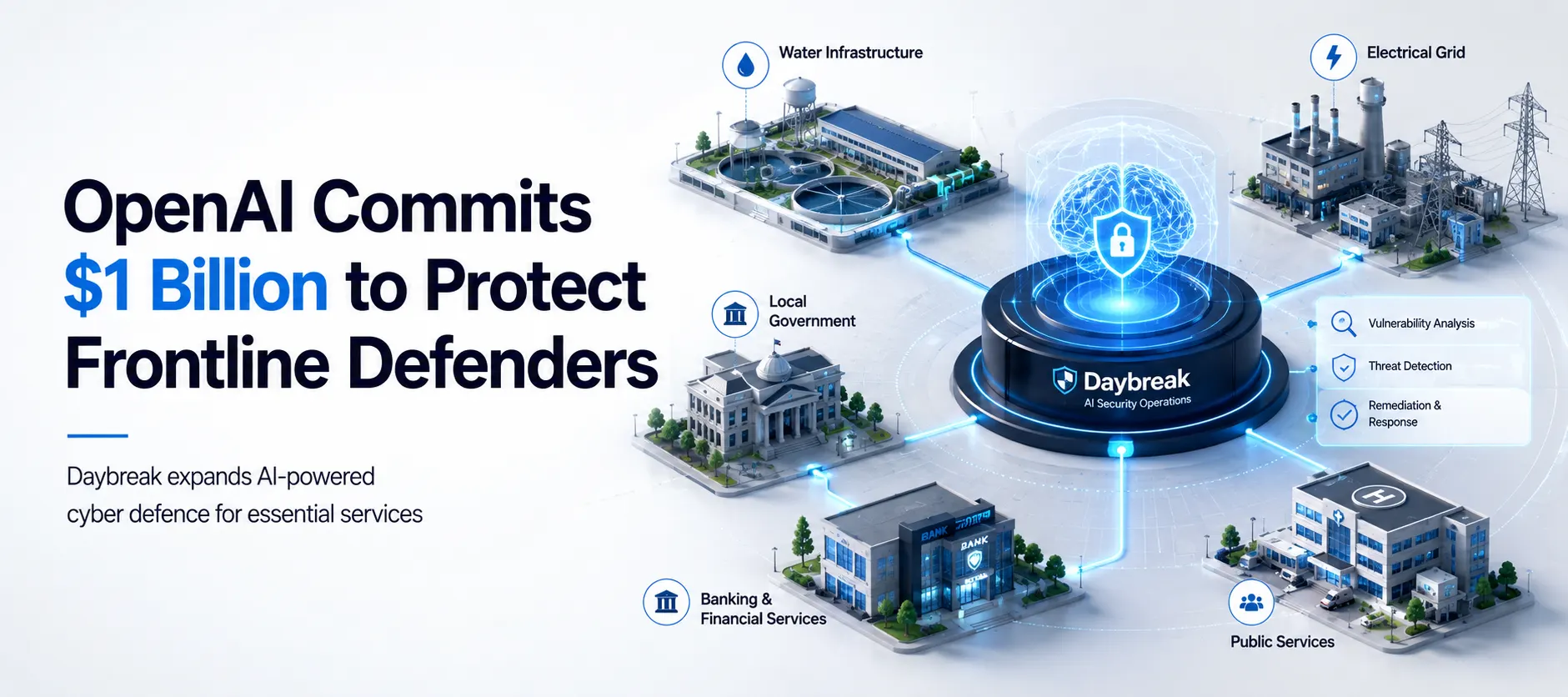
OpenAI has announced Daybreak for Frontline Defenders, a global initiative designed to expand access to AI-powered cybersecurity capabilities for organisations responsible for protecting essential services.
The company says the initiative includes a $1 billion global commitment covering subsidised access to Daybreak cyber models and products, training, technical support and partnerships. The programme will initially focus on the United States, with OpenAI saying it intends to expand the model to partner countries in the coming weeks.
The announcement comes as critical infrastructure operators, local governments, financial institutions and other organisations face the challenge of defending complex systems while often working with fewer security resources than large enterprises.
OpenAI's central argument is that advanced AI could help these defenders identify weaknesses, analyse suspicious activity and develop fixes more quickly.
What Is Daybreak for Frontline Defenders?
Daybreak for Frontline Defenders brings together several elements of OpenAI's existing cybersecurity work under a broader initiative focused on organisations that protect essential services.
According to OpenAI, the programme combines:
$1 billion in subsidised access to Daybreak cyber capabilities
Training and technical assistance
New partnerships with defenders
Expanded access to AI-powered cybersecurity tools
Support for organisations with limited security resources
Integration of Daybreak capabilities into enterprise security products and services
The initiative is intended to serve defenders operating in sectors such as water and wastewater, electricity, government, banking and other essential services.
Why Frontline Defenders Are a Focus
OpenAI says many frontline security teams operate complex and sometimes ageing systems while facing constraints around staffing, budgets, tools and specialised expertise.
This creates an important cybersecurity challenge.
A vulnerability in a large technology company can be serious, but weaknesses in systems supporting water supplies, electricity, public services or financial institutions can also affect communities directly.
OpenAI's initiative is therefore focused on extending advanced cybersecurity capabilities beyond organisations with the largest security budgets.
The company describes this opportunity as a "defender's window", referring to a period in which defenders can use increasingly capable AI to address security gaps before attackers take advantage of them.
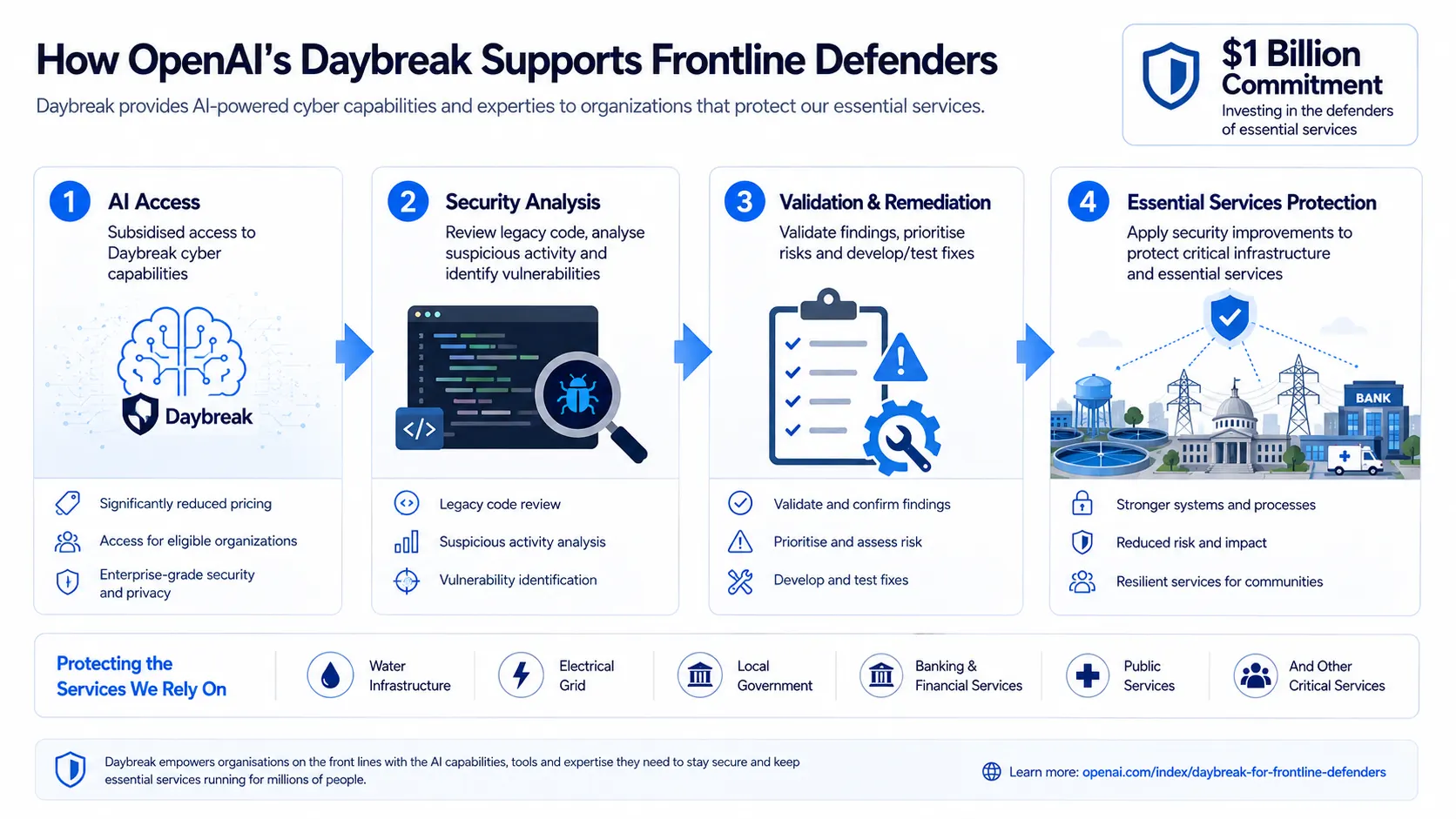
$1 Billion Commitment Targets Resource-Constrained Organisations
OpenAI says the $1 billion commitment is intended to be consumed over the next six months, beginning with the United States.
The company says priority areas include:
Water and wastewater systems
Electric grid operators
State and local governments
Community and regional banks
Nonprofits
Open-source maintainers
Other organisations with limited security resources
The announcement states that Daybreak access can assist defenders with reviewing legacy code, analysing suspicious activity, identifying and validating vulnerabilities, prioritising serious risks, and developing and testing fixes.
This is significant because the initiative is not positioned simply as access to an AI model. OpenAI is combining model access with training, technical assistance and partnerships.
That distinction matters for organisations that may have limited experience integrating advanced AI into existing security operations.
Support for Water Infrastructure
OpenAI also points to earlier assistance provided following recent attacks on U.S. water systems.
The company says affected states and utilities were offered up to $1 million in no-cost API credits, Daybreak access and technical assistance.
According to OpenAI, teams used that support to review code and system configurations, validate findings, develop patches and confirm fixes while water systems continued operating.
OpenAI presents this experience as part of the foundation for its broader Daybreak for Frontline Defenders programme.
The company did not provide specific information about the individual systems involved or disclose detailed technical results from those engagements.
Daybreak Expands AI-Powered Cyber Defence Access
OpenAI says it launched Daybreak earlier in 2026 to allow verified public and private sector defenders to use advanced AI for authorised cyber defence.
The programme includes two described modes.
Daybreak Blue supports common defensive cybersecurity work using OpenAI's mainline models.
Daybreak Red provides approved organisations with access to specialised cyber models for more sensitive and technically demanding defensive work.
OpenAI says thousands of defenders across 2,000 approved organisations and workspaces are already using Daybreak, including cybersecurity companies, defence organisations and law enforcement organisations.
The company is now expanding its focus towards organisations that may not have the same resources as large enterprises.
This includes providing more direct engagement with utilities, state and local governments, community banks and other frontline defenders.
The Role of Hands-On Support
One of the more notable aspects of the announcement is OpenAI's emphasis on human support alongside AI access.
OpenAI says it has been holding meetings with frontline defenders to understand their operational challenges and help them use its tools to harden systems.
The company also says a second utility gathering held during the announcement week included participants representing 40 states and the District of Columbia, collectively providing essential services to more than half of the U.S. population.
These engagements suggest that OpenAI sees AI deployment in cybersecurity as more than a software-access problem.
Organisations also need training, implementation support and processes for translating AI-generated findings into security decisions.
OpenAI Announces MS-ISAC Pilot
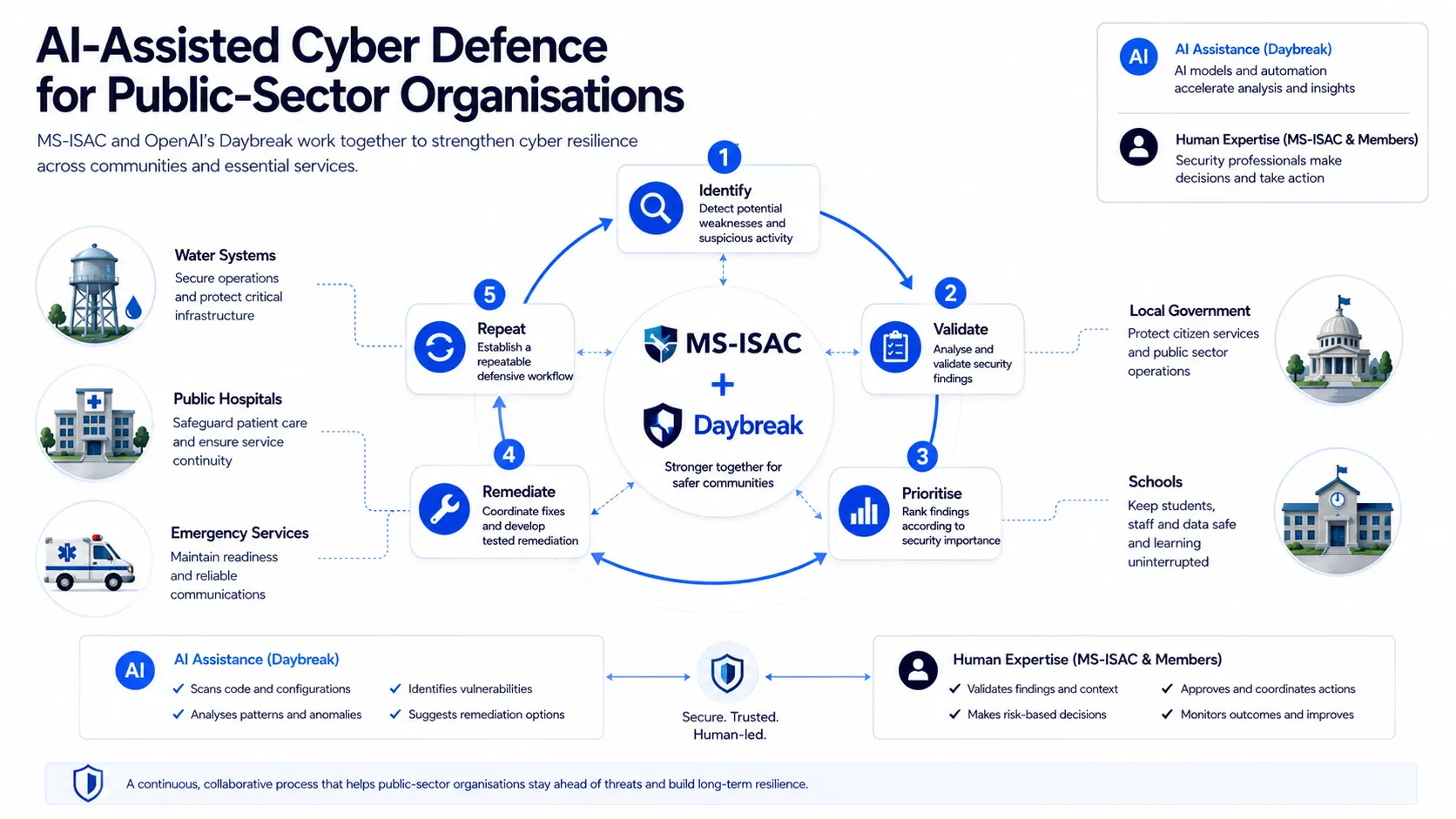
OpenAI is also announcing a public-sector and water-focused pilot with the Multi-State Information Sharing and Analysis Center (MS-ISAC).
The programme is designed to train and support state, local, tribal and territorial cyber defenders.
According to OpenAI, the pilot will combine Daybreak access with guided training and hands-on assistance for an initial group of public-sector and water-system defenders.
The programme will focus on activities including:
Validating security findings
Prioritising findings
Coordinating remediation
Developing repeatable security processes
OpenAI says the objective is to develop an approach that could eventually be expanded to a wider community of public-sector organisations.
MS-ISAC supports thousands of public-sector organisations and provides services including cyber-threat intelligence, incident-response support and information sharing, according to OpenAI's announcement.
More Than 35 Products Join the Daybreak Defense Network
OpenAI says cybersecurity capabilities also need to reach defenders through the products and services they already use.
The company says partners in the Daybreak Defense Network are announcing more than 35 partner products and partner-operated services that integrate Daybreak cyber models into enterprise tools, services and workflows.
The announcement does not provide detailed technical specifications for every partner product.
Additional details were not disclosed in the announcement.
The broader objective is to make AI-assisted cybersecurity available through existing security and engineering workflows rather than requiring every organisation to create a completely new operating model.
For enterprise security teams, this could mean AI capabilities becoming part of established vulnerability management, software engineering and security operations processes.
That is an editorial interpretation of the announcement, rather than a specific claim about the performance of individual partner products.
From Finding Vulnerabilities to Building a "Defense Factory"
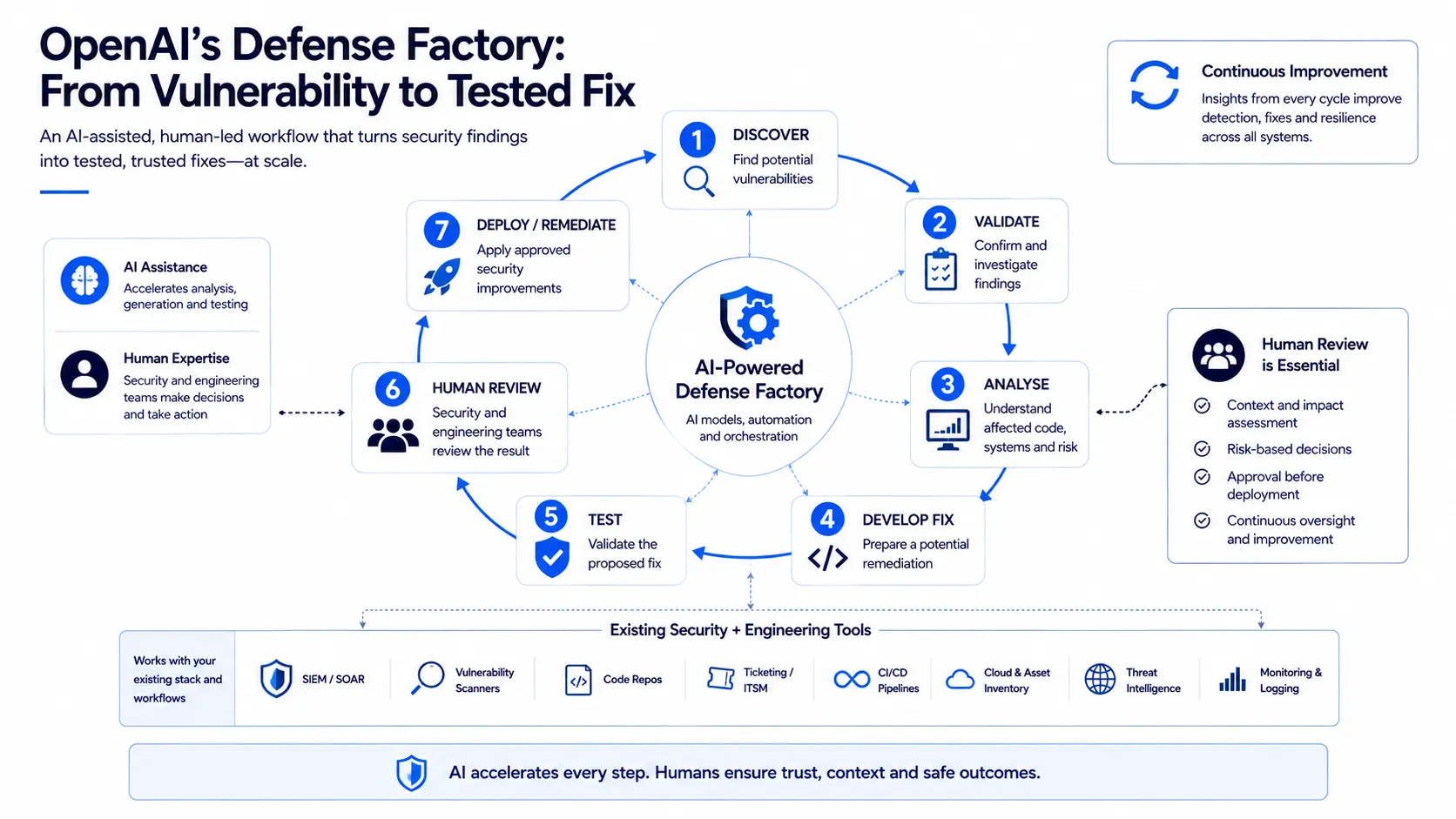
OpenAI also connects the initiative with its recently published approach to building what it calls a Defense Factory.
The concept is described as a continuous, agent-first security operation that builds on existing security and engineering tools.
According to OpenAI, the approach is intended to:
Find vulnerabilities
Validate vulnerabilities
Prepare tested fixes
Send those fixes for review
OpenAI says it is sharing the architecture and lessons from this approach so that other defenders can adapt the model to their own environments.
The distinction between identifying a vulnerability and fixing it is important.
Security teams can accumulate vulnerability findings faster than they can investigate and remediate them. An AI-assisted workflow that helps move from discovery towards validated remediation could therefore address part of the operational workload.
However, the announcement does not provide enough information to independently assess the effectiveness, accuracy or performance of the Defense Factory approach.
Why the Initiative Matters for Critical Infrastructure
The announcement highlights a broader industry shift toward using AI to increase the capacity of cybersecurity teams.
Critical infrastructure presents a particular challenge because organisations often have to protect systems that cannot simply be taken offline for extensive security work.
Water systems, electricity infrastructure, government services and financial institutions all support functions that communities depend on.
OpenAI's initiative is therefore focused on applying AI to practical defensive activities such as vulnerability analysis, suspicious-activity investigation and remediation.
For enterprises, this could mean a growing emphasis on AI-assisted security engineering, where AI is used to support security professionals rather than operate independently.
The development also reflects growing demand for tools that can help security teams reduce the distance between identifying a weakness and implementing a tested fix.
At the same time, AI does not remove the need for governance, validation or human oversight. OpenAI's own description of the Defense Factory includes review of prepared fixes, while the Daybreak initiative combines AI access with training and technical assistance.
The Global Expansion Question
Although the programme initially focuses on the United States, OpenAI describes Daybreak for Frontline Defenders as a global initiative.
The company says it intends to expand the model to partner countries in the coming weeks.
The announcement does not identify all future partner countries or provide detailed timelines for individual international programmes.
The company did not provide specific information about this area.
The international dimension could become important because essential-service operators around the world face similar challenges around legacy infrastructure, limited cybersecurity resources and increasing threat complexity.
However, the specific scope and implementation of any international expansion remain to be disclosed.
What Organisations Should Take Away
The announcement points to several practical themes for cybersecurity leaders.
1. AI-assisted defence is moving towards operational workflows
Rather than focusing only on AI-generated analysis, the initiative emphasises activities such as vulnerability validation, prioritisation, remediation and testing.
2. Access alone is not enough
OpenAI is pairing technology access with training and technical assistance. This highlights the importance of skills and implementation when introducing AI into security operations.
3. Critical infrastructure remains a priority
Water, electricity, government and financial services are among the areas explicitly identified by OpenAI.
4. Vulnerability remediation is becoming a central AI use case
The Defense Factory concept focuses on progressing from vulnerability discovery to tested fixes, rather than stopping at vulnerability identification.
5. Partnerships can extend reach
The MS-ISAC pilot and Daybreak Defense Network show OpenAI's strategy of working through organisations and products that already operate within cybersecurity and public-sector environments.
OpenAI's $1 Billion Cybersecurity Commitment: Key Facts
Area | Details |
|---|---|
Initiative | Daybreak for Frontline Defenders |
Commitment | $1 billion in subsidised access and support |
Initial focus | United States |
Planned expansion | Partner countries |
Support | AI access, training, technical assistance and partnerships |
Priority sectors | Water, wastewater, electricity, government, banking and other essential services |
Public-sector pilot | MS-ISAC |
Defense Network | More than 35 partner products and services |
Security workflow | Find, validate, prioritise, develop and test fixes |
Source | OpenAI |
All factual entries in the table are based on OpenAI's September 3, 2026 announcement.
Conclusion
OpenAI's Daybreak for Frontline Defenders represents a substantial expansion of its cybersecurity initiative, with the company committing $1 billion towards subsidised AI access, training, technical support and partnerships.
The focus is deliberately broader than large enterprises. Water utilities, electricity operators, public-sector organisations, community banks, nonprofits and other resource-constrained defenders are among the groups OpenAI says it wants to support.
The initiative also illustrates an increasingly practical direction for AI in cybersecurity: helping teams move through the security lifecycle from finding vulnerabilities to validating and testing remediation.
Whether these capabilities deliver measurable improvements across different environments will depend on implementation, governance, security expertise and the quality of human review. The announcement provides the framework for the initiative, but does not disclose enough information to independently evaluate its long-term effectiveness.
For now, the central message is clear: OpenAI wants advanced AI cybersecurity capabilities to reach the organisations protecting the essential services on which communities depend.
Source: OpenAI
About the Author