
Cisco Expressway CVE-2026-76466: Critical RCE Vulnerability Scores 9.8
Cisco has patched CVE-2026-76466, a critical vulnerability in clustered Expressway-C and Expressway-E deployments that could enable remote root-level command execution. No workaround is available, making a review of affected systems and software updates essential.
Xcademia Team
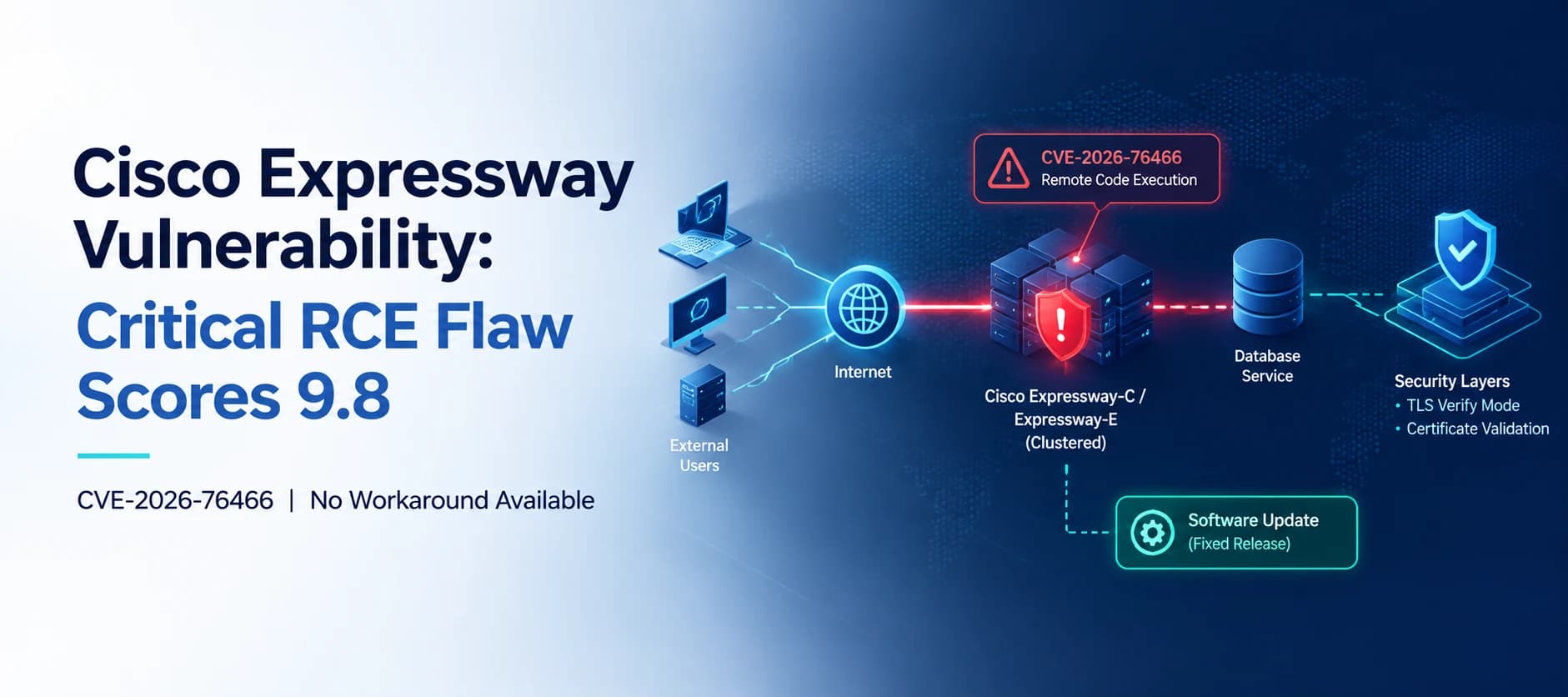
Cisco has disclosed a critical remote code execution vulnerability affecting certain clustered deployments of its Expressway Series products. The flaw, tracked as CVE-2026-76466, has a CVSS base score of 9.8 out of 10 and could allow a remote attacker to execute arbitrary operating system commands with root privileges.
Published on 21 October 2026, the advisory identifies affected Cisco Expressway-C and Expressway-E deployments running vulnerable software releases. Cisco has issued software updates to address the issue and confirmed that no workaround is available.
The vulnerability highlights the importance of reviewing exposed infrastructure, validating software versions and prioritising security updates for critical communications systems.
Key Details at a Glance
Detail | Information |
|---|---|
Vendor | Cisco |
Vulnerability | CVE-2026-76466 |
Affected products | Cisco Expressway-C and Expressway-E |
Severity | Critical |
CVSS score | 9.8 out of 10 |
Weakness classification | CWE-798, Use of Hard-coded Credentials |
Potential impact | Remote operating system command execution as root |
Workaround | None available |
Fixed release | X15.5.20 |
Advisory date | 21 October 2026 |
Source: Cisco Security Advisory.
How the Cisco Expressway Vulnerability Works
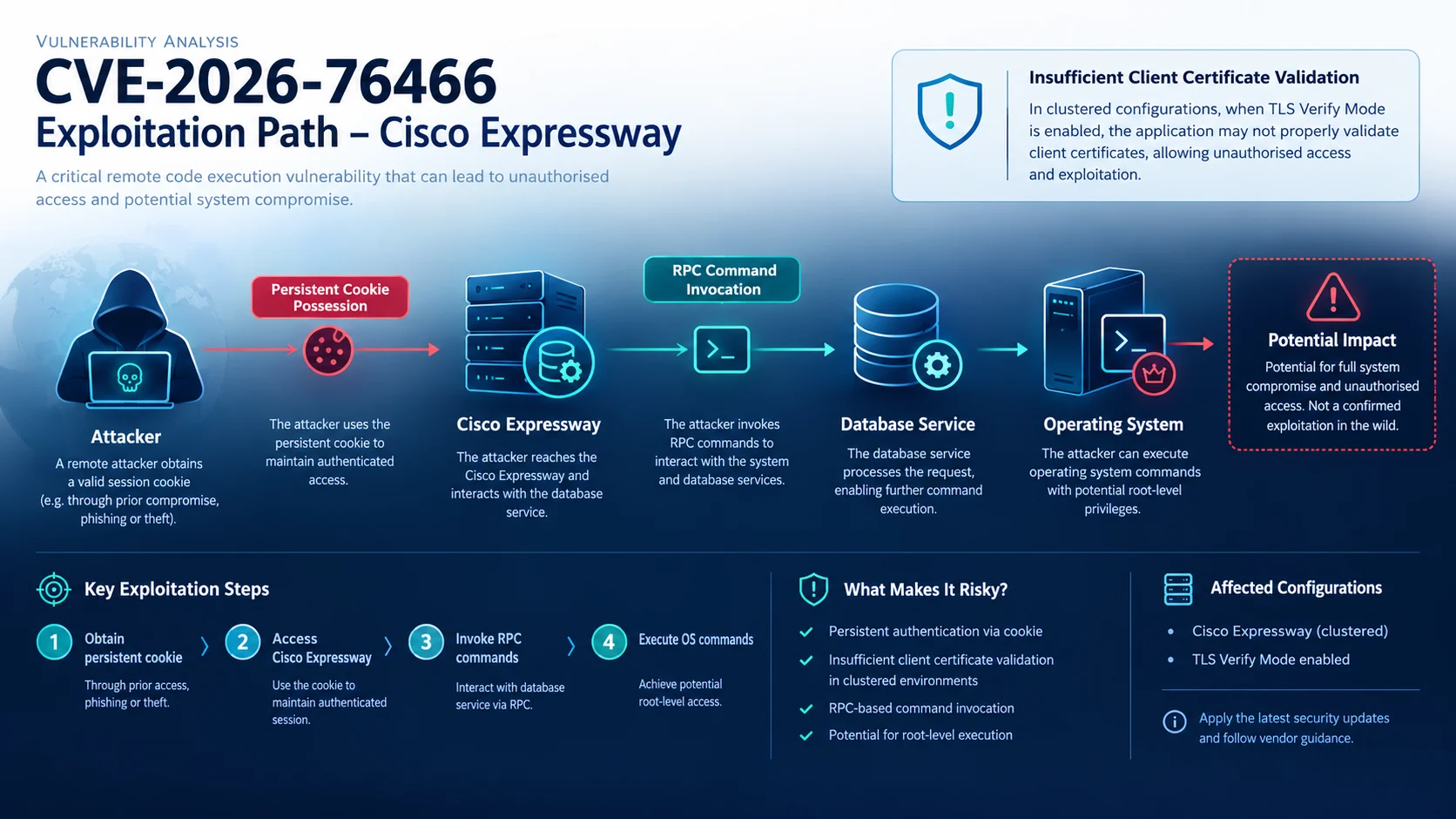
Cisco attributes the vulnerability to the use of persistent cookies in the database service feature. The advisory also identifies insufficient client certificate validation when TLS Verify Mode is enabled for clustering, meaning client certificates are not properly validated in the described configuration.
An attacker who possesses the relevant cookies could connect to the database service and invoke specific remote procedure call (RPC) commands. Successful exploitation could allow arbitrary commands to run as root on the affected device's underlying operating system.
Root is a highly privileged account on Unix-like systems. Command execution at this level can give an attacker extensive control over the affected device.
Cisco classifies the vulnerability as critical because of its potential impact and the conditions described in the advisory. The CVSS vector indicates that the vulnerability is network-accessible, requires low attack complexity and does not require user interaction or prior privileges.
Which Cisco Expressway Products Are Affected?
The advisory identifies Cisco Expressway-C and Cisco Expressway-E as affected products when they are running vulnerable software and configured in a cluster.
The affected product scope includes both virtual and appliance versions. Organisations should therefore check their deployments against Cisco's official release guidance rather than assuming that a particular deployment type is unaffected.
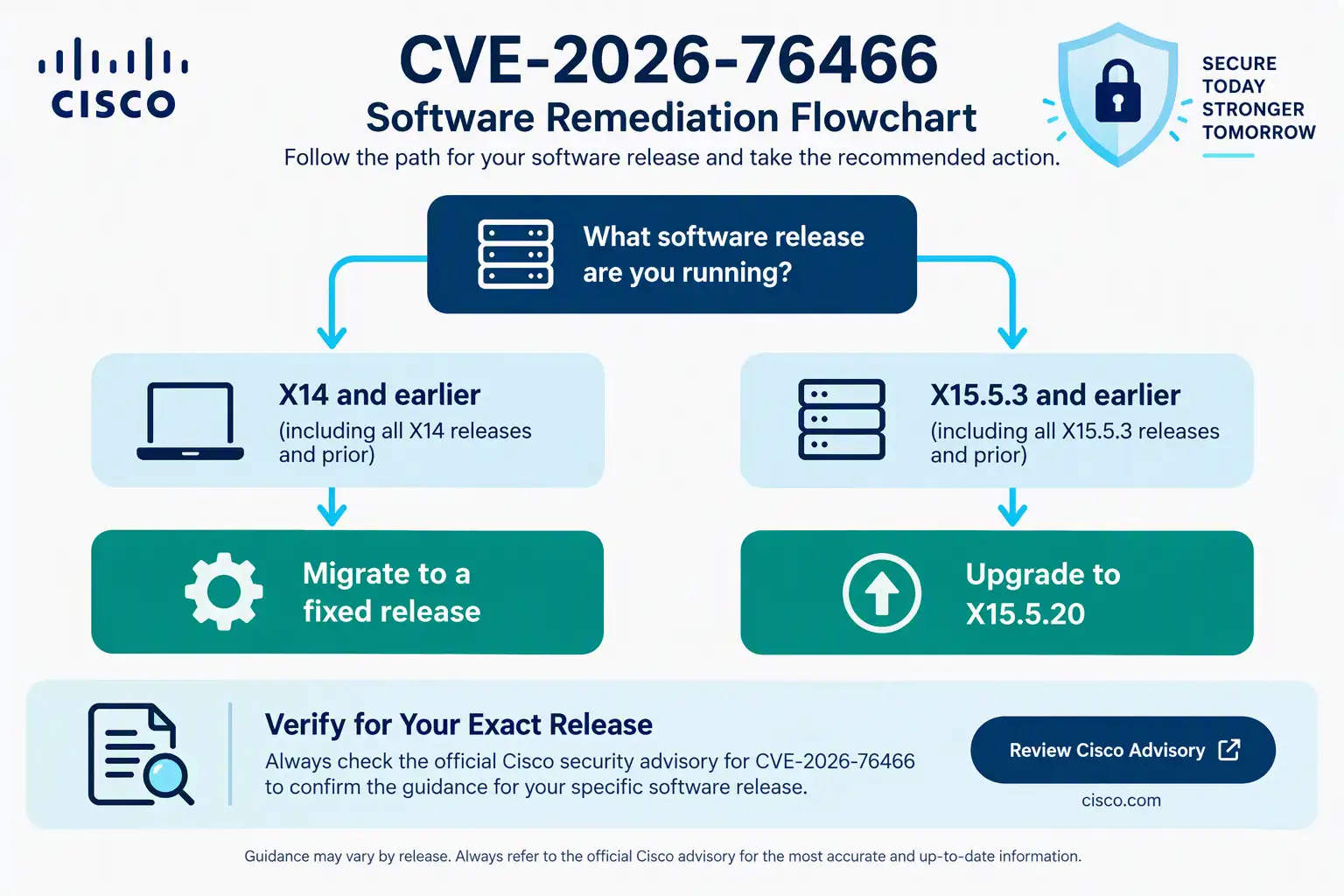
Cisco lists the following release guidance:
X14 and earlier: Migrate to a fixed release.
X15.5.3 and earlier: Upgrade to X15.5.20.
Administrators should consult the official advisory's fixed software section to confirm the appropriate upgrade path for their exact release and deployment.
Cisco Confirms That No Workaround Is Available
Cisco explicitly states that no workaround addresses this vulnerability. The company recommends upgrading to the appropriate fixed software release to remediate the issue and avoid continued exposure.
This makes software remediation the central action for affected organisations. Security teams should identify clustered Expressway-C and Expressway-E systems, determine their running versions and plan upgrades in line with Cisco's published guidance.
Where an upgrade requires operational coordination, administrators should follow their established change-management procedures while prioritising the security risk.
Cisco also notes that the fix is included in the broader Cisco Expressway Series Security Hardening Release for October 2026. Organisations reviewing their communications infrastructure can consult that related advisory for additional information about the broader hardening release.
Has Cisco Reported Active Exploitation?
At the time of publication, Cisco's Product Security Incident Response Team (PSIRT) stated that it was not aware of public announcements or malicious use of this specific vulnerability.
This is an important distinction. The absence of known exploitation does not establish that a vulnerable system is safe or that exploitation is impossible. It reflects the information Cisco disclosed in its advisory.
Organisations should use the published severity rating and affected-version guidance to assess their exposure rather than waiting for reports of an attack.
Cisco credited Stefan Aleksic of Jane Street for reporting the vulnerability.
What Security Teams Should Do Next
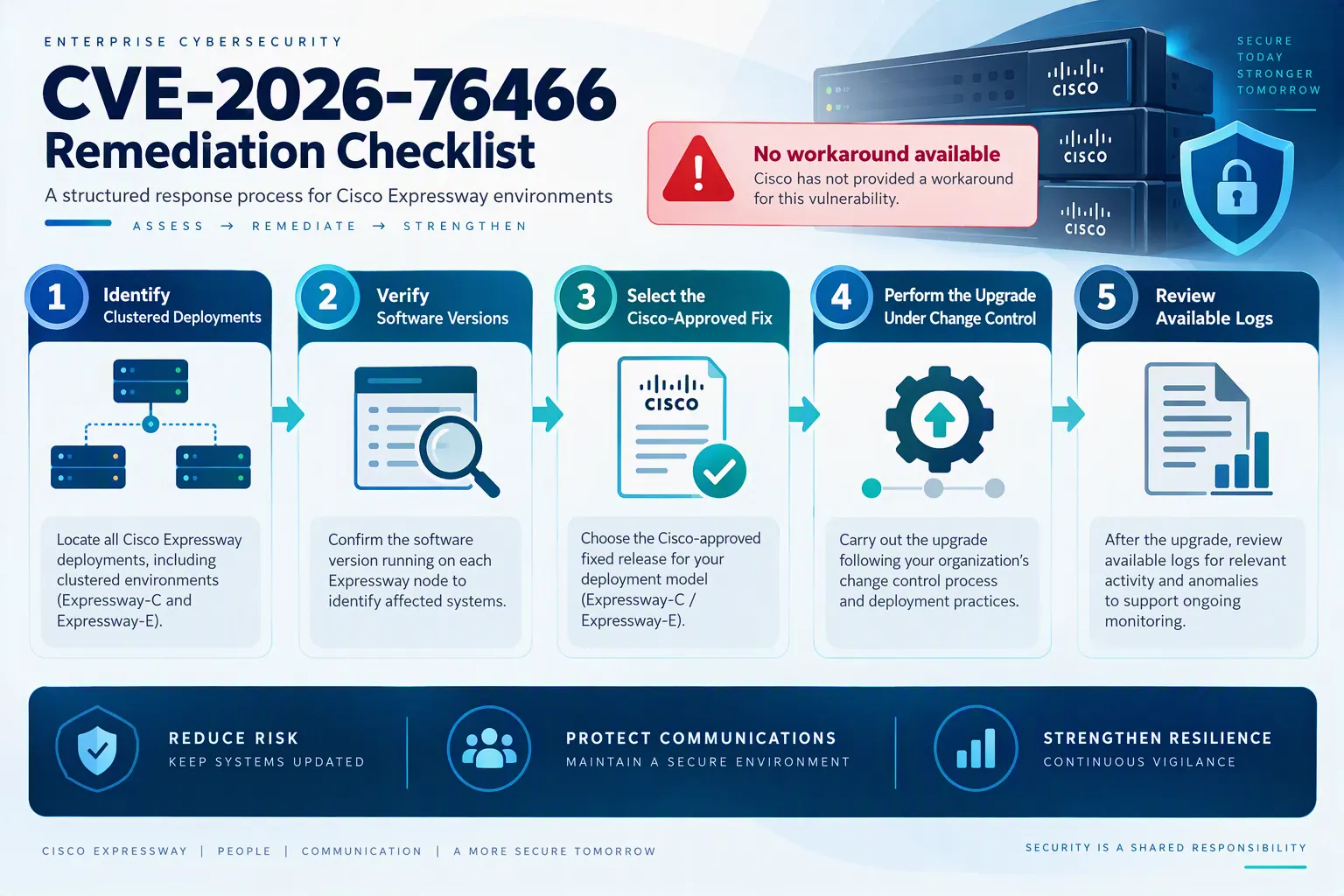
Organisations using Cisco Expressway should consider the following actions:
Identify affected deployments. Inventory Expressway-C and Expressway-E virtual and appliance systems, paying particular attention to clustered configurations.
Verify software versions. Compare installed releases with the affected and fixed release information in Cisco's advisory.
Prioritise the upgrade. Plan migration or upgrading to an appropriate fixed release. Cisco states that no workaround is available.
Review security monitoring. As a general defensive measure, review available system and network logs for activity that warrants investigation. The advisory does not disclose specific indicators of compromise.
Follow Cisco's official guidance. Consult the original advisory and the October 2026 Expressway security hardening release for applicable remediation details.
Analysis: Why This Vulnerability Matters
The announcement highlights a broader security priority for enterprise communications infrastructure: weaknesses in authentication-related mechanisms and certificate validation can have serious consequences when they affect services that are reachable over a network.
The reported potential for root-level command execution makes the vulnerability particularly important for administrators responsible for clustered communications deployments. A critical severity rating does not establish that an attack has occurred, but it provides a strong reason to assess exposure promptly.
For enterprises, the practical lesson is to maintain accurate asset inventories, track vendor security advisories and establish a clear process for applying security updates. These measures are especially relevant when a vendor confirms that no workaround is available.
Conclusion
CVE-2026-76466 is a critical Cisco Expressway vulnerability with a CVSS score of 9.8. It affects vulnerable clustered Expressway-C and Expressway-E deployments and could permit remote execution of operating system commands as root under the conditions described by Cisco.
Cisco has released fixes and confirmed that no workaround addresses the flaw. Organisations should verify their software versions and follow the official upgrade guidance without assuming that the absence of known exploitation removes the risk.
Source: Cisco Security Advisory
About the Author