
Microsoft Links Storm-0940 to AI-Driven ConnectWise Supply Chain Attack
Microsoft says Storm-0940 used the ARTEX agentic AI framework to accelerate a ConnectWise supply chain compromise, targeting hundreds of organisations and obtaining privileged cloud access in some cases in under three hours.
Xcademia Team
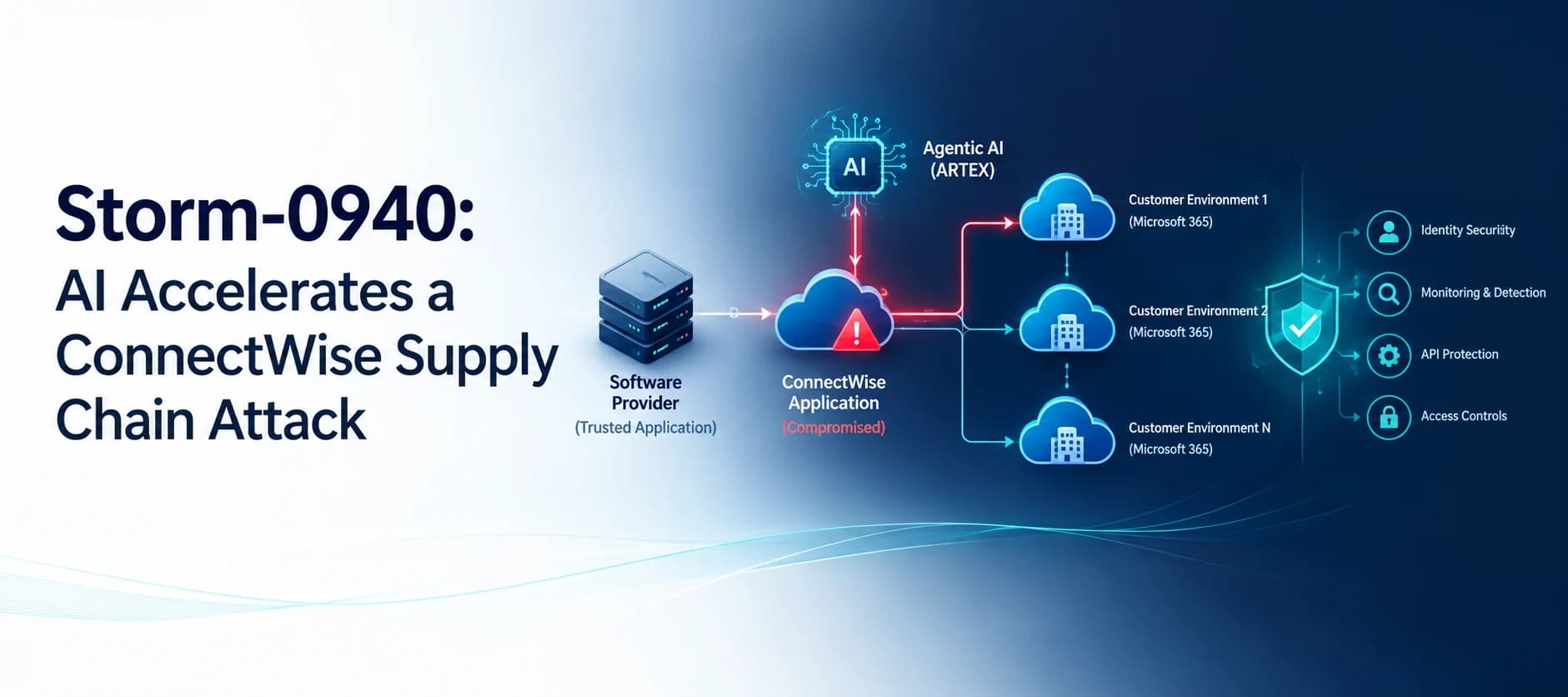
How AI-Driven Attacks Are Exploiting Trusted Cloud Applications
Microsoft has attributed a recent ConnectWise supply chain compromise to Storm-0940, a China-state-aligned threat actor that used an agentic artificial intelligence framework called ARTEX to automate offensive security workflows. The activity affected organisations across multiple industries and involved attempts to access downstream Microsoft 365 customer environments through applications that had already been granted permissions.
The findings highlight a growing security challenge: AI-assisted attacks can accelerate existing intrusion techniques, while trusted applications and authorised permissions can provide a route into cloud environments without requiring a conventional interactive user sign-in.
Microsoft reported that some attacks resulted in privileged access to cloud infrastructure, with several cases reaching that stage in less than three hours after initial targeting. However, the company cautioned that identifying an affected application or a successful authentication event does not automatically mean customer data was accessed or stolen.
1. What happened in the ConnectWise supply chain compromise?
According to Microsoft, Storm-0940 began using ARTEX in attacks as early as September 2026. The activity targeted hundreds of organisations globally, including those in aerospace and defence, automotive, energy, financial services, government, manufacturing, software and technology.
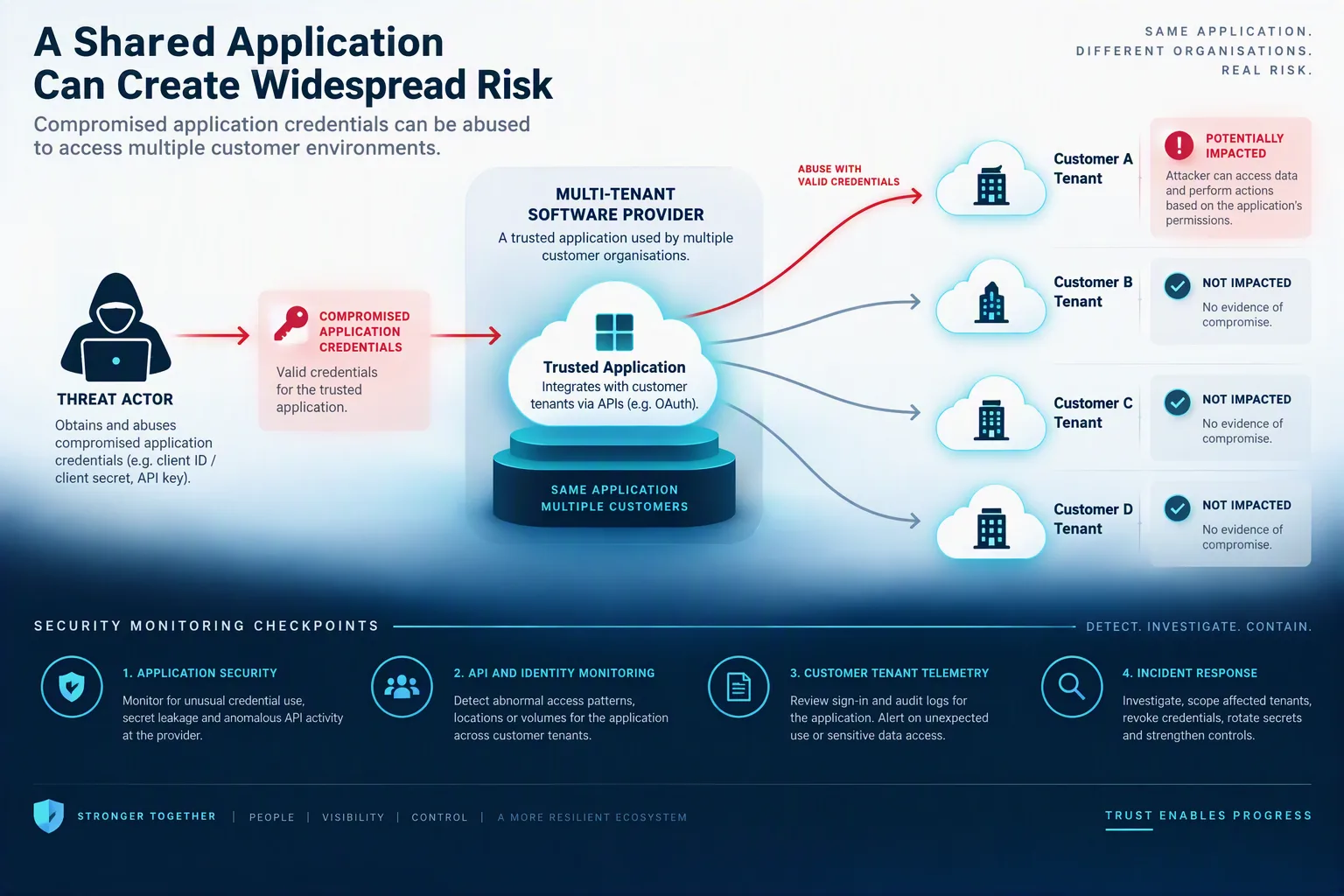
Microsoft assesses that Storm-0940 was responsible for the recently disclosed compromise involving a multi-tenant ConnectWise application. A multi-tenant application can be authorised by multiple customer organisations. If its credentials or access mechanisms are abused, the risk can extend beyond the original service provider to connected customer environments.
The incident illustrates why supply chain security extends beyond a company's own infrastructure. Organisations also need to understand the applications, service providers and third-party identities that hold access to their cloud resources.
2. What is Storm-0940, and how was ARTEX used?
Microsoft describes Storm-0940 as a China-state-aligned threat actor active since 2021, with a history of targeting organisations for data theft. Its previously observed methods included password spraying and exploiting internet-facing applications to obtain initial access, followed by movement through compromised environments.
In the ConnectWise-related campaign, Microsoft observed ARTEX being used to accelerate several activities:
Scanning and reconnaissance: Identifying potential targets and gathering information about cloud resources.
Password spraying: Attempting commonly used passwords across accounts.
OAuth application abuse: Using applications with existing authorisation to access cloud environments.
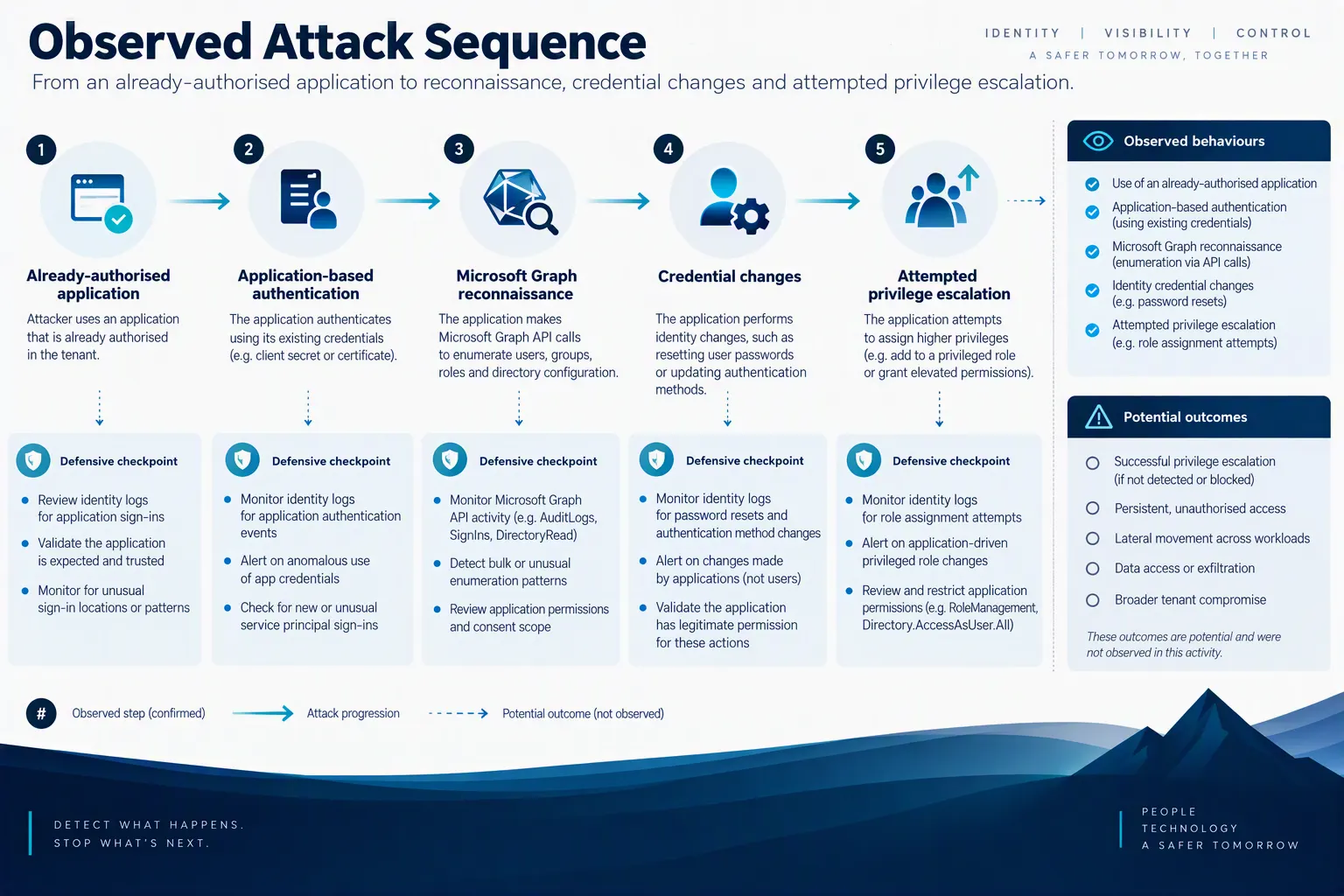
Post-compromise activity: Conducting reconnaissance through Microsoft Graph, changing application credentials and attempting privilege modifications.
ARTEX is an agentic AI penetration testing framework. Microsoft describes it as a tool that can use AI models to automate offensive security workflows. Although penetration testing has legitimate defensive uses, automation can also be repurposed by attackers to execute malicious activity at greater speed and scale.
Microsoft's central concern is not simply that AI was present in the attack. It is that AI-enabled automation accelerated established techniques and allowed multiple attack paths to be pursued without the same human scheduling constraints.
3. Why application permissions and OAuth matter
A key part of the reported activity involved applications that had already been granted access to Microsoft 365 environments.
OAuth is a widely used authorisation framework that allows applications to access resources under defined permissions. Applications may authenticate using their own identities and credentials, rather than requiring a user to sign in interactively each time.
That distinction matters during incident response. Security teams cannot rely exclusively on unusual interactive logins or compromised employee passwords to identify suspicious activity.
Microsoft observed follow-on activity through Microsoft Graph, the API used to access Microsoft cloud data and services. The activity included reconnaissance, application credential changes and attempts to modify privileges that could support expanded or persistent access.
The broader security lesson is that legitimate authentication mechanisms can be abused when application credentials, permissions or trusted integrations are compromised.
4. Less than three hours from targeting to privileged access
One of the most significant details in Microsoft's report is the speed of some intrusions. The company said several ARTEX-driven attacks resulted in privileged cloud access, with multiple instances reaching that stage in less than three hours after initial targeting.
This is an important operational warning for defenders. When reconnaissance, credential abuse and follow-on actions are automated, an organisation may have less time to investigate early warning signs before an attacker attempts to expand access.
It does not mean every attack succeeded, nor does it establish that all affected organisations suffered data theft. Microsoft explicitly distinguishes suspicious authentication and follow-on activity from confirmed access to or exfiltration of customer data.
For security operations teams, the implication is clear: detection and response processes should account for rapid sequences of related events, rather than assessing every alert in isolation.
5. What Microsoft says organisations should do
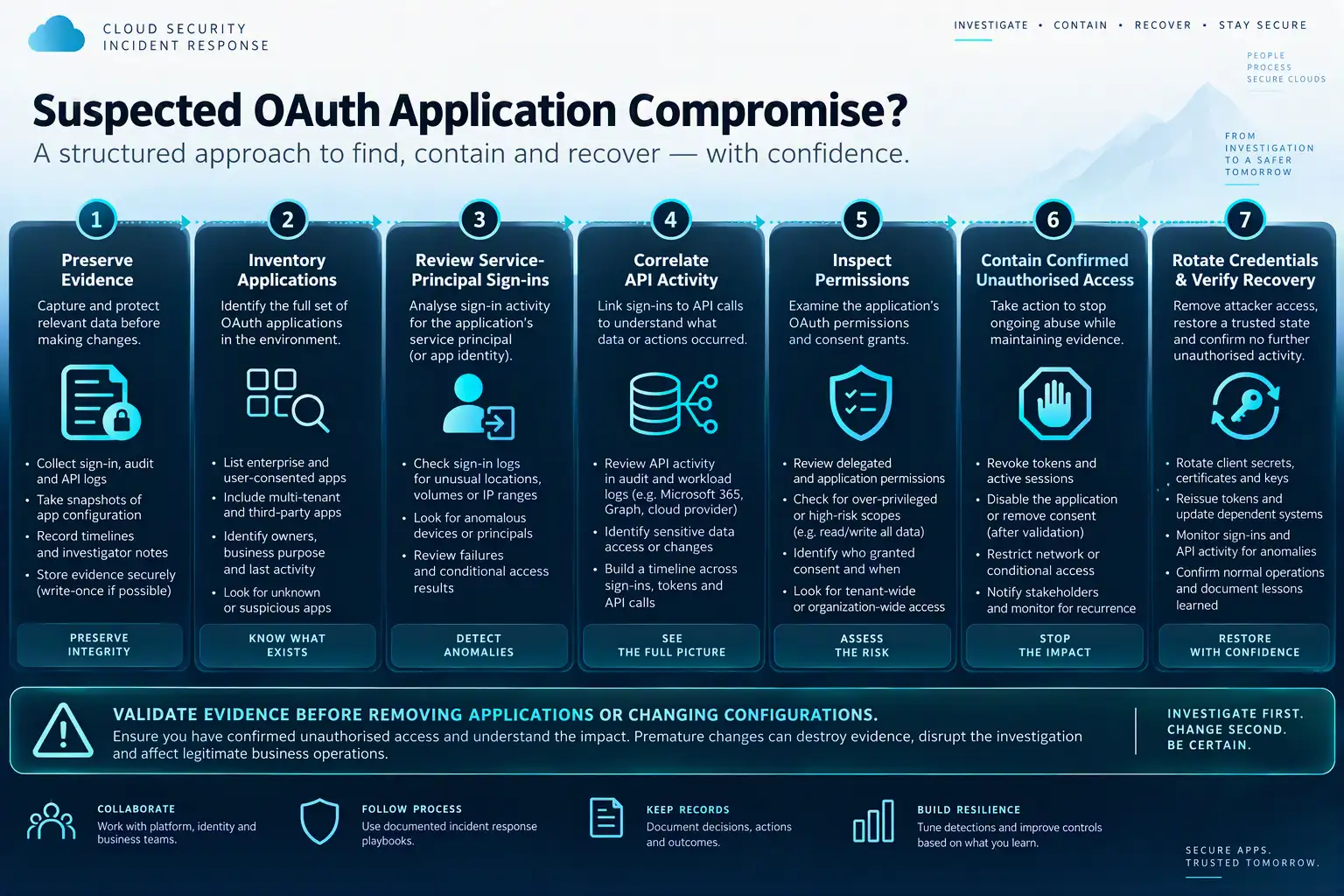
Microsoft recommends a focused investigation of potentially affected ConnectWise applications and the identities and permissions associated with them.
Its immediate guidance includes:
Keep affected connections disabled until ConnectWise provides formal restoration instructions.
Preserve evidence before making changes. Do not delete enterprise applications as the first response.
Inventory affected application IDs and identify their tenant-specific service principal object IDs.
Review current and historical authorisations across Microsoft 365 tenants, including integrations that are no longer in use.
Inspect sign-in and audit records for unfamiliar service-principal activity, credential additions, new application owners, consent grants and unexpected privilege assignments.
Investigate unusual data access, including suspicious mailbox activity, downloads, forwarding rules and file access.
Revoke unnecessary permissions and rotate credentials when suspicious activity is confirmed.
Verify remediation to establish whether unauthorised access remains and assess the operational impact on backup and restoration workflows.
Microsoft also recommends applying least privilege to multi-tenant application permissions and consent grants, alongside monitoring unusual application-only activity and changes to credentials or privileged roles.
The company advises organisations to preserve available Microsoft Entra sign-in and audit records, Microsoft Purview Audit records, security information and event management (SIEM) data, and Microsoft Graph telemetry. It also provides investigation queries for Microsoft Defender XDR and Microsoft Sentinel to help security teams correlate application sign-ins with subsequent API activity.
6. Microsoft's detection and investigation approach
Microsoft identifies several suspicious behaviours that defenders can investigate, including unusual Microsoft Graph activity associated with affected ConnectWise applications, applications assigning themselves highly privileged roles, and suspicious OAuth application access to mail or collaboration resources.
The company's published hunting guidance helps security teams determine whether an affected application is present, what permissions it holds, whether it authenticated and what API activity followed. Microsoft also cautions that finding an application in a tenant establishes potential exposure, not proof that the application was abused.
This distinction is important for accurate incident assessment. Security teams need to correlate identity events, application configuration changes, API requests and data-access records before reaching conclusions about the extent of a compromise.
Microsoft additionally points organisations to its Security Dashboard for AI, which brings together AI-related security, identity and data risk information across Microsoft Defender, Microsoft Entra and Microsoft Purview. The company recommends threat protection for AI services and stronger governance of application permissions as part of broader AI risk management.
7. What this means for enterprise security
The incident highlights a broader industry shift toward AI-assisted cyber operations. Attackers do not necessarily need entirely new exploitation techniques to increase their operational reach. Automating existing workflows can make familiar methods faster and allow more targets or attack paths to be handled in parallel.
For enterprises, this could mean reassessing how quickly security teams can detect and respond to application identity abuse, particularly in environments that depend on third-party integrations.
Three priorities stand out:
Treat application identities as security-critical assets. Review their permissions, credentials, owners and business justification.
Correlate identity and API activity. A successful authentication should be examined alongside subsequent actions and resource access.
Prepare for faster incident timelines. Detection, evidence preservation and containment procedures should be ready before an incident occurs.
These are operational implications drawn from the reported activity, rather than guarantees that any single security control will prevent similar attacks.
Conclusion
Microsoft's investigation into Storm-0940 and the ConnectWise supply chain compromise demonstrates how agentic AI can accelerate established attack techniques and increase pressure on cloud security teams. The reported use of ARTEX, abuse of authorised applications and attempts to expand privileges reinforce the importance of securing application identities as carefully as user accounts.
Organisations should review the relevant vendor guidance, investigate suspicious service-principal and Microsoft Graph activity, preserve evidence and verify that remediation has removed unauthorised access. The key lesson is not that AI makes every attack successful, but that automation can shorten the time defenders have to recognise and contain a complex intrusion.
Source: Microsoft Security Blog
About the Author