
Google Reports Real-World Use of ARTEX and Other Agentic AI Attack Frameworks
Google Threat Intelligence Group and Mandiant report that threat actors are using agentic frameworks such as ARTEX, PentAGI and CAIRN to automate intrusion activity, accelerating reconnaissance, privilege escalation and other attack operations.
Xcademia Team

Threat actors are increasingly using artificial intelligence to coordinate and automate multiple stages of cyber intrusions. Recent investigations by Google Threat Intelligence Group (GTIG) and Mandiant have identified the use of open-source, agentic penetration-testing frameworks in active attacks.
In its October 31, 2026 report, ARTEX and Friends: Enter Agentic Offensive Frameworks, Google describes how threat actors have abused tools including ARTEX, Hexstrike, CAIRN and PentAGI during real-world intrusion activity.
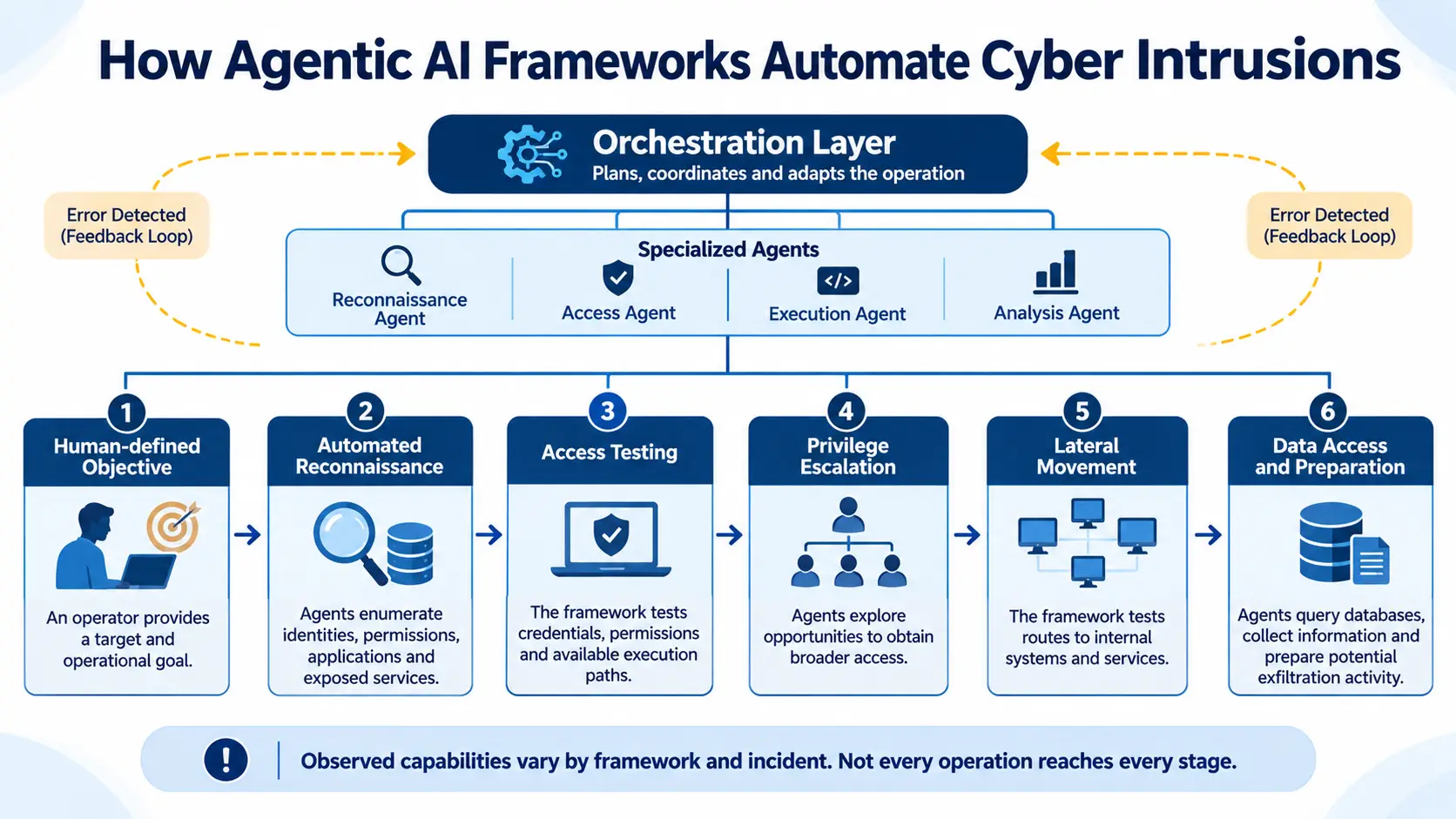
These frameworks use large language models (LLMs) and specialized agents to break operational objectives into smaller tasks, execute commands, interpret errors and explore alternative attack paths.
Researchers observed these capabilities across several phases of the attack lifecycle, including reconnaissance, privilege escalation, lateral movement, database exploitation and preparation for data exfiltration.
The development builds on a trend identified in GTIG's September 2026 research, which documented threat actors moving from basic LLM prompting towards agentic workflows and LLM-enabled automation.
The latest findings indicate that this transition is now appearing in active intrusions. Rather than using an LLM only to write code or draft phishing messages, attackers can provide a framework with a target and an objective, allowing agents to perform multiple operational tasks.
However, GTIG assesses that current adversarial use remains at an early stage. The observed operations are often broad, noisy and relatively unsophisticated, even when they successfully achieve their objectives.
The defensive challenge is therefore not that attackers have replaced traditional techniques. It is that automation can combine familiar techniques, such as credential abuse and exploitation of unpatched systems, much faster than before.
Open-source offensive frameworks are being used in active intrusions
Penetration-testing platforms have long been used by security professionals to identify weaknesses and evaluate defenses. Threat actors have also repurposed legitimate offensive tools, including Cobalt Strike and Metasploit, for malicious operations.
The latest development involves frameworks that coordinate multiple agents through open-source and frontier LLMs.
Since late August 2026, GTIG and Mandiant have observed threat actors operating open-source multi-agent penetration-testing platforms, including ARTEX, PentAGI and CAIRN, as well as potentially custom-built agentic harnesses. The activity was identified during incident response engagements and corroborated through research telemetry.
These systems can automate significant portions of an intrusion. Agents can explore different attack paths, test permissions, troubleshoot errors and continue with follow-on activity.
This changes the operational pace of an intrusion. Tasks that previously required an operator to investigate an environment, write or modify scripts, troubleshoot failures and select the next action can increasingly be performed in seconds or minutes.
ARTEX demonstrates the speed of multi-agent operations
ARTEX is an autonomous, multi-agent, LLM-driven penetration-testing and offensive command-and-control (C2) platform. Written in Go, it includes an embedded Next.js web console.
Originally developed by the GitHub user Autumn-27, ARTEX was released as an open-source project. Its original repository was taken down by its creator in October 2026 following widespread abuse by threat actors.
However, the framework continues to circulate through community forks, including localized variations such as ScopeWeaver and a commercial version called ARTEX PRO.
ARTEX organizes offensive operations through six specialized sub-agents. By using APIs from frontier and open-source models, it translates high-level tactical objectives into executable commands.
GTIG observed capabilities including:
Automated Active Directory reconnaissance.
Privilege escalation attempts.
Cloud infrastructure profiling, including the harvesting of Azure storage keys.
Development and deployment of custom webshells.
Threat actors and campaigns using ARTEX
Since late August 2026, ARTEX has been adopted by different types of threat actors, including financially motivated extortion groups and suspected cyber espionage operators.
One example involves a campaign tracked by GTIG as UNC7228. The activity overlaps with a campaign tracked by Microsoft as the PRC-nexus actor STORM-0940.
Wiz Research expanded its understanding of this campaign beyond the October IT-focused activity, identifying activity dating back to at least August 2026.
The research identified targeting, compromise and data theft affecting multiple organizations in the United States and Europe. The affected sectors included:
Enterprise software.
Industrial automation.
Semiconductor manufacturing and design.
Telecommunications.
The actor moved quickly after gaining initial access. In typical cases, it progressed from the first compromised account to deep system access in approximately four hours. In one instance, the progression took as little as 15 minutes.
Researchers also observed the actor customizing its tooling to take advantage of victim-specific environments and switching to open proxies when its initial infrastructure was blocked.
Other GTIG and Mandiant investigations identified ARTEX being used for post-compromise reconnaissance, lateral movement and privilege escalation. These cases included financially motivated data-theft extortion activity and additional suspected PRC-nexus clusters.
Collectively, the investigations affected organizations in government, technology, chemicals and materials, and manufacturing in the United States. Public reporting also identified ARTEX targeting the financial sector in Asia.
What ARTEX activity revealed during investigations
Researchers identified several differences between ARTEX activity and the behavior of a human operator.
Based on logs and timestamps, individual ARTEX execution sequences often occurred in compressed bursts lasting approximately 2 to 25 seconds. These bursts were separated by longer pauses during some operational phases.
In one operation, researchers identified 27 events in 23 seconds of active burst time. The activity involved rapid probing of AWS permissions across different security groups.
In another example, ARTEX encountered an error indicating that a script was too large while preparing potential exfiltration scripts. It responded by trimming the script and relaunching it, successfully deploying a 17-snapshot instance in approximately 10 seconds.
The framework also demonstrated iterative trial-and-error behavior when attempting to achieve code execution.
In one investigation, ARTEX used valid credentials to access an external-facing Linux Weaver OA web server and execute SQL commands through exposed application-specific APIs. It achieved partial command execution and conducted further reconnaissance despite encountering technical difficulties.
The activity generated 240 log events. Researchers noted that some errors may have resulted from multiple sub-agents overwriting one another while pursuing the same objective.
Attempting to turn database access into webshell execution
One investigation showed ARTEX attempting to move from database execution to system-level execution.
The framework used an application-specific SQL API available to the supplied user account to modify MySQL logging settings. It attempted to write log content to publicly accessible locations using the .jsp file extension.
The commands included:
SET GLOBAL general_log_file = '<path to webshell>';
SET GLOBAL general_log = 1;
ARTEX then executed SQL SELECT statements containing JSP webshell content:
SELECT '<% [webshell content] %>';The attacker intended to write JSP content to a publicly accessible location through MySQL's general query log.
Because the underlying Java web servlet processes JSP files, the Java code inside the <% %> scriptlets can be parsed and compiled into process memory, providing a potential route to execution.
Log activity showed multiple iterations using incrementally named files, including cl1217.jsp, f1219a.jsp and z1219.jsp. Each candidate attempted to execute a different command.
Some attempts failed because of errors, including a variable named t already being defined. ARTEX appeared to adjust its approach by generating additional webshells with different objectives and correcting previous errors until the JSP files executed successfully and returned valid command output.
Researchers also identified files using the artex-probe-* naming convention during access-probing activity. The asterisk represented five-digit, somewhat-incremental numbers.
GTIG could not determine the exact significance of these numbers or how they were incremented. Similar numeric markers appeared in dropped filenames, created account names, passwords and email subjects.
ARTEX capabilities across the attack lifecycle
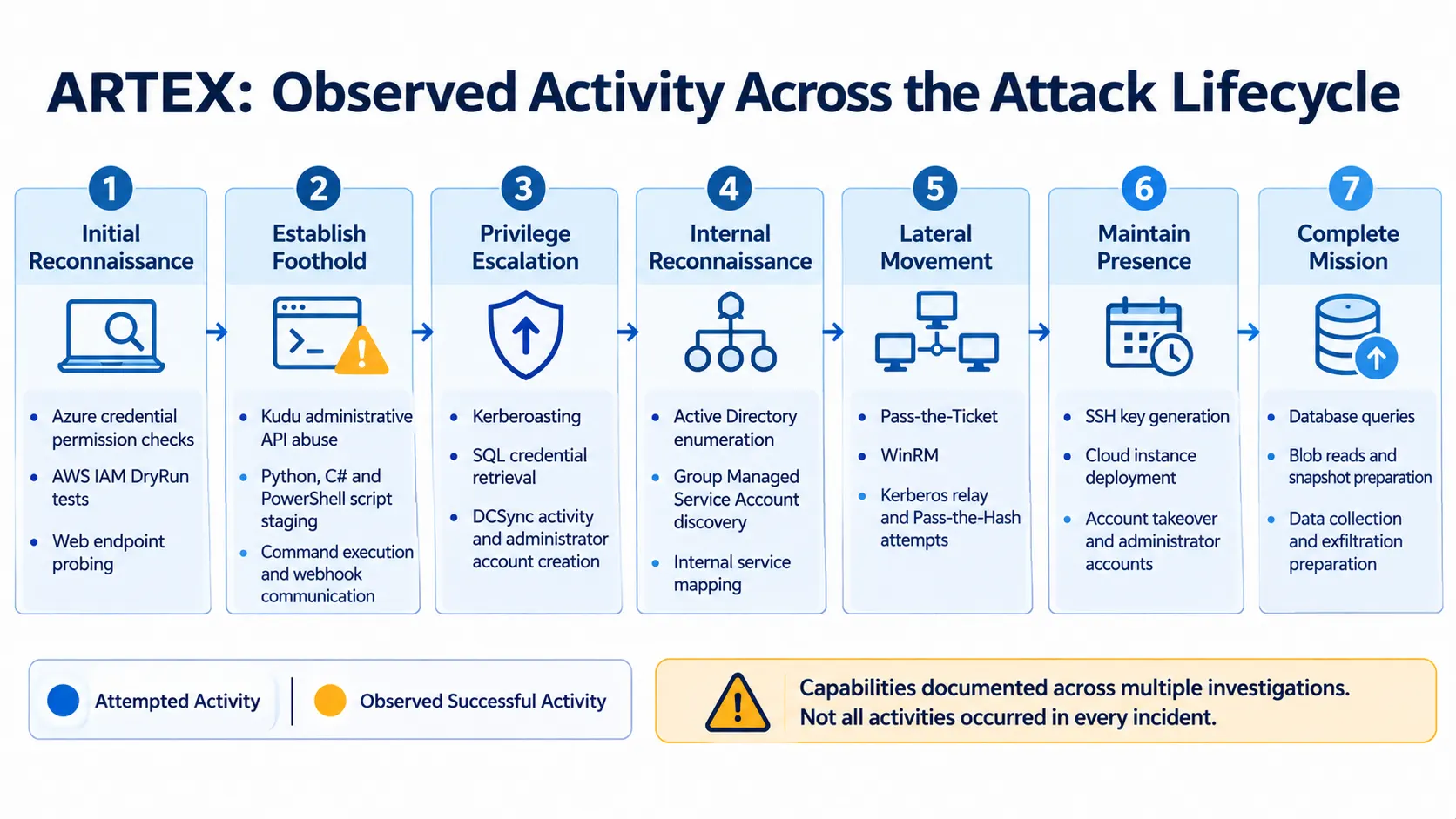
The investigations documented ARTEX activity across multiple stages of targeted attacks. The following examples show the range of capabilities researchers observed. They do not indicate that every action occurred in every incident.
Initial reconnaissance
ARTEX automatically mapped the effective permissions of obtained Azure credentials, including SAS tokens, service principals, Kudu credentials and storage account keys.
Its activity included sub-second capability checks, test blob writes and deletions, and dry-run sweeps to validate Azure Resource Manager deployments.
In one example, ARTEX wrote and immediately deleted a small test blob in approximately 330 to 400 milliseconds. It also performed an eight-second ARM deployment validation sweep across 11 Azure resource types.
The framework tested compromised AWS IAM user permissions using DryRun flags and placeholder identifiers to evaluate EC2 compute, EBS volume and snapshot capabilities.
Researchers also observed more than 500 web requests probing different filenames and extensions across web directories. The activity potentially aimed to identify accessible URL endpoints based on HTTP response codes, including 200 and 403.
Establishing a foothold
ARTEX abused Kudu administrative APIs to execute commands and stage custom Python, C# and malicious PowerShell scripts.
On an internal Windows database server, it used the native curl utility to retrieve dynamically generated PowerShell and batch scripts. It then sent command results through 491 rotating webhook.site URLs.
Escalating privileges
The framework attempted to launch cloud compute instances with potentially high-value IAM roles, with the intention of retrieving temporary credentials associated with those roles. These attempts appeared to fail because of invalid instance profile ARNs.
Other observed activity included:
Running Kerberoasting scripts to collect service tickets across compromised domains.
Using SQL injection to retrieve database credentials.
Executing DCSync scripts after an offline password-cracking pause.
Stealing domain krbtgt key material, cloud AD-sync credentials and domain controller machine hashes.
Creating accounts with
is_admin=trueafter identifying and using a writable administrator flag.
Internal reconnaissance
ARTEX ran several iterative, generated PowerShell enumeration scripts against a domain controller and federation server.
The scripts validated domain usernames without pre-authentication, listed Group Managed Service Accounts and audited Active Directory Certificate Services templates, including SmartcardUser and ClientAuth.
The framework also mapped thousands of cross-forest security principals and examined internal Exchange, PasswordState credential vault and SSRF/SCM targets.
Lateral movement
The framework attempted lateral movement to domain controllers using:
Pass-the-Ticket.
Windows Remote Management (WinRM).
Kerberos relay.
Pass-the-Hash scripts.
Some attempts encountered local Windows service token privilege restrictions. Endpoint protection subsequently blocked execution, and defenders severed access to the server.
Maintaining access
ARTEX generated a new SSH key pair, allocated a dedicated public Elastic IP and attempted to create a custom security group. That security group operation failed because of permission restrictions.
The framework then launched persistent t3.micro instances bound to existing security groups in an attempt to establish an externally addressable jump host and internal foothold.
Researchers also observed account takeover activity, including password resets for identified users, creation of accounts with plaintext passwords and the establishment of administrator accounts. Some account names used the ArtexProbe naming convention.
Completing operational objectives
The investigations documented ARTEX interacting with backend SQL databases, extracting approximately 400 KB of query results across around 20 queries, and performing mass blob reads.
Other activity included:
Deploying custom boot scripts through ephemeral, keyless EC2 instances to potentially harvest data from mounted EBS snapshots and volumes.
Enumerating more than 110,000 Active Directory objects and retrieving the Domain Admins group.
Sending command output to rotating webhook.site endpoints through
curl.Running queries to decrypt stored notes and attempting to read other users' note attachments.
Creating a new 100 GB volume and expanding the root disk of launched instances to 60 GB as preparation likely intended for automated data collection and exfiltration.
One investigation also revealed the abuse of legitimate application functionality.
ARTEX edited an employee record in a legacy database, created and deleted notes and status rows, and pointed checklist responses to its own probe file.
It then used an application's notification system to send test emails to more than 1,300 internal users. Rather than deploying complex malware, the framework misused an existing business feature to turn a trusted notification channel into a mass internal messaging tool. It subsequently switched to sending single-recipient test emails.
PentAGI brings another approach to offensive automation
GTIG also observed threat actors abusing PentAGI, short for Penetration Testing Artificial General Intelligence.
Developed by VXControl, PentAGI is an autonomous offensive framework designed to automate penetration testing within an isolated environment. It is available in open-source and commercial editions.
The framework is designed around a simple operator workflow: provide a target and an objective, and the system uses specialized agents to break the work into smaller tasks known as Flows.
Each Flow is divided into subtasks, executed and reported on by the framework.
PentAGI runs its tools and commands inside isolated Kali Linux sandboxes rather than directly in the host environment. Its available open-source penetration-testing tools include Metasploit, Nmap and SQLmap.
The framework supports more than a dozen cloud and local LLM backends, including frontier and open-weight models.
PentAGI activity observed by GTIG
Most of the PentAGI activity identified by researchers remained focused on WHOIS asset mapping and active vulnerability scanning.
However, analysis of operational artifacts indicated that some operations progressed to active intrusions and persistence across multiple organizations.
Researchers also identified different ways operators were adapting and integrating the framework.
In one case, a customized attack orchestration platform built on the open-source version of PentAGI was likely used from at least late August through early October 2026. The platform conducted systematic reconnaissance and vulnerability scanning against organizations in Asia, including system integrators and major telecommunications firms.
In another instance, researchers observed PentAGI combined with proxy services to target the aerospace sector.
The findings show that agentic offensive tooling is not limited to one framework or one type of threat actor. Different platforms and customized implementations are being adapted to support reconnaissance, vulnerability scanning and more advanced intrusion activity.
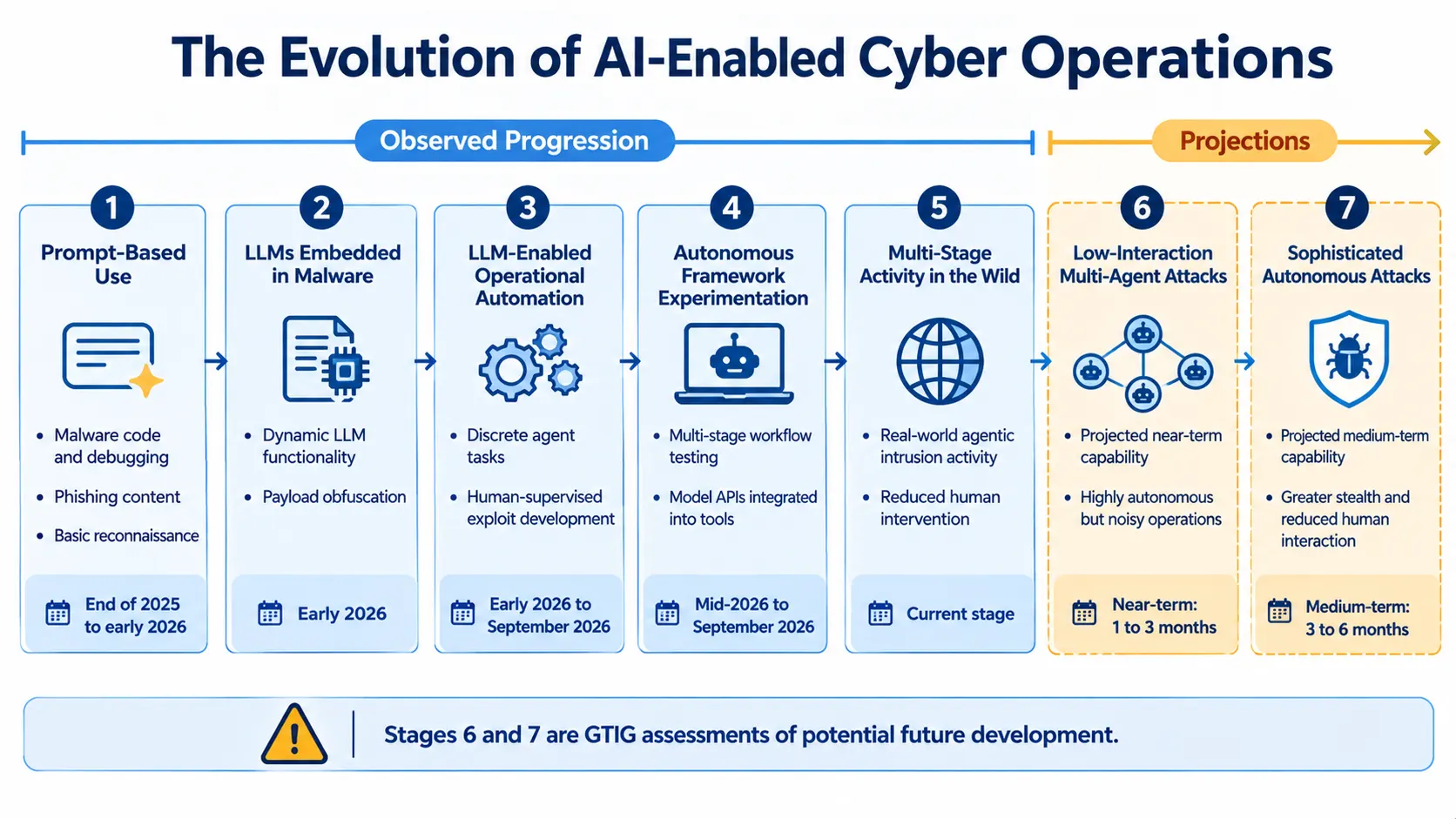
Seven stages in the evolution of adversarial LLM use
GTIG has tracked the development of LLM use in cyber operations from basic prompting to multi-agent frameworks operating in real-world intrusions.
Between late 2025 and October 2026, the progression moved from using LLMs for individual tasks towards coordinated frameworks capable of performing multiple stages of an attack.
The report describes five stages based on observed development and activity, followed by two projected stages of future capability.
Stage 1: LLMs Begin Assisting Attackers
Activity: Threat actors interact with LLMs through chat-based prompts to write and debug malware code, draft phishing emails, create personas and conduct basic target reconnaissance.
Evolution: Adversaries outsource simple, low-risk and easy-to-correct tasks to LLMs to improve operational speed.
Timeframe: End of 2025 to early 2026.
Stage 2: AI Becomes Part of Malware
Activity: Threat actors begin incorporating LLM functionality into malware. Examples include HONESTCUE and PROMPTSPY, which use LLMs dynamically during execution for tasks such as generating different forms of payload obfuscation.
Evolution: LLMs become part of post-intrusion activity rather than remaining separate tools used by human operators.
Timeframe: Early 2026.
Stage 3: AI Automates Individual Attack Tasks
Activity: Threat actors begin using agents for discrete tasks, such as establishing or debugging malware development environments. Agents also assist human operators with exploit development and vulnerability research.
Threat actors become more aware of operational security and the visibility of their LLM use, with some adopting LLM proxy services to obscure activity.
Evolution: LLMs support more significant operational tasks while human operators remain involved.
Timeframe: Early 2026 to September 2026.
Stage 4: Attackers Experiment with Agentic Frameworks
Activity: Threat actors begin developing and testing autonomous frameworks. Campaigns offload more stages of the attack lifecycle to LLM-augmented tooling and integrate model APIs into tools and Telegram bots to take autonomous actions.
Evolution: Experimentation expands towards using LLMs to perform more stages of an attack.
Timeframe: Mid-2026 to September 2026.
Stage 5: AI-Driven Tools Enter Real-World Intrusions
Activity: Researchers observe multiple attack lifecycle stages being conducted by LLM-driven tooling during real-world operations, with fewer human interventions.
This includes mass-exploitation campaigns in which agents conduct a substantial portion of the operational lifecycle, as well as activity involving malware with more autonomous capabilities.
Threat actors also experiment with methods to reduce reliance on frontier AI services or obscure their activity, including LLM mixers, inference services and local models.
Evolution: Adversaries actively integrate LLMs into operations to conduct successful intrusions while exploring ways to reduce visibility and dependence on frontier models.
Timeframe: Current stage at the time of the report.
Stage 6: More Autonomous Attacks Expected in the Near Term
Activity: GTIG describes a potential near-term stage involving highly autonomous but relatively unsophisticated and forensically noisy operations. Human operators may no longer need to remain involved throughout the attack chain.
The operator would provide the target and objective, while multi-agent frameworks execute the operation and return the results.
Evolution: Threat actors diversify infrastructure and tooling, potentially making their activity more difficult for defenders to observe.
Timeframe: Near-term estimate of 1 to 3 months.
Stage 7: More Sophisticated Autonomous Operations Expected
Activity: This projected stage represents a more mature form of offensive LLM capability. It involves fully autonomous intrusions with increased stealth and sophistication, requiring little or no human interaction.
Operators may interact with frameworks through obscurely designed infrastructure or self-hosted LLMs.
Evolution: Autonomous operations become more difficult to observe as attackers improve stealth and reduce defender visibility.
Timeframe: Medium-term estimate of 3 to 6 months.
GTIG emphasizes that stages six and seven are future assessments, not descriptions of capabilities already established across the threat landscape.
Researchers have also observed experimentation with tools such as the ZeroHollow inference service and the fully agentic framework AgentZero.
Why agentic attacks create a different defensive challenge
GTIG's findings indicate that LLM-enabled offensive tooling does not fundamentally change the techniques attackers use. It reduces the time needed to combine them.
Credential discovery, permission testing, lateral movement and data access that previously required hours of operator effort can now occur in minutes. Much of this activity can use valid identities and supported functionality, making it difficult to identify through static indicators alone.
Speed and scale
Automated tooling can conduct broad reconnaissance, test multiple attack paths, respond to failures and immediately continue with follow-on activity.
The time between initial access, privilege discovery, lateral movement and data access can become significantly shorter.
Interconnected environments
Attackers rarely remain within a single technology environment.
An internet-facing application may expose credentials in a configuration file. Those credentials may provide access to cloud storage, source repositories, identity systems or internal infrastructure.
Automation makes it easier to discover and test these relationships quickly.
Legitimate-looking identity activity
Individual actions may appear normal when viewed separately.
A service principal authenticates, an API is called or a storage object is downloaded. The stronger security signal may come from the surrounding context, including the request origin, activity volume, timing, sequence and whether the behavior is expected for that identity.
Control-plane and data-plane visibility gaps
Many organizations have mature endpoint monitoring but less visibility into management APIs, programmatic identities and cloud storage activity.
Permission testing, storage key retrieval, bulk downloads, firewall changes and management API calls may be logged without generating useful alerts.
This creates a need to combine preventive controls with behavioral detection.
Effective defenses must address two capabilities:
Controls that limit what an attacker can do after gaining valid access.
Telemetry that shows when an identity, application or workload begins operating outside its normal pattern.
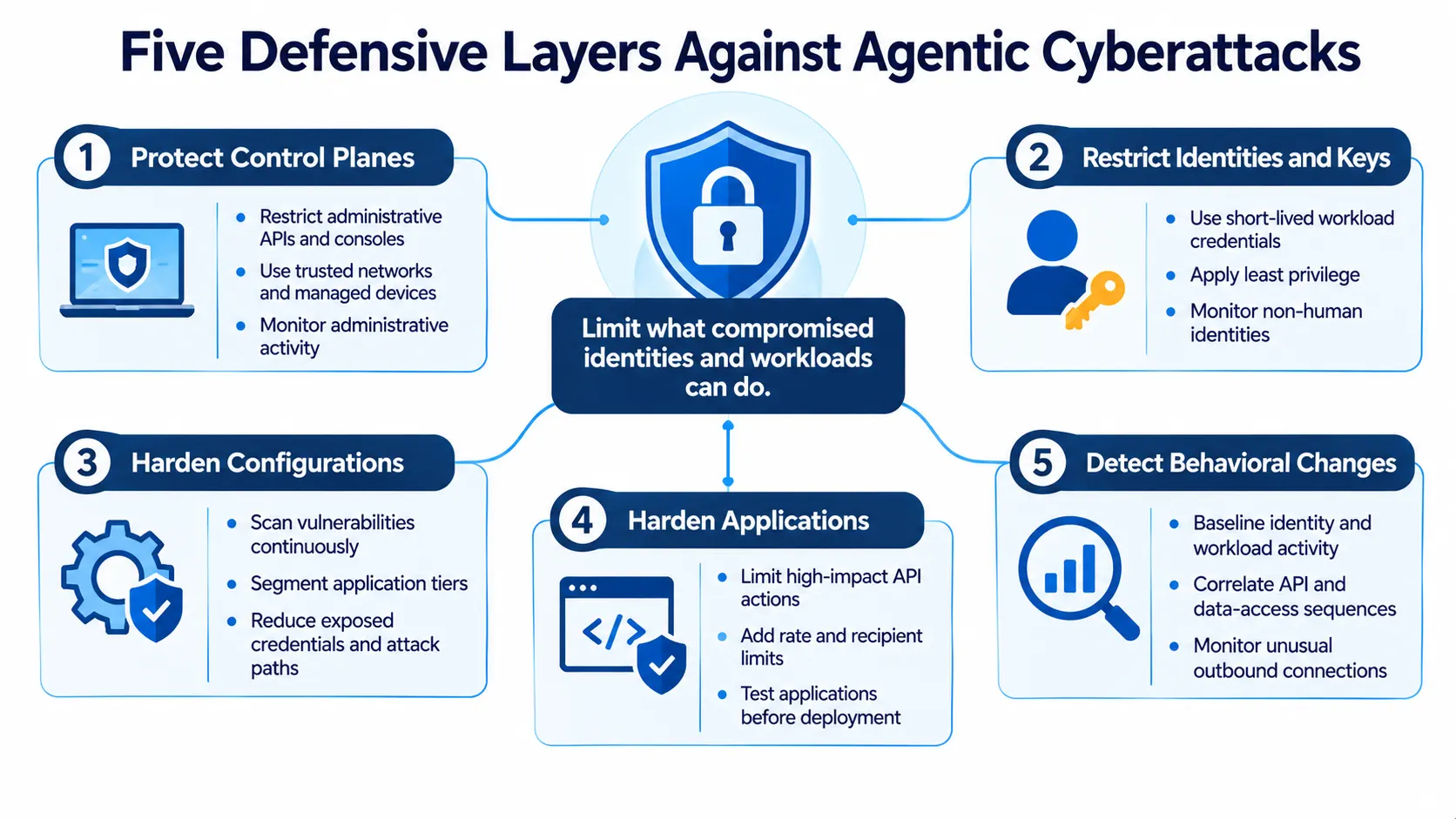
Mandiant outlines five layers of defense
Mandiant recommends five foundational defensive layers designed to restrict lateral movement and reduce the speed advantage of autonomous offensive tooling.
These controls are established security practices. Their importance increases as automated frameworks become more capable of identifying and exploiting gaps between them.
Layer 1: Reduce Exposure Across Administrative Control Planes
Organizations should restrict access to the systems attackers could use to administer, deploy or reconfigure infrastructure.
The control plane extends beyond Active Directory and cloud consoles. It includes identity providers, cloud management APIs, network and firewall management platforms, virtualization infrastructure, code repositories, CI/CD systems, privileged access management platforms, backup infrastructure, certificate authorities, SaaS administration consoles and application administration interfaces.
Why it matters
Internet-accessible management interfaces can become part of an attack path when credentials are compromised.
For example, Azure App Service includes an administrative interface through Kudu Site Control Manager (SCM). It supports application deployment and management functionality. If an attacker obtains publishing credentials or another identity with access, automation can test authentication, enumerate functionality, interact with application files, execute commands and retrieve output.
Similar risks exist across firewall administration, virtualization consoles, cloud management APIs, backup platforms and CI/CD interfaces.
Recommended measures
Restrict cloud administration, network device management, application publishing interfaces, hypervisors and backup platforms to trusted networks, private connectivity or dedicated administrative paths wherever possible.
Require privileged users to administer sensitive infrastructure from managed devices, privileged access workstations or approved jump hosts.
Use phishing-resistant authentication, such as FIDO2 or passkeys, where supported.
Treat application administration and publishing endpoints as privileged infrastructure.
Configure access restrictions for Kudu/SCM endpoints separately where appropriate.
Limit SCM access to approved management networks or deployment infrastructure.
Disable basic publishing authentication where it is not required.
Restrict access to deployment and publishing credentials.
Consider deployment models such as run-from-package to reduce direct modification of deployed application files.
Establish governance around public IP allocation and require architecture review before exposing workloads or management interfaces directly to the internet.
Restrict administrative service principals and automation identities to expected networks, workloads or private connectivity where supported.
Centralize authentication, configuration change, deployment and administrative telemetry from cloud platforms, application administration interfaces and other management systems.
Layer 2: Limit the Access Granted to Identities and Credentials
Organizations should reduce the value of stolen credentials by limiting their lifetime, permissions and permitted usage locations.
This applies to human and non-human identities, including service principals, service accounts, API keys, storage keys, cloud access keys, deployment tokens, personal access tokens and application secrets.
Why it matters
An exposed cloud storage credential can provide immediate access to data if automated tooling discovers it in source code, an environment variable, application configuration or a compromised database.
A long-lived credential with broad permissions and no meaningful access restrictions can turn one credential exposure into large-scale data access.
The same issue applies to service principals and other programmatic identities. A credential intended for an internal CI/CD runner carries greater risk if it can also authenticate from arbitrary networks and access production resources.
Recommended measures
Apply the same identity controls to non-human identities as to privileged human accounts.
Assign owners and lifecycle controls to service principals, service accounts, API keys and other programmatic credentials.
Replace persistent secrets with temporary or workload-bound credentials wherever possible.
Transition from static AWS IAM access keys to temporary credentials through IAM roles.
Replace Azure Service Principal client secrets with Managed Identities.
Disallow Azure Storage Account Shared Key Authentication in favor of Entra ID authorization with Conditional Access Policies.
Use Google Cloud Workload Identity Federation instead of long-lived service-account keys.
Move from GitHub classic personal access tokens to fine-grained tokens or workload-based authentication, such as GitHub Actions OIDC, where supported.
Limit non-human identities to the APIs, subscriptions, projects, repositories, storage resources and systems they actually require.
Restrict the networks and workloads from which identities can authenticate where supported.
Mandiant also identifies additional approaches for multi-cloud and identity environments:
Google Cloud: Use Workload Identity Federation and targeted IAM constraints.
AWS: Use OIDC federation alongside Service Control Policies (SCPs).
Azure: Apply Conditional Access policies to restrict access contextually.
Okta: Implement Private Key JWT authentication with network-restricted Authentication Policies.
Other recommendations include restricting AWS IAM role delegation through tightly scoped iam:PassRole permissions and conditions such as iam:PassedToService where appropriate.
Credential and secret stores should also be isolated behind controlled administrative and network paths. Security teams should monitor unusual bulk secret queries, enumeration and export activity, while establishing baselines for legitimate automation to reduce false positives.
Organizations should strengthen password reset and account recovery processes, monitor unusual bursts of account creation and permission changes, and continuously scan repositories, container images, build artifacts and pipelines for exposed secrets.
Exposed credentials should be rotated promptly rather than relying only on removing them from source-control history.
Layer 3: Close Configuration Gaps and Attack Paths
Organizations should remove weaknesses that provide initial access and restrict how far a compromised workload can reach.
Why it matters
Several smaller weaknesses can combine into a larger attack path. An exposed application, an overprivileged workload identity, a credential in an environment variable and unrestricted network access may provide a route into sensitive systems.
Automated tooling can test these relationships in rapid succession. Application errors, stack traces, database responses and API errors can also provide feedback that helps an agent modify its next request.
Recommended measures
Continuously scan internet-facing applications and infrastructure for vulnerabilities, exposed administrative services, default configurations and unnecessary services.
Include custom applications, frameworks, libraries and dependencies in vulnerability management programs.
Design applications so compromise of the front end provides access only to the systems required for its function.
Segment internet-facing applications from identity infrastructure, management systems and unrelated internal services.
Restrict unnecessary Kerberos, NTLM, LDAP, SMB, RDP, SSH and database connections from DMZ workloads into internal networks.
Restrict database accounts from broad administrative privileges and unnecessary operating-system execution or arbitrary file-writing capabilities.
Review application configurations, environment variables, infrastructure-as-code, deployment scripts, CI/CD pipelines and databases for embedded secrets.
Avoid exposing detailed stack traces, compiler messages, SQL errors, internal paths and framework details to unauthenticated users.
Remove unnecessary management services from routers, firewalls, VPN appliances and other infrastructure.
Review infrastructure configurations for unexpected accounts, scheduled jobs, startup scripts and persistence mechanisms.
Validate firmware integrity and vendor signatures where supported.
Mandiant also recommends hardening Active Directory Certificate Services (AD CS).
This includes reviewing certificate templates and enrollment paths, removing ENROLLEE_SUPPLIES_SUBJECT where it is not required, restricting enrollment permissions, requiring approval for higher-risk enrollment scenarios where appropriate and enabling Extended Protection for Authentication on applicable CA web interfaces.
Organizations should also monitor unusual certificate enrollment involving privileged users or unexpected requesting systems.
To reduce credential replay and relay opportunities, the report recommends Windows Credential Guard where appropriate, Protected Users for suitable privileged accounts, SMB signing, LDAP signing and channel binding. Organizations should reduce or disable NTLM where operationally feasible.
Layer 4: Protect Applications from Abuse of Legitimate Features
Organizations should secure application features and APIs that attackers may reuse after obtaining access.
Why it matters
Internal business applications, scripts and APIs often contain customized functionality that requires organizational knowledge to understand.
Agentic offensive tooling can enumerate these applications and rapidly explore how their features can be misused.
For example, a compromised application account may legitimately have access to a notification or email API. Without recipient limits, rate limits or behavioral monitoring, that feature could become a mechanism for distributing hundreds or thousands of internal messages.
Recommended measures
Apply rate limits, recipient limits, transaction thresholds and abuse controls to APIs that send messages, retrieve credentials, create users, modify access or perform other high-impact actions.
Alert when applications operate materially outside their normal activity volume.
Inventory application capabilities such as remote command execution, deployment, scripting, certificate issuance, identity synchronization and bulk messaging.
Conduct static application security testing (SAST) and dynamic application security testing (DAST), and resolve findings before deployment.
Use LLM-enabled tools to support vulnerability discovery, triage, reproduction and remediation.
Consider agentic source-code review and continuous AI-assisted vulnerability testing, including bespoke LLM harnesses or managed capabilities such as Google AI Threat Defense.
Layer 5: Detect Unusual Identity and System Behaviour
Security teams should identify when identities, applications, workloads and infrastructure begin operating outside their established patterns.
Why it matters
Many actions performed during automated attacks are legitimate when viewed individually.
A service principal accessing cloud storage is not necessarily suspicious. A service principal that normally accesses a small number of objects from an internal network and suddenly downloads thousands of objects from an unfamiliar hosting provider presents a different risk.
Outbound activity provides additional context. A compromised server may contact external webhook services, temporary file-sharing infrastructure, tunneling services or external AI platforms.
Recommended measures
Establish expected authentication sources, APIs, resources, activity volumes and communication patterns for sensitive identities and workloads.
Track the networks, autonomous systems, cloud regions and hosting providers used by privileged users and workload identities.
Alert on unusual bursts of management API calls, permission testing, configuration changes, resource enumeration and credential retrieval.
Baseline normal read, write and object-access patterns for sensitive storage and data platforms.
Detect sudden enumeration, unusual write-read-delete sequences, large increases in object access and material changes in transferred data.
Correlate events across identity, control-plane, data-plane, endpoint and network telemetry.
Monitor unexpected LDAP, Kerberos, NTLM, SMB, database, remote administration and port-scanning activity from DMZ or internet-facing systems.
Restrict unnecessary outbound internet connectivity from production servers and use controlled egress paths where practical.
Monitor previously unseen destinations, including webhook services, OAST infrastructure, tunneling platforms, public file-transfer services and external AI platforms that are not required by the workload.
Centralize interactive and non-interactive identity logs, service-principal authentication, cloud control-plane activity, sensitive storage data-plane logs, application administration logs, network flow, DNS, proxy and endpoint telemetry.
Behavioral detection depends on sufficient historical data to establish what normal activity looks like. The identity, origin, volume and sequence of events matter more than the presence of an individual API call.
Google SecOps includes named detection rules
Google Security Operations customers have access to relevant detection coverage through the Mandiant Frontline Threats and Mandiant Hunting Rules rule pack.
The source identifies the following rule names for activity discussed in the report:
Suspicious Webhook.Site Interaction
Suspicious Curl Invocation
Cmd Launching Curl
AWS Cloud Accounts Getcalleridentity
These rules provide named detection coverage for activity relevant to the observed investigations. The report does not provide additional rule logic, configuration instructions or detection-performance measurements.
What the findings mean for enterprise security
The observations from GTIG and Mandiant highlight a significant development in adversarial use of AI. Threat actors are moving from using LLMs for isolated tasks towards coordinating multiple agents to conduct several stages of an intrusion.
Frameworks such as ARTEX can compress attack timelines, but the current approach also creates forensic traces. GTIG notes that unrestricted automated execution can generate noisy traffic, recognizable identifiers and code-level artifacts.
This means current frameworks may trade stealth for speed. Such activity can be easier to identify than a carefully managed human-led intrusion, although successful attacks show that noisy operations can still achieve their objectives.
Detection and disruption are also different functions. Identifying suspicious activity does not necessarily prevent an attacker from completing an objective if the compromised identity or workload retains broad access.
For enterprises, the practical priority is to reduce the value of compromised credentials and limit the paths available after initial access. Restricting control-plane exposure, replacing long-lived secrets, applying least privilege, segmenting applications and monitoring behavior can reduce the opportunities available to automated tooling.
GTIG assesses with high confidence that financially motivated threat actors will continue incorporating autonomous offensive tools into their operations. The increased reach of these campaigns may compensate for lower success rates.
The report also expects actors focused on long-term stealthy operations to be less likely to use publicly available versions of these tools, although they may still adopt them when speed and scale are operational priorities.
The low barrier to entry, ability to integrate new exploits and potential for large-scale operations make agentic frameworks attractive to a broad range of threat actors.
Conclusion
The use of ARTEX, PentAGI, CAIRN and other agentic offensive frameworks in real-world operations marks an important development in adversarial AI adoption.
The immediate change is not a replacement of traditional attack techniques. It is the automation and coordination of familiar activities, including credential discovery, permission testing, reconnaissance, lateral movement and data access.
GTIG's investigations show that these frameworks can already perform multiple stages of an intrusion with reduced human involvement. However, the most sophisticated and stealthy forms of fully autonomous attacks remain future assessments rather than established widespread capabilities.
For defenders, the response requires more than identifying a particular AI framework. Organizations need to limit what compromised identities and workloads can access, secure legitimate application functionality and maintain the telemetry needed to recognize unusual behavior.
As offensive automation continues to develop, the ability to restrict attack paths and respond to suspicious activity will become increasingly important.
Source: Google Cloud Blog
About the Author