
DOJ Disrupts West African Scam Networks in Global Operation, 3.7 Million Accounts Removed
The US Department of Justice reports 28 arrests, more than 3.7 million online accounts removed, hundreds of devices seized, and more than $11 million in potentially freezable funds identified during an international crackdown on scam networks operating in West Africa.
Xcademia Team
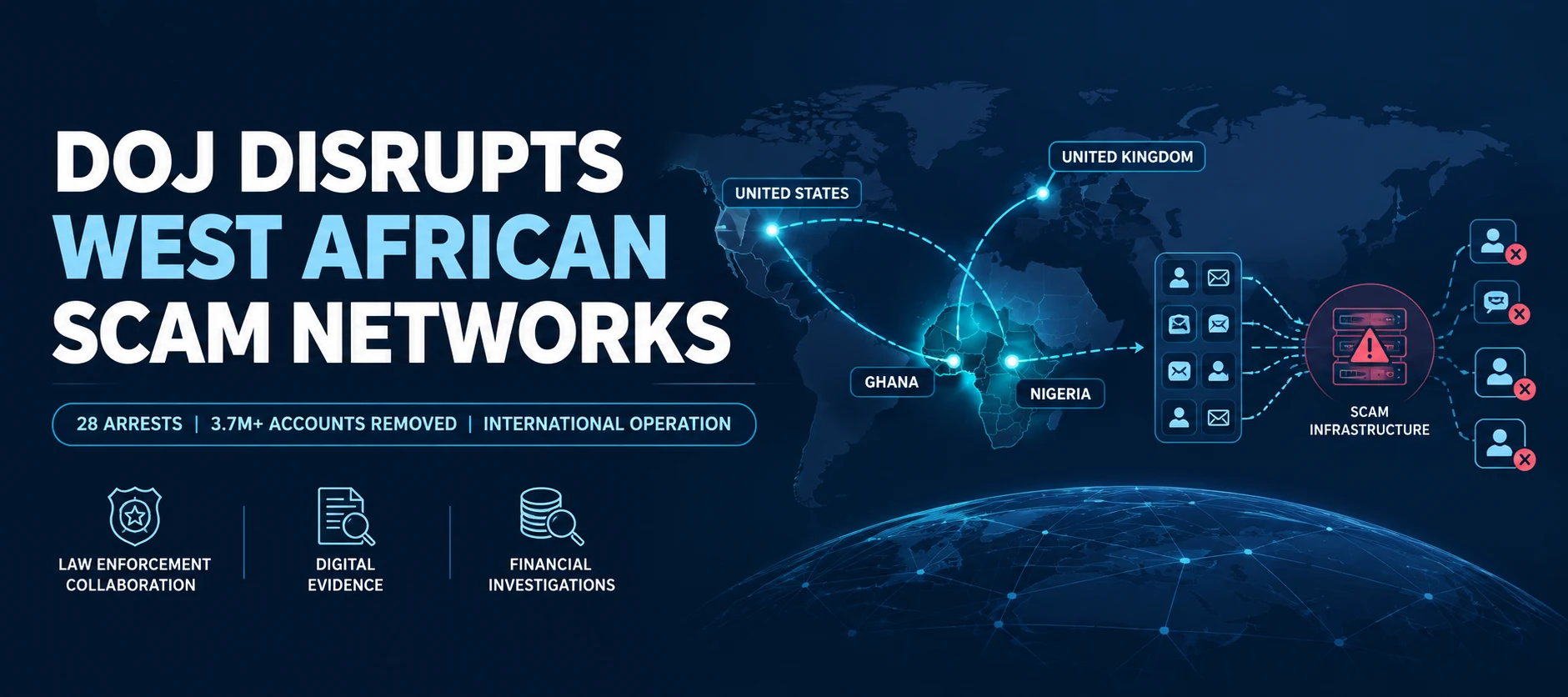
The US Department of Justice (DOJ) has announced the results of an international law enforcement operation targeting online scam accounts and transnational criminal networks operating in West Africa. The coordinated effort resulted in 28 arrests, the removal of more than 3.7 million accounts, Pages and Groups, and the seizure of hundreds of electronic devices.
The operation, known as Joint Disruption Week, also led to the identification of more than $11 million in potentially freezable funds and the identification of human trafficking victims during enforcement actions in Ghana and Nigeria.
Announced on October 13, 2026, the initiative brought together law enforcement agencies from multiple countries and technology companies to disrupt the digital infrastructure used by scam operations. The UK National Crime Agency (NCA) hosted the effort at its headquarters in London.
According to the DOJ, this was the first coordinated international disruption effort focused specifically on scam networks operating in West Africa. The operation targeted schemes affecting victims in the United States, the United Kingdom and other countries.
Joint Disruption Week Targets Scam Infrastructure
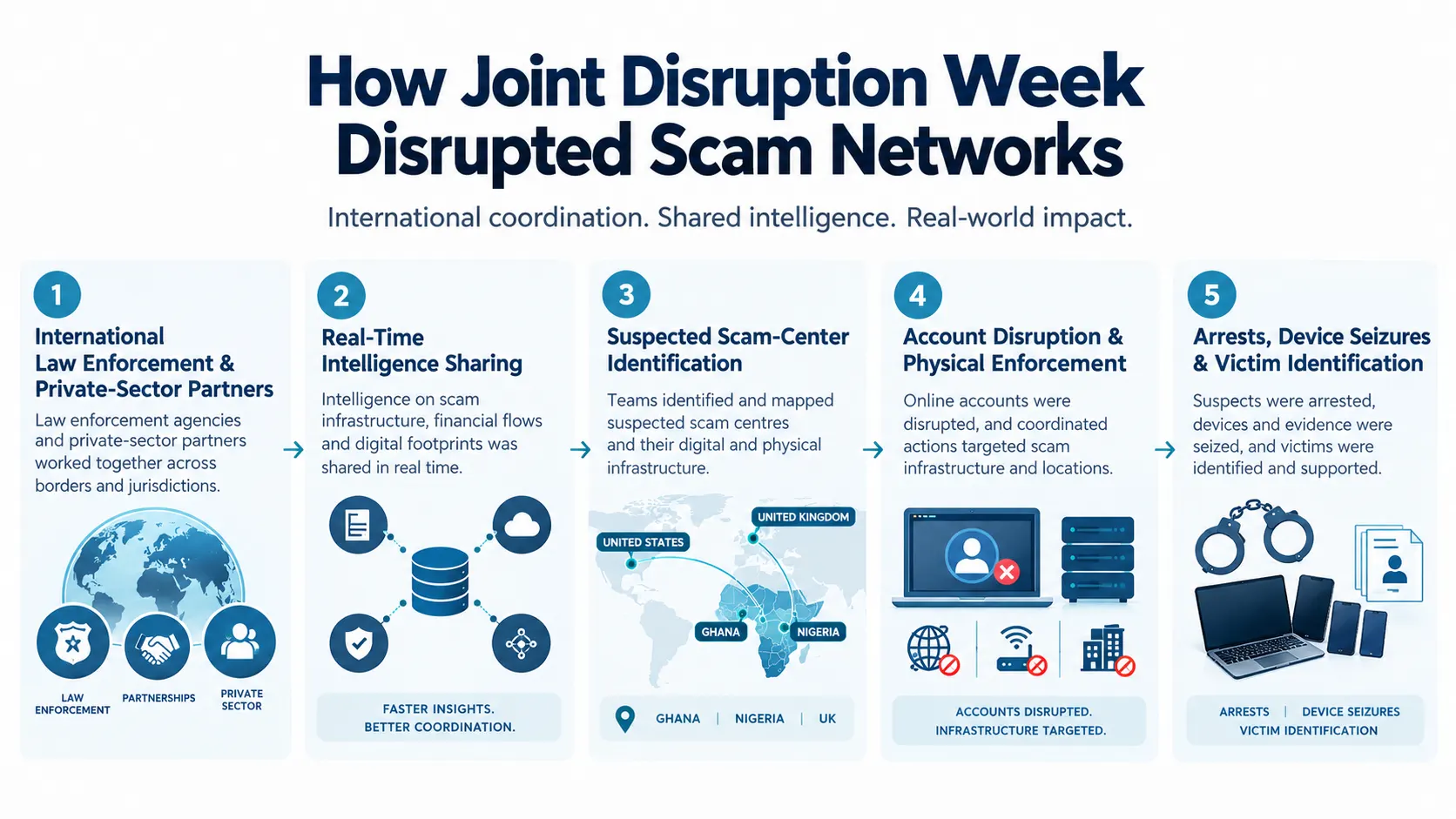
Investigators and private-sector partners exchanged real-time intelligence during the week beginning October 6. This cooperation helped authorities identify and disrupt suspected scam centers in Nigeria, Ghana and other African countries.
The effort combined criminal investigations, physical enforcement actions and voluntary measures by technology companies to remove accounts and other online resources associated with suspected fraud.
The DOJ reported that private-sector partners shared leads on more than 30 suspected scam centers with law enforcement. The resulting actions included arrests, electronic device seizures, cryptocurrency seizures and efforts to identify victims.
The operation also demonstrated the importance of coordinating investigations across national borders. Criminal networks can operate from one country while using online platforms to target individuals in several others, making cooperation between law enforcement and technology providers an important part of disruption efforts.
More Than 3.7 Million Accounts Removed
One of the operation's largest reported outcomes was the removal of more than 3.7 million accounts, Pages and Groups targeting people in the United States, the United Kingdom and elsewhere.
Participating companies voluntarily took action on their own networks to disrupt suspected scammers using their platforms to facilitate fraud. Meta played a key role in coordinating the event and encouraging wider participation from private-sector organizations.
The participating companies also shared intelligence with investigators, helping authorities identify suspected scam centers and support enforcement actions.
The DOJ named several private-sector participants, including Meta, Adobe, Binance, Coinbase, Cyjax, Elliptic, Chainalysis, Flashpoint, Google, Microsoft, OpenAI, Silent Push, Starlink and TRM Labs.
The scale of the account removals highlights how online platforms can become part of the operational infrastructure used by criminal networks. Removing accounts can restrict access to potential victims, while intelligence sharing can help investigators connect online activity with suspected criminal operations.
However, the announcement does not establish how many individual scammers were directly affected by the account removals or how long the disruptions will last.
Arrests and Device Seizures in Ghana and Nigeria
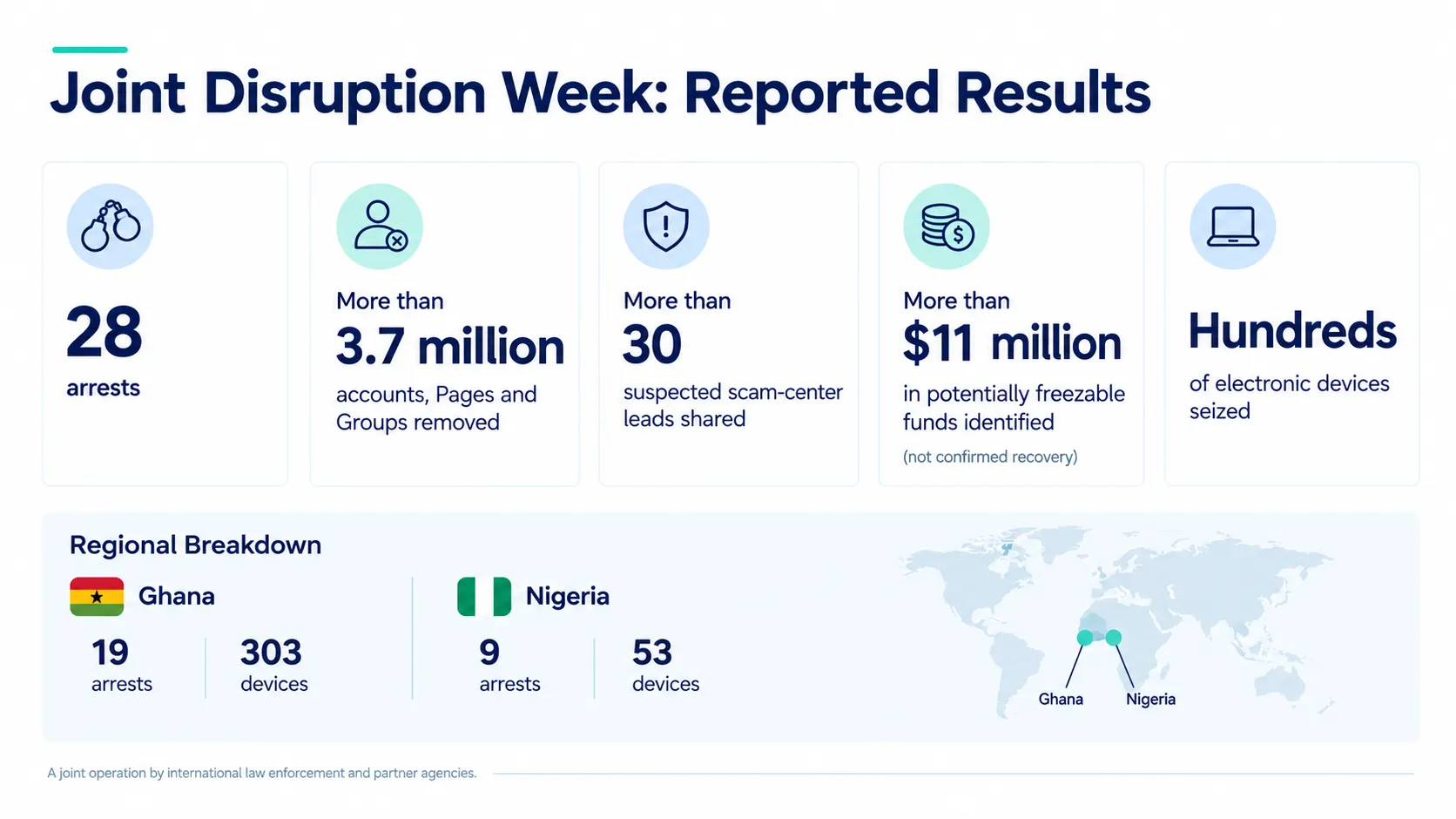
The international operation resulted in 28 arrests involving individuals linked to criminal scam operations. Authorities reported enforcement actions in Ghana and Nigeria, with Ghana accounting for the larger share of the arrests detailed in the announcement.
Ghana: 19 arrests and 303 devices seized
In Sasaabi, a suburb of Accra, authorities arrested 19 individuals and seized 303 electronic devices.
Investigators also identified 117 human trafficking victims who were awaiting repatriation to Nigeria. Separately, authorities identified 89 scam victims whose reported losses were estimated at approximately $8.3 million.
The Ghana operation was led by the Ghana Cyber Security Authority, the Ghana Police Service Criminal Investigation Department and the National Security Service, with support from the UK National Crime Agency, the FBI and Nigeria's Economic and Financial Crimes Commission.
The DOJ also highlighted enforcement activity conducted during the final week of September. At six locations, authorities made numerous arrests, identified 34 trafficking victims and seized 129 electronic devices.
Nigeria: Nine arrests and 53 devices seized
In Nigeria, authorities arrested nine individuals during the enforcement period and seized 53 electronic devices.
The announcement did not provide a detailed breakdown of the alleged activities attributed to each arrested individual or specify the total number of suspects charged as a result of the operation.
Taken together, the Ghanaian and Nigerian enforcement figures account for the 28 arrests reported by the DOJ.
More Than $11 Million in Potentially Freezable Funds Identified
Financial disruption was another major objective of the operation.
Private-sector partners identified more than $11 million in potentially freezable funds, according to the DOJ. The operation also involved cryptocurrency seizures.
The distinction between identified funds and recovered money is important. The announcement describes the funds as potentially freezable, which does not mean the entire amount had already been frozen, seized or returned to victims.
The DOJ did not disclose a final recovery figure or provide a complete breakdown of the identified funds by asset type, jurisdiction or suspected criminal network.
Financial intelligence from cryptocurrency analytics companies and other private-sector partners can help investigators trace transactions, identify suspicious flows and support efforts to disrupt the movement of suspected criminal proceeds. The specific contribution of each participating company to this operation was not detailed in the announcement.
Scam Types Targeted by Investigators
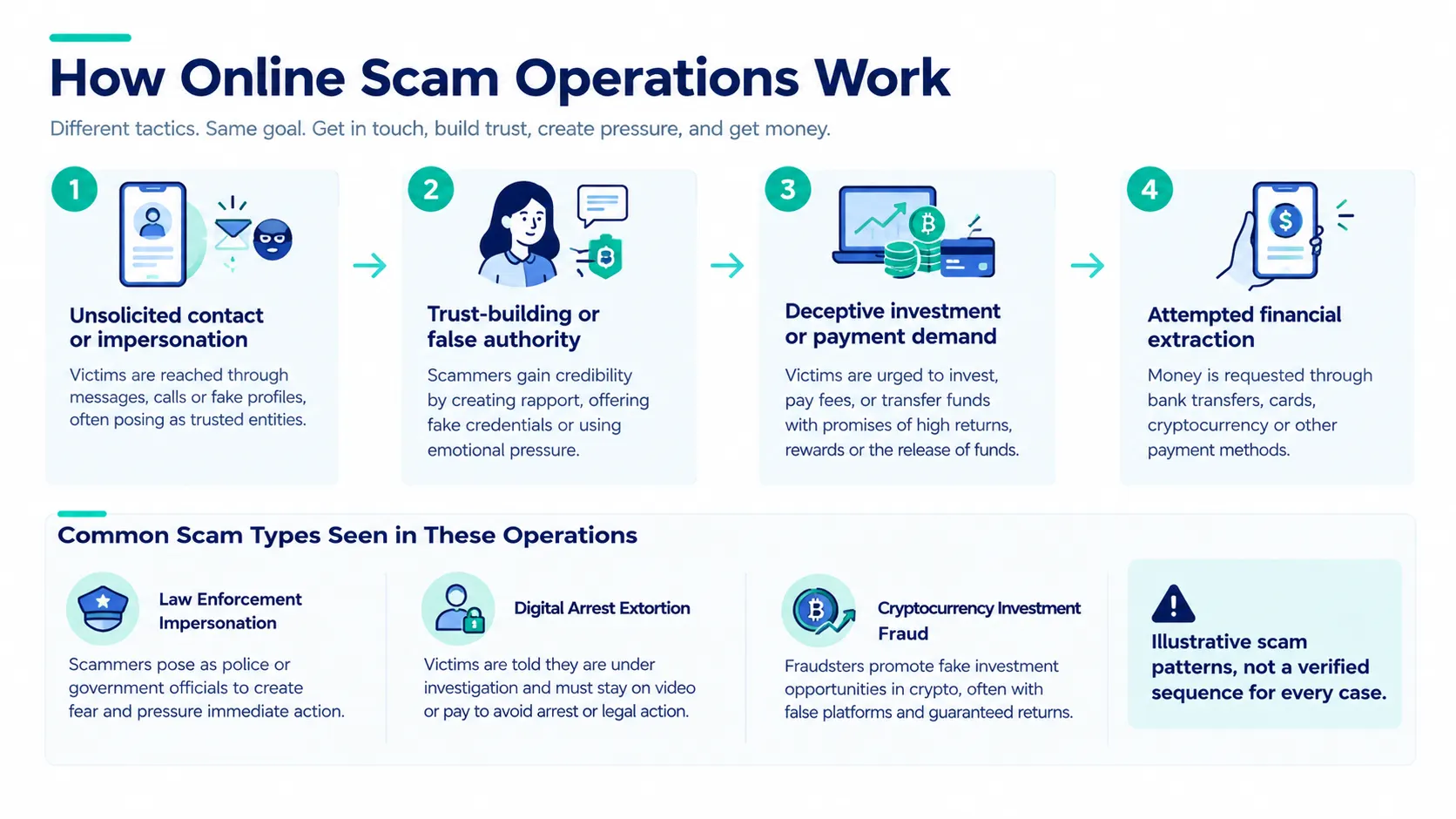
Authorities disrupted several types of fraud, including schemes that relied on impersonation, coercion and deceptive investment opportunities.
The DOJ identified the following categories:
Law enforcement impersonation scams: Criminals pose as police officers or other authorities to deceive victims into making payments or disclosing information.
Digital arrest extortion: Scammers use fabricated arrest claims or threats of legal consequences to pressure victims into transferring money.
Cryptocurrency investment fraud: Fraudsters persuade victims to invest through deceptive schemes, including operations commonly known as pig butchering.
Other online fraud operations: The targeted networks also conducted additional forms of fraud against victims in different countries.
These schemes can use social media, online communications and other digital channels to establish contact with victims and maintain deceptive interactions.
Cryptocurrency investment scams can be particularly difficult for victims to identify when fraudsters build trust over time before encouraging increasingly large investments. In some cases, victims may initially believe they are receiving legitimate investment returns.
The DOJ's announcement does not attribute every listed scam type to each individual arrested or to every suspected center disrupted during the operation.
FBI Data Highlights the Scale of Investment Fraud
The DOJ cited figures from the FBI's Internet Crime Complaint Center (IC3) to illustrate the financial impact of investment scams.
According to the announcement, IC3 received 72,984 investment scam reports in 2025, with cryptocurrency investment fraud accounting for 72% of that category.
Reported losses associated with investment scams increased from $3.96 billion in 2023 to $5.8 billion in 2024. The DOJ also reported that losses from investment scams involving cryptocurrency rose by 24% in 2025, exceeding $7.2 billion, according to IC3's 2025 annual report.
These figures are based largely on victim reports. The DOJ cautioned that reported losses likely underestimate the actual scale of the problem because many victims do not report fraud to law enforcement.
The announcement also cited a government report estimating that the annual value of funds stolen by scam syndicates worldwide approached $64 billion by the end of 2023. This is a separate estimate of global criminal activity, not a measurement of losses from the Joint Disruption Week operation.
Together, the figures illustrate why investigators are focusing on the people, digital platforms and financial infrastructure involved in cross-border fraud.
International Agencies and Technology Companies Work Together
Joint Disruption Week involved a broad group of law enforcement organizations and private-sector companies.
US participants included the Department of Justice, the FBI, the US Secret Service, the Department of the Treasury, Homeland Security Investigations and the Homeland Security Task Force. The DOJ's Scam Center Strike Force also participated.
International participants included the UK's National Crime Agency, Nigeria's Joint Case Team on Cybercrimes, the Nigeria Police Force's National Cybercrime Center, Ghana's Cyber Security Authority, INTERPOL and law enforcement agencies from Australia, Canada, Ghana, India, New Zealand and Nigeria.
Private-sector organizations contributed by sharing intelligence and taking action on their own networks. Their participation expanded the operation beyond traditional law enforcement investigations to include disruption of the online services and accounts used to contact potential victims.
The announcement did not disclose the exact contribution made by every agency or company, the full technical methods used to identify accounts, or the complete list of suspected centers affected.
DOJ Initiatives Focus on Sustained Accountability
The DOJ linked the operation to its broader efforts to investigate and prosecute cyber-enabled financial crime.
Cyber-Enabled Scam Initiative
The Criminal Division's Cyber-Enabled Scam Initiative (CSI) focuses on disrupting criminal networks that target victims through online fraud. Its remit includes cryptocurrency investment fraud, government impersonation schemes, romance and inheritance scams, financially motivated sextortion, lottery and sweepstakes fraud, and other predatory schemes.
The initiative brings together prosecutors to advance cases involving cyber-enabled financial crime, working with US Attorney's Offices across the country.
Scam Center Strike Force
The Scam Center Strike Force was launched in November 2025 by US Attorney Jeanine Ferris Pirro. The DOJ says it was established to address criminal scam centers, primarily in Southeast Asia, and targets cryptocurrency investment fraud, cyber-enabled fraud, human trafficking and money laundering.
The Strike Force works with federal agencies and private-sector organizations to pursue criminal networks and the infrastructure supporting their operations.
Homeland Security Task Force
The Homeland Security Task Force's National Coordination Center coordinates federal efforts to detect, disrupt, dismantle and deter cyber-enabled criminal activity conducted by foreign transnational criminal organizations and associated networks.
Its remit includes activity targeting US individuals, businesses, critical infrastructure and public services, with private-sector participation where appropriate.
The DOJ also referenced a March 6, 2026, executive order directing the US administration to prioritize cybercrime, fraud and predatory schemes that drain Americans' savings.
Why the Operation Matters for Cybersecurity
Joint Disruption Week highlights a broader shift in the response to online fraud: investigators are increasingly working with technology companies and financial intelligence providers to disrupt criminal operations across multiple layers.
Account removals can limit the use of online services for suspected scams. Intelligence sharing can help investigators connect activity across platforms and jurisdictions. Physical enforcement actions can produce electronic evidence and support efforts to identify suspects and victims.
These measures address different parts of the same problem. Disrupting an online account does not, by itself, dismantle the organization behind it. Similarly, identifying suspicious funds does not establish that those funds have been recovered or returned to victims.
For enterprises, digital platforms and financial service providers, the announcement reinforces the importance of timely information sharing, fraud detection and cooperation with legitimate investigations. The exact practices adopted by individual companies during this operation were not fully disclosed.
The case also illustrates the connection between cyber-enabled fraud and human trafficking. The identification of trafficking victims in Ghana shows that some scam-center investigations involve potential victims of exploitation as well as people defrauded online.
Conclusion
The DOJ's Joint Disruption Week announcement reports a significant coordinated effort against transnational scam networks operating in West Africa. The operation produced 28 arrests, more than 3.7 million account removals, hundreds of electronic device seizures and the identification of more than $11 million in potentially freezable funds.
Authorities also identified human trafficking victims and pursued suspected scam centers in Ghana and Nigeria. The results demonstrate the reach of international cooperation between law enforcement agencies and technology companies, although the long-term impact on the criminal networks remains to be established.
The DOJ said the FBI, the Scam Center Strike Force and international partners intend to continue expanding this public-private collaboration to dismantle criminal networks responsible for online fraud.
For now, the operation offers a clear example of how cross-border investigations can combine digital disruption, financial intelligence and law enforcement action. Sustained investigations and accountability will remain important to determining whether these disruptions lead to lasting reductions in fraud and meaningful outcomes for victims.
Source: US Department of Justice (DOJ)
About the Author