
Cloudflare Warns of AI-Powered Hacking Surge, Introduces Six-Pillar Modern Security Model
Cloudflare reports a surge in autonomous AI penetration-testing frameworks, including ARTEX forks, and recommends six security measures to help organisations defend against automated reconnaissance, exploitation and credential-based attacks.
Xcademia Team

Artificial intelligence is changing how organisations approach cybersecurity, but it is also increasing the speed and scale of offensive operations. Cloudflare has warned that autonomous AI-powered penetration-testing frameworks are proliferating rapidly, enabling threat actors to automate reconnaissance, vulnerability discovery and exploitation across multiple organisations.
In a security analysis published on 13 November 2026, Cloudflare's security teams reported observing more than 50 families of AI-driven penetration-testing frameworks attempting to scan its customers globally. The company also highlighted a significant increase in requests associated with these tools and documented incidents involving compromised credentials, lateral movement and unauthorised access to cloud environments.
At the centre of the development is ARTEX, an open-source AI penetration-testing orchestrator whose original repository was taken down by its creator on 8 October 2026. However, Cloudflare reports that the removal did not stop its development ecosystem. Instead, numerous forks and alternative frameworks emerged.
In response, Cloudflare has introduced what it calls the Modern Security Model, a six-pillar defensive approach designed to address the changing threat landscape.
AI-Powered Penetration Testing Frameworks Are Expanding Rapidly
Traditional penetration testing often relies on security professionals operating specialised tools to identify vulnerabilities, assess configurations and validate potential attack paths.
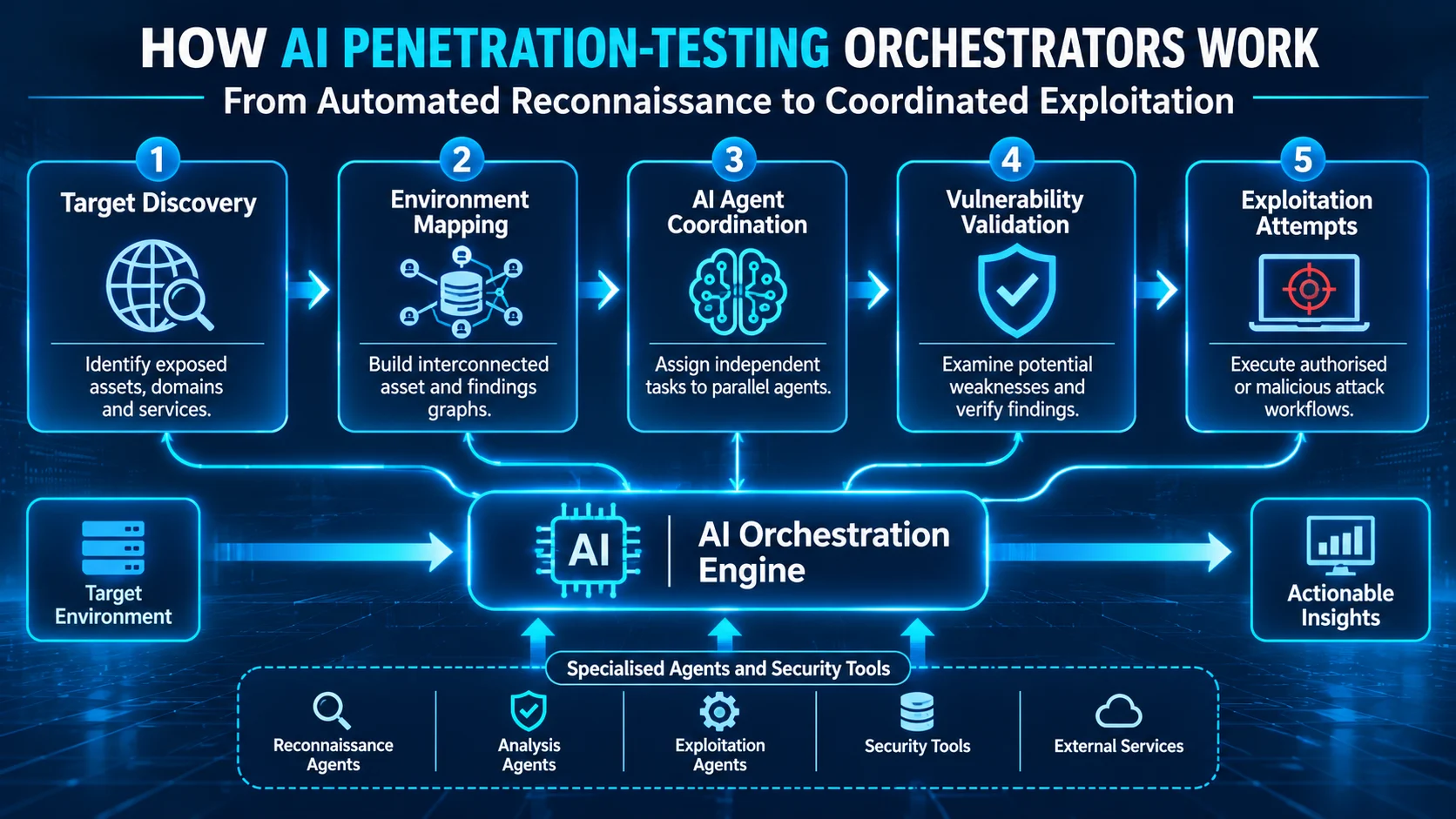
AI-powered penetration-testing orchestrators introduce a different approach. They coordinate multiple AI agents and existing security tools to automate several stages of an attack workflow.
According to Cloudflare, these frameworks can map environments, enumerate assets, identify potential weaknesses, verify findings and attempt exploitation with limited human direction.
The systems can also connect existing penetration-testing utilities through orchestration frameworks and the Model Context Protocol (MCP).
This allows different agents to work on separate tasks while sharing information about discovered assets, vulnerabilities and potential attack paths.
Cloudflare reported that it had observed more than 50 AI LLM agent families operating in this category.
The company also highlighted the growth of the ARTEX ecosystem:
More than 12,000 repositories were associated with the broader ARTEX-related ecosystem.
Several hundred unique forks contained lineage from the original repository.
Hundreds of additional agentic orchestration frameworks had emerged following the original repository's removal.
More than 50 framework families had attempted to scan Cloudflare customers globally.
These observations indicate that removing an individual tool or repository may not be sufficient to eliminate the broader ecosystem when its underlying techniques and code are replicated.
ARTEX and the Evolution of Autonomous Cyber Operations
ARTEX was an open-source agentic penetration-testing system designed to automate offensive security workflows.
Its architecture connects AI agents with security tools, allowing them to perform reconnaissance, analyse targets and coordinate subsequent actions.
Cloudflare explains that ARTEX and its forks organise information through interconnected graphs representing goals, findings and target assets.
Multiple agents can operate in parallel to enumerate environments, verify information, develop potential attack approaches and attempt exploitation.
This architecture changes how offensive security operations can be conducted.
Instead of requiring an operator to manually perform every action, an orchestrator can continuously observe the environment, evaluate available information, select an action and execute it.
Cloudflare identifies several important characteristics of these systems:
1. Reduced dependence on manual operations
AI orchestration can automate multiple stages of offensive security workflows, reducing the need for an operator to perform each task individually.
2. Parallel execution
Multiple agents can work towards different objectives simultaneously, increasing the speed at which an environment can be examined.
3. Greater operational scale
A single operator can coordinate activities against multiple organisations, potentially increasing the scope of an operation.
4. Continuous discovery
Autonomous frameworks can systematically examine exposed services and configurations, identifying weaknesses that might otherwise receive less attention.
The important distinction is that AI does not simply assist with individual penetration-testing commands.
It can coordinate entire sequences of activities.
Five AI Penetration-Testing Orchestrators Highlighted by Cloudflare
Cloudflare identified several prominent frameworks in its analysis, illustrating the diversity of architectures emerging in the AI-powered offensive security ecosystem.
Framework | Architecture | Notable characteristics |
|---|---|---|
ARTEX and forks | Planner with parallel agents | Uses interconnected goal and asset graphs |
LuaN1aoAgent | Supervisor, planner and executor agents | Uses multiple graphs and supports SSH and Chisel |
Decepticon | Orchestrator with specialist sub-agents | Includes post-access, Active Directory and cloud pivoting capabilities |
Cairn | Dispatcher coordinating existing AI harnesses | Works with tools such as Codex, Claude Code and Pi |
PentestGPT-Agent | Supervisor and generic executor | Uses task dependencies, goals and evidence |
Cloudflare notes that these systems use different approaches to planning, execution and post-exploitation activities.
Their architectures demonstrate how AI agents can coordinate existing tools and security capabilities rather than depending on a single standalone application.
Cloudflare Observes a Sharp Increase in AI-Driven Attack Activity
One of the most significant findings in Cloudflare's report concerns the growth in activity associated with AI-powered penetration-testing tools.
According to the company, daily requests from AI penetration-testing and exploitation tools increased approximately 30 times between 1 October and the publication of the report.
Cloudflare also reported that traffic had grown more than tenfold since the original ARTEX repository was removed on 8 October.
As of 12 November, ARTEX and its forks accounted for more than 60% of the currently known AI penetration-testing orchestrators tracked by Cloudflare.
The company also observed thousands of IP addresses running these frameworks, with the number continuing to increase.
Cloudflare suggested that removing the original ARTEX repository may have contributed to a fragmented ecosystem in which forks and modified versions continued to spread.
This illustrates an important challenge for security teams: disabling one prominent framework does not necessarily eliminate the underlying techniques or the tools derived from it.
How AI Frameworks Can Turn Stolen Credentials into Wider Compromises
Cloudflare's incident response investigations revealed another concerning development: the combination of compromised credentials with autonomous AI exploitation frameworks.
The company's Cloudforce One team reported involvement in multiple investigations concerning ARTEX and ARTEX-derived frameworks over the preceding eight weeks.
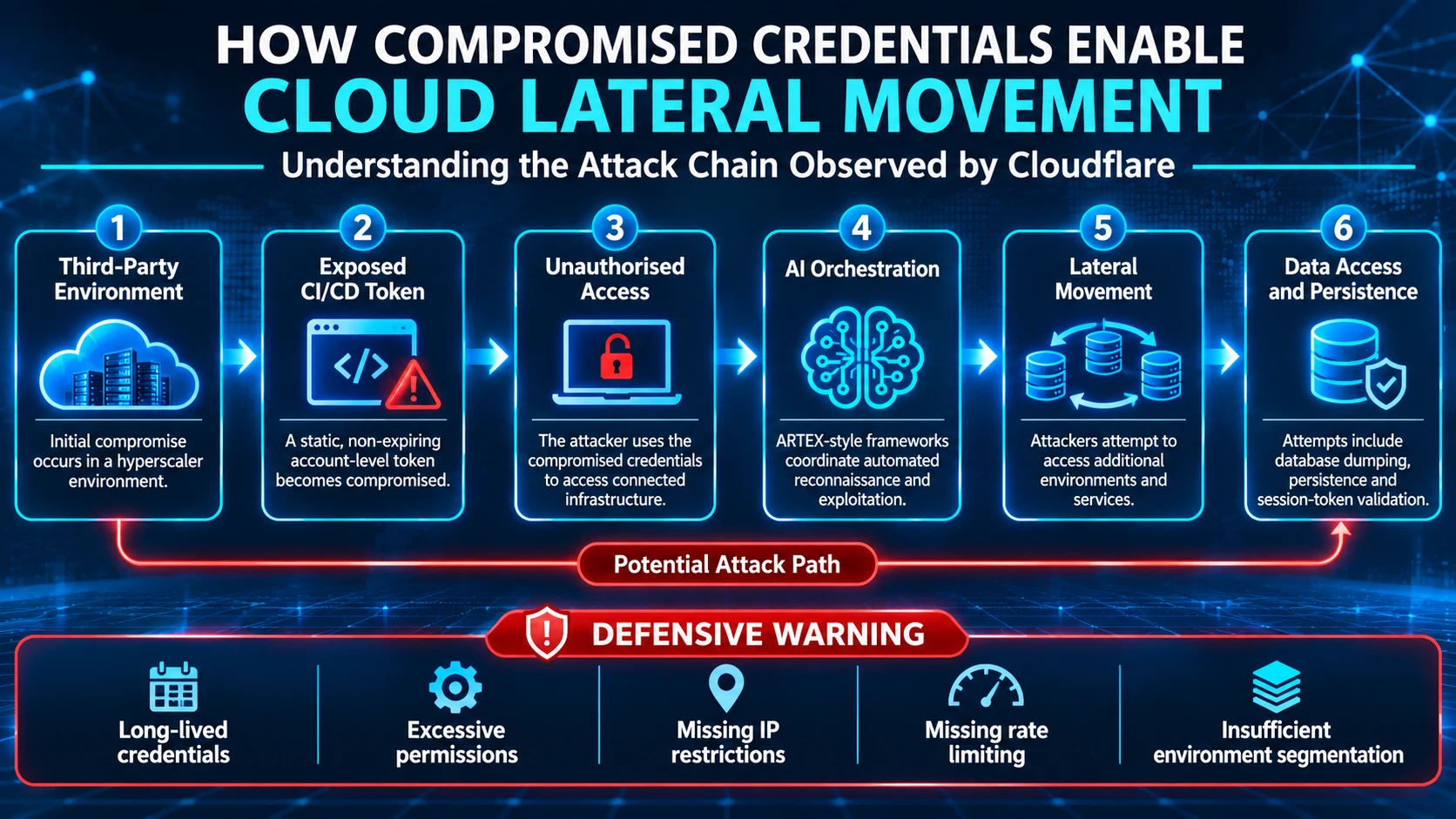
In several incidents, attackers initially gained access to a hyperscaler environment and subsequently moved into a customer's Cloudflare environment.
Investigations identified a recurring credential-management weakness: static, non-expiring tokens used within CI/CD pipelines.
These tokens provided broad access across different environments within an organisation's cloud infrastructure.
When attackers obtained access to such credentials, they could potentially use them to move between interconnected environments.
This creates a wider attack surface because a compromised credential may provide access beyond the original system where it was exposed.
Cloudflare also warned that AI-powered exploitation frameworks increase the likelihood of compromised API keys being used for lateral movement and attempts to access other tenant environments.
ARTEX in Action: An Incident Response Investigation
Cloudflare provided an example from an incident investigation involving a compromised account-level API token previously used for CI/CD operations.
The token had no IP restrictions or rate limiting. Available evidence suggested that the initial compromise most likely originated through a third-party hyperscaler.
Following access to the token, Cloudflare observed the creation of numerous Worker scripts with naming patterns including:
artex-*artex-pgrecon-*artex-pgw-*artex-do-*
The naming patterns corresponded to different activities performed by the scripts.
Cloudflare reported observing:
More than 69 requests per minute across multiple parts of the affected Cloudflare infrastructure.
Approximately 400 database dump requests within one hour.
Attempts to establish persistence.
Attempts to validate session tokens associated with other third-party applications.
Cloudflare noted that much of the activity appeared to be lightly guided by a human operator.
The incident demonstrates how compromised credentials and automated exploitation frameworks can work together to increase the speed and breadth of post-compromise activity.
Cloudflare Introduces a Six-Pillar Modern Security Model
In response to the growing use of autonomous AI penetration-testing frameworks, Cloudflare recommends moving beyond traditional perimeter-focused security.
The company introduces a six-pillar Modern Security Model designed to protect applications, identities, APIs and internal infrastructure.
The model uses the analogy of protecting a residential estate, with different security mechanisms protecting different entry points and internal areas.
1. Fortify the Front Gate: Web Application Firewall and Traffic Control
The first pillar focuses on protecting the network perimeter.
Cloudflare recommends implementing a Web Application Firewall (WAF) with advanced security rules, including rate limiting.
A WAF helps identify and block suspicious requests before they reach vulnerable applications.
Rate limiting can restrict excessive request activity and help protect services against automated probing and high-volume traffic.
The objective is to prevent unwanted traffic from reaching application infrastructure.
2. Establish a Security Station: Anomaly Detection
The second pillar focuses on detecting suspicious behaviour within web applications.
AI-powered penetration-testing tools can generate unusual request patterns, manipulate application paths and repeatedly test exposed functionality.
Cloudflare recommends anomaly detection across customer-facing web applications.
Security teams should monitor suspicious request patterns, repeated access attempts and unusual interactions with application endpoints.
The company also highlights the importance of security keys and hardware-based FIDO authentication keys.
These controls help strengthen application access and reduce exposure to credential-based attacks.
3. Identify Fake Visitors: Bot Defence
The third pillar addresses automated reconnaissance and bot-driven activity.
AI-powered agents may use automated browsers, scripts and other tools to interact with web applications.
Their behaviour can differ from legitimate human users, particularly in request frequency, interaction patterns and browsing activity.
Cloudflare recommends implementing Bot Defense and challenge mechanisms to identify suspicious automated activity.
The objective is to distinguish legitimate visitors from malicious automation before it can interact with sensitive application functionality.
4. Remove the Back Door: Identity-Gated Access and Micro-Segmentation
The fourth pillar focuses on reducing the exposure of internal applications and infrastructure.
Many organisations operate internal administration panels, diagnostic endpoints and remote access gateways.
If these systems remain publicly accessible, attackers may discover and attempt to exploit them.
Cloudflare recommends identity-gated access for high-risk external and internal applications.
Under this approach, access is granted only after verifying the identity and eligibility of the requesting user or device.
The company also recommends micro-segmentation.
Micro-segmentation restricts communication between different parts of an infrastructure environment.
For example, access to a development environment should not automatically provide access to production systems.
This approach helps limit lateral movement when credentials or individual systems are compromised.
5. Inspect Every Delivery: API Schema Validation and Explicit Security Controls
The fifth pillar focuses on securing incoming application and API traffic.
Unvalidated requests and improperly structured payloads can create opportunities for attackers to bypass application controls.
Cloudflare recommends:
OpenAPI schema validation for incoming API requests.
Mutual TLS (mTLS) certificates to establish authenticated connections.
Explicit security controls for incoming traffic.
Rejection of requests that fail validation or lack the required credentials.
A default-deny security posture.
The default-deny approach ensures that requests are not automatically trusted simply because they reach an application endpoint.
Instead, access must satisfy explicitly defined security requirements.
6. Establish a Neighbourhood Watch: Threat Intelligence
The final pillar focuses on gaining visibility into emerging threats.
Threat intelligence helps organisations understand attacker infrastructure, changing techniques and indicators associated with malicious activity.
Cloudflare recommends using threat intelligence to identify new attack patterns and update defensive controls accordingly.
This allows security teams to improve their awareness of emerging threats rather than relying exclusively on previously identified attack signatures.

Why Traditional Defence-in-Depth Needs to Evolve
Cloudflare argues that traditional defence-in-depth approaches, particularly those centred on a conventional network demilitarised zone (DMZ), may not provide sufficient protection against modern AI-orchestrated attacks.
The challenge is not limited to identifying a single vulnerability.
Autonomous frameworks can connect multiple stages of an attack, validate findings and use discovered credentials to explore additional environments.
This means that an organisation may face several connected attack activities rather than isolated security events.
Cloudflare therefore emphasises identity-gated access, micro-segmentation and containment-focused security.
The objective is to make sensitive systems inaccessible to unauthorised users and reduce the ability of attackers to move between environments after gaining initial access.
For organisations operating legacy equipment and on-premises infrastructure, Cloudflare recommends an identity-gated approach that prevents direct internet exposure.
What Organisations Should Take Away from Cloudflare's Warning
Cloudflare's findings highlight a broader industry shift towards increasingly automated offensive security operations.
AI penetration-testing orchestrators can combine reconnaissance, vulnerability validation and exploitation workflows into coordinated processes.
For enterprise security teams, this creates several important considerations:
Credential hygiene must become a priority. Static, non-expiring tokens and broadly privileged API keys can create opportunities for attackers to move between connected environments.
Internet-facing applications require continuous monitoring. Traditional perimeter controls should be complemented by anomaly detection, rate limiting and bot defence.
Internal infrastructure should not be implicitly trusted. Identity-gated access and micro-segmentation can reduce unnecessary exposure and restrict lateral movement.
API security needs explicit validation. Schema validation, authenticated connections and default-deny policies help establish stronger boundaries around application traffic.
Threat intelligence must inform defensive decisions. Organisations need visibility into emerging frameworks and changing attacker techniques.
These recommendations are particularly relevant to organisations with interconnected cloud environments, CI/CD pipelines, publicly exposed applications and complex identity infrastructure.
The broader lesson is that defensive strategies must account for the speed and coordination of automated offensive tools.
Conclusion
The proliferation of ARTEX-derived frameworks highlights how quickly AI-powered offensive security capabilities can evolve.
Cloudflare's observations show that removing an individual open-source tool does not necessarily prevent its techniques from spreading through forks, modified implementations and alternative orchestration frameworks.
More importantly, the company's incident investigations demonstrate how automated exploitation can become more damaging when combined with weak credential management and excessive access privileges.
Cloudflare's six-pillar Modern Security Model provides a structured approach to addressing these challenges through traffic control, anomaly detection, bot defence, identity-gated access, API validation and threat intelligence.
As AI-powered attack orchestration continues to develop, organisations will need security architectures that prioritise identity verification, continuous monitoring and containment rather than relying solely on traditional perimeter protection.
Source: Cloudflare Blog
About the Author