
Cisco Finesse Vulnerability Allows Unauthenticated SSRF Attacks, No Workaround Available
Cisco has disclosed a high-severity SSRF vulnerability in Finesse that could expose limited sensitive information to unauthenticated remote attackers. The flaw carries a CVSS score of 7.2, with no available workaround.
Xcademia Team

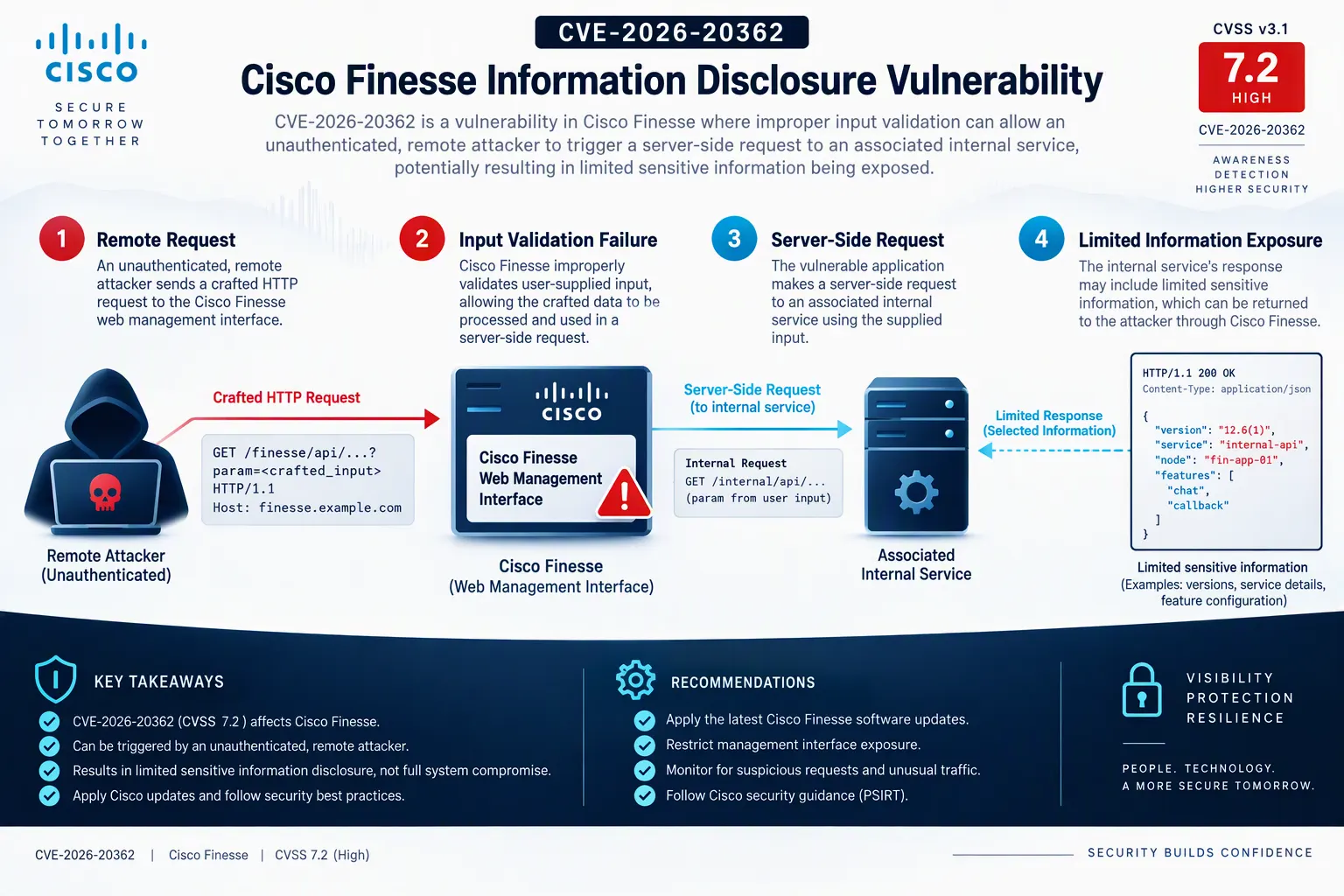
Cisco has disclosed a high-severity security vulnerability in its Cisco Finesse platform that could allow unauthenticated remote attackers to conduct Server-Side Request Forgery (SSRF) attacks and obtain limited sensitive information from services associated with affected devices.
Tracked as CVE-2026-20362, the vulnerability carries a CVSS 3.1 base score of 7.2, placing it in the high-severity category.
Published on 7 October 2026 and updated on 29 October 2026, Cisco's advisory confirms that the vulnerability affects Cisco Finesse regardless of device configuration. The company has also confirmed that no workaround is available to address the security issue.
Understanding CVE-2026-20362
The vulnerability exists in the web-based management interface of Cisco Finesse and results from improper input validation when processing specific HTTP requests.
An attacker could exploit the weakness by sending a specially crafted HTTP request to an affected device. The attack does not require authentication or user interaction.
According to Cisco, successful exploitation could allow an attacker to retrieve limited sensitive information from services associated with the affected device.
The vulnerability is classified as Server-Side Request Forgery (SSRF) and is associated with CWE-918.
Vulnerability Details
Attribute | Details |
|---|---|
Vendor | Cisco |
Product | Cisco Finesse |
Vulnerability | Server-Side Request Forgery (SSRF) |
CVE ID | CVE-2026-20362 |
CWE | CWE-918 |
CVSS Version | 3.1 |
CVSS Score | 7.2 |
Severity | High |
Attack Vector | Network |
Attack Complexity | Low |
Privileges Required | None |
User Interaction | None |
Workaround | Not available |
Initial Publication | 7 October 2026 |
Last Updated | 29 October 2026 |
Affected Cisco Products
Cisco confirmed that the vulnerability affects Cisco Finesse regardless of device configuration.
The following products that may include Cisco Finesse are also affected:
Cisco Packaged Contact Center Enterprise (Packaged CCE)
Cisco Unified Contact Center Enterprise (Unified CCE)
Cisco Unified Contact Center Express (Unified CCX)
Organisations using these platforms should identify whether their deployments include affected Cisco Finesse components.
Cisco has also clarified that Cisco Unified Intelligence Center is not affected by this vulnerability.
How the SSRF Vulnerability Could Be Exploited
Server-Side Request Forgery occurs when an application processes attacker-controlled requests in a way that causes the server to make unintended requests to other services.
In this case, the security weakness is associated with improper input validation in specific HTTP requests handled by the Cisco Finesse web-based management interface.
An attacker could send a crafted HTTP request without authentication. If successfully exploited, the vulnerability could allow the attacker to obtain limited sensitive information from services associated with the affected device.
The CVSS vector published by Cisco is:
AV:N/AC:L/PR:N/UI:N/S:C/C:L/I:L/A:N
This indicates:
Network (AV): The vulnerability can be exploited over a network.
Low Complexity (AC): Exploitation does not require complex conditions.
No Privileges Required (PR): An attacker does not need an authenticated account.
No User Interaction (UI): Victim interaction is not required.
Changed Scope (S): The potential impact extends beyond the vulnerable component's security authority.
Limited Confidentiality Impact (C): Limited information disclosure is possible.
Limited Integrity Impact (I): The published CVSS vector records a low integrity impact.
No Availability Impact (A): No availability impact is recorded in the vector.
Cisco describes the potential outcome as limited sensitive information exposure. The advisory does not establish unrestricted access to internal services or complete system compromise.
Cisco Releases Security Updates
Cisco has published fixed software release information for affected products.
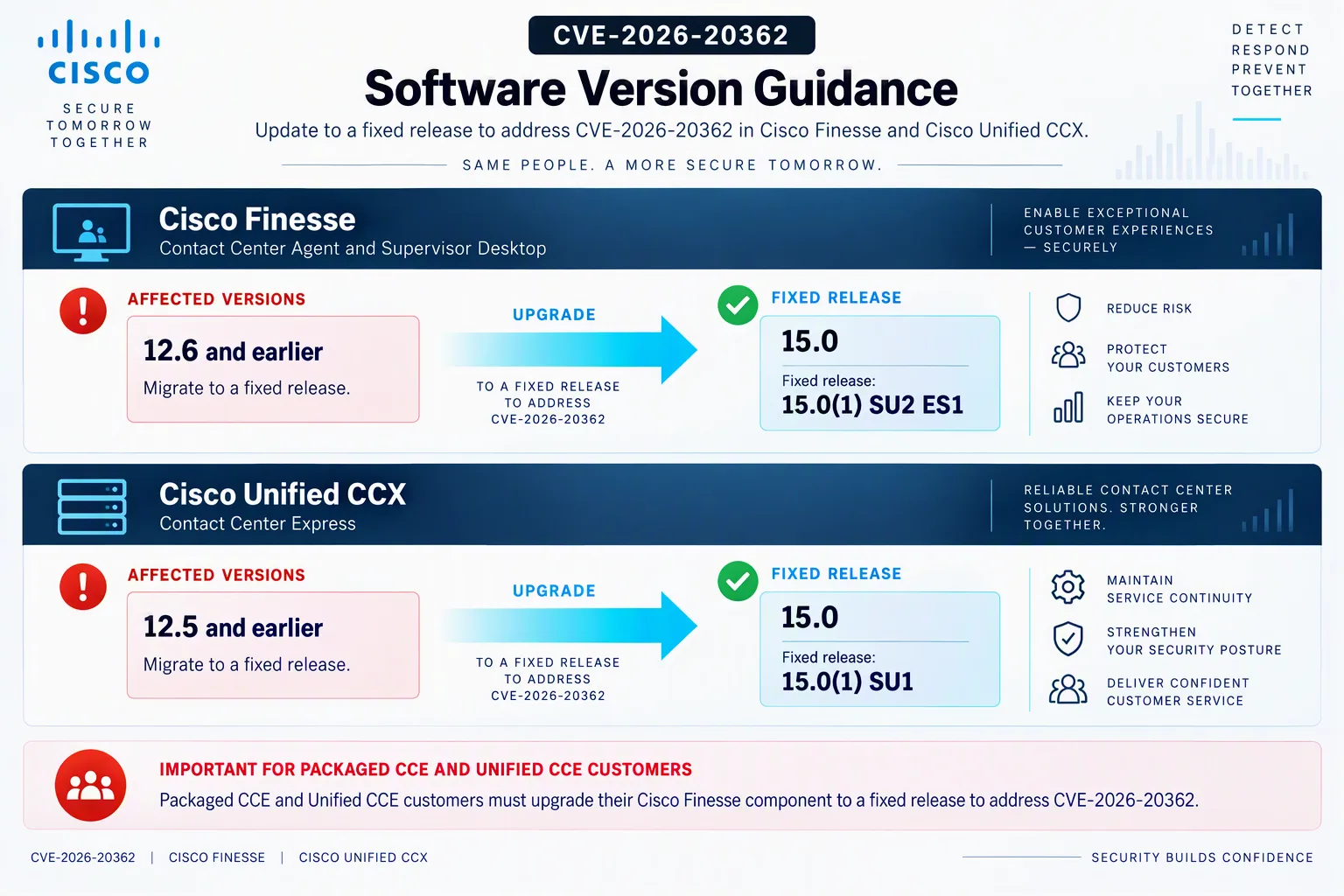
According to the advisory's latest revision on 29 October 2026, the following upgrade paths address the vulnerability.
Affected Product | Vulnerable Releases | First Fixed Release |
|---|---|---|
Cisco Finesse | 12.6 and earlier | Migrate to a fixed release |
Cisco Finesse | 15.0 | 15.0(1) SU2 ES1 |
Cisco Unified CCX | 12.5 and earlier | Migrate to a fixed release |
Cisco Unified CCX | 15.0 | 15.0(1) SU1 |
Organisations running Cisco Packaged CCE or Unified CCE must upgrade the Cisco Finesse component to address the vulnerability.
Cisco recommends upgrading to the appropriate fixed software release to remediate the issue and avoid continued exposure.
The company also advises customers to verify their existing software versions and ensure that their hardware and software configurations remain supported after upgrading.
No Workaround Available
One of the most important points in Cisco's advisory is the absence of an available workaround.
Cisco explicitly states that no workaround addresses CVE-2026-20362.
The company considers workarounds and mitigations temporary measures where applicable and recommends upgrading to fixed software releases.
For organisations operating affected contact centre infrastructure, this makes identifying vulnerable deployments and planning the appropriate software upgrade particularly important.
The company did not provide specific information about alternative mitigation procedures for this vulnerability.
Exploitation Status and Vulnerability Disclosure
Cisco's Product Security Incident Response Team (PSIRT) confirmed that a public announcement about the vulnerability is available.
However, Cisco stated that its security response team was not aware of any malicious exploitation of the vulnerability at the time of the advisory update.
The vulnerability was reported by Noah King and Brandon Peterson of Horizon3, whom Cisco acknowledged in its security advisory.
The availability of a public announcement does not, by itself, establish active exploitation in the wild.
Recommended Actions for Security and IT Teams
Organisations using Cisco Finesse or associated contact centre platforms should prioritise reviewing their software versions and following Cisco's published remediation guidance.
Recommended actions based on the advisory include:
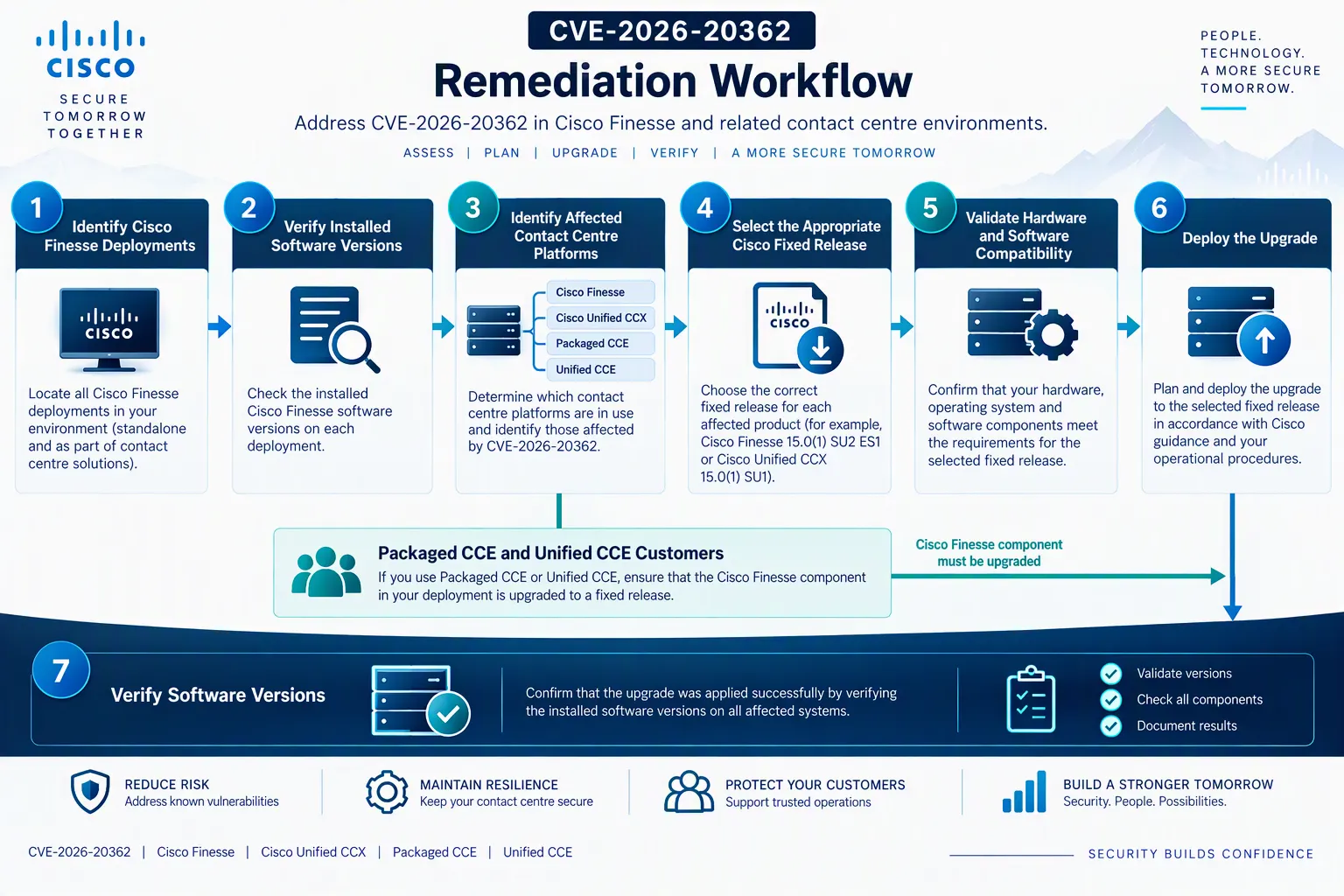
Identify affected deployments: Review Cisco Finesse installations and associated Packaged CCE, Unified CCE and Unified CCX environments.
Verify software versions: Compare deployed versions against Cisco's affected and fixed release information.
Plan software upgrades: Upgrade Cisco Finesse to the appropriate fixed release according to the vendor's guidance.
Review dependent platforms: Organisations running Packaged CCE or Unified CCE should ensure that the Cisco Finesse component is upgraded.
Validate compatibility: Check hardware requirements, available memory and software support before deploying upgrades.
Monitor Cisco advisories: Follow Cisco PSIRT updates for any changes to vulnerability information or remediation guidance.
What This Means for Enterprises
The Cisco Finesse vulnerability highlights the security implications of weaknesses in web-based management interfaces, particularly when those interfaces process requests that can reach associated services.
For enterprises operating contact centre infrastructure, the issue reinforces the importance of maintaining updated software, reviewing externally reachable management interfaces and following vendor security advisories.
The absence of an authentication requirement and the lack of an available workaround make timely vulnerability assessment and software remediation important priorities.
Although Cisco has not reported awareness of malicious exploitation, organisations should not interpret this as evidence that affected deployments are free from risk.
The immediate priority is to identify affected Cisco Finesse components and upgrade to the appropriate fixed software releases.
Official Security Advisory
Cisco published the vulnerability details, affected product information and fixed software guidance through its official security advisory.
Source: Cisco Security Advisory
About the Author