
CERT-In Warns of High-Severity Vulnerabilities in Mozilla Firefox and Thunderbird
CERT-In has issued a High-severity warning for multiple vulnerabilities in Mozilla Firefox, Firefox ESR, and Thunderbird that could enable arbitrary code execution, sensitive information disclosure, or denial of service. Users and organizations should update to the late versions.
Xcademia Team

The Indian Computer Emergency Response Team (CERT-In) has issued Vulnerability Note CIVN-2026-0531, warning of multiple vulnerabilities affecting Mozilla Firefox, Firefox Extended Support Release (ESR), and Thunderbird.
Published on October 28, 2026, the notice assigns the vulnerabilities a High severity rating and warns that successful exploitation could allow attackers to execute arbitrary code, obtain sensitive information, or cause denial-of-service (DoS) conditions on affected systems.
CERT-In identifies memory safety issues, incorrect boundary conditions, cryptographic issues, and improper escaping of attribute values among the causes of the reported vulnerabilities. The agency recommends applying the relevant software updates referenced in its notice.
The advisory applies to individuals and organizations using affected Mozilla products. CERT-In also assesses the potential impact as complete compromise of affected systems.
Which Mozilla Products Are Affected?
CERT-In lists the following affected software versions.
Product | Affected versions |
|---|---|
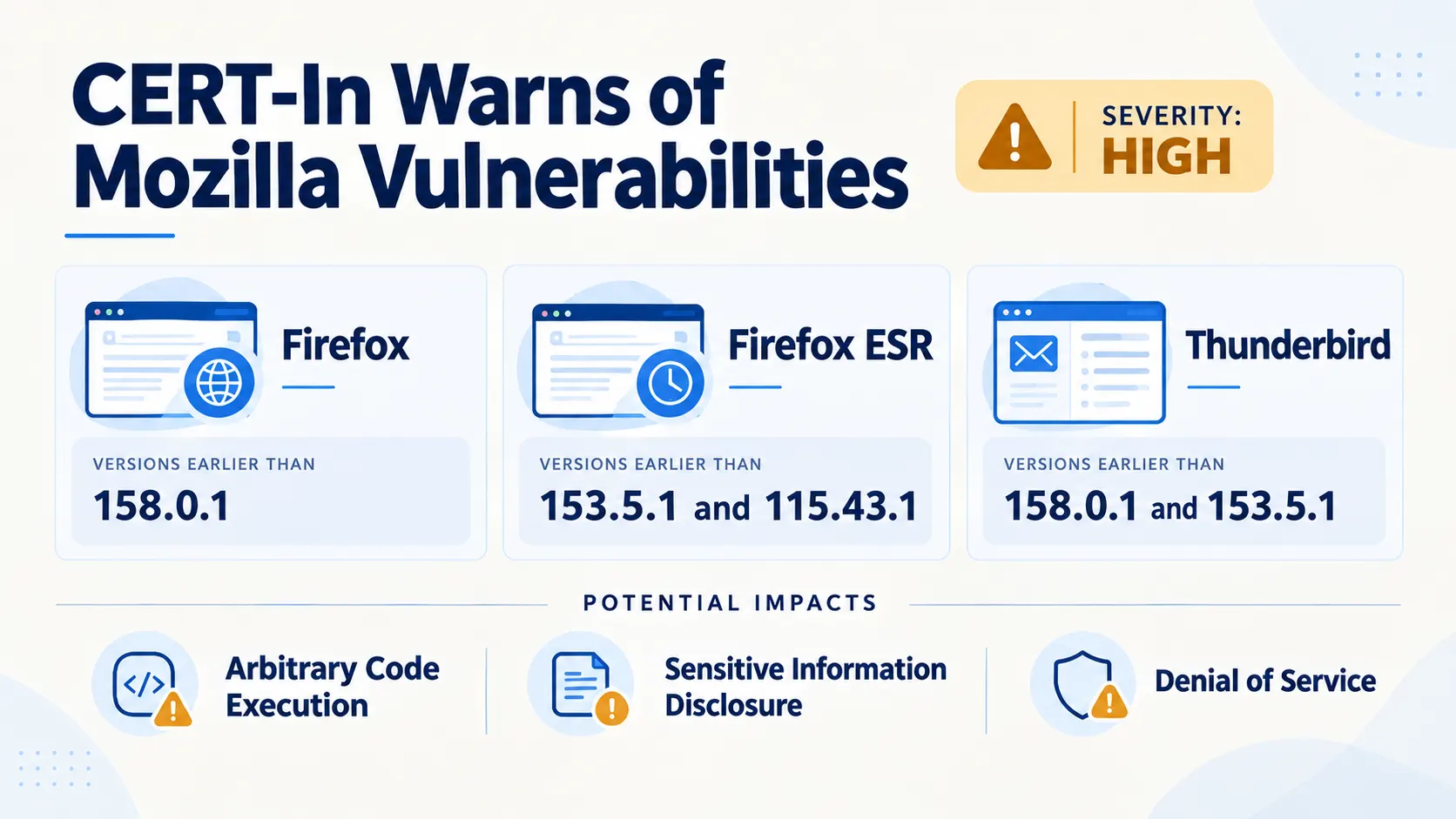
Mozilla Firefox | Versions earlier than 158.0.1 |
Mozilla Firefox ESR | Versions earlier than 153.5.1 and 115.43.1 |
Mozilla Thunderbird | Versions earlier than 158.0.1 and 153.5.1 |
Systems running versions below the applicable thresholds fall within the affected ranges specified by CERT-In. Administrators should verify the installed version and apply the update appropriate to their product and release channel.
What Types of Vulnerabilities Were Reported?
CERT-In identifies several underlying vulnerability categories in the affected Mozilla products.
Memory safety issues
Memory safety problems can arise when software handles memory incorrectly. Depending on the specific flaw and its exploitability, these issues can lead to crashes, memory disclosure, or potentially arbitrary code execution.
CERT-In includes memory safety issues among the causes of the vulnerabilities covered by this notice. It does not provide a separate technical breakdown of every memory-related issue in the summary.
Incorrect boundary conditions
Boundary-condition errors occur when software does not correctly handle the limits of an operation or the range of data it processes. Such errors can create opportunities for unintended behavior.
Mozilla's linked Firefox security advisory identifies CVE-2026-113399 as an incorrect-boundary-conditions issue in the SVG component. The advisory lists the issue as High impact. Mozilla Firefox security advisory.
Cryptographic issues
Cryptographic flaws can affect how software handles security-related information and trust decisions. The CERT-In notice lists cryptographic issues among the causes covered by the alert.
Mozilla's linked advisories also identify CVE-2026-113470 as a cryptographic issue involving security block lists, allow lists, and related state. Mozilla describes an update to the OneCRL block list intended to ensure compromised intermediate certificates are blocked even when RemoteSettings is disabled by policy or unavailable. Mozilla security advisory.
Improper escaping of attribute values
Software that fails to handle attribute values correctly may interpret untrusted input in unintended ways. Depending on where the issue occurs, this can affect how applications process data or construct messages.
CERT-In includes improper escaping of attribute values among the vulnerability causes in the notice.
Mozilla's Thunderbird advisories describe an XMPP chat issue involving unescaped attribute values that could allow a remote XMPP user to inject stanzas into a connection. That issue is specifically associated with Thunderbird's XMPP chat functionality. Mozilla Thunderbird security advisory.
These examples provide additional context from Mozilla's linked advisories. They should not be interpreted as meaning that every listed vulnerability affects every product in the same way.
Potential Security Impact
According to CERT-In, successful exploitation of the reported vulnerabilities could have three main consequences.
Arbitrary code execution: An attacker could potentially cause a vulnerable system to execute code without authorization.
Sensitive information disclosure: Vulnerabilities could expose information that should remain protected.
Denial of service: Exploitation could disrupt application availability or cause the affected software to stop functioning.
CERT-In warns that the potential impact could extend to complete compromise of affected systems.
However, the notice does not state that all vulnerabilities necessarily lead to all three outcomes, nor does it provide a single exploitation method that applies to every issue.
The advisory says a remote attacker could exploit the vulnerabilities by sending a specially crafted request to a targeted system. Additional details were not disclosed in the CERT-In summary.
CVE References and Mozilla Security Advisories
CERT-In links seven CVE identifiers to the vulnerability note:
The CERT-In notice also references five Mozilla security advisories:
These vendor advisories provide product-specific information about the security fixes. Administrators should consult the advisory relevant to the installed product and release channel rather than assume that every CVE applies to every Mozilla application.
How Users and Organizations Should Respond
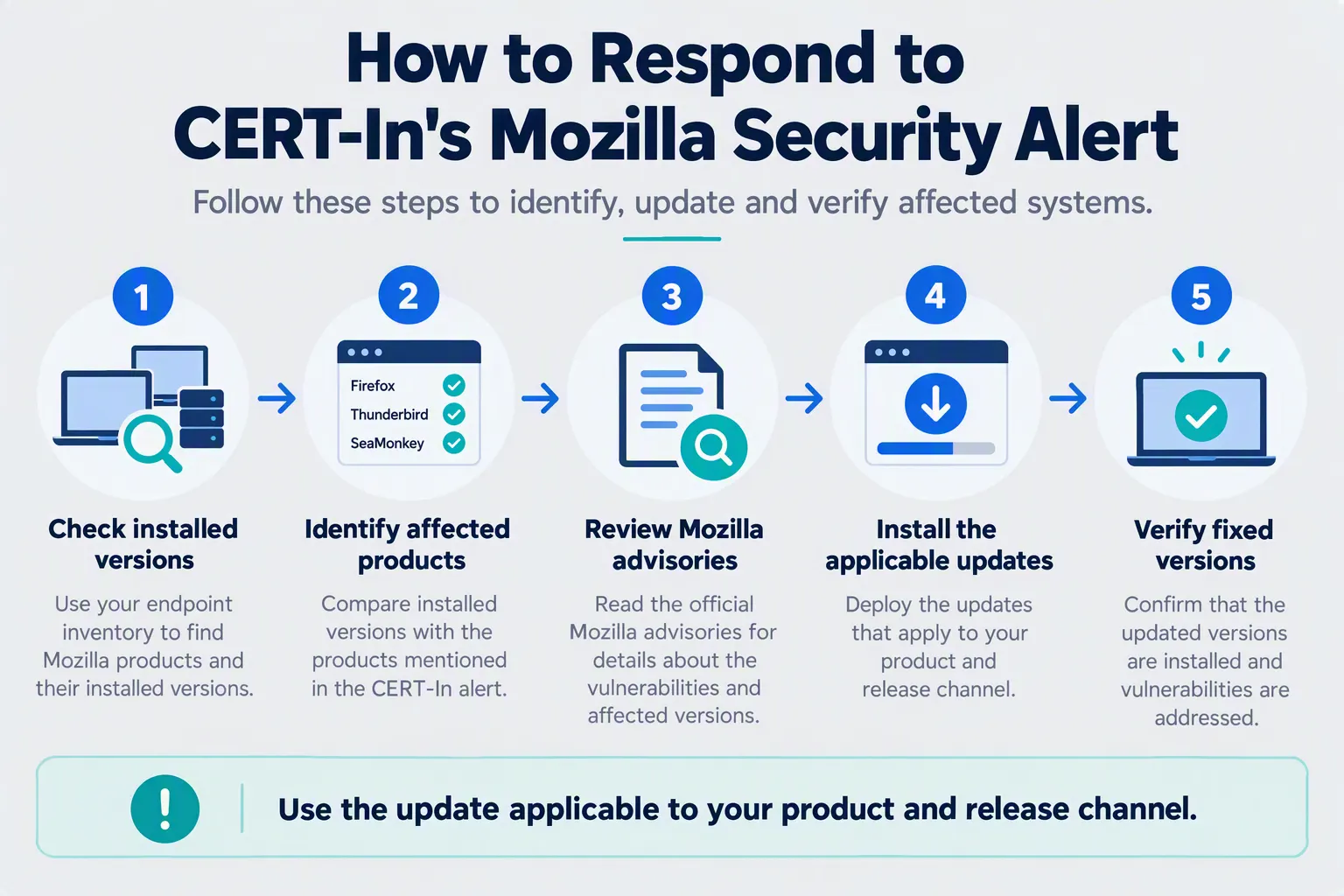
CERT-In's stated solution is to apply the appropriate updates referenced in the notice. Users and IT teams should take the following steps to address the advisory.
Check installed versions. Verify the versions of Firefox, Firefox ESR, and Thunderbird across individual devices and managed systems.
Identify affected installations. Compare installed versions against the affected ranges listed by CERT-In.
Apply the relevant updates. Use the official Mozilla security advisory corresponding to the product and release channel.
Prioritize managed environments. Organizations should identify affected endpoints and coordinate updates through their established software-management processes.
Verify the update. Confirm that systems are running the applicable fixed version after installation.
CERT-In does not provide a separate workaround in the vulnerability note. Applying the relevant vendor updates is the stated remediation.
What This Alert Means for IT Teams
The advisory highlights the importance of maintaining current versions of browsers and email clients across an organization's endpoint environment. These applications process content and data from external sources, making security updates an important part of routine vulnerability management.
For IT administrators, the immediate task is to identify affected installations and apply the corresponding vendor updates. Organizations using Firefox ESR should pay particular attention to the release channel and version deployed across their systems.
The separate Mozilla advisories are also important because they provide details beyond the high-level summary in the CERT-In notice. Reviewing the relevant vendor documentation helps administrators understand which issues apply to their software and which update addresses them.
This is operational guidance based on the published notice, not a claim that the vulnerabilities are being actively exploited. CERT-In's cited notice does not establish active exploitation in the wild.
Conclusion
CERT-In's CIVN-2026-0531 warns of multiple High-severity vulnerabilities affecting Mozilla Firefox, Firefox ESR, and Thunderbird. The reported issues could lead to arbitrary code execution, sensitive information disclosure, or denial of service, with the agency assessing the potential impact as complete system compromise.
Users and organizations should check their installed versions and apply the appropriate Mozilla security updates. IT teams should verify remediation across managed endpoints and use the vendor advisories to confirm the relevant fixes.
About the Author