
CERT-In Issues Critical Warning Over Multiple Apache Tomcat Vulnerabilities
CERT-In warns of critical Apache Tomcat vulnerabilities that could enable authentication bypass, disrupt request handling and expose sensitive data. Organizations should check affected versions and apply available security updates.
Xcademia Team
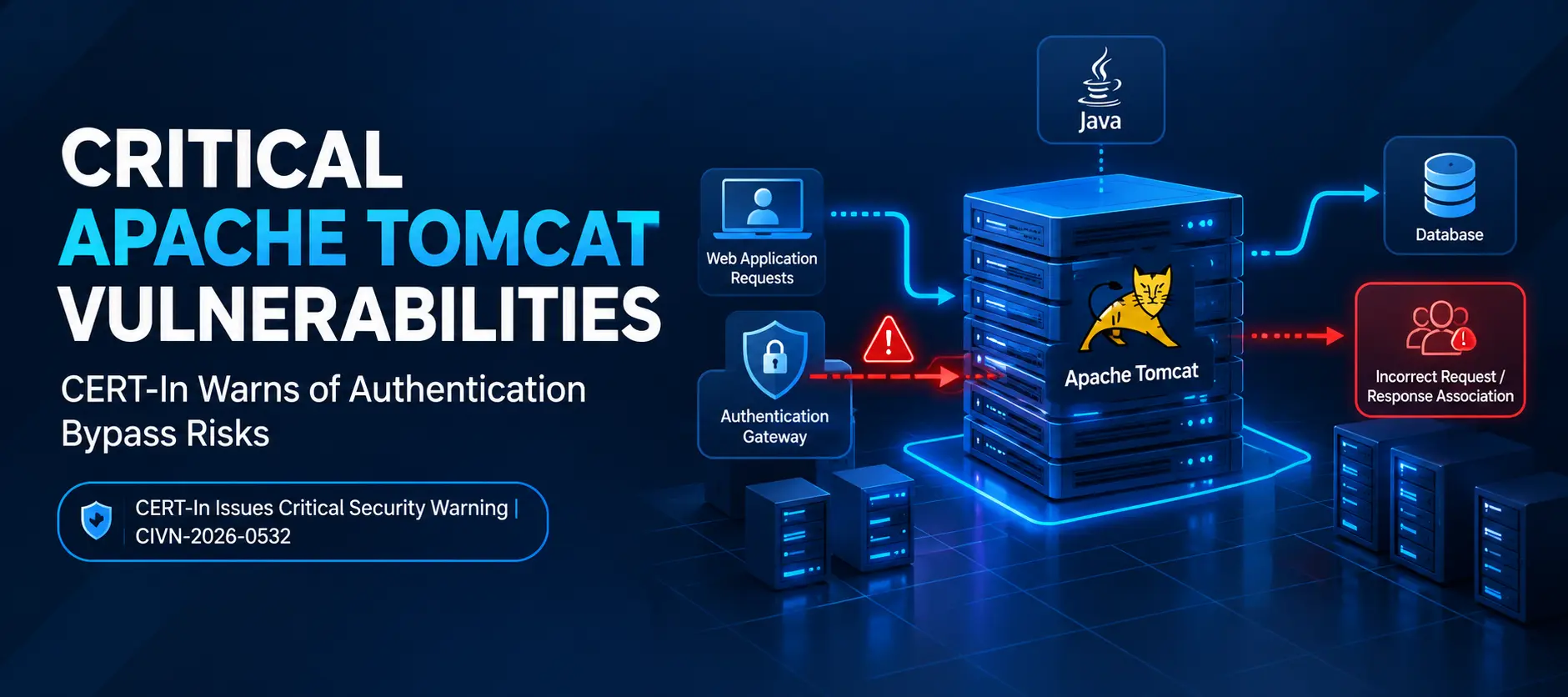
The Indian Computer Emergency Response Team (CERT-In) has issued a critical security warning about multiple vulnerabilities affecting Apache Tomcat, an open-source web server and servlet container widely used to deploy Java-based web applications.
Published on October 29, 2026, under vulnerability note CIVN-2026-0532, the warning highlights security weaknesses that could allow remote attackers to bypass authentication and cause requests or responses to be incorrectly associated with different users.
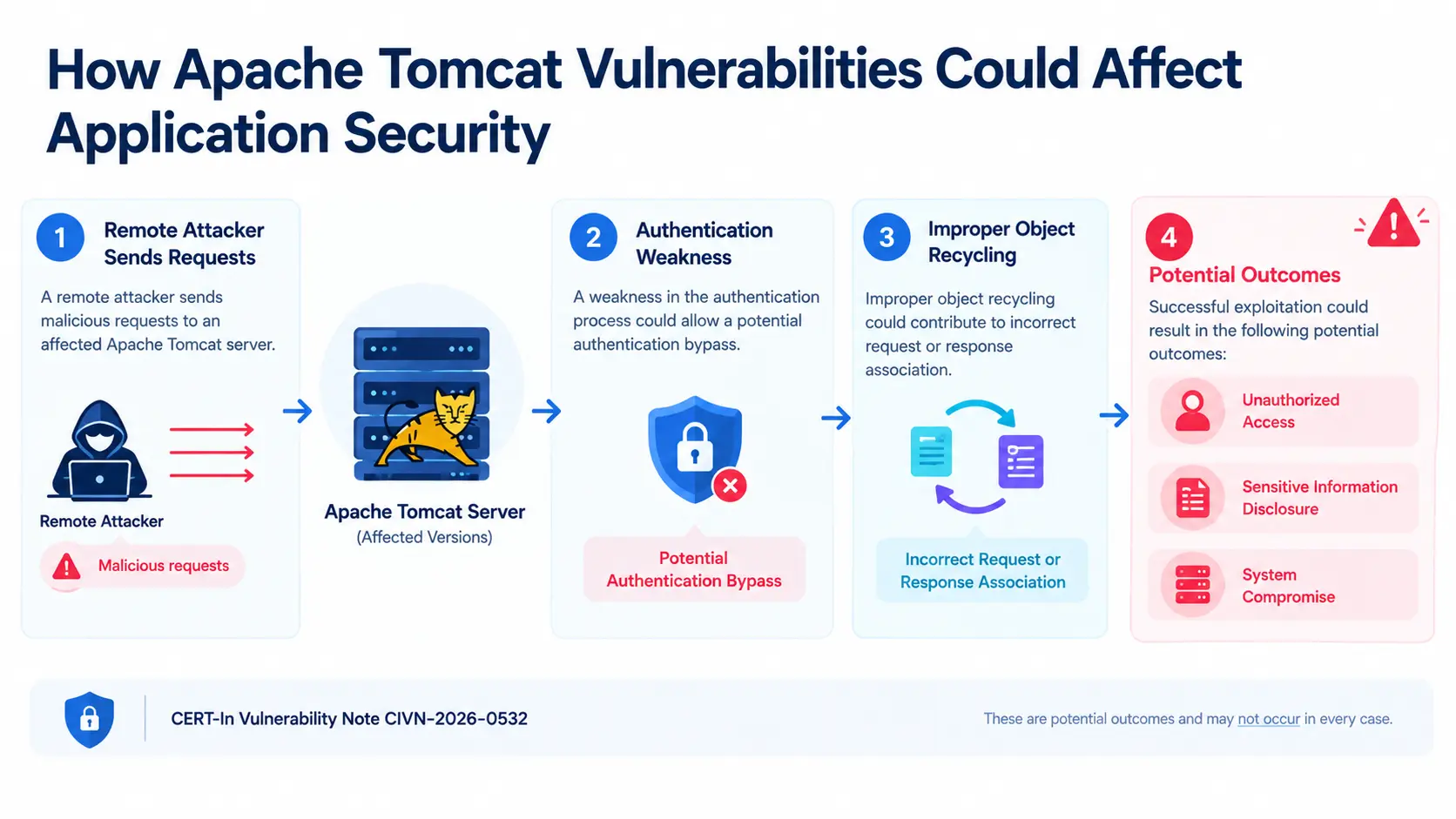
According to CERT-In, successful exploitation could result in unauthorized access, sensitive information disclosure and potential system compromise.
The vulnerabilities are associated with improper object recycling and missing critical steps in authentication processes.
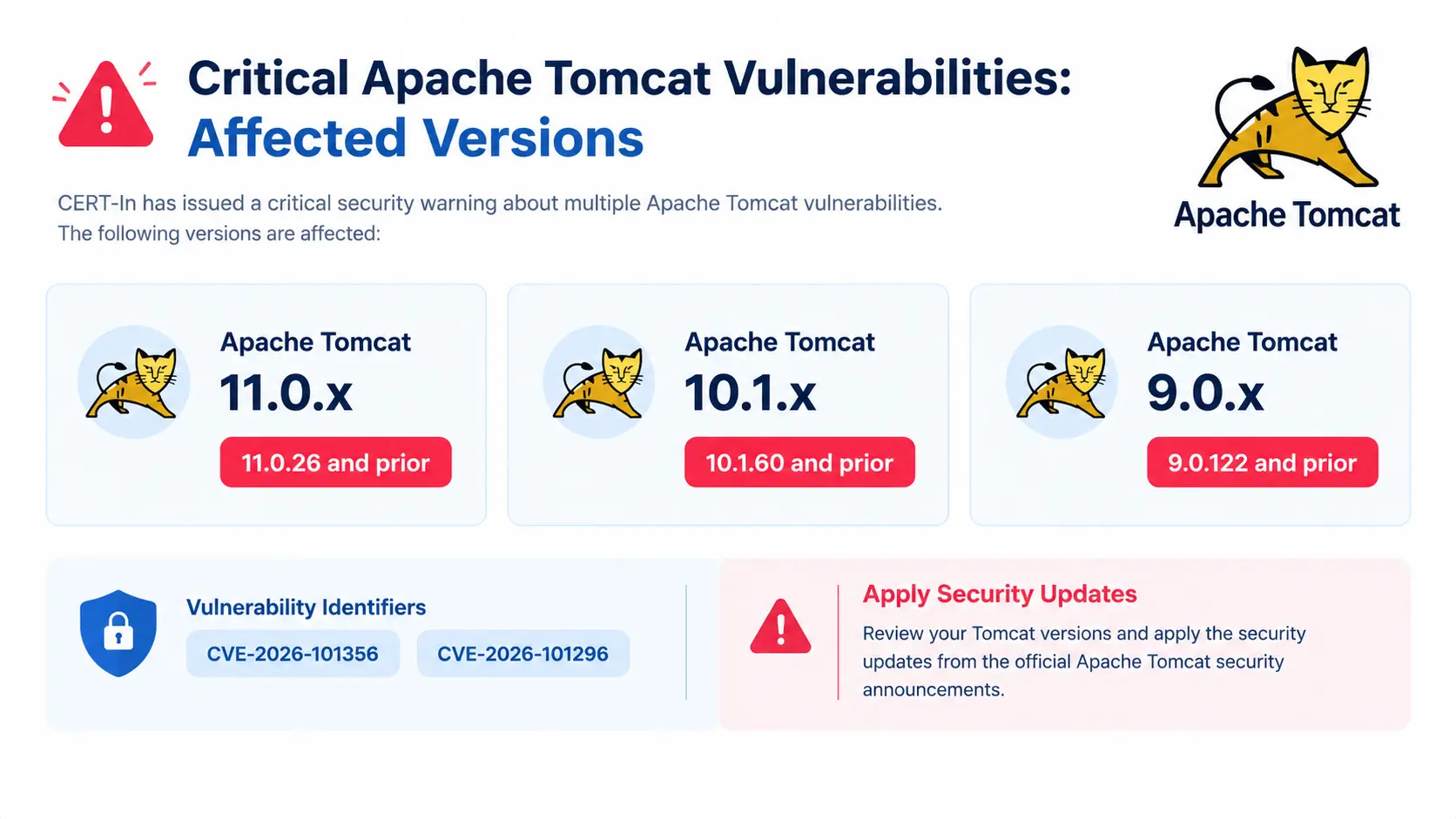
The advisory identifies two CVEs: CVE-2026-101356 and CVE-2026-101296.
Organizations running affected Apache Tomcat versions are advised to review their deployments and apply the security fixes referenced in the official Apache Tomcat security updates.
Which Apache Tomcat Versions Are Affected?
CERT-In has identified three Apache Tomcat release branches containing affected versions.
Software | Affected Versions |
|---|---|
Apache Tomcat 11.0.x | Version 11.0.26 and prior |
Apache Tomcat 10.1.x | Version 10.1.60 and prior |
Apache Tomcat 9.0.x | Version 9.0.122 and prior |
Organizations using these versions should assess their exposure and follow the vendor's security guidance.
Important: The vulnerability note identifies affected versions but does not specify the fixed version numbers in its summary. Administrators should consult the official Apache security announcements before selecting an upgrade.
What Are the Security Risks?
Apache Tomcat is commonly used to run Java-based web applications and handle application requests and responses.
The vulnerabilities identified by CERT-In involve two security-related weaknesses:
1. Improper Object Recycling
CERT-In identifies improper object recycling as one of the underlying causes.
In software systems, objects may be reused to manage resources and improve processing efficiency. If objects are not properly reset or handled before reuse, information or state from an earlier operation could affect a subsequent operation.
In the reported vulnerabilities, this weakness contributes to the possibility of requests or responses being incorrectly associated with different users.
2. Missing Critical Authentication Steps
The second identified weakness involves missing critical steps in authentication processes.
Authentication verifies whether a user or application is permitted to access a protected resource.
If critical authentication checks are missing, an attacker could potentially bypass security controls and gain access without completing the expected authentication process.
CERT-In warns that successful exploitation could allow remote attackers to bypass authentication or cause cross-user request and response mix-ups.
Potential Impact on Organizations
The vulnerabilities could create security risks for organizations operating affected Apache Tomcat deployments.
CERT-In identifies the following potential consequences:
Authentication bypass: Remote attackers could potentially bypass authentication controls.
Unauthorized access: Attackers could gain access to resources without the expected authorization.
Sensitive information disclosure: Incorrect request and response associations could expose information belonging to different users.
System compromise: Successful exploitation could affect the security of applications running on vulnerable Tomcat deployments.
The risks are particularly relevant to organizations that operate Java-based applications using affected Tomcat versions.
However, CERT-In has not disclosed specific affected organizations, confirmed exploitation incidents or the number of systems exposed to these vulnerabilities.
Additional details were not disclosed in the announcement.
CERT-In Recommends Applying Apache Tomcat Security Updates
CERT-In recommends applying the appropriate fixes provided in the official Apache Tomcat security updates.
Organizations should prioritize reviewing their Apache Tomcat deployments and identifying whether affected versions are running in their environments.
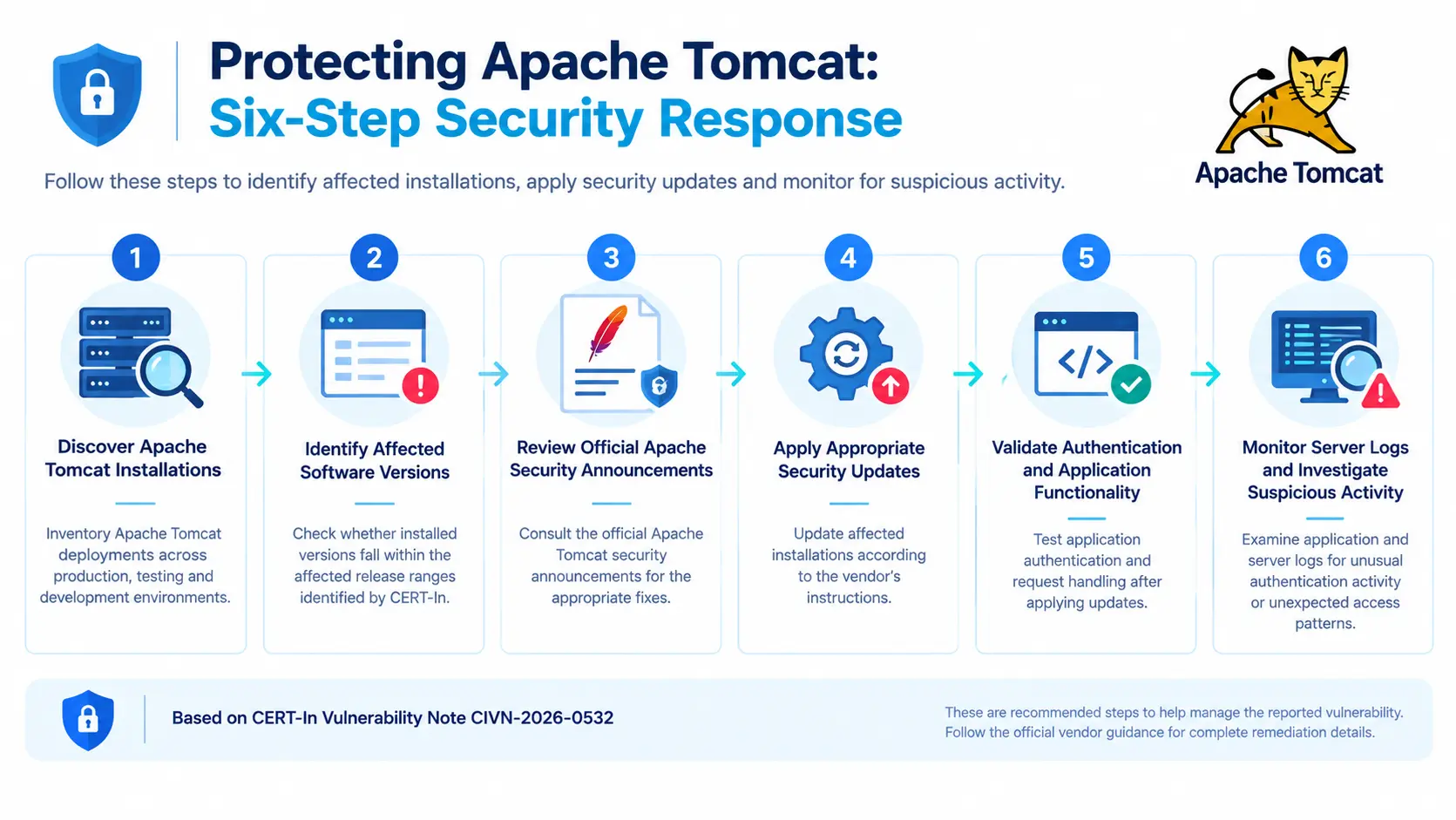
Recommended response steps include:
Identify affected installations: Inventory Apache Tomcat deployments across production, testing and development environments.
Verify software versions: Check whether installed versions fall within the affected release ranges identified by CERT-In.
Review vendor security updates: Consult the official Apache Tomcat security announcements for the appropriate fixes.
Apply security fixes: Update affected installations according to the vendor's instructions.
Validate application functionality: Test application authentication and request handling after applying updates.
Review security logs: Examine relevant application and server logs for unusual authentication activity or unexpected access patterns.
These are operational recommendations for managing the reported vulnerability. CERT-In's stated solution is to apply the appropriate vendor-provided security fixes.
Why This Vulnerability Matters for Java Application Security
Apache Tomcat plays an important role in Java application environments, making vulnerabilities in its authentication and request-handling processes relevant to application security teams.
The latest CERT-In warning highlights how weaknesses in server-side components can affect application-level security.
Authentication is not simply a login mechanism. It is part of the broader process of ensuring that requests are processed within the correct user context and that protected resources remain accessible only to authorized users.
For enterprises, this could mean reviewing not only application code but also the underlying server infrastructure and its security update practices.
The announcement highlights a broader industry shift toward treating application server security as an essential part of enterprise cybersecurity management.
Organizations should therefore include Apache Tomcat version checks and vendor security updates in their regular vulnerability management processes.
Final Thoughts
CERT-In's vulnerability note CIVN-2026-0532 highlights critical security weaknesses affecting multiple Apache Tomcat release branches.
The possibility of authentication bypass and cross-user request or response mix-ups makes the vulnerabilities important for organizations operating Java-based applications.
Administrators should identify affected installations, review the official Apache security announcements and apply the appropriate vendor-provided fixes.
Keeping application servers updated remains an important part of reducing exposure to remotely exploitable security weaknesses.
About the Author