
CERT-In Flags Critical Brotli Decoder Flaw Affecting Node.js, Bun, .NET and More
CERT-In has issued a critical warning about CVE-2026-111497, an out-of-bounds write vulnerability in Google's Brotli decoder. The flaw affects multiple software ecosystems, including Node.js, Bun, .NET, Envoy, Python packages and PHP Windows builds.
Xcademia Team
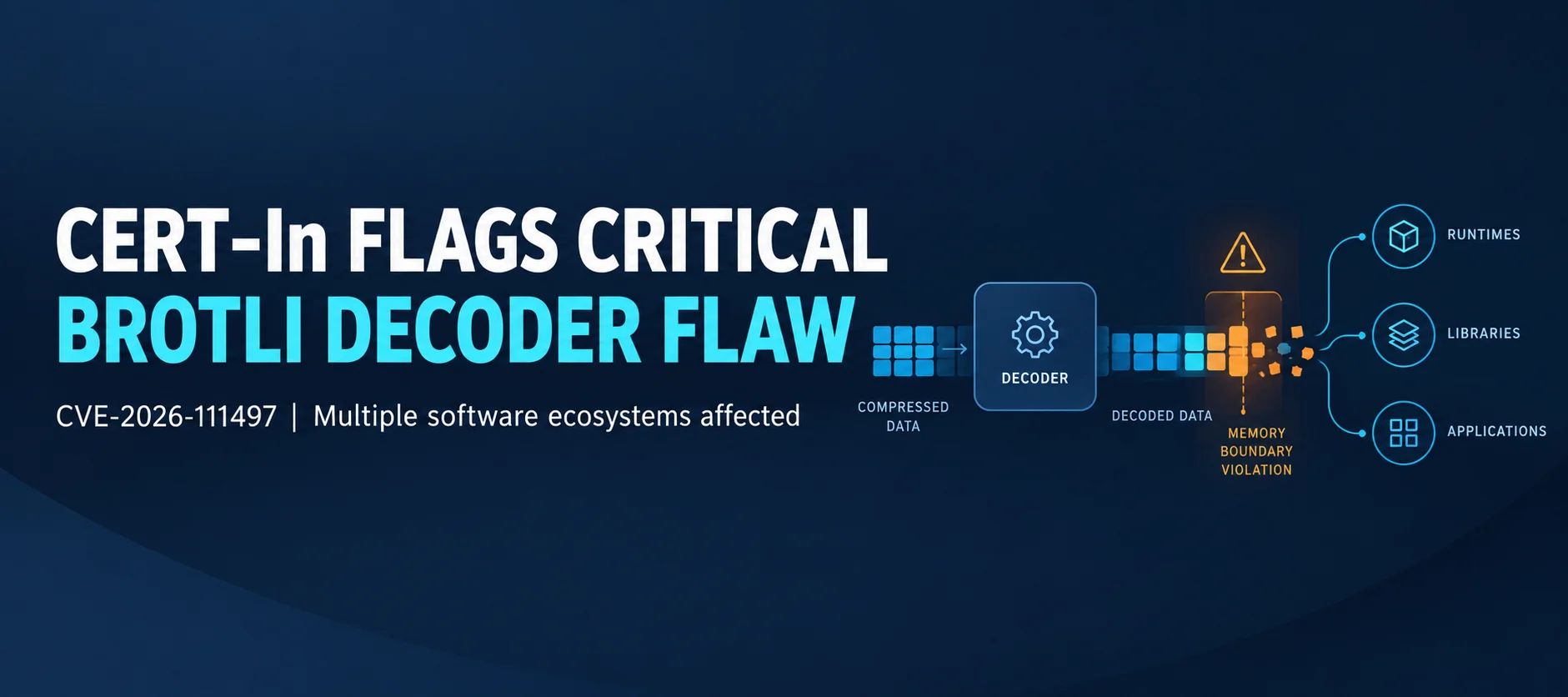
India's Computer Emergency Response Team (CERT-In) has issued a critical security advisory for CVE-2026-111497, an out-of-bounds write vulnerability in Google's Brotli decoder. Published on October 27, 2026, advisory CIAD-2026-0055 warns that the flaw could allow a remote unauthenticated attacker to corrupt memory, disclose sensitive information, cause a denial of service or potentially execute arbitrary code.
The vulnerability affects Google Brotli versions 1.0.3 through 1.2.0 across all platforms, with specific exceptions and fixes documented in the relevant project advisories. Because several software projects incorporate the decoder into their own products, the issue extends beyond the original library.
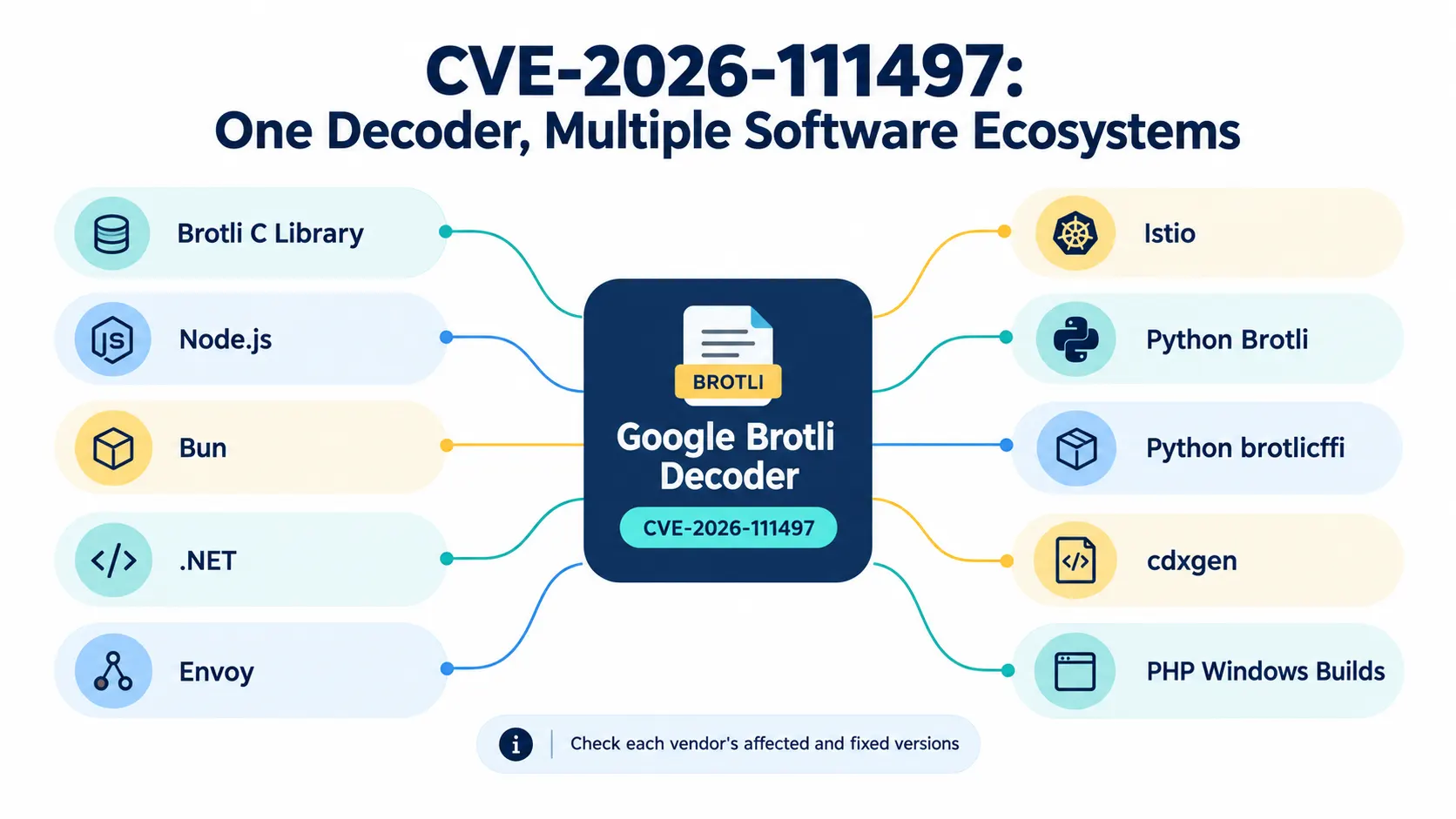
CERT-In identifies Node.js, Bun, Microsoft .NET, Envoy, Istio, Python's Brotli and brotlicffi packages, cdxgen and PHP among the affected software. It advises users and organizations to apply the updates provided by the respective vendors.
What Is CVE-2026-111497?
CVE-2026-111497 is a buffer overflow vulnerability in the Brotli decoder, located in the c/dec/decode.c file of Google's Brotli C library.
Brotli is a data compression format used to reduce the size of web content and other data transferred or stored by applications. Software that supports Brotli must decode compressed data before it can use the original content.
According to CERT-In, a remote unauthenticated attacker can exploit the vulnerability by supplying a specially crafted Brotli-compressed stream. The decoder may then write beyond the intended memory boundary and corrupt adjacent decoder state memory.
The potential consequences include:
Arbitrary code execution: An attacker could potentially cause code of their choosing to execute.
Memory corruption: Data or program state outside the intended memory area could be overwritten.
Sensitive information disclosure: The flaw could expose contents of sensitive memory.
Denial of service: Malformed compressed data could cause an affected application or service to fail.
System compromise: Successful exploitation could have broader consequences, depending on the affected software and execution environment.
These are potential impacts described by the advisory, not confirmation that every affected product is exploitable in every configuration.
Which Products Are Affected?
The vulnerability reaches multiple products because they use or bundle Brotli decoding functionality. However, the affected and fixed versions differ by project.
The table below consolidates the version information available from the original CERT-In advisory and the linked vendor notices. Where the original advisory does not provide a complete version range, the table identifies the relevant vendor-specific information rather than assuming that every release is affected.
Product or component | Affected versions or builds | Fixed version or update |
|---|---|---|
Google Brotli C library | Versions 1.0.3 through 1.2.0, with fixes already present in certain releases | 1.0.10, 1.1.1 or 1.2.1 |
Node.js | Affected releases in the 22.x, 24.x and 26.x lines before the security fixes; older end-of-life lines may also be affected | 22.23.4, 24.22.1 or 26.12.1 |
Bun | 1.4.3 and earlier; the vendor advisory specifies affected versions from 1.0.21 to before 1.4.4 | 1.4.4 |
Microsoft .NET | .NET 8 before 8.0.33, .NET 9 before 9.0.22, .NET 10 before 10.0.14, and affected .NET 11 preview builds before the listed release candidate | 8.0.33, 9.0.22, 10.0.14 or 11.0.0-rc.3.26522.148 |
Envoy | Affected releases include 1.36.11, 1.37.7, 1.38.5 and 1.39.2, with corresponding earlier versions in those release lines requiring review | 1.36.12, 1.37.8, 1.38.6, 1.39.3 or 1.40.0 |
Istio | 1.31.0 to 1.31.1, 1.30.0 to 1.30.5, and 1.29.0 to 1.29.8 | 1.31.2, 1.30.6 or 1.29.9 |
Python | Version 1.2.0 and earlier, subject to the package's release history | 1.2.1 |
Python | Version 1.2.0.x and earlier | 1.2.1.0 |
cdxgen | Affected standalone binaries and container images, including releases 13.4.0 and 12.8.8 and earlier | 13.5.0 or 12.8.9 |
PHP for Windows | The PHP team's October 26 announcement identifies Windows builds using the vulnerable Brotli dependency | Updated builds PHP 8.5.12-1, 8.4.27-1, 8.3.36-1 and 8.2.35-1 |
Version notes: The Google Brotli library's fixed releases include 1.0.10 and 1.1.1, so the broad 1.0.3 to 1.2.0 range should not be interpreted as meaning that every release within it remains vulnerable. For PHP, the listed fixes are Windows package rebuilds with updated dependencies, not new PHP source versions.
Organizations should consult the applicable vendor notice for package-specific conditions and supported release lines.
Relevant vendor notices:
How the Vulnerability Can Affect Applications
The vulnerability resides in the decoder rather than in a single application feature. Its practical relevance depends on whether an affected software component processes a crafted Brotli-compressed stream.
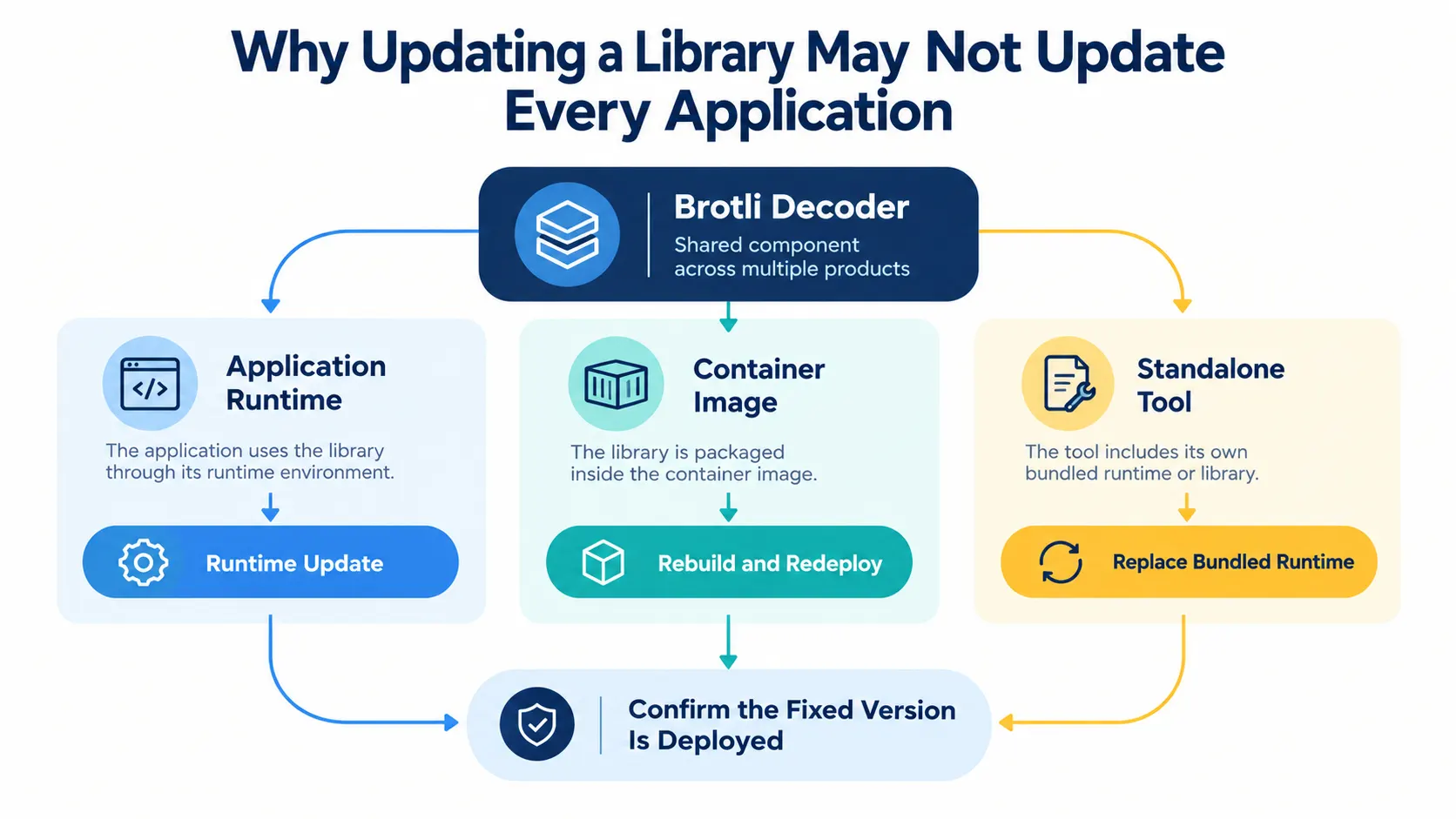
Software that bundles its own copy of Brotli may need a separate update even when another application or system library has already been patched. This is why the remediation guidance differs across runtimes, libraries, proxies and tools.
For example, Bun's advisory explains that its releases bundled an affected Brotli library and identifies version 1.4.4 as the fix. The .NET advisory also lists specific affected runtime and NativeAOT package versions. The PHP announcement concerns updated Windows builds that include Brotli 1.2.1.
The exact exposure conditions can differ by product and configuration. The relevant vendor advisory should therefore be used to determine whether a particular deployment processes untrusted compressed data and which update applies.
Recommended Actions for Organizations
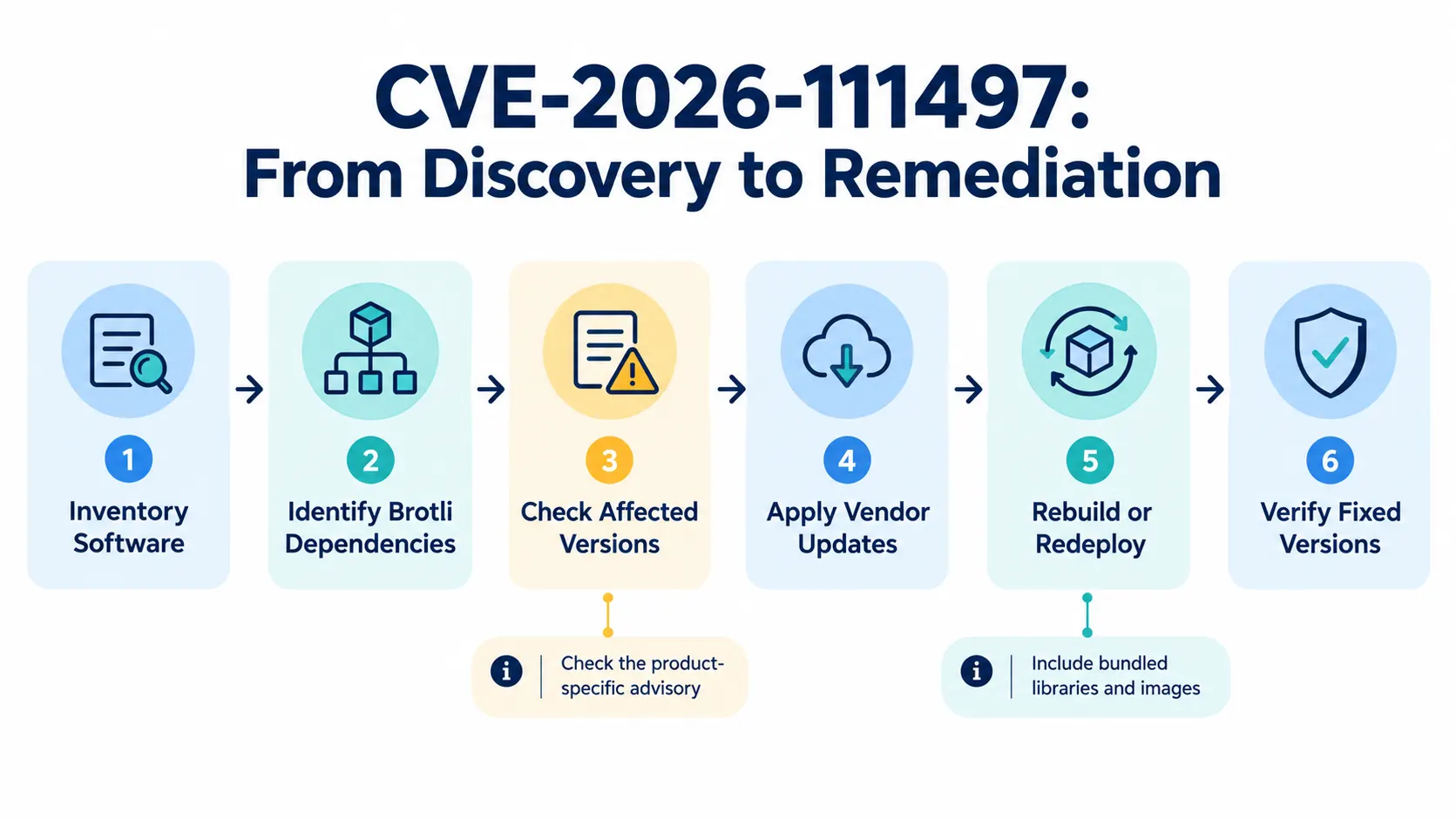
CERT-In recommends applying the appropriate vendor updates. Organizations using any of the listed products should take the following steps.
Identify affected software. Inventory runtimes, libraries, proxy infrastructure, Python packages, container images and standalone tools that may include Brotli decoding functionality.
Verify installed versions. Compare installed releases with the affected and fixed versions in the corresponding vendor advisory. Do not rely solely on the version of the top-level application if it bundles a separate decoder or runtime.
Apply the relevant vendor patch. Update the affected library, runtime, package, proxy or application to a version confirmed as fixed by its maintainer.
Rebuild and redeploy where necessary. Where a product ships a bundled dependency, ensure that the deployed artifact contains the updated component. For container images and standalone binaries, verify that the replacement artifact is actually in use.
Check all deployment environments. Review production, development, test and build environments, along with systems that may use different versions of the same software.
Confirm remediation. Validate installed versions after updating and follow each vendor's guidance for restarting services or redeploying affected workloads.
If a required update is not immediately available, consult the relevant vendor's mitigation guidance. The company did not provide a single workaround that applies to every affected product.
Why Dependency Visibility Matters
Analysis: This incident highlights a broader challenge in software security: a vulnerability in a shared component can affect products maintained by different teams, each with its own release process.
Patching the original library is not necessarily sufficient if an application continues to bundle an older version. Organizations need visibility into direct and indirect dependencies, including the components embedded in runtimes, packaged tools and deployment images.
The advisory also illustrates why vulnerability response requires more than identifying a CVE. Teams must establish which product versions they run, whether those versions include the vulnerable component, which fixed release applies and whether the updated software has reached the relevant environment.
These steps can help organizations prioritize remediation using verified vendor guidance rather than assuming that every product has the same exposure or the same patch.
Conclusion
CERT-In's CIAD-2026-0055 advisory warns of a critical out-of-bounds write vulnerability in Google's Brotli decoder, tracked as CVE-2026-111497. The issue affects a range of software that incorporates the decoder, including Node.js, Bun, .NET, Envoy, Istio, Python packages, cdxgen and PHP Windows builds.
Organizations should identify affected deployments, consult the relevant vendor advisories and apply the correct product-specific updates. Because fixes differ across software ecosystems, verifying the installed and deployed versions is an important part of remediation.
About the Author