
AWS Continuum Brings AI-Powered Penetration Testing Into Every Deployment
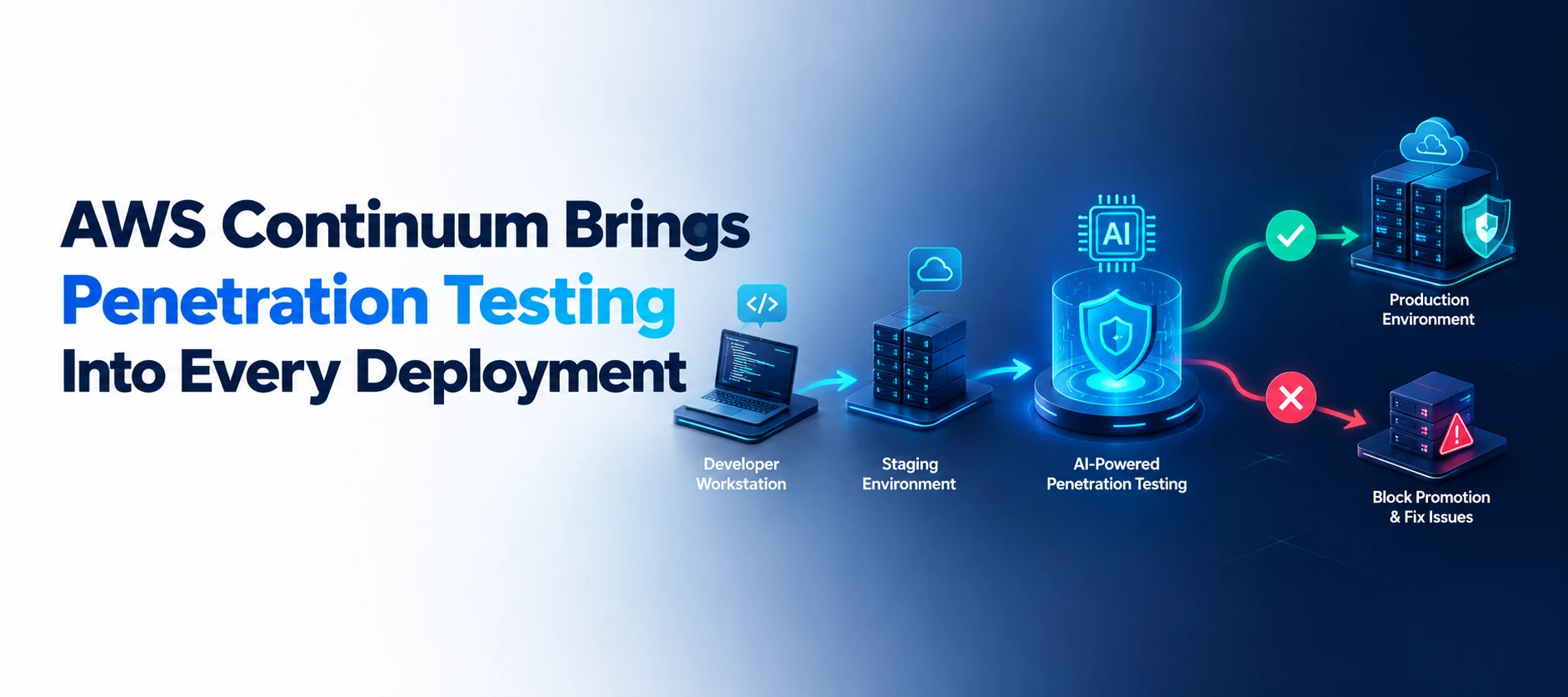
AWS is showing how AI-powered penetration testing can become a deployment gate. With AWS Continuum, development teams can test application changes in staging and block production releases when validated vulnerabilities exceed their chosen severity threshold.
Xcademia Team
Software teams increasingly integrate security checks into their development pipelines. However, identifying a potentially vulnerable code pattern is not the same as confirming that an attacker can exploit it.
AWS is addressing this distinction with an approach that brings penetration testing closer to the software deployment process. In a technical article published on 14 October 2026, the company explained how AWS Continuum for penetration testing can be configured as a post-deployment security gate.
The approach runs a scoped penetration test against changes deployed to a staging environment. If the test identifies validated vulnerabilities at or above a configured severity threshold, the pipeline can prevent the change from progressing to production.
The integration supports GitHub Actions, GitLab CI/CD, Bitbucket Pipelines and Azure DevOps Pipelines. AWS provides a worked implementation using GitHub Actions.
The central idea is straightforward: test relevant application changes as part of deployment rather than relying exclusively on periodic penetration testing engagements.
Why Traditional CI/CD Security Checks Are Not Enough
Modern continuous integration and continuous delivery (CI/CD) pipelines can include several security testing methods.
Static application security testing (SAST) examines source code for potentially insecure patterns. Software composition analysis (SCA) checks software dependencies, while dynamic application security testing (DAST) evaluates running applications for security weaknesses.
These methods help teams identify risks during development. However, a detected pattern does not necessarily demonstrate that a vulnerability is exploitable in the application's actual environment.
Penetration testing takes a different approach by attempting to validate whether weaknesses can be exploited under the defined testing conditions.
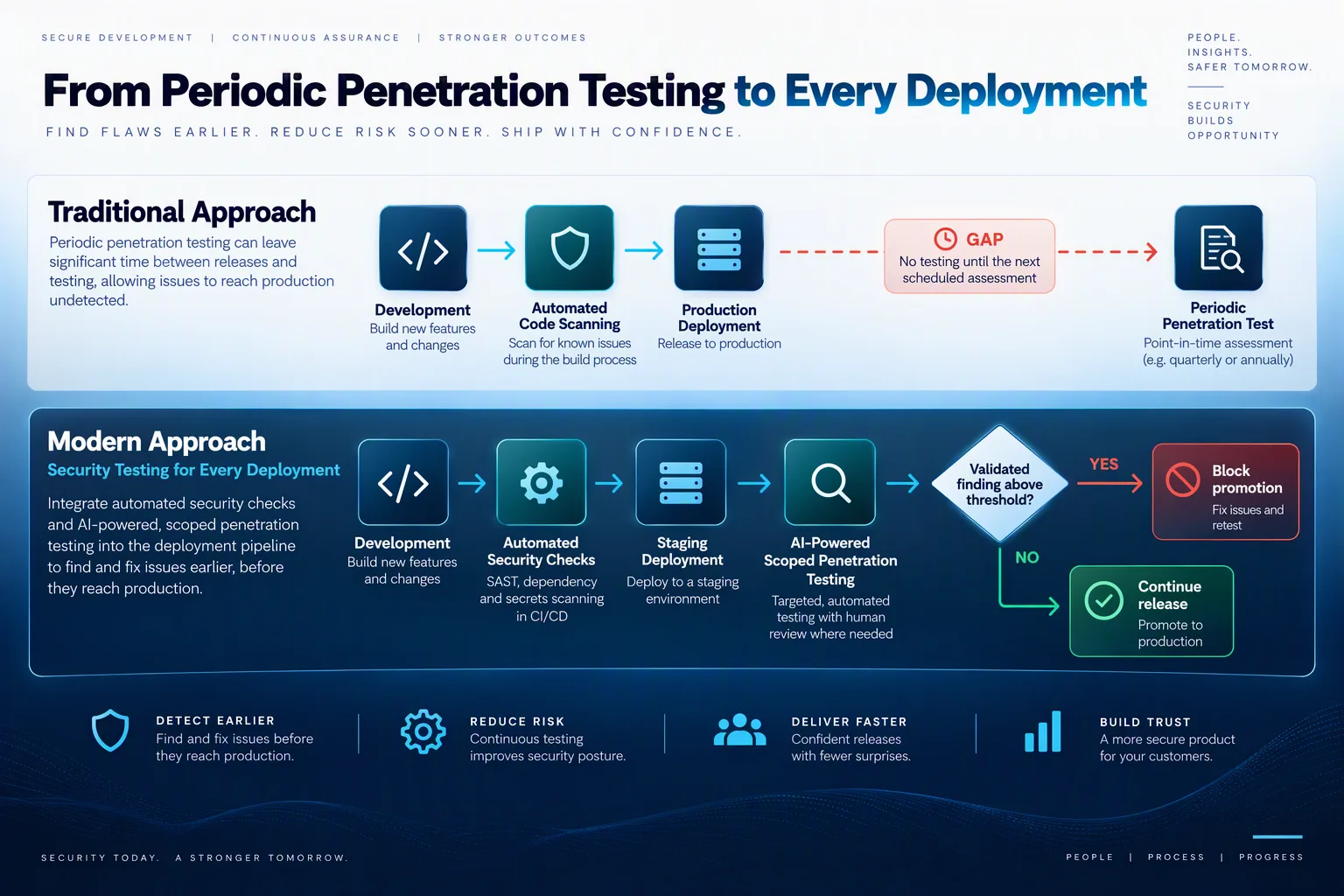
AWS notes that penetration testing has traditionally been conducted through scheduled engagements outside the deployment process. Consequently, application changes can reach production between testing engagements without equivalent penetration-testing validation.
AWS Continuum introduces a way to integrate this validation into the deployment workflow.
Rather than replacing existing security scanners, the approach adds a further check after a change has been deployed to staging.
How AWS Continuum Works as a Deployment Gate
The proposed workflow adds a penetration-testing step between staging and production.
According to AWS, the process has three main stages.
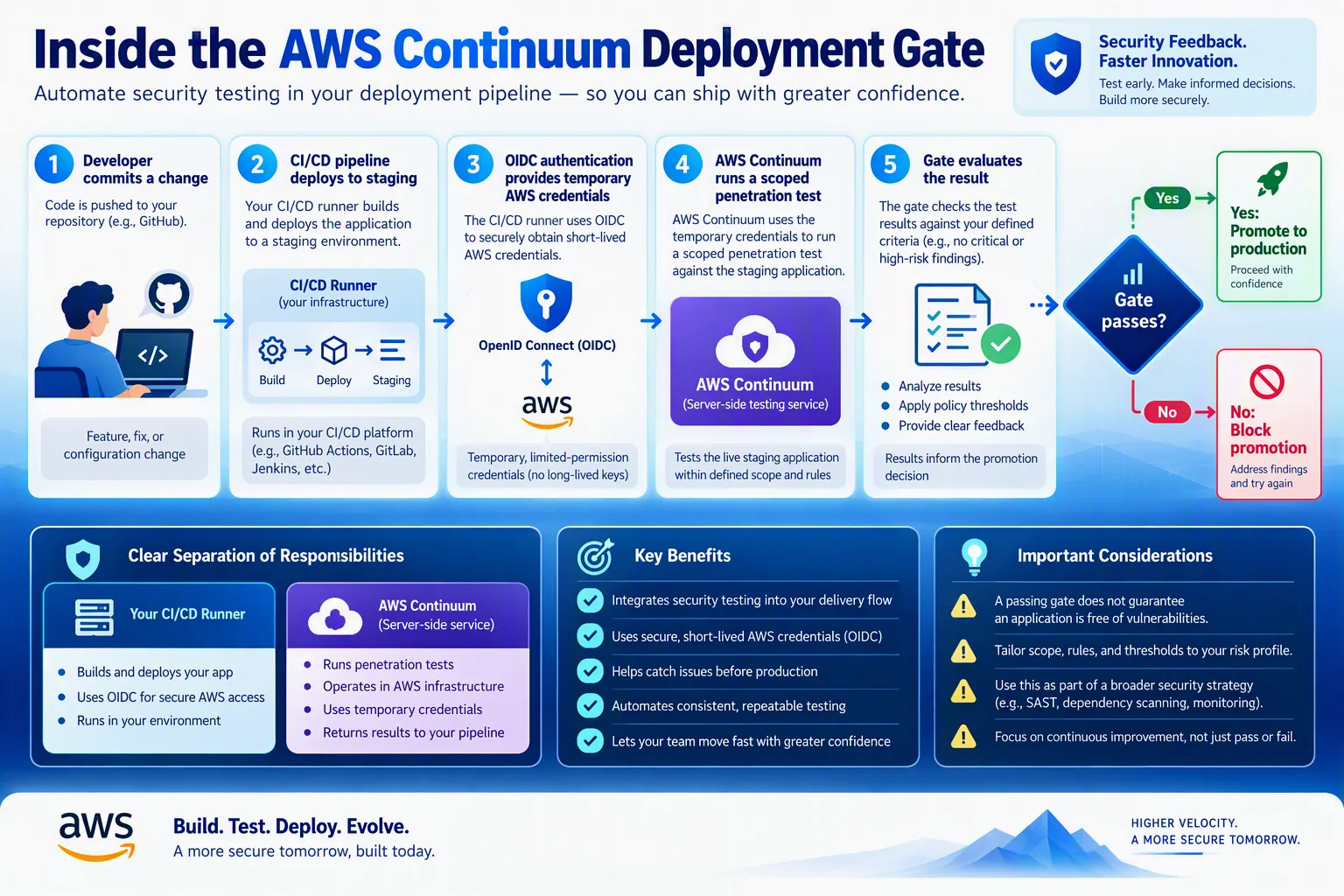
1. Deploy the application change to staging
The CI/CD pipeline deploys the application update to a staging environment that the penetration test can reach. This provides the target environment for evaluating the deployed change before production promotion.
2. Run a scoped penetration test
The pipeline authenticates to AWS using OpenID Connect (OIDC) and invokes Continuum for penetration testing. The service runs the test against the configured staging target.
The test is scoped to the change since the previous passing gate, rather than automatically retesting the entire application on every deployment.
3. Evaluate the result before production promotion
The gate waits for the test result and reports the outcome to the CI/CD pipeline. Depending on the configured severity threshold and handling policies, the pipeline can block or permit promotion to production.
AWS also explains that the penetration-testing work runs server-side in the AWS account. The CI/CD runner invokes the integration but does not execute the penetration-testing logic itself.
This separation is relevant to teams designing their deployment architecture because it distinguishes pipeline orchestration from the service performing the security test.
Why Testing Only the Change Matters
One of the most important elements of the AWS approach is its use of change-based scoping.
Running a comprehensive penetration test against an entire application after every small deployment may be difficult to incorporate into routine delivery workflows. AWS proposes testing the change between the current commit and the previously cleared commit.
The current commit is the version being evaluated. The baseline is the previous commit that passed the gate.
This approach focuses testing on the changes introduced since the last successful security checkpoint. AWS says this helps make penetration testing practical for every deployment.
Each run produces one of three scope decisions.
Scope decision | What it means |
|---|---|
In scope | The change affects the attack surface, so findings are evaluated against the configured severity threshold. |
Scoped out | The change does not introduce a security-relevant change within the configured scope, so the pipeline passes. |
Scope conflict | The change falls outside the configured scope and was not tested. The team decides whether this outcome should block the pipeline. |
These distinctions are important. A scoped-out result does not mean that the entire application has passed a fresh penetration test. Similarly, a scope conflict means the relevant change was not tested under the configured scope.
AWS records the scope decision and commit range in the Continuum for penetration testing console.
The approach also changes the meaning of a failing security gate. Instead of failing only because a scanner detected a suspicious pattern, the gate can block on vulnerabilities that the service has validated as exploitable.
This gives development and security teams a more specific issue to investigate before release.
Setting Up the Integration: Three Essential Steps
AWS describes three main implementation steps: configure the penetration test, establish secure pipeline authentication and add the gate to the CI/CD workflow.
Step 1: Configure the penetration test
Teams must complete the initial setup for their target application.
AWS outlines the following prerequisites:
Verify the target domain.
Create a penetration test in the relevant Agent Space.
Enable CI/CD mode.
Connect the repository.
Record the Agent Space ID and penetration test ID for the pipeline integration.
The configured target and scope determine what the penetration test covers. Teams should therefore confirm that the test is directed at the intended staging environment and that the scope matches their deployment process.
Step 2: Configure authentication with OIDC
The pipeline needs permission to invoke the penetration-testing integration.
AWS recommends using OpenID Connect federation rather than storing long-lived AWS access keys in CI/CD variables.
The CI/CD provider issues a short-lived token identifying the pipeline. AWS Security Token Service (AWS STS) exchanges that token for temporary credentials when the pipeline assumes the configured AWS Identity and Access Management (IAM) role.
This removes the need to store long-lived AWS access keys as pipeline variables for this integration.
Two IAM policies are particularly important:
Trust policy: Defines which pipelines or identities can assume the role.
Permissions policy: Defines what the assumed role can do.
AWS recommends restricting the trust policy as narrowly as the deployment architecture permits. For example, a pipeline that deploys only from a specific branch can restrict access to that branch when the provider's identity claims support it.
Teams should also confirm the exact identity claims emitted by their CI/CD provider. AWS specifically notes that GitHub repositories created or renamed on or after 15 July 2026 use an immutable sub claim containing numeric IDs.
The permissions granted to the role should also be limited to the operations required by the integration.
Step 3: Add the gate to the pipeline
The integration can be added to the supported CI/CD workflow. AWS recommends pinning it to an immutable release tag, commit SHA or component version so that upstream changes do not silently alter what runs in the pipeline.
Before enabling the gate for normal deployments, teams should execute a dry run.
According to AWS, this checks authentication, the AWS Region and repository resolution without starting a scoped penetration-testing job. Configuration failures surface during this validation.
AWS provides a worked example for GitHub Actions, alongside guidance for GitLab CI/CD, Bitbucket Pipelines and Azure DevOps Pipelines.
How the GitHub Actions Workflow Controls Production Releases
The GitHub Actions example separates deployment into three jobs.
Job | Responsibility |
|---|---|
| Deploys the application change to staging. |
| Runs the scoped penetration-testing gate. |
| Promotes the change to production after the gate passes. |
The production job depends on the successful completion of the security-testing job. If the gate fails, GitHub Actions skips the dependent production deployment.
AWS's example includes a configurable severity threshold and a policy for handling scope conflicts. This allows teams to define how security findings affect the release process.
The example also contains an important permission detail. The gate updates a baseline marker stored as a repository reference, so the workflow needs the appropriate repository permissions for that operation. AWS's example grants contents: write for this purpose.
The integration's credentials must remain valid long enough for the penetration test to finish. AWS warns that an insufficient AWS STS session duration can cause the workflow to fail while the test is still running.
These settings are not simply implementation details. They determine whether the gate can authenticate correctly, evaluate the intended change and reliably control production promotion.
Rolling Out the Gate Without Disrupting Releases
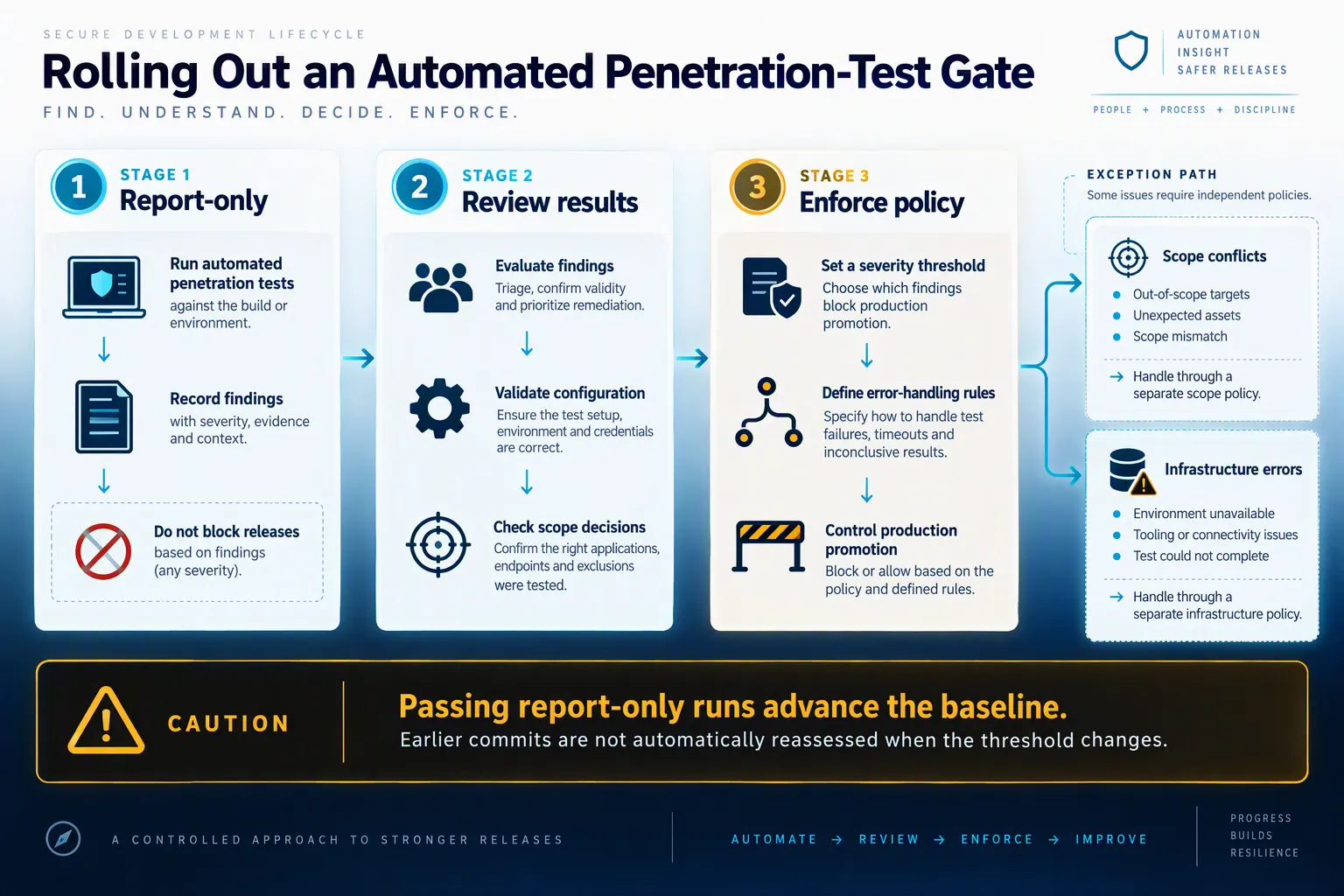
AWS recommends introducing the gate in report-only mode before using it to block production releases.
In this initial configuration, the severity threshold is set to NONE. The test can run and publish findings without blocking the pipeline on vulnerability severity.
Teams can observe the results over a release or two before increasing the threshold, for example, to HIGH.
However, AWS highlights a significant baseline behaviour that teams must understand before adopting this rollout strategy.
A passing report-only run advances the baseline.
The commits covered by that run are recorded as cleared. If the team later changes the severity threshold, the gate does not automatically revisit all the commits that passed during report-only operation.
For example, switching from report-only mode to a HIGH threshold does not automatically reassess vulnerabilities reported in earlier passing runs. The new threshold applies to changes after the last passing baseline.
This means teams need a deliberate rollout plan. If they want previously reported findings evaluated against a stricter threshold, they must address that requirement separately rather than assuming the gate will automatically retest the historical commit range.
AWS also identifies three independent settings that control different failure scenarios:
severity-threshold: Determines how vulnerability findings affect the gate.on-scope-conflict: Determines what happens when the change falls outside the configured testing scope.fail-on-infrastructure-error: Determines how infrastructure-related testing failures affect the pipeline.
These controls should be configured according to the organisation's release and security requirements. Changing one does not automatically change the behaviour of the others.
Extending the Approach Across AWS Accounts
AWS's example uses one account for simplicity, but the company also describes a multi-account deployment pattern.
In environments where staging and production run in separate AWS accounts, AWS recommends keeping the gate's IAM role in the security account where the penetration test and Agent Space reside.
The pipeline can assume that role through OIDC even when the workload being deployed resides in a different account. This avoids the need to distribute copies of the gate role or long-lived AWS access keys across every workload account.
AWS also recommends running the gate against each pre-production environment through which a release passes and making promotion to the next stage conditional on the result.
For deployments where the gate is required for security approval, AWS advises setting fail-on-infrastructure-error to true and restricting who can override pipeline variables.
The integration should remain pinned to a reviewed version so changes to the component are evaluated before they enter the deployment workflow.
These recommendations are particularly relevant to organisations with multiple environments, central security teams or formal release approval processes.
What This Means for Development and Security Teams
AWS's announcement highlights a broader industry shift towards integrating security validation directly into software delivery.
The most notable element is not simply the use of AI in penetration testing. It is the connection between the test result and the production release decision.
For developers, this approach can make security testing part of the normal deployment workflow rather than a separate activity that happens after development. A validated vulnerability can stop a release before production promotion, giving the team an opportunity to investigate and fix the issue.
For security teams, change-based testing offers a way to connect security validation more closely to individual releases. The scope decisions and recorded commit ranges also provide context for understanding what was tested and why a gate passed or failed.
For platform and DevOps engineers, the implementation introduces additional responsibilities. They must configure OIDC trust, IAM permissions, testing scope, severity thresholds, failure handling and baseline management correctly.
The approach does not eliminate the need for other security controls. Its coverage depends on the configured penetration test and the changes within its scope. Teams still need to manage vulnerabilities outside that scope and maintain their wider application security programme.
AWS's article focuses on the technical implementation of the gate. It does not provide a quantified performance benchmark or a universal estimate of how much testing time or cost organisations will save. Additional details were not disclosed in the announcement.
Conclusion
AWS Continuum for penetration testing provides a documented approach for making scoped penetration testing part of the CI/CD release process.
The workflow deploys changes to staging, invokes the test through an authenticated pipeline integration and uses the result to determine whether production promotion can proceed. AWS supports implementations across GitHub Actions, GitLab CI/CD, Bitbucket Pipelines and Azure DevOps Pipelines.
For teams considering this model, the main implementation priorities are clear: scope tests correctly, use narrowly restricted OIDC-based IAM access, pin the integration version and understand how severity thresholds, infrastructure failures and baseline advancement affect releases.
The wider lesson for development teams is that identifying security risks and validating exploitability are different tasks. Bringing both closer to deployment can help teams make more informed release decisions, provided the testing scope and gate policies are designed and maintained carefully.
Source: AWS Security Blog
About the Author