
ARTEX-Powered Cyberattacks Target Financial Institutions as Criminals Expand AI-Driven Operations
Microsoft warns that cybercriminals are using the ARTEX agentic AI framework to automate vulnerability exploitation, steal credentials, deploy remote access trojans and compromise financial organisations, particularly across Southeast Asia.
Xcademia Team

ARTEX Abuse Expands: Cybercriminals Use Agentic AI to Target Financial Institutions
Cybercriminals are increasingly using agentic artificial intelligence (AI) frameworks to automate sophisticated cyberattacks, and the financial sector is becoming a major target.
In a security investigation published on 6 November 2026, Microsoft Threat Intelligence disclosed that a financially motivated threat actor tracked as Storm-3358 had begun using the ARTEX agentic AI offensive framework to target financial organisations.
Microsoft observed the activity beginning in October 2026. The campaign primarily targets financial institutions across Southeast Asia, with a smaller number of large financial organisations elsewhere in the world also affected.
The attackers combine ARTEX with conventional security testing and exploitation tools to scan internet-facing systems, exploit application vulnerabilities, compromise credentials and deploy remote access trojans (RATs).
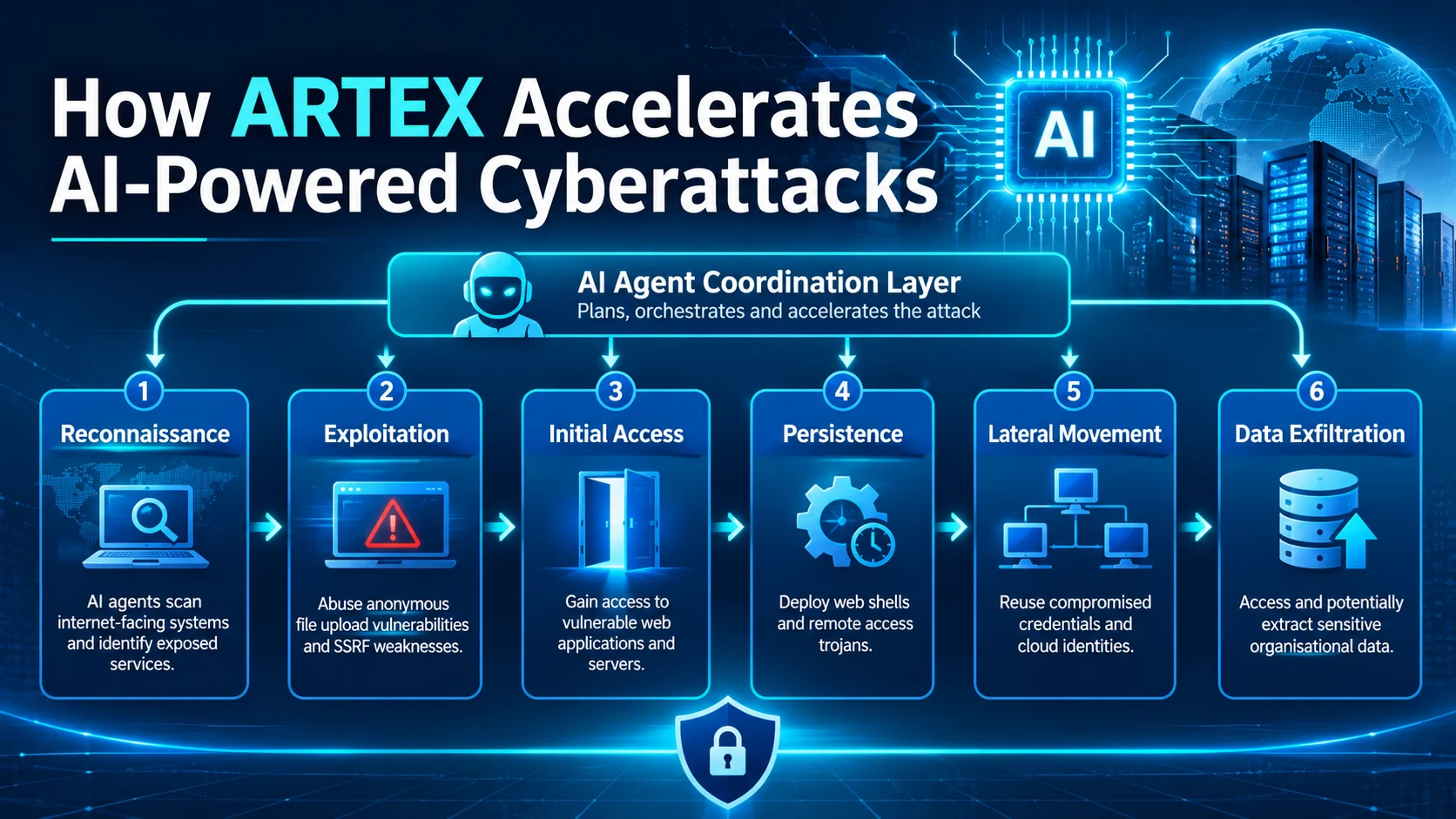
The findings highlight an important development in the cyber threat landscape: threat actors are using AI agents to accelerate multiple stages of an attack, from initial reconnaissance to lateral movement and potential data exfiltration.
1. Who Is Storm-3358?
Microsoft tracks Storm-3358 as a Cambodia-based intrusion cluster associated with financially motivated cybercrime.
The group primarily targets financial organisations in Southeast Asia, although Microsoft has also identified activity involving a smaller number of large financial institutions globally.
Its latest operations demonstrate how attackers can combine agentic AI frameworks with established offensive security utilities to automate activities that traditionally required significant manual coordination.
Rather than relying on a single attack technique, Storm-3358 uses multiple methods to identify exposed services, exploit weaknesses, establish persistence and gain access to additional systems.
Microsoft's investigation identifies ARTEX as a central component of this activity.
2. How ARTEX Is Being Used in Cyberattacks
ARTEX is an agentic AI offensive framework that can coordinate security assessment and attack activities through automated tools.
In Storm-3358 operations, Microsoft observed ARTEX working alongside conventional utilities, including:
Nmap for network discovery and port scanning.
curl for transferring files and communicating with remote services.
wget for downloading files.
Python HTTP clients for web requests.
Playwright with headless Chromium for browser-based interactions.
These tools allow the framework to interact with exposed systems and perform different stages of an attack.
Microsoft reported that ARTEX agents were used to scan and exploit web application vulnerabilities, including anonymous file upload weaknesses and server-side request forgery (SSRF).
The attackers also used web shells to maintain access to compromised web servers.
The important distinction is that ARTEX does not replace traditional attack tools. It helps coordinate and accelerate their use through an agentic workflow.
3. Remote Access Trojans Used to Maintain Access
One of the significant findings in Microsoft's investigation is the deployment of open-source remote access trojans.
Microsoft identified three RATs associated with Storm-3358 activity:
RAT | Observed role |
|---|---|
WISP | Remote access and command-and-control activity |
vshell | Remote access capabilities |
AdaptixC2 | Command-and-control and post-compromise operations |
These tools can help attackers maintain access to compromised environments and support subsequent operations.
Microsoft observed ARTEX agents using utilities such as netcat and curl to download these RATs onto compromised systems.
This combination of automated orchestration and established remote access tooling creates opportunities for attackers to move from initial compromise to sustained access.
The use of open-source tools also illustrates why defenders should not rely exclusively on detecting unfamiliar or custom-developed malware. Legitimate administrative utilities can become part of malicious activity when used in suspicious contexts.
4. Credential Theft and Cloud Identity Abuse
Microsoft's investigation also highlights the role of compromised credentials in the campaign.
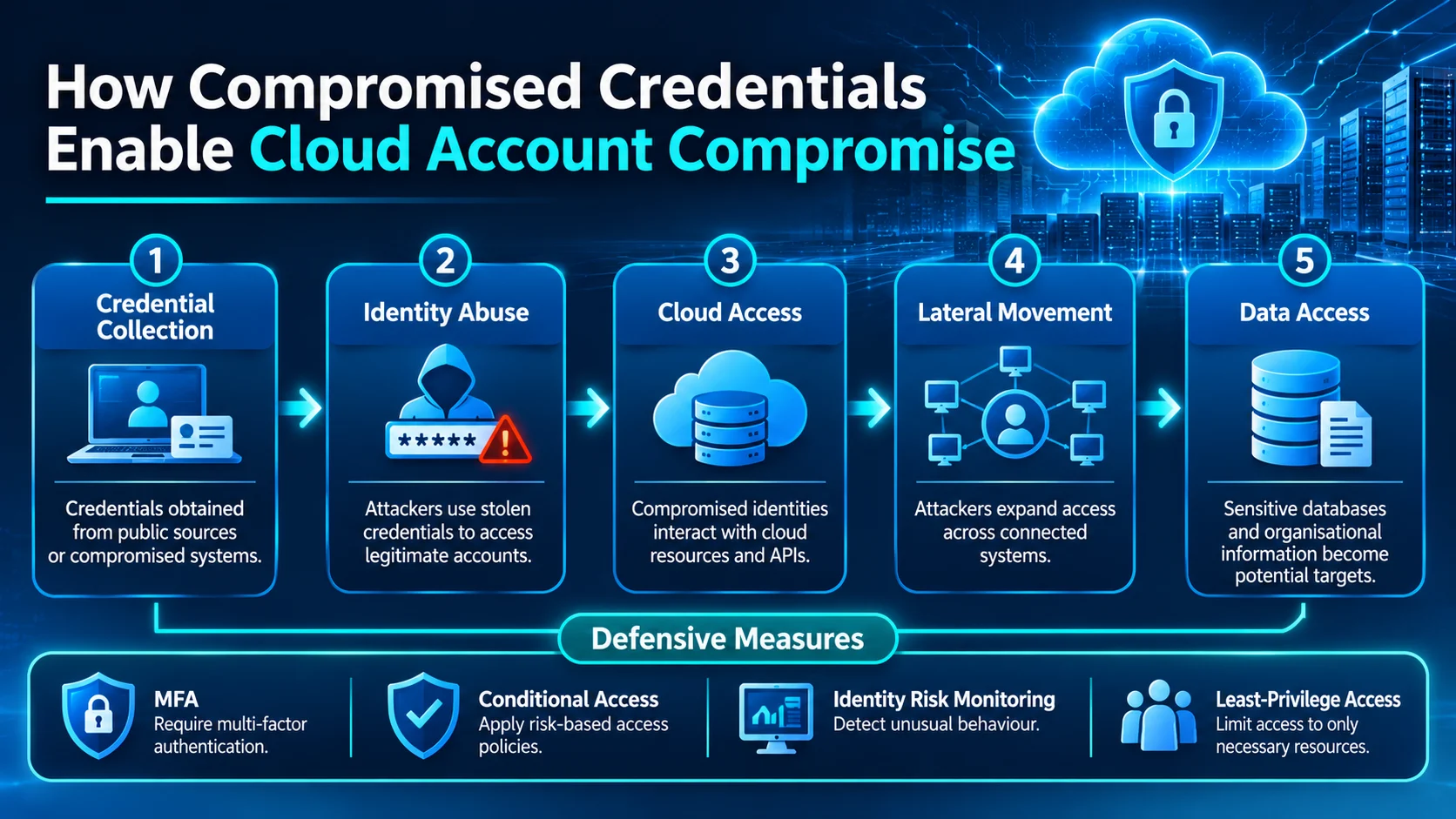
Storm-3358 operations involved obtaining credentials from publicly accessible sources and compromised systems.
The attackers could then use compromised identities to support further access and persistence.
Microsoft identified several activities associated with this stage:
Brute-force password attacks.
Password spraying.
API enumeration and abuse.
Credential compromise.
Cloud identity misuse.
Database dumping.
Compromised cloud identities can be particularly valuable because they may provide access to resources beyond the initially compromised application or server.
When attackers obtain valid credentials, they may be able to interact with systems using apparently legitimate authentication mechanisms.
This makes identity monitoring, access governance and investigation of unusual authentication behaviour important elements of financial-sector security.
Microsoft also noted that agentic frameworks can use compromised credentials and systems to accelerate lateral movement, privilege escalation and data exfiltration.
5. How Organisations Can Identify Agentic AI Attacks
Microsoft highlighted several behavioural signals that can help security teams identify activity involving agentic AI frameworks.
Unlike traditional attacks that may involve slower, manually coordinated actions, agentic frameworks can generate large volumes of requests within short periods.
Security teams should pay particular attention to the following patterns:
Rapid request generation
AI agents may send a wide variety of requests in a short period while scanning exposed systems.
Repeated exploitation attempts
Agents may retry variations of the same technique or quickly move towards another attack method.
Unusual command-line activity
Tools such as Nmap, curl, wget and Python HTTP clients may generate suspicious activity when used in unexpected contexts.
Distinctive network characteristics
Default user-agent strings and other traffic characteristics can provide useful detection signals.
However, Microsoft cautions that blocking traffic based on these characteristics alone will not stop agentic attacks. AI agents can quickly change their network behaviour.
Therefore, defenders should use these signals as part of broader behavioural detection and investigation strategies rather than treating them as standalone prevention mechanisms.
6. Defensive Deception: Redirecting AI-Powered Attacks
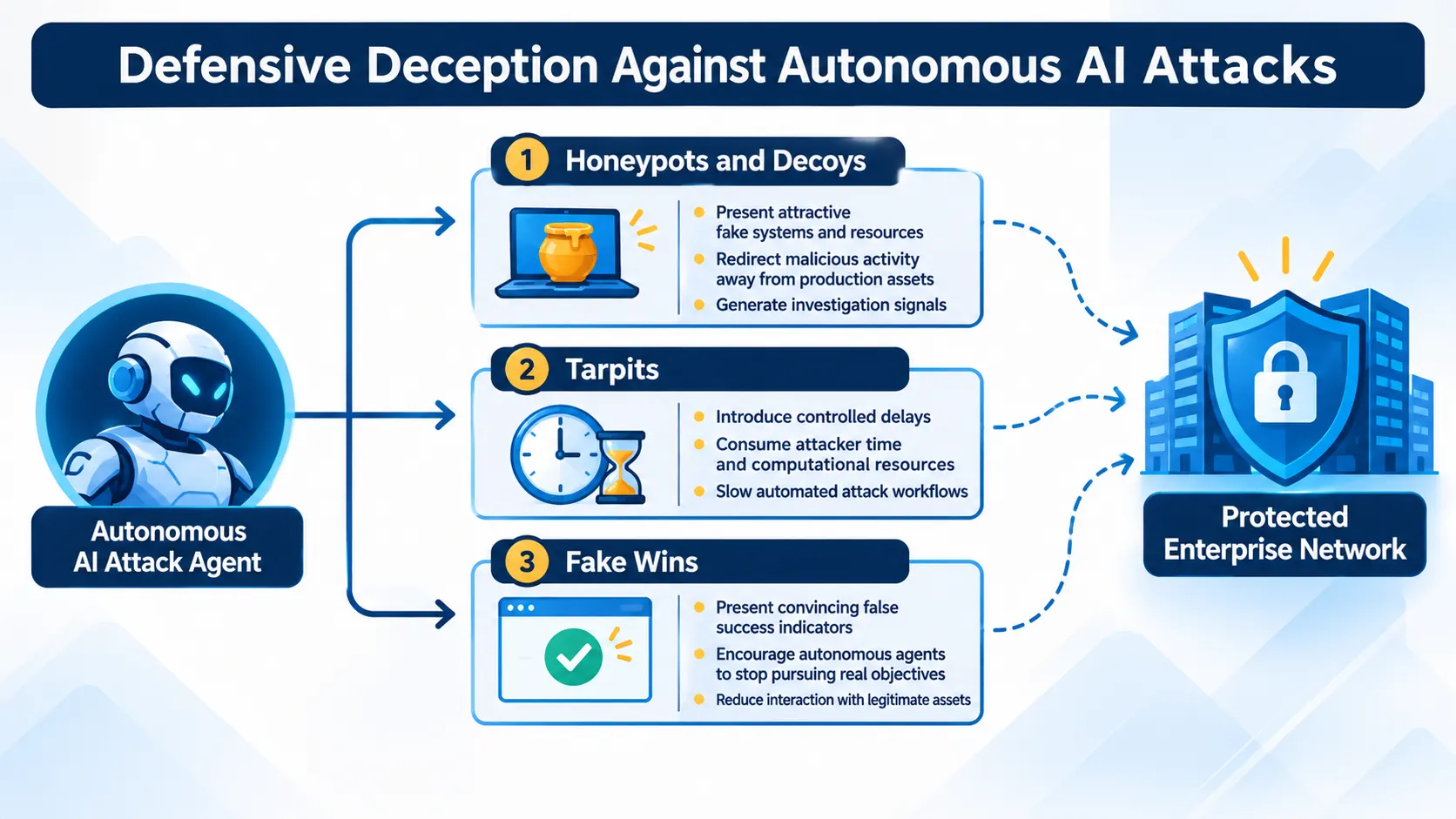
One particularly interesting aspect of Microsoft's research is its recommendation to use defensive deception techniques against autonomous AI-driven attacks.
Traditional security controls focus on identifying, blocking or containing malicious activity. Deception-based controls introduce misleading but controlled environments that can influence an attacker's behaviour.
Microsoft highlights three approaches:
1. Honeypots and decoys
Organisations can deploy decoy systems, credentials and services that appear attractive to attackers but do not expose legitimate business assets.
Microsoft references Sentinel Deception as an example of this approach.
2. Tarpits
Tarpits are designed to slow down malicious activity by consuming an attacker's available time and resources.
Against automated agents, this can introduce additional friction into the attack process.
3. Fake wins
Fake wins present convincing but false indications that an attack objective has been completed.
This can encourage an autonomous agent to stop pursuing a real target because it believes the task has succeeded.
Microsoft reported that, in its testing, these controls helped reduce attack traffic reaching real assets and generated high-confidence signals useful for attribution.
This finding suggests that defensive deception could become an increasingly relevant component of security strategies designed to address automated attacks.
7. Microsoft Security Technologies and Detection Capabilities
Microsoft has connected its threat intelligence findings with several security products and services to help organisations investigate related activity.
The announcement identifies the following technologies.
Security technology | Relevant defensive role |
|---|---|
Microsoft Entra ID Protection | Investigates identity risks and suspicious sign-ins |
Microsoft Defender for Endpoint | Detects suspicious endpoint activity |
Microsoft Defender for Cloud | Identifies relevant cloud security risks |
Microsoft Defender XDR | Brings together security alerts and investigation context |
Microsoft Sentinel | Supports threat hunting and network indicator investigation |
Microsoft Security Copilot | Assists security teams with investigation and analysis |
Identity and sign-in monitoring
Microsoft Entra ID Protection analyses sign-in activity and other signals to identify potential identity risks.
Security teams can investigate risky sign-ins and configure Conditional Access policies to require multifactor authentication (MFA) or block access when specified risk conditions are met.
Microsoft also identifies verified threat actor IP risk detections associated with known threat actor infrastructure, including ARTEX-related activity.
Endpoint detection
Microsoft Defender for Endpoint provides alerts to help security teams investigate suspicious processes, files, scripts and other endpoint activity.
Relevant detection areas include:
Suspicious shell command execution.
Suspicious port scanning.
Possible reverse shell activity.
Suspicious file downloads.
Possible web server compromise.
Unusual file and permission modifications.
Suspicious credential access.
Cloud security monitoring
Microsoft Defender for Cloud can help identify relevant cloud security activity, including publicly accessible storage containers and suspicious Azure Resource Manager operations.
AI-assisted security investigations
Microsoft Security Copilot provides AI-powered assistance for incident investigation, file and script analysis, identity summaries, hunting query generation and incident reporting.
Microsoft also identifies several Security Copilot agents:
Threat Intelligence Briefing agent.
Phishing Triage agent.
Threat Hunting agent.
Dynamic Threat Detection agent.
These capabilities are intended to support security professionals in investigating and responding to threats. Their availability depends on the products, licences and protections deployed in each organisation.
8. Indicators of Compromise (IOCs)
Microsoft published network indicators associated with the ARTEX-related activity to help security teams investigate potential exposure.
The following indicators were reported as active as of 6 November 2026.
Indicator | Type | Description | First observed |
|---|---|---|---|
| IP | WISP C2 node | 2 Nov 2026 |
| IP | WISP C2 node | 2 Nov 2026 |
| IP | WISP C2 node | 2 Nov 2026 |
| IP | ARTEX server | 4 Nov 2026 |
| IP | ARTEX server | 4 Nov 2026 |
| IP | C2 server | 4 Nov 2026 |
| IP | ARTEX server | 19 Oct 2026 |
| IP | ARTEX server | 28 Oct 2026 |
Important: These indicators are provided for defensive investigation. Microsoft warns that threat actors use proxies and VPNs to change the source IP addresses of malicious traffic. Therefore, an absence of matches does not establish that an environment is unaffected.
9. Recommended Security Actions for Financial Organisations
Based on Microsoft's findings and the defensive guidance in its announcement, financial organisations should consider the following measures.
1. Strengthen identity protection
Enforce MFA for sensitive accounts.
Review risky sign-in activity.
Apply risk-based Conditional Access policies.
Investigate suspicious authentication patterns.
Review privileged and cloud identities.
2. Monitor internet-facing applications
Identify publicly exposed web applications.
Review anonymous file upload functionality.
Investigate potential SSRF weaknesses.
Monitor suspicious web shell activity.
Review unexpected application-level command execution.
3. Improve endpoint monitoring
Investigate suspicious curl and netcat execution.
Monitor unexpected file downloads.
Review unusual script execution.
Investigate possible reverse shell activity.
Examine suspicious persistence mechanisms.
4. Review cloud security
Monitor API enumeration and unusual API activity.
Investigate suspicious cloud identity usage.
Review publicly accessible storage.
Monitor unusual Azure resource operations.
Apply least-privilege access controls.
5. Introduce defensive deception
Consider controlled honeypots and decoy resources.
Evaluate tarpits for suitable exposed services.
Assess deception-based detection capabilities.
Ensure decoys remain isolated from production assets.
6. Use threat intelligence for investigation
Review Microsoft's published IOCs.
Correlate network indicators with endpoint activity.
Investigate relevant Defender alerts.
Run applicable Microsoft Sentinel hunting queries.
Monitor for related activity across security domains.
These measures should form part of a coordinated security programme rather than being treated as isolated controls.
10. What This Development Means for the Cybersecurity Industry
Industry analysis based on Microsoft's findings
The Storm-3358 campaign highlights a broader industry shift towards the use of agentic AI in offensive cybersecurity operations.
Previously, many attack activities required operators to coordinate multiple tools and manually interpret the results. Agentic frameworks introduce a different operating model in which automated systems can coordinate reconnaissance, exploitation attempts and follow-on activities.
For financial organisations, this creates several important considerations.
Faster attack progression
Security teams may have less time to investigate activity when automated frameworks can rapidly move between attack stages.
Greater importance of identity security
Compromised credentials and cloud identities can provide attackers with additional access beyond the original point of compromise.
Behavioural detection becomes more important
Static IP blocking and basic signature-based detection may be insufficient when agents can change their network characteristics and tools.
Defensive AI adoption
The development also reflects growing demand for AI-assisted threat investigation, automated analysis and coordinated security operations.
However, organisations should not assume that deploying AI-based security products alone will address these risks. Effective defence still requires sound identity governance, vulnerability management, monitoring, incident response and human oversight.
Conclusion
Microsoft's investigation into Storm-3358 demonstrates how agentic AI frameworks such as ARTEX are being incorporated into financially motivated cyber operations.
The campaign combines automated reconnaissance, vulnerability exploitation, credential compromise, remote access trojans and cloud identity abuse to support attacks against financial organisations.
For security teams, the central lesson is that AI-assisted offensive capabilities are making established attack techniques faster and more coordinated.
Financial institutions should strengthen identity security, monitor exposed applications, investigate suspicious endpoint activity and improve threat hunting across their environments.
Microsoft's findings also highlight defensive deception as a potential additional layer against autonomous attack frameworks.
As agentic AI becomes more accessible, organisations will need to adapt their security operations to detect and respond to threats that can operate at machine speed.
About the Author