
Anthropic Cuts AI Distillation Data Harvesting by Up to 99% With New Defenses
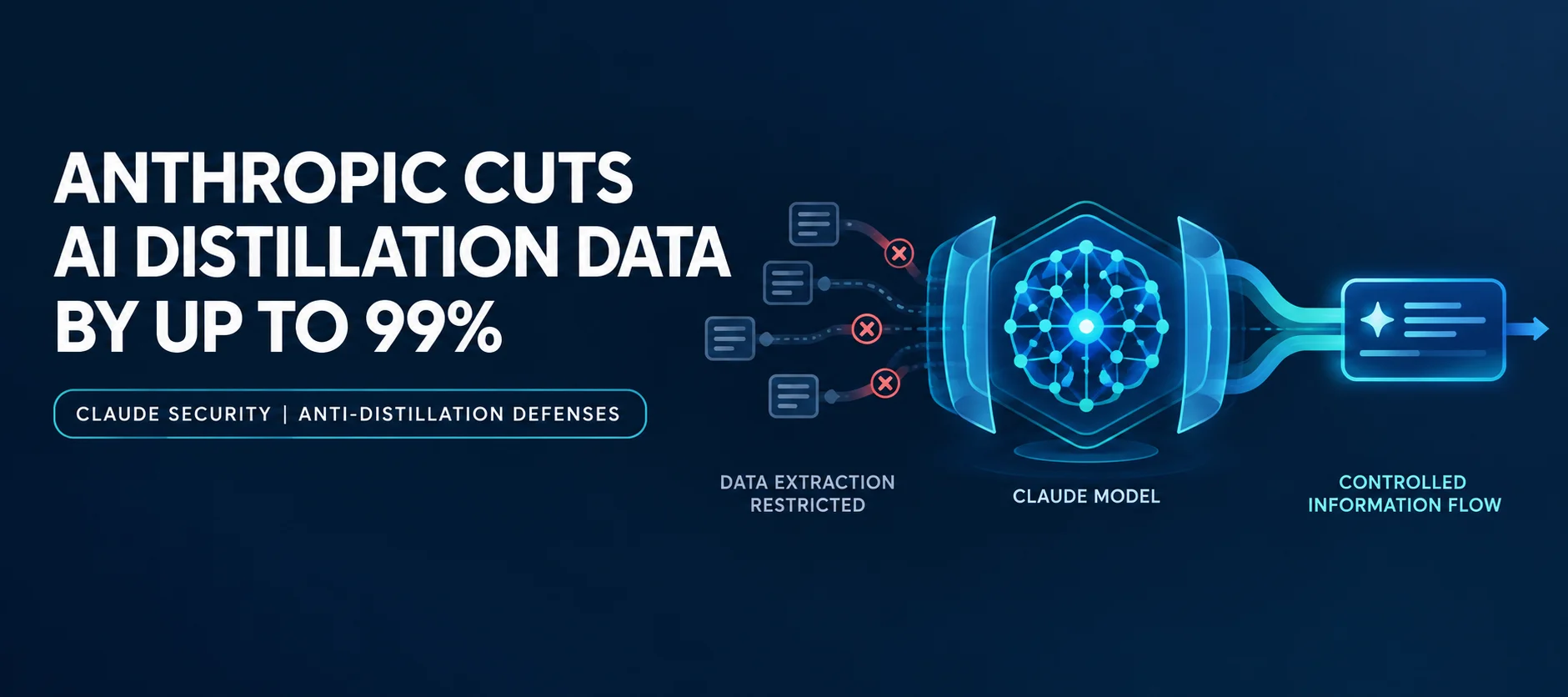
Anthropic says new safeguards have reduced the reasoning data extracted from Claude by 90% to 99%. Its approach combines reasoning controls, detection classifiers, and stricter enforcement against suspected distillation campaigns.
Xcademia Team
Anthropic Cuts AI Distillation Data Harvesting by Up to 99% With New Defenses
Anthropic says new safeguards have significantly reduced attempts to extract Claude's reasoning data for unauthorized AI model training. The company reports that the amount of reasoning data harvested by distillers on its platform has fallen by approximately 90% to 99% following the introduction of additional defenses.
In a research update published on October 12, 2026, Anthropic described a layered approach that combines controls over reasoning data, classifiers designed to detect extraction attempts, and stricter measures against accounts associated with repeated misuse.
The company says the changes have made it more difficult to use Claude to reproduce its capabilities in other models without authorization. However, Anthropic acknowledges that the defenses involve trade-offs for legitimate developers and customers, and that attackers may eventually find ways around them.
What Are AI Distillation Attacks?
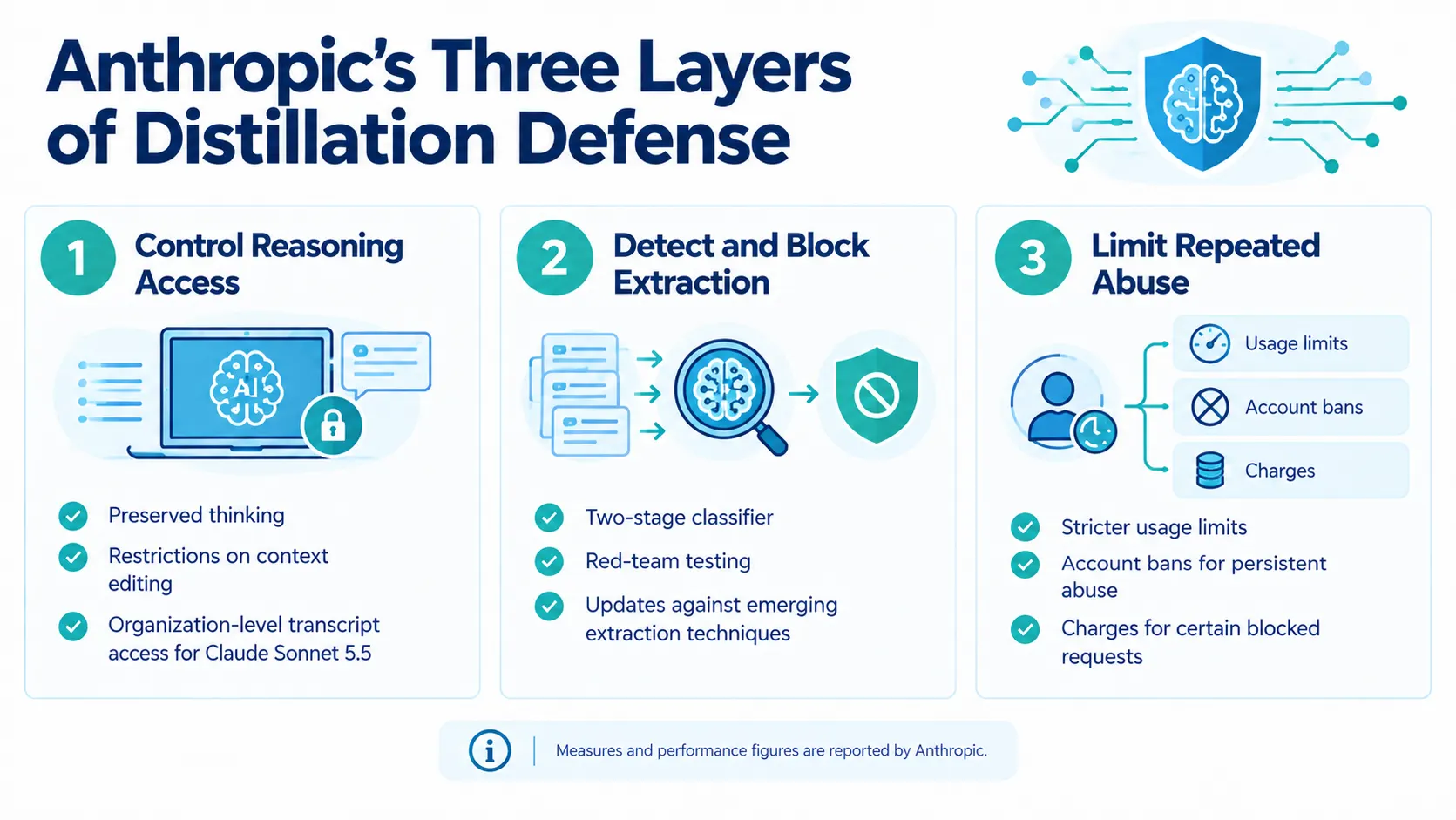
Model distillation is a machine learning technique in which a smaller model learns from the outputs or behavior of a more capable model. It can be used for legitimate purposes, including developing more compact models.
Anthropic's announcement focuses on illicit distillation attacks, which it describes as campaigns that extract a model's capabilities without the original developer's authorization. According to the company, these campaigns can involve large numbers of requests sent through networks of fraudulent accounts.
The objective is to collect enough information from a capable model to train another model to reproduce some of its behavior, potentially reducing the time and resources required to develop similar capabilities independently.
Anthropic says reasoning transcripts are particularly valuable to distillers because they can reveal more about how a model approaches a task than its final answer alone. Its defenses therefore focus heavily on limiting access to the model's protected reasoning.
The company raises two principal concerns. First, distilled models may reproduce advanced capabilities without equivalent safeguards, creating potential risks in areas such as cybersecurity and biology. Second, Anthropic argues that unauthorized distillation can create national security concerns when the resulting capabilities are incorporated into military, intelligence, or surveillance systems.
Anthropic cites its previous investigations involving Zhipu's GLM-5.3 development and requests routed from Moonshot's Kimi models to Claude as examples of the activity it is attempting to prevent. These are claims and findings reported by Anthropic, rather than independently established conclusions within this announcement.
Why Earlier Defenses Were Not Enough
Anthropic initially introduced measures intended to make Claude's reasoning less useful for unauthorized training. One approach summarized the model's reasoning before showing it to users.
The company evaluated this method by training a pretrained Claude model on transcripts from Claude Opus 4.8 and measuring its performance on the SWE-bench Verified coding benchmark.
The reported results were:
80.4% when the model was trained using full reasoning transcripts.
71.8% when it was trained using summarized reasoning transcripts.
According to Anthropic, the lower score indicated that summarized transcripts provided less useful training information in this evaluation.
However, the company says some distillers subsequently shifted toward active extraction attempts, using prompts designed to make Claude reveal protected reasoning despite the summarization safeguards.
Anthropic describes a range of attempts, from direct requests to reproduce previous reasoning to more extensive campaigns involving thousands of different prompts. It also reports that some operators developed proxy networks involving large numbers of fraudulent accounts to continue making requests after individual accounts were blocked.
In one previously documented case, Anthropic said a network managed more than 20,000 fraudulent accounts simultaneously. The company argues that the scale and persistence of these campaigns required stronger defenses than simple request blocking.
Anthropic's Three Layers of New Defenses
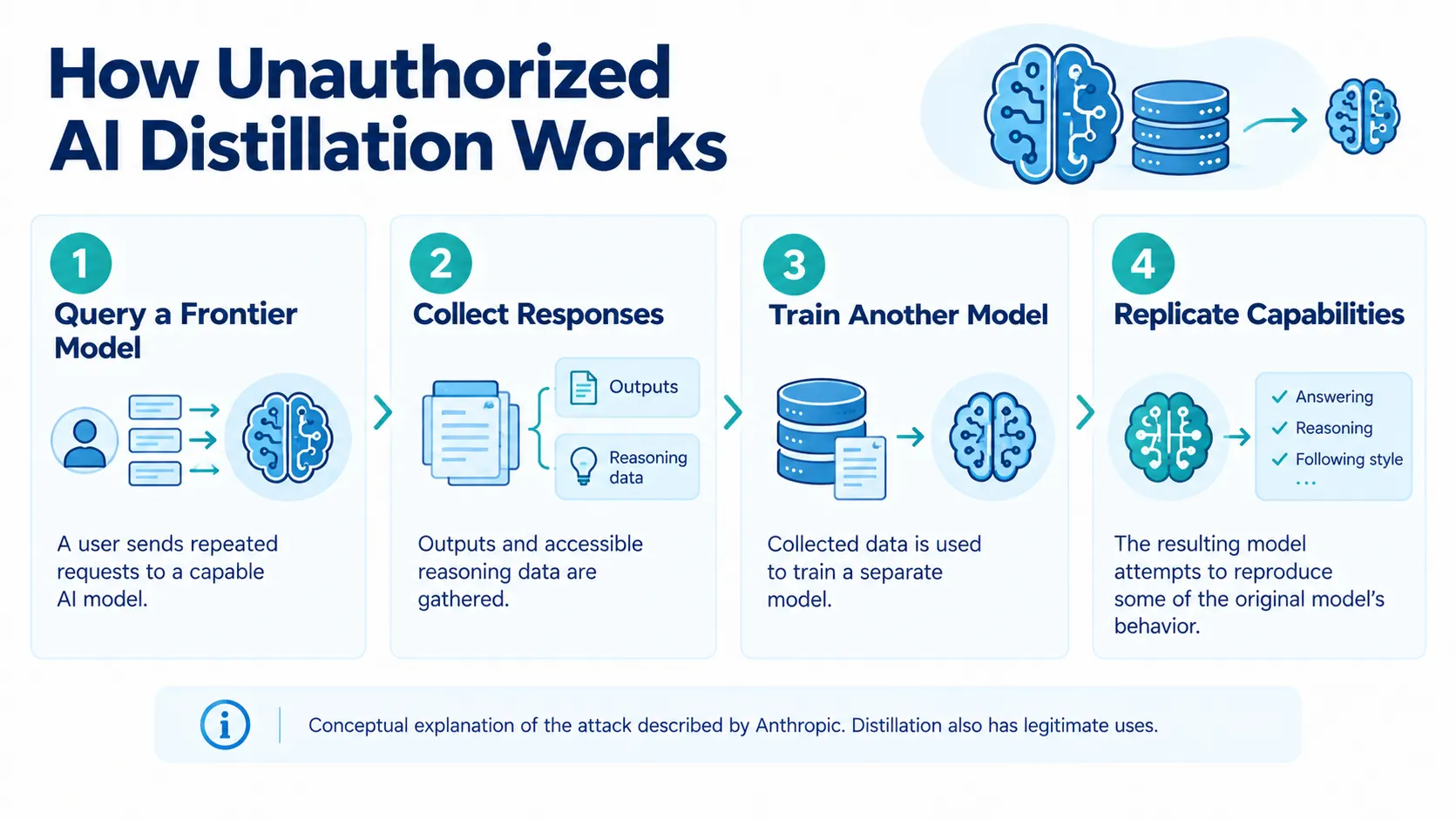
Anthropic says its updated approach disrupts distillation campaigns in three main ways: controlling where reasoning data can go, blocking extraction attempts, and making repeated attempts more difficult.
1. Controlling Access to Reasoning Data
One challenge is preventing attackers from moving protected reasoning between conversations, models, and accounts to bypass existing safeguards.
Anthropic says it introduced a feature called preserved thinking with Claude Fable 5.1 and Claude Opus 5.5. For new API accounts created on or after August 31, 2026, the measure prevents users from editing Claude's prior context in ways that could help expose protected reasoning.
The company also says it has prevented the reasoning from these models from being read by earlier models with weaker anti-distillation safeguards.
For Claude Sonnet 5.5, Anthropic says reasoning transcripts are accessible only to the organization whose request produced them.
Together, these measures are intended to reduce opportunities to transfer protected reasoning across accounts and models in ways that facilitate unauthorized extraction.
2. Detecting and Blocking Extraction Attempts
Anthropic has also developed a two-stage classifier system designed to identify requests that attempt to extract protected reasoning.
The company says it tested the classifiers through internal and external red-teaming, using manual and automated methods to identify weaknesses. It then updated the safeguards to address vulnerabilities found during testing.
According to Anthropic, the system has a false positive rate of less than 0.1%. This means that a small proportion of legitimate requests may still be incorrectly identified or blocked.
The company reports deploying the classifiers on its most capable generally available models, including Claude Sonnet 5.5, Claude Opus 5 and 5.5, and Claude Fable 5 and 5.1.
Anthropic also says it has updated the defenses in response to new extraction techniques. Examples include attempts to obtain earlier reasoning by asking Claude to translate it into another language or reproduce it using tags alongside an answer.
The company expects this work to continue as attackers develop new methods.
3. Restricting Repeated Attempts
Anthropic says it applies stricter usage limits to accounts that repeatedly attempt to extract protected reasoning and bans accounts associated with persistent distillation activity.
The company also resumed charging, on September 24, for requests blocked by safeguards before Claude responds in specific areas where the false positive rate is below 0.1%, including distillation.
Anthropic presents these measures as a way to make repeated attempts more costly and less effective. It also acknowledges that the policies can affect legitimate customers, particularly when developers need to update integrations or when a benign request is incorrectly blocked.
How Effective Are the New Defenses?
Anthropic reports that its updated safeguards have reduced the amount of reasoning data available to distillers on its platform by approximately 90% to 99%.
To measure the results, the company estimates the number of reasoning tokens extracted by distillers before and after introducing the new classifier system. It says the number of reasoning tokens extracted is now consistently 10 to 100 times lower than before.
Anthropic attributes the improvement to the combined effect of its classifier and preserved-thinking controls.
The company also reports banning tens of thousands of accounts associated with distillation campaigns. In many cases, it says, accounts were banned less than two hours after a campaign began.
These figures reflect Anthropic's own measurements and enforcement activity. The announcement does not establish that the same reduction would occur across other AI providers or third-party inference platforms.
Anthropic also cautions that it does not yet know how long the improvements will last. The company expects a continuing cycle in which distillers develop new extraction techniques and providers update their defenses in response.
It further says it has not yet observed a highly sophisticated and persistent attempt to circumvent the strengthened safeguards. This limits what can currently be concluded about their resilience against the most advanced future attacks.
The Trade-Offs for Developers and Customers
Anthropic acknowledges that its approach has not completely eliminated the impact on legitimate users.
Preserved thinking has required some developers to update their integrations. The classifiers can also misidentify benign requests, and Anthropic now charges for certain requests blocked before a response is generated.
The company says the false positive rate is below 0.1%, but that figure does not mean false positives are impossible or that every customer will experience the same impact.
For developers using Claude through APIs, the announcement highlights the importance of reviewing integration behavior and understanding how reasoning controls and request-blocking policies may affect their workflows.
Anthropic says it has also turned away meaningful revenue and large volumes of paid traffic associated with distillation activity. It frames these costs as part of protecting its models from unauthorized extraction.
The announcement does not disclose a complete financial breakdown of the revenue impact or a comprehensive measurement of the operational costs for customers.
Why AI Developers and Platforms Share Responsibility
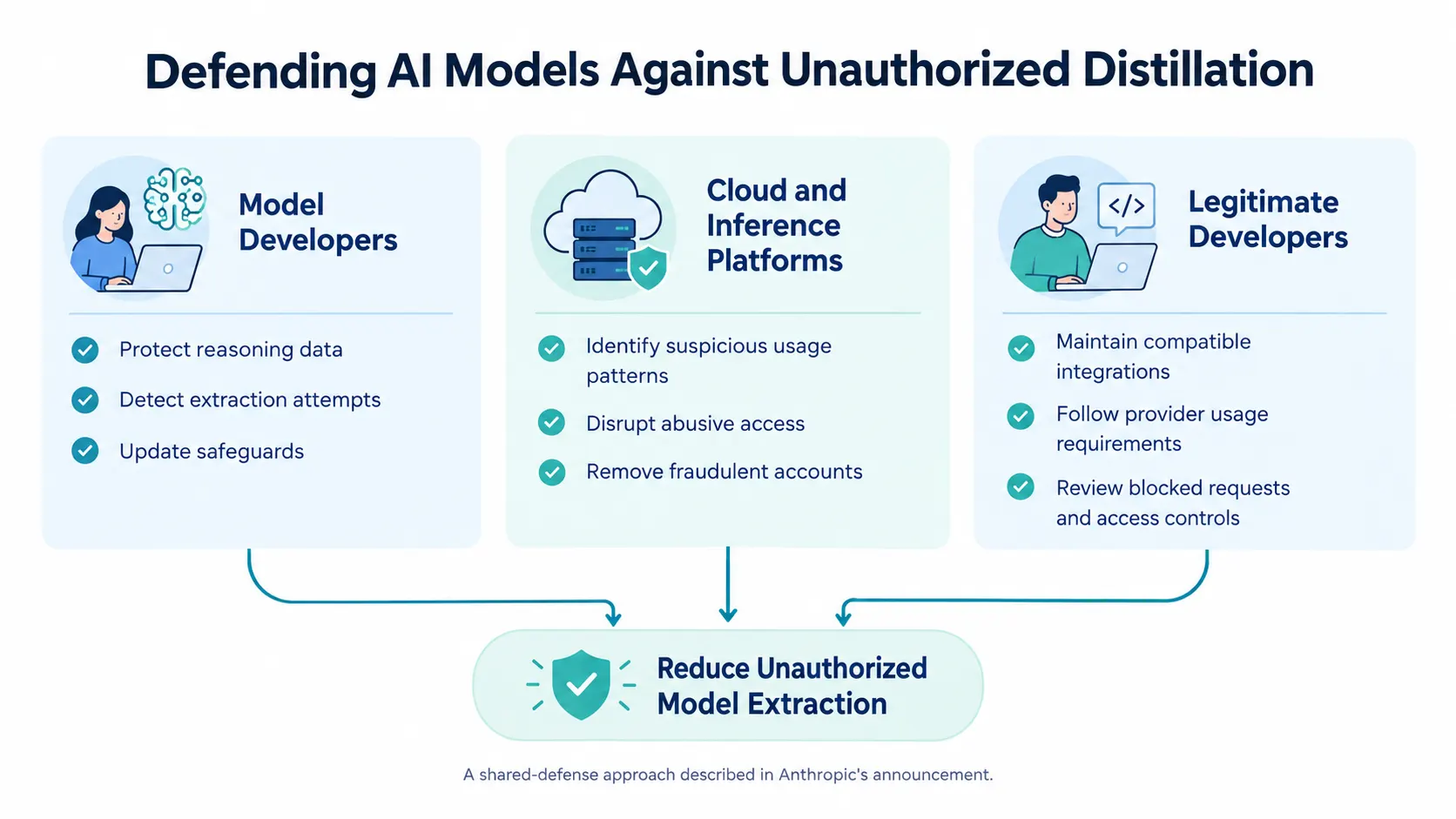
Anthropic argues that no single model provider can address unauthorized distillation alone.
Distillation campaigns can distribute requests across a model provider's API, third-party cloud platforms, and other inference services. This can make it harder for any one provider to identify the full scope of activity.
The company says platforms and model developers can help by detecting suspicious usage, disrupting abusive access, and removing fraudulent accounts.
Anthropic also argues that the effectiveness of its safeguards could be undermined if attackers can obtain similar capabilities from models with weaker protections.
Its position is that stronger controls need broader industry participation, especially when advanced models could be used in sensitive areas such as cybersecurity and biology.
What the Announcement Means for AI Security
Anthropic's announcement highlights a growing security challenge for companies that provide advanced AI models through APIs. A provider must manage not only direct misuse of its models but also attempts to collect enough model-generated data to reproduce their capabilities elsewhere.
The reported results suggest that limiting access to protected reasoning, identifying suspicious extraction requests, and restricting repeated abuse can reduce the data available for unauthorized training on a provider's own platform.
However, the announcement also illustrates the difficulty of maintaining these defenses over time. Attackers may adapt their methods, while legitimate developers can face integration changes, blocked requests, and additional costs.
For the wider industry, Anthropic's position is that effective anti-distillation defenses require cooperation among model developers, cloud platforms, and inference providers. The extent to which these measures can be applied consistently across services remains an open question.
Conclusion
Anthropic says its updated defenses have reduced the reasoning data harvested by distillers on its platform by approximately 90% to 99%. Its approach combines controls over reasoning access, a two-stage classifier system, and stricter enforcement against accounts associated with persistent extraction attempts.
The company acknowledges that the safeguards can affect legitimate users and that their long-term effectiveness is uncertain as extraction techniques evolve.
The announcement presents anti-distillation protection as an ongoing security responsibility rather than a problem that can be solved through a single technical change. Its longer-term effectiveness will depend on continued testing, updates to safeguards, and cooperation across the AI infrastructure ecosystem.
Source: Anthropic
About the Author