
Pythian Builds an AI Operating Model to Connect Enterprise AI With Business ROI
Pythian says its internal AI operating model helped triple active user engagement and cut database incident resolution times by 80%, while shaping how the company approaches enterprise AI adoption and production.
Xcademia Team
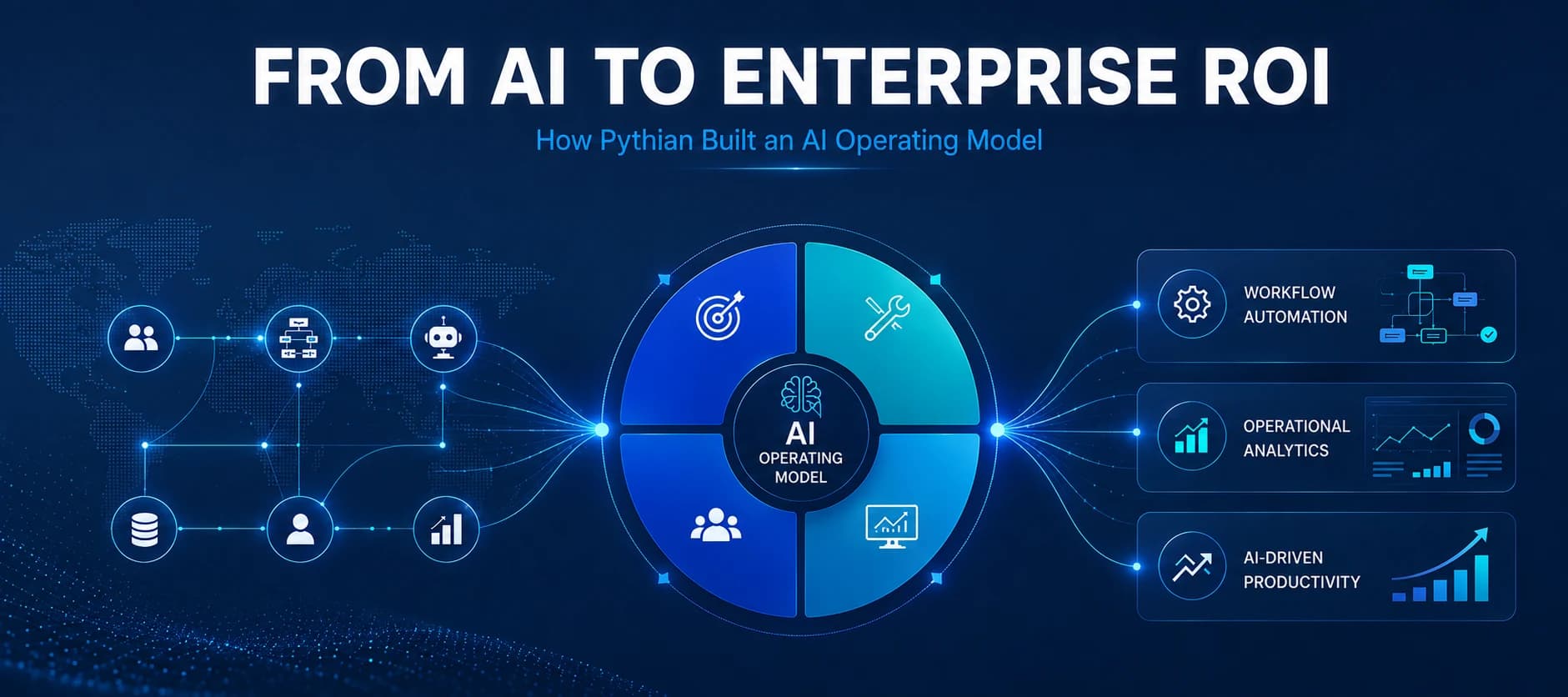
Enterprise AI adoption often starts with selecting the right tools. But according to Pythian, deploying AI across an organization is only the beginning. The larger challenge is connecting those tools to valuable workflows, supporting adoption, and keeping AI systems effective once they reach production.
In a Google Cloud Blog post published August 28, 2026, Pythian executives Paul Lewis and Vanessa Simmons described how the company used its own 500-person organization across 27 countries as a testing ground for enterprise AI.
The company says its experience with Google Cloud's Gemini Enterprise and earlier enterprise AI deployments led it to develop what it calls the Pythian AI Operating Model, an end-to-end framework covering strategy, technology deployment, execution, and ongoing production management.
Pythian says applying the model internally resulted in a 3x increase in active user engagement and an 80% reduction in database incident resolution times.
The company argues that these results came not simply from making AI tools available, but from connecting AI adoption to specific business workflows and establishing dedicated teams for execution and ongoing operations.
Why Pythian Says Enterprise AI Initiatives Stall
Pythian's experience points to a challenge in enterprise AI adoption: organizations can become focused on tools rather than outcomes.
According to the company, businesses may purchase AI licenses, make tools broadly available, and expect value to emerge naturally. This can result in a focus on small individual productivity gains, such as saving a few minutes on isolated tasks, instead of identifying workflows where AI could have a broader operational role.
Pythian also highlights challenges involving custom AI agents.
Building an agent does not necessarily mean the deployment will remain effective in production. The company says organizations can face issues involving model drift, agent lifecycle management, and observability after an AI system moves beyond the pilot stage.
Pythian developed its AI Operating Model around a continuous process that connects strategic planning with deployment, adoption, and production management.
The Four Pillars of the Pythian AI Operating Model
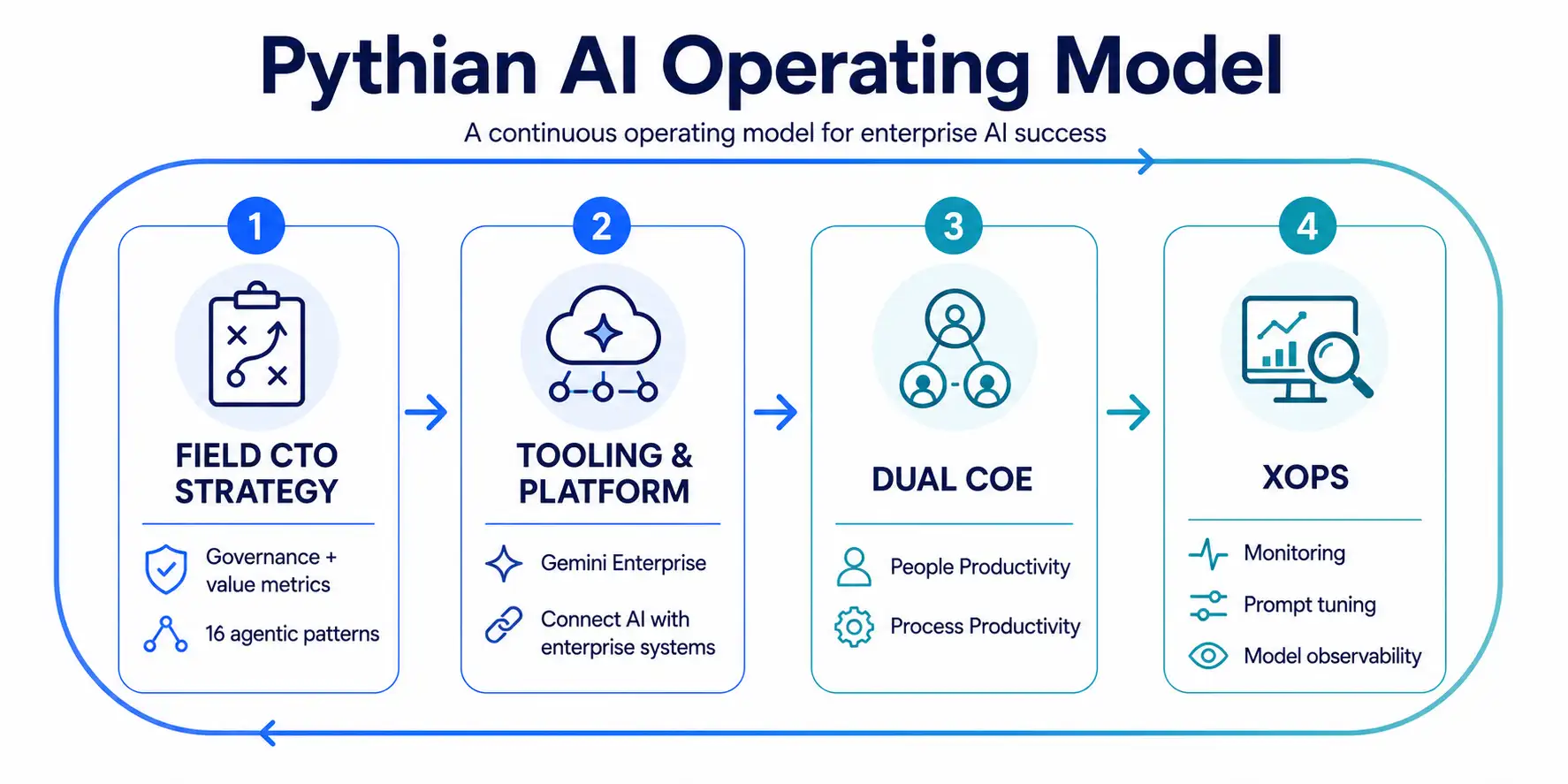
The company's framework consists of four connected areas:
Field CTO strategy and governance → Tooling and platform deployment → Dual COE execution → Production XOps
Each component has a specific role in moving AI initiatives from planning into sustained use.
1. Field CTO Strategy and Governance
Pythian's Field CTO practice provides executive-level advisory and helps establish steering committees and value metrics.
The company says its team evaluates operations using 16 horizontal agentic patterns, including areas such as automated document processing and runbook creation.
The goal is to create a prioritized backlog of AI use cases before development begins, with an emphasis on opportunities Pythian considers capable of delivering significant business value.
This places use-case selection and governance before implementation.
2. Tooling and Platform Deployment
The second pillar focuses on establishing the technical foundation required for enterprise AI.
Pythian says its teams deploy platforms such as Gemini Enterprise and connect AI capabilities with corporate systems, including CRMs, ERPs, and database environments.
The company describes this layer as a production-oriented foundation that allows AI systems to work with organizational context and existing enterprise workflows.
3. The Dual Center of Excellence
Pythian's execution model is divided into two specialized centers of excellence, or COEs.
People Productivity COE
The People Productivity COE focuses on adoption and change management.
Rather than expecting employees in non-technical functions such as HR or Procurement to develop their own AI agents, Pythian says this team builds no-code agents for those groups.
The focus is on enabling employees to use AI without requiring them to become AI developers.
Process Productivity COE
The Process Productivity COE focuses on more complex AI implementations.
According to Pythian, this team develops custom-coded agents and agentic workflows that integrate with core data platforms and support more advanced operational processes.
The division allows the company to approach employee productivity and deeper process automation as separate but connected areas.
4. XOps for AI Production Management
The final pillar is what Pythian calls XOps, its AI production management practice.
Pythian says deploying an AI agent represents only part of the overall lifecycle. Maintaining accuracy and reliability after deployment requires ongoing operational work.
The company says its XOps practice addresses this through continuous monitoring, prompt tuning, and model observability.
Pythian also points to model and prompt drift as reasons why AI systems need ongoing management rather than being treated as static software deployments.
From Database Operations to Global Supply Chains
Pythian says its internal experience and customer deployments illustrate how the operating model can be applied to different types of enterprise workflows.
The examples described by the company range from database operations and IT support to supply chain forecasting and retail product onboarding.
Pythian's Internal Database Operations
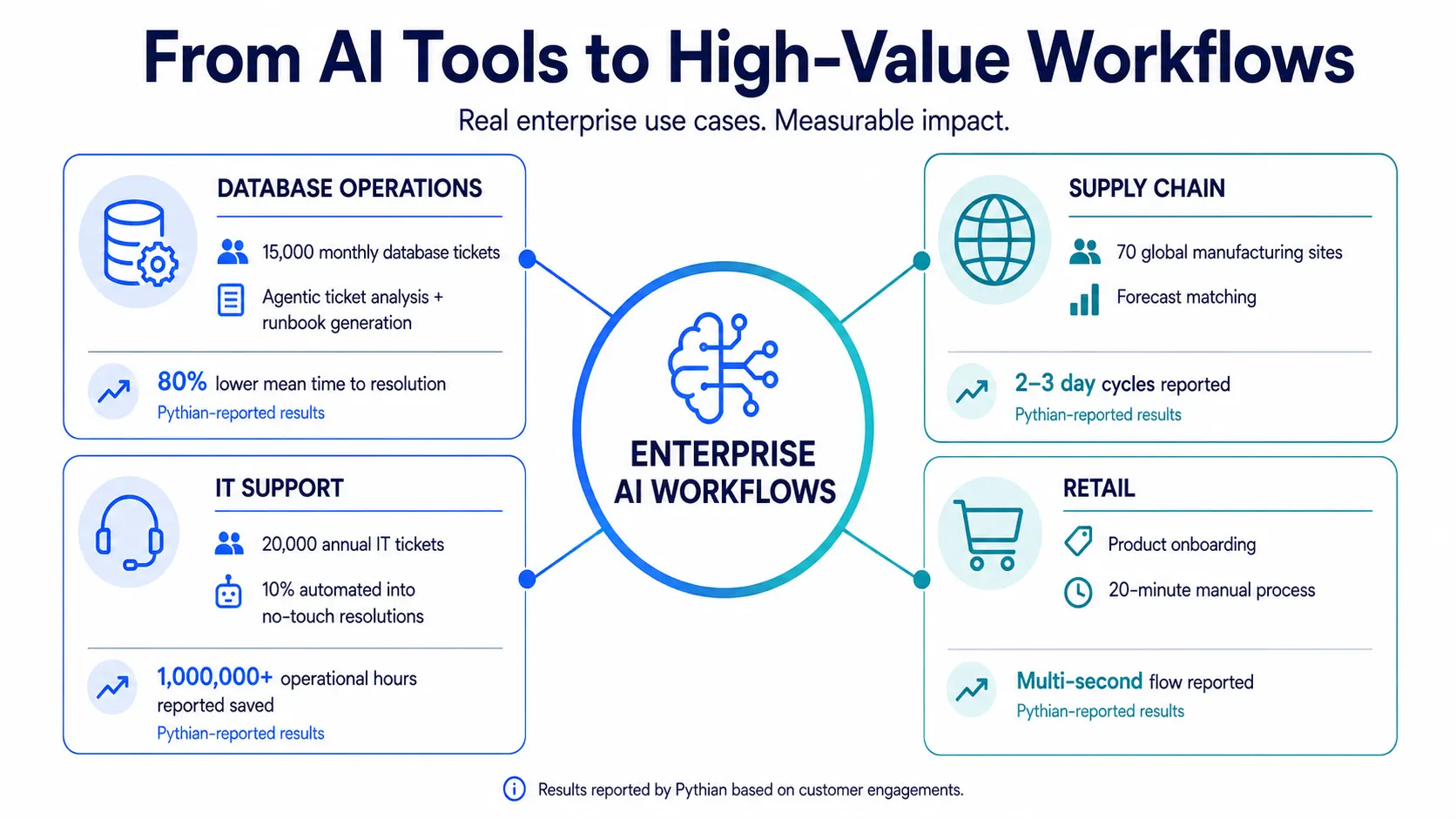
Pythian says its Process Productivity COE worked across approximately 15,000 monthly database tickets.
The team deployed an agentic workflow designed to read support tickets, search knowledge bases, and automatically generate mini runbooks before an engineer begins work.
According to Pythian, the approach helped reduce mean time to resolution by 80% and triple active user engagement.
The source does not provide additional details about the underlying test methodology, baseline measurements, or independent validation of these results.
Knowledge Management and IT Support
For a knowledge management customer, Pythian says it deployed autonomous IT support agents across 10,000 consultants.
The company reports that the system automated 10% of 20,000 annual IT tickets into what it describes as "no-touch" resolutions.
Pythian says this resulted in savings of more than 1,000,000 operational hours.
Additional details were not disclosed in the announcement about how those hours were calculated.
Supply Chain Operations
Pythian also describes a supply chain deployment involving 70 global manufacturing sites.
The company says it built custom agentic supply chain tools on Gemini Enterprise that reduced forecast-matching cycles from weeks to 2-3 days.
The source does not provide additional information about the specific workflows, implementation configuration, or methodology used to measure the change.
Retail Product Onboarding
In a retail example, Pythian says it combined Gemini Agentic AI with computer vision to automate store product onboarding.
According to the company, a manual process that previously took approximately 20 minutes was transformed into a process taking only several seconds.
The announcement does not provide further technical or operational details about this deployment.
Why Production Management Matters
A major theme in Pythian's approach is that AI deployment does not end when an agent is launched.
The company says AI models and prompt structures can change over time, creating a need for continued monitoring and adjustment.
This is where Pythian positions XOps as an important part of the operating model.
Instead of treating an AI agent as a finished deployment, the company describes a production lifecycle that includes monitoring, prompt tuning, and observability.
For enterprises, the development highlights the importance of considering how AI systems will be monitored and maintained after deployment.
The broader lesson is that organizations need to consider not only how an AI system will be built, but also how it will be monitored and maintained after deployment.
From Individual Productivity to Workflow Transformation
Pythian's approach also reflects a distinction between incremental productivity improvements and structural workflow changes.
Saving several minutes on an individual task can provide value, particularly at large scale. But Pythian argues that enterprises should also look for opportunities where AI can change how an entire process operates.
This means identifying workflows where AI can interact with existing data, systems, and operational processes.
The company's internal database-ticket example illustrates this approach. Rather than simply giving employees access to an AI assistant, Pythian integrated an agentic workflow into an existing operational process.
This approach shifts the question from:
"How can employees use AI?"
to:
"Which business processes should be redesigned around AI?"
That distinction is central to the operating model described by Pythian.
The Role of Centers of Excellence in AI Adoption
The dual COE structure also highlights a broader organizational issue.
AI adoption involves both technical implementation and employee adoption.
The People Productivity COE addresses the user-facing side of AI adoption through enablement and no-code agents.
The Process Productivity COE focuses on deeper engineering work involving custom agents and workflows.
This division allows the operating model to address two different forms of enterprise AI adoption without treating them as the same problem.
The approach also reinforces Pythian's broader argument that successful AI deployment requires organizational capabilities alongside technology.
What Pythian's Approach Could Mean for Enterprise AI
Pythian's experience highlights a broader industry shift toward treating enterprise AI as an operating capability rather than simply a software purchase.
The company's model brings together strategy, technology deployment, specialized AI teams, employee adoption, and production operations.
For enterprises, this could mean placing greater emphasis on the organizational systems surrounding AI.
That includes determining which workflows are worth transforming, establishing ownership for AI deployments, integrating AI with enterprise data, and planning for ongoing monitoring after launch.
The approach also suggests that different AI use cases may require different execution models. Employee-facing productivity applications can be supported through no-code tools and adoption programs, while complex operational workflows may require custom development and deeper integration.
Pythian's framework is its own operating model, so organizations should evaluate which elements are appropriate for their particular business requirements.
The Role of Google Cloud and Gemini Enterprise
Google Cloud's announcement places Gemini Enterprise within Pythian's broader AI deployment strategy.
Pythian says it rolled out Gemini Enterprise across its 500-person organization in 27 countries and subsequently used its internal experience to inform its AI Operating Model.
The company also describes using Gemini Enterprise in customer-facing supply chain workflows.
The source does not provide a detailed comparison of Gemini Enterprise against other enterprise AI platforms, nor does it provide independent performance benchmarks.
The significance of the deployment in this announcement is primarily its role within Pythian's broader strategy for operationalizing enterprise AI.
A Model Built Around Continuous AI Operations
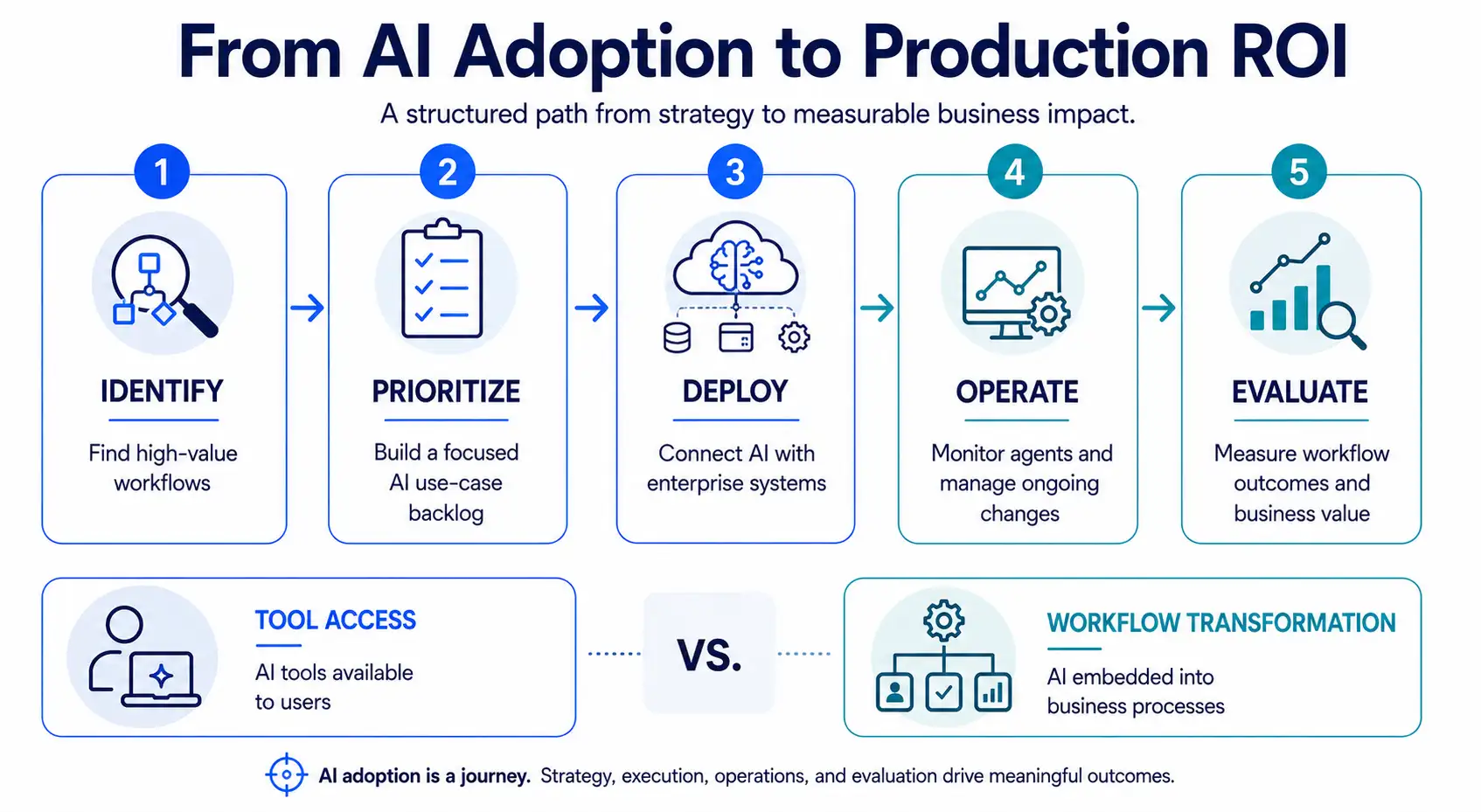
Pythian's AI Operating Model ultimately places AI adoption within a continuous cycle:
Strategy → Deployment → Execution → Production Operations → Evaluation
This differs from a project-based approach in which an organization develops an AI proof of concept, launches it, and considers the initiative complete.
The company's framework instead treats governance, adoption, development, monitoring, and optimization as connected activities.
For organizations moving beyond AI experimentation, that operating perspective may be particularly relevant.
The development also reflects growing demand for approaches that connect AI investments with measurable business workflows rather than focusing only on access to AI tools.
Pythian's Internal Deployment as a Testing Ground
Pythian says it first applied its AI operating model internally.
The company describes its own organization as a proving ground for understanding how enterprise AI can generate ROI.
The internal deployment covered its 500-person workforce across 27 countries.
According to Pythian, the results included:
3x increase in active user engagement
80% reduction in database incident resolution times
These figures are reported by Pythian and should not be interpreted as independently verified benchmarks for Gemini Enterprise or enterprise AI generally.
The case study describes how Pythian used its own operational environment to refine its approach before applying the model to customer scenarios.
Conclusion
Pythian says its experience deploying enterprise AI internally led it to develop an AI Operating Model designed to connect strategy, technology deployment, execution, and production operations.
The model is built around four pillars: Field CTO strategy and governance, tooling and platform deployment, a dual center of excellence, and XOps for AI production management.
According to Pythian, applying the model internally resulted in a 3x increase in active user engagement and an 80% reduction in database incident resolution times.
The company also describes deployments involving IT support, supply chain operations, and retail product onboarding, with reported outcomes ranging from automated ticket resolution to shorter forecasting cycles.
The broader takeaway is that enterprise AI adoption may require more than providing employees with access to AI tools. Pythian's approach emphasizes selecting high-value workflows, building the right execution structure, integrating AI with enterprise systems, and managing deployments after they reach production.
As enterprises continue moving AI projects from experimentation toward operational use, the ability to connect AI investments with specific workflows and measurable outcomes is likely to remain an important consideration.
Source: Google Cloud Blog
About the Author