
AWS Open-Sources TorchNeuron to Simplify PyTorch on Trainium
AWS has launched TorchNeuron in public beta, enabling developers to run existing PyTorch code on AWS Trainium with fewer changes. The open-source release aims to reduce hardware migration friction and expand flexibility across AI training and inference workloads.
Xcademia Team
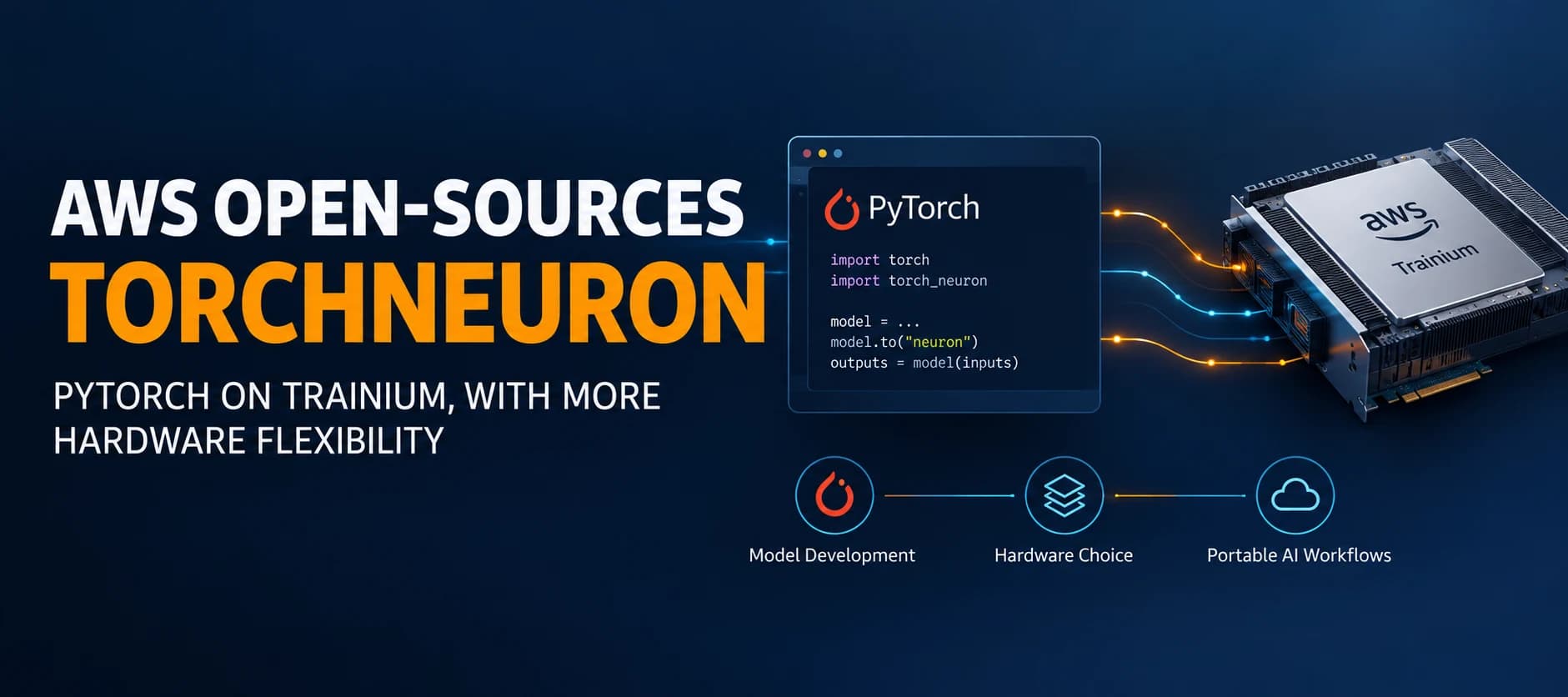
AWS has announced TorchNeuron, an open-source software project designed to help developers run PyTorch workloads natively on AWS Trainium AI chips. Released in public beta under the Apache 2.0 license, TorchNeuron aims to make it easier for AI teams to evaluate and adopt Trainium without rewriting their existing models and code in many cases.
In a post published on October 20, 2026, AWS Insights author Dr. Matt Wood presents the launch as part of a broader goal: giving developers more freedom to choose computing hardware based on price, performance, and availability, rather than being constrained by earlier technology decisions.
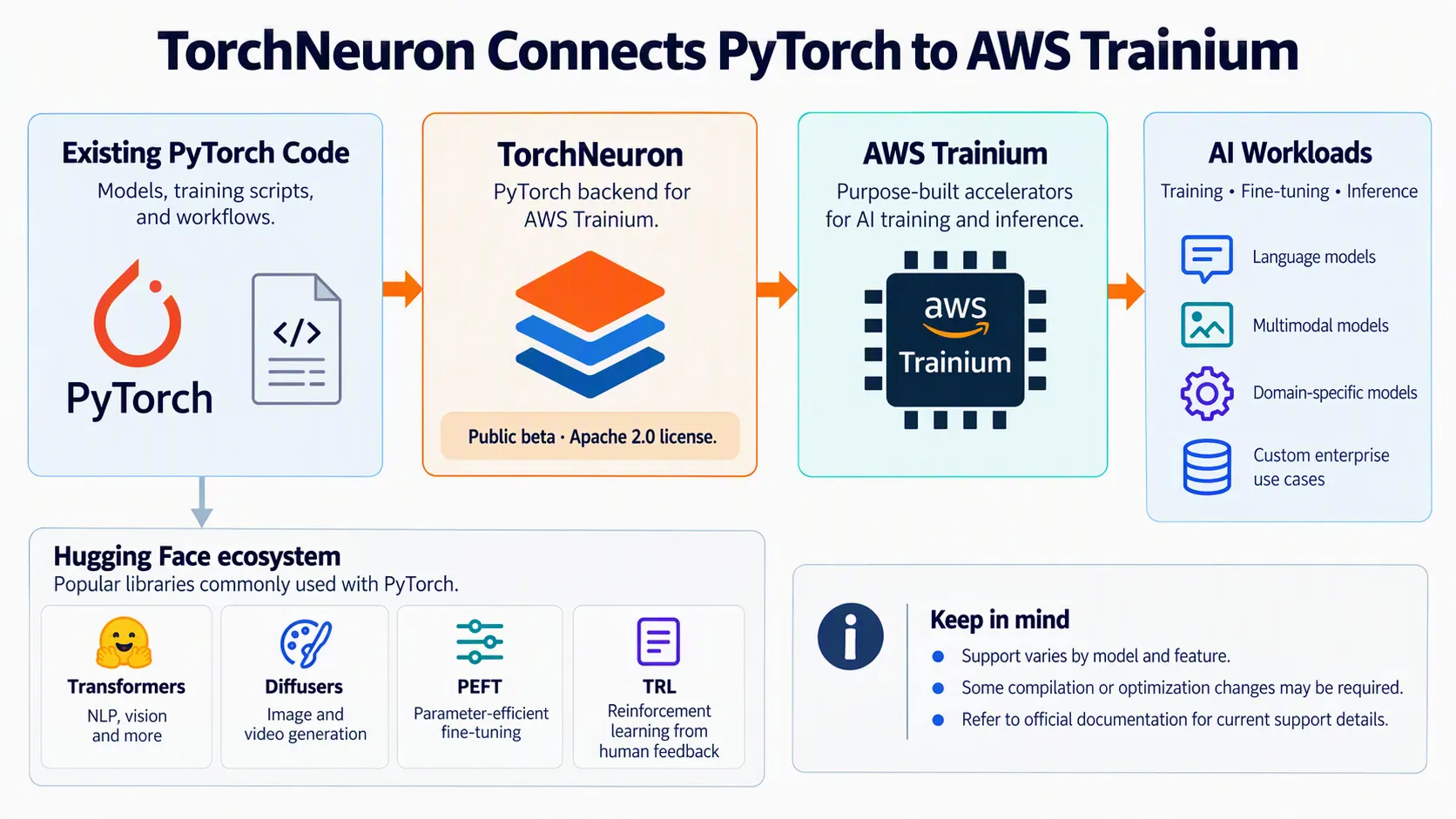
AWS says TorchNeuron was developed in close collaboration with the PyTorch team at Meta, with changes contributed back to PyTorch itself. The company also worked with Hugging Face to add native Trainium support across several libraries.
The announcement focuses on more than compatibility with a new AI chip. It argues that reducing the effort required to move workloads between hardware platforms can help teams adapt their infrastructure as their applications and requirements change.
TorchNeuron Aims to Reduce PyTorch Migration Work
Moving an AI workload to a different accelerator can involve adapting code, validating model outputs, and evaluating whether the new hardware suits the workload. According to AWS, these tasks can consume engineering time that teams could otherwise spend improving their products.
TorchNeuron is designed to reduce that burden by allowing developers to run existing PyTorch code on Trainium. AWS says that, in most cases, teams can try Trainium through a configuration change rather than rewriting their code or models.
The project builds on PyTorch, a widely used framework for developing and running AI models. By keeping development within familiar PyTorch workflows, TorchNeuron aims to make Trainium more accessible to teams already using the framework.
AWS also says its contributions to PyTorch itself are intended to make it easier to run PyTorch on other hardware in the future.
TorchNeuron is available as an open-source project under the Apache 2.0 license and entered public beta on October 20, 2026.
Project: TorchNeurohttps://github.com/aws-neuron/torch-neuronxn on GitHub
License: Apache 2.0
Release status: Public beta
Framework: PyTorch
Hardware platform: AWS Trainium
Hugging Face Adds Native Trainium Support
A key part of the announcement is AWS's collaboration with Hugging Face, whose libraries are widely used to build, adapt, and run AI models.
AWS says Trainium is now supported as a native device across four Hugging Face libraries:
Transformers: For working with transformer-based models.
Diffusers: For generative models, including image-generation workflows.
PEFT: For parameter-efficient fine-tuning.
TRL: For transformer reinforcement learning.
According to AWS, developers can use the same scripts on Trainium that they run on other supported hardware. The company also states that the 100 most-used text-generation model architectures work out of the box.
AWS further says that models trained on Trainium are saved as standard checkpoints that can be loaded on other supported hardware. This is intended to preserve flexibility when teams need to change or expand their computing infrastructure.
These claims describe the compatibility AWS announced. Actual support and execution requirements may still depend on the model, library version, and hardware configuration.
Hardware Choice and Long-Term Development Flexibility
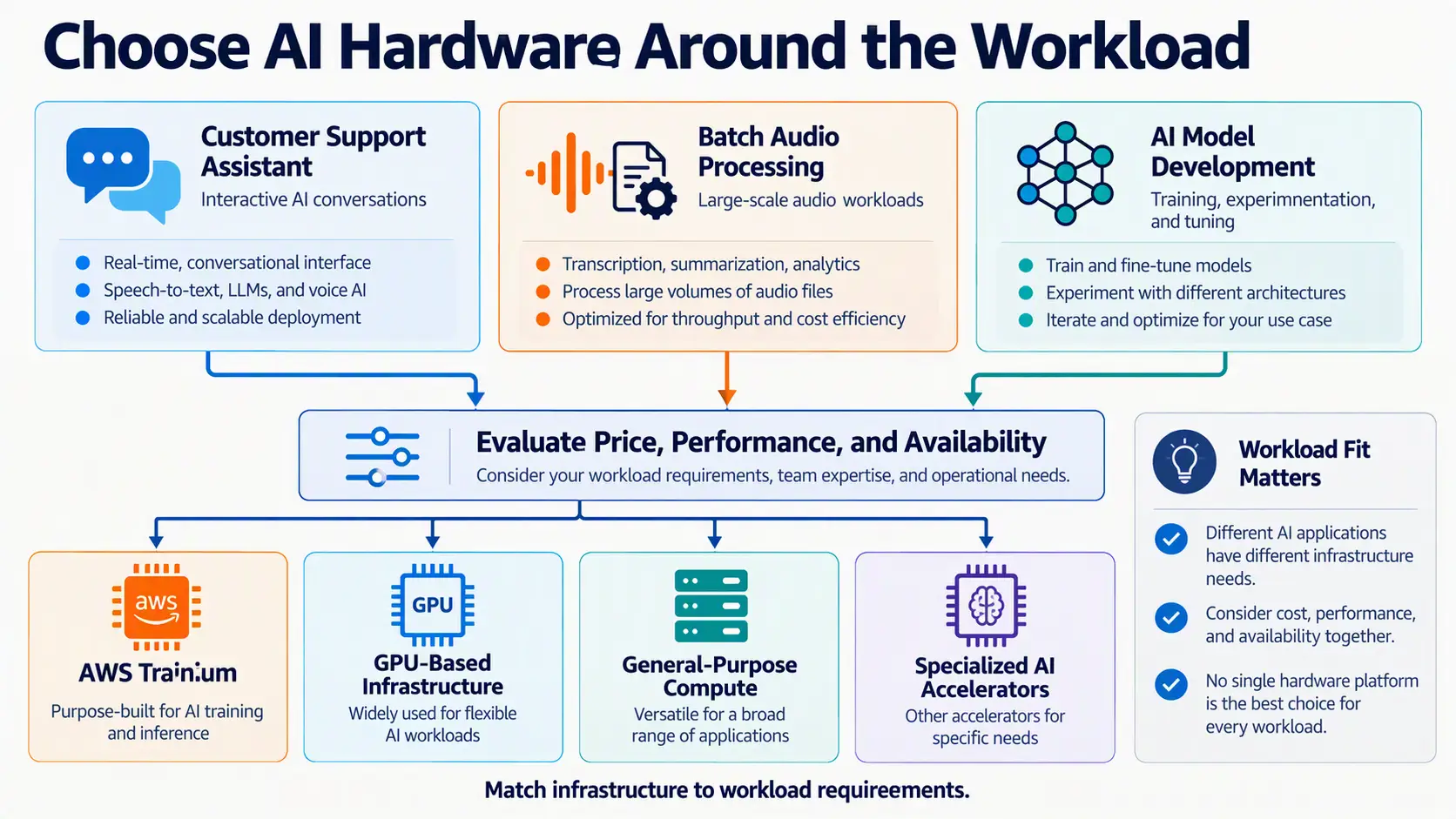
AWS positions TorchNeuron as a way to make hardware selection more flexible over the life of an AI project.
A team starting a new application may not know exactly how its computing requirements will evolve. Model architectures, application workloads, and infrastructure needs can change over time. If switching hardware requires extensive code changes and validation, the initial choice may become difficult to revisit.
AWS argues that reducing migration effort gives developers more room to select hardware for individual projects based on price, performance, and availability.
This approach also supports the possibility of using different hardware for different applications rather than committing every workload to one platform. For example, a customer-support assistant may have different latency requirements from a batch-processing system handling large volumes of audio.
The announcement does not suggest that all workloads should move to Trainium. Instead, it emphasizes making that option easier to evaluate and use when it fits the application's requirements.
Deepgram Reports Higher Audio Throughput per Dollar
AWS highlights Deepgram as an example of a company evaluating Trainium for speech-processing workloads.
Deepgram provides speech-to-text technology to more than 200,000 developers, according to the source. Working with the AWS Generative AI Innovation Center, the company moved its speech model to Trainium using the PyTorch tools its engineers already use.
In the benchmarks Deepgram evaluated, AWS reports that Trainium processed about 60% more audio per dollar than the company's existing GPU setup.
Deepgram says this efficiency allows it to bring better models to customers at lower prices. The example illustrates how an infrastructure decision can affect the economics of an AI service, rather than remaining an internal engineering consideration.
The result is specific to the benchmarks and setup described in the announcement. AWS does not establish that Trainium will deliver the same improvement for every audio workload or AI application.
AWS's Broader Argument: Make More Ideas Practical
The TorchNeuron announcement also presents a broader argument about how access to computing resources influences product development.
AWS draws a comparison with the launch of Amazon EC2 in 2006. According to Dr. Matt Wood, EC2 initially offered one type of virtual compute server, while AWS now offers hundreds of options with different processors, memory, and networking capabilities.
The point of the comparison is that greater choice can allow customers to build applications that were previously difficult to support well.
AWS applies the same reasoning to AI hardware. If teams can evaluate alternative accelerators without taking on a major software migration, they may be more willing to reconsider projects that were previously constrained by cost or infrastructure requirements.
For example, AWS describes the possibility of processing an entire archive of recordings that a voice company had previously ruled out. It also points to research teams that may want to design models around a particular approach while retaining more than one hardware option.
These are illustrative scenarios in the source, not claims that TorchNeuron has already enabled every such use case.
What the Launch Means for AI Teams
TorchNeuron's public beta gives developers another way to evaluate AWS Trainium while working within the PyTorch ecosystem.
For AI engineers, the announced integrations with Hugging Face may reduce the amount of adaptation required for supported workloads. Standard model checkpoints may also make it easier to preserve options when moving between supported hardware platforms.
For businesses, the Deepgram example illustrates why hardware economics can matter beyond infrastructure budgets. Changes in processing cost can influence the economics of delivering AI services, although the outcome will depend on the workload and the results achieved in practice.
There are important limits to keep in mind. TorchNeuron is in public beta, and the source does not provide a universal compatibility guarantee or claim that every workload will benefit from moving to Trainium.
Organizations should assess model support, validate outputs, and benchmark their own applications before making infrastructure decisions.
The central message is that hardware choices should remain open to review as projects evolve. TorchNeuron is AWS's attempt to lower one of the barriers to making that possible.
Conclusion: Keeping AI Hardware Decisions Open
AWS has introduced TorchNeuron to make it easier to run PyTorch workloads on Trainium and reduce the effort involved in evaluating alternative AI hardware.
The project combines an open-source release, collaboration with the PyTorch team at Meta, and native Trainium support across Hugging Face Transformers, Diffusers, PEFT, and TRL. AWS also says standard checkpoints can be loaded on other supported hardware, helping preserve flexibility beyond the initial deployment choice.
For developers and businesses, the significance is the ability to reconsider hardware as workload requirements change. The practical value will depend on compatibility, validation, and workload-specific economics, but the release gives PyTorch teams another option to investigate within the AWS ecosystem.
Source: AWS Insights
About the Author