
OpenAI Launches Patch the Planet Framework to Coordinate Critical Vulnerability Response
OpenAI outlines Patch the Planet, a coordinated approach to finding and fixing critical software vulnerabilities with AI, maintainers, security providers and government agencies. The initiative follows critical flaws discovered in PHP.
Xcademia Team

OpenAI has outlined a new approach to coordinating the discovery, disclosure and remediation of critical software vulnerabilities, following a collaborative effort to address serious security flaws in PHP, the open-source programming language used to build websites and web applications.
Announced on 21 October 2026, the initiative, called Patch the Planet, brings together software maintainers, security researchers, infrastructure providers and government agencies to help turn AI-assisted vulnerability discoveries into practical protections.
OpenAI said security firm Calif identified a critical PHP flaw using GPT-5.6 Sol as part of the initiative. Security company Wiz independently discovered and reported both vulnerabilities discussed in the announcement. PHP's maintainers led the fixes and release, while OpenAI, Wiz, Cloudflare and other participants contributed research, technical support and coordination ahead of public disclosure.
The announcement sets out a proposed framework for handling vulnerabilities that affect widely used software. It also describes support for open-source maintainers, investment in defensive AI capabilities and longer-term work to build more secure software.
For organisations responsible for websites, applications and critical infrastructure, the central issue is not simply how quickly AI can identify a vulnerability. It is how quickly the wider software ecosystem can validate the finding, prepare a fix, protect affected systems and deploy the update safely.
AI-assisted vulnerability discovery creates a coordination challenge
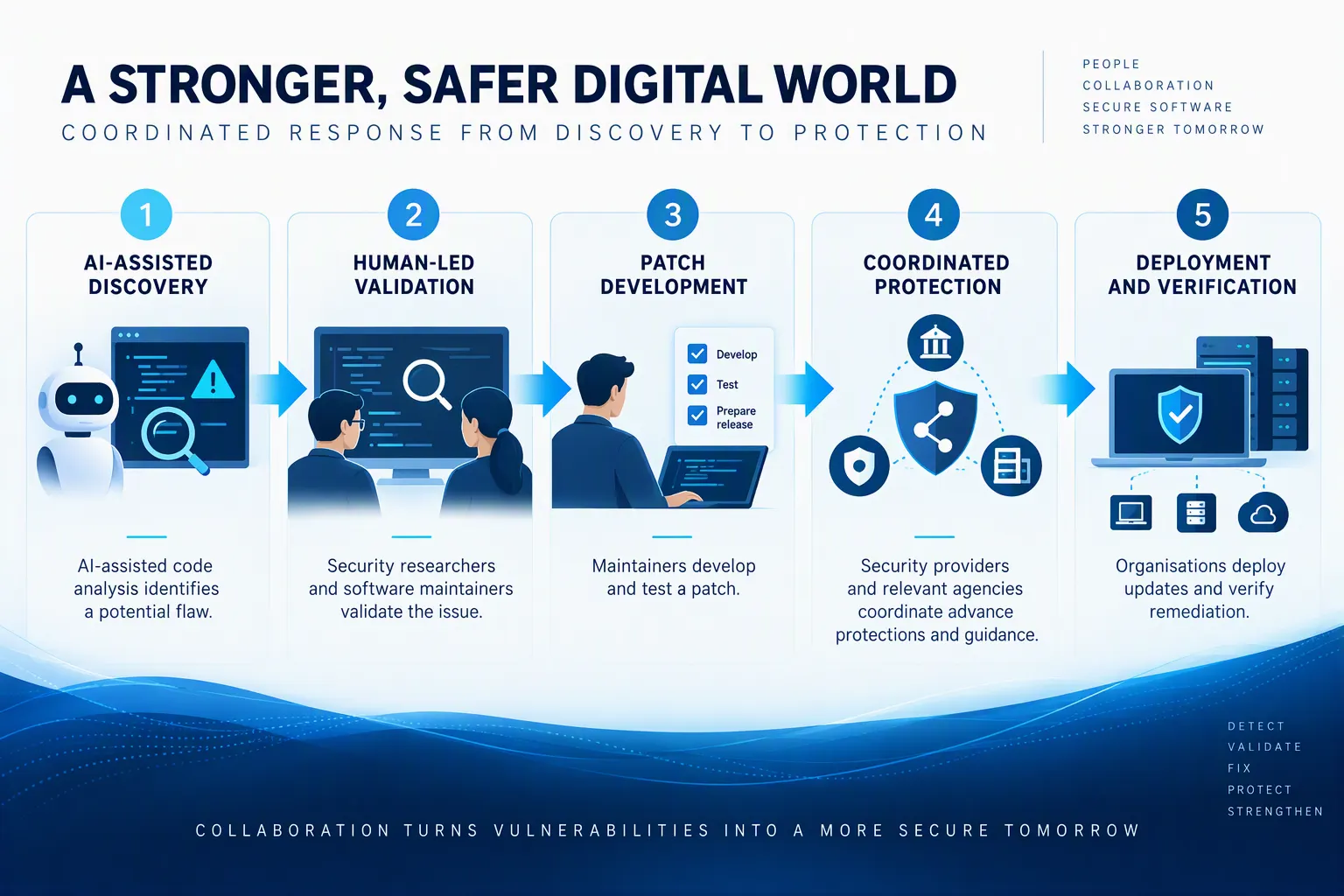
AI models are becoming increasingly useful for analysing code and identifying potential security weaknesses. However, discovering a vulnerability is only one part of the remediation process.
Software maintainers must validate the issue, understand its impact and test a reliable fix. Distributors may need to adapt that fix for older software versions, while hosting providers and security companies may need to prepare temporary protections. Organisations running affected systems then need to identify their exposure and deploy the appropriate updates.
These activities can involve multiple teams across different organisations, each with different technical responsibilities and deployment timelines.
OpenAI said its recent PHP response demonstrated the need for a repeatable process that can support wider coordination when a vulnerability affects widely deployed software.
The company also warned that the same AI capabilities that help defenders find weaknesses can help attackers develop offensive tools and exploits. This creates a limited opportunity for defenders to prepare protections before vulnerabilities become widely known or actively exploited.
OpenAI refers to this opportunity as the "Defender's Window". The aim is to use the time between discovery and public disclosure to validate findings, prepare fixes and give affected organisations a meaningful opportunity to protect their systems.
What happened in the PHP vulnerability response?
The PHP effort is the practical example behind OpenAI's proposed approach.
According to the announcement, Calif discovered a critical flaw using GPT-5.6 Sol through Patch the Planet. Wiz independently discovered and reported both vulnerabilities. PHP's maintainers led the work to fix the issues and release the necessary updates.
OpenAI and its partners contributed research, technical assistance and coordination with infrastructure providers. The effort also included engagement with government cyber agencies to help security guidance reach organisations responsible for critical services.
The process illustrates the different responsibilities involved in a coordinated disclosure:
Researchers identify and investigate potential vulnerabilities.
Software maintainers validate findings and lead the development and release of fixes.
Infrastructure and security providers prepare mitigations and protective measures for affected environments.
Government cyber agencies help coordinate the response and distribute guidance to critical organisations.
System operators assess exposure, apply the appropriate updates and verify remediation.
OpenAI also announced a PHP version checker delivered as a Codex skill to help operators identify potentially vulnerable PHP versions and determine which updates may apply, alongside official PHP and provider guidance.
Organisations should consult the PHP maintainers' official security advisories and upgrade instructions rather than relying on a version-checking tool alone.
OpenAI proposes a five-stage framework for critical vulnerabilities
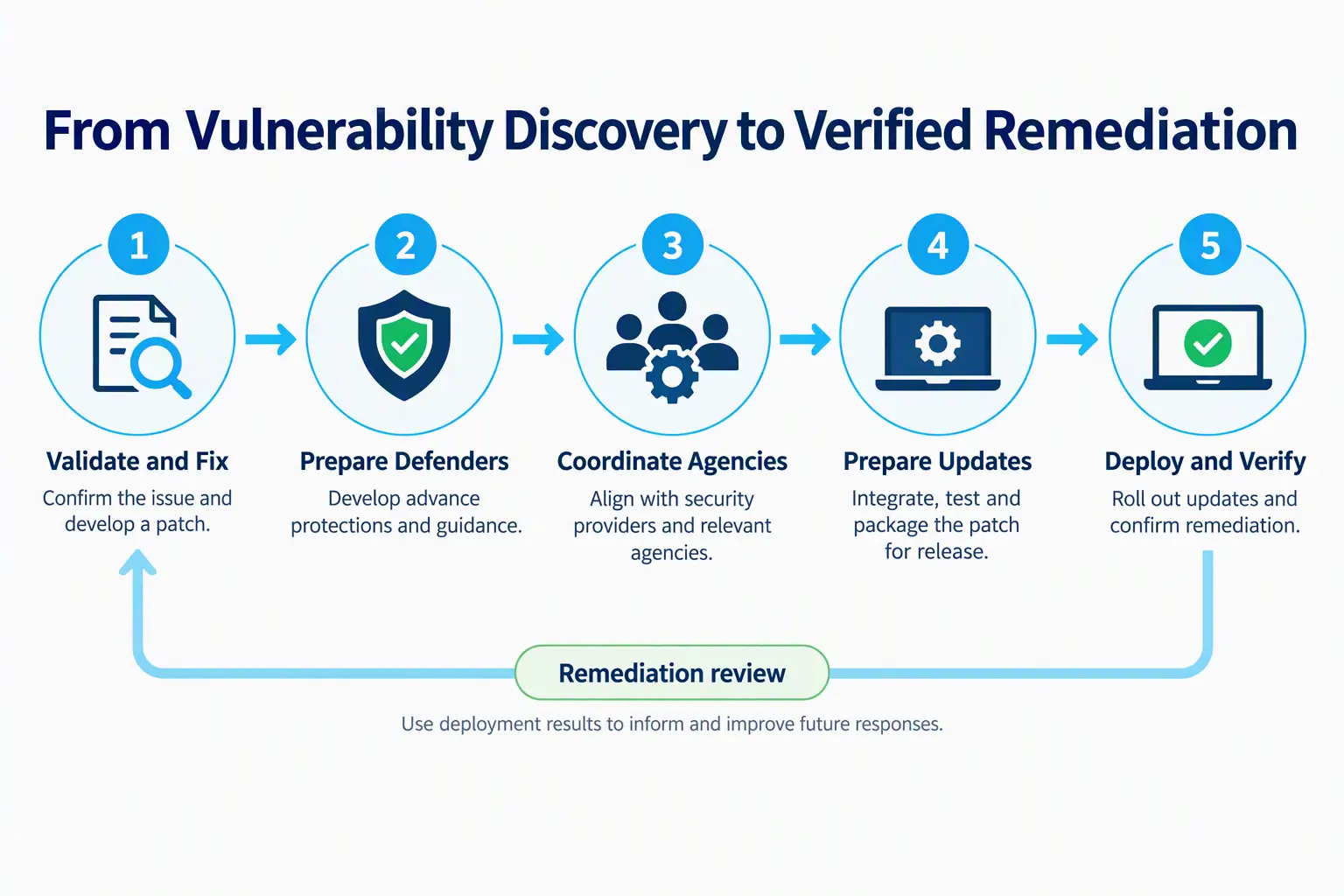
Patch the Planet introduces a proposed process for cases where a vulnerability requires coordination beyond the original software development team.
1. Validate the vulnerability and develop a fix
The first stage involves confirming the finding, assessing its impact and developing and testing a fix with the software maintainer and relevant technical partners.
OpenAI also proposes adversarial testing with advanced AI models to look for ways around a patch and identify related variants of the vulnerability.
This step matters because a patch must address the underlying weakness without introducing additional security issues or breaking expected software behaviour.
2. Give affected organisations time to prepare
Not every organisation can deploy an update immediately. Distributors may need to adapt a fix for older releases, hosting providers may need to test mitigations, and security providers may need to prepare detection or prevention rules.
OpenAI proposes assessing which organisations need advance information to take meaningful protective action. Software maintainers would decide whom to involve, while the process would consider each participant's defensive role, readiness and ability to handle sensitive information.
The goal is to provide enough preparation time without unnecessarily increasing the risk of a vulnerability being exposed before protections are ready.
3. Coordinate with government cyber agencies
Government agencies can help distribute guidance to organisations responsible for critical infrastructure and other essential services.
OpenAI said the PHP response involved engagement with multiple parts of the US government, including the Office of the National Cyber Director and the Cybersecurity and Infrastructure Security Agency, alongside international partners.
The announcement also references the White House's Super Intelligence Force. It does not provide a detailed breakdown of the individual contributions made by each government body.
4. Prepare updates across affected products
A vulnerability in a widely used component may affect products and services maintained by different organisations.
Once the fix and disclosure plans become more stable, the proposed process allows additional distributors, hosting providers, service providers, response teams and operators to prepare updates and address gaps in coverage.
This stage recognises that fixing the original software is not necessarily enough. Organisations that package, host or depend on that software may need additional work before the protection reaches end users.
5. Publish guidance and support deployment
After a patch becomes available, public guidance helps organisations assess their exposure, locate authoritative updates and apply interim mitigations where necessary.
Operators should then verify that the corrected software is running and reassess their priorities as circumstances change. If there is evidence of active exploitation, a leak or a delay that increases risk to users, the response timeline may need to be reconsidered.
OpenAI emphasises that temporary mitigations can reduce risk but have limitations and operational trade-offs. They should not automatically be treated as substitutes for lasting remediation.
Supporting open-source maintainers
A coordinated disclosure process depends on the people responsible for maintaining software.
Many open-source projects operate with small teams that must balance security reports against routine development work. These teams need to distinguish new findings from duplicates, assess the seriousness of reported issues and test fixes across supported versions.
OpenAI said it supports maintainers through funding, access to capable AI models and hands-on engineering assistance.
Its stated activities include:
Codex for OSS: subscriptions for open-source maintainers.
Project sponsorship: direct support for projects such as the Rust Foundation, with each project setting its own priorities.
Patch the Planet: an application route for open-source projects seeking hands-on support.
Reusable security workflows: tests and processes that can help maintainers handle future findings more efficiently.
The broader objective is to improve the capacity of open-source projects to investigate vulnerabilities and deliver dependable fixes.
This is an important part of the response because the security of downstream applications often depends on components maintained by teams with limited resources.
Funding and access to defensive AI capabilities
OpenAI said it has committed $1 billion in subsidised Daybreak access through Daybreak for Frontline Defenders. The initiative focuses on organisations with limited security resources that protect essential services.
The company also said it is refining additional blocking classifiers for Daybreak to reduce the potential misuse of its capabilities.
This reflects a difficult balance for providers of advanced AI models. Security researchers need capable tools to investigate vulnerabilities, test patches and strengthen defences. However, similar capabilities may be misused to develop offensive tools or exploit software weaknesses.
Overly restrictive safeguards can interfere with legitimate security research, while insufficient protections can increase misuse risks.
OpenAI said it intends to preserve the capabilities defenders need while limiting harmful use. The announcement does not disclose a detailed technical evaluation of these safeguards or quantify their effectiveness.
Moving from vulnerability discovery to secure-by-design software
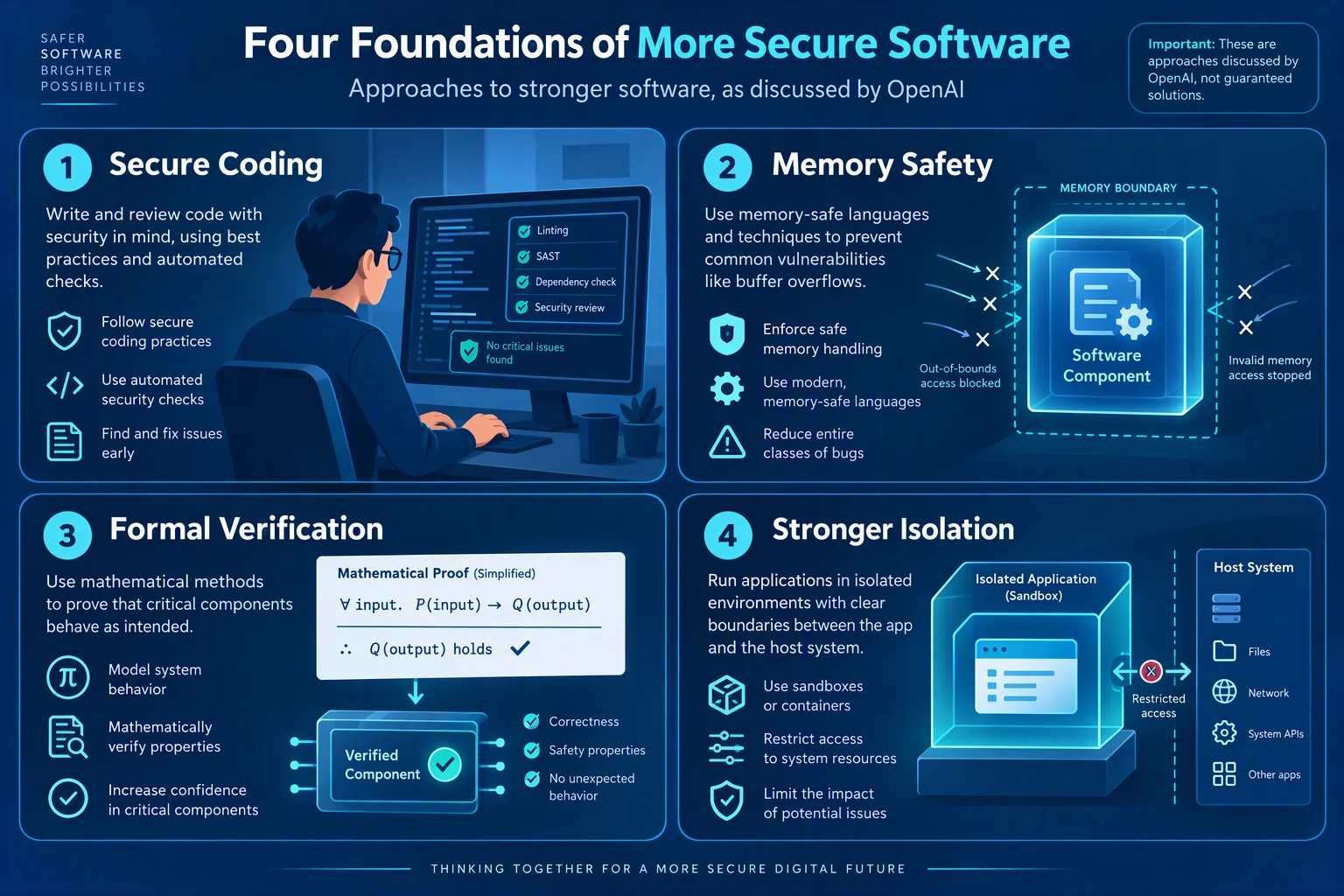
OpenAI's proposal extends beyond identifying and fixing individual flaws. It describes four areas where AI could help engineers build more secure software from the outset.
Secure coding practices
AI coding tools could help developers select safer defaults, use security libraries correctly and identify risky patterns during development.
The objective is to catch weaknesses earlier, reducing the need for emergency fixes after software has been deployed. Human review and appropriate testing remain important to confirm that proposed changes are correct.
Memory-safe software
Memory-safe programming languages can eliminate common classes of memory-related errors when used appropriately.
OpenAI sees an opportunity for AI to help engineers migrate critical components to memory-safe languages. Such migrations require tests and expert review to confirm that functionality and compatibility are preserved.
Formal verification
Formal verification uses mathematical methods to demonstrate that a component satisfies specified properties under stated assumptions.
OpenAI suggests that applying these methods to widely used components could help rule out certain classes of vulnerabilities. The announcement does not claim that formal verification can eliminate every security risk or prove a system secure in all circumstances.
Stronger isolation and sandboxing
Software that processes untrusted files, images or media should be restricted so that a compromise does not automatically grant access to the wider system.
OpenAI proposes using AI to help test and strengthen sandboxing technologies. Effective isolation can limit the potential damage from vulnerabilities that have not yet been discovered or fixed.
Together, these areas represent a broader approach: discover existing weaknesses, improve the remediation process and reduce the likelihood or impact of future vulnerabilities.
Unresolved questions around disclosure and emergency response
OpenAI is presenting Patch the Planet as a proposed approach and has invited feedback from maintainers, researchers, service providers, operators and independent security experts.
The company highlights several questions that still require discussion.
How long should the disclosure window last? Maintainers and operators need enough time to prepare reliable fixes, but delaying public disclosure for too long may leave users exposed. OpenAI is seeking views on what evidence should trigger earlier disclosure.
When should emergency patching be permitted? The announcement raises questions about whether governments or other operators should ever patch systems they own or are authorised to manage after losing administrative access, and what safeguards such actions would require. It also discusses a possible future approach involving continuous scanning for known vulnerabilities, followed by owner notification or authorised remediation. These are discussion points, not a declared operational policy.
Who should receive early notification? Organisations need advance warning when it enables concrete protective action. However, sharing sensitive technical details with a wider group can increase the risk of leaks. The proposed framework seeks to balance coverage against that risk.
How should older software be protected? Some downstream packages may require fixes before upstream changes are available. Other systems may rely on versions that no longer receive security updates. OpenAI is seeking ideas for testing, maintaining and distributing safer packages in these circumstances.
These questions show that coordinated disclosure is not simply a technical process. It also involves operational authority, trust, information-sharing rules and decisions about how to balance preparation time against exposure.
What this means for security teams
OpenAI's announcement highlights a broader industry shift towards using AI to support vulnerability research while strengthening the processes that turn discoveries into deployed protections.
For enterprise security teams, the practical lesson is to prepare for a world in which serious software weaknesses may be identified more quickly, while remediation still depends on people, vendors and infrastructure operators working together.
Organisations can draw several practical considerations from the proposed framework:
Maintain an accurate software inventory. Know which applications and services depend on critical open-source components.
Monitor authoritative security advisories. Use maintainers' guidance and trusted provider communications to determine which versions and systems are affected.
Prepare an emergency patching process. Establish ownership, testing procedures, rollback plans and escalation routes before a critical vulnerability is announced.
Use temporary mitigations carefully. Understand their limitations and plan for a permanent fix.
Verify remediation. Confirm that updates are installed and assess whether additional investigation is necessary.
Support upstream security work. Where feasible, contribute to the projects and maintainers on which organisational systems depend.
These are operational recommendations derived from the announcement's approach, not additional measures that OpenAI claims every organisation has already adopted.
The company has not provided a universal remediation deadline or a single process that will fit every software ecosystem. Response priorities should reflect the affected systems, exposure, available fixes and the guidance issued by the relevant maintainers and security authorities.
The road ahead for AI-assisted vulnerability response
Patch the Planet reflects a growing recognition that AI-assisted vulnerability discovery needs to be matched by a dependable response process.
Finding a critical flaw earlier can create an opportunity to protect users before public disclosure. However, that opportunity depends on accurate validation, reliable fixes, careful handling of sensitive information and effective deployment across the organisations that rely on affected software.
OpenAI's proposal brings these requirements together in a framework that places software maintainers at the centre of remediation while involving researchers, security providers, infrastructure operators and government agencies where necessary.
Its long-term direction also includes more secure coding, memory safety, formal verification and stronger isolation. These measures target not only individual vulnerabilities but also the software design choices that influence how future weaknesses emerge and how much damage they can cause.
The framework remains open to feedback, and questions around disclosure timing, emergency patching and secure software distribution are still being explored.
For defenders, the key takeaway is straightforward: AI can help uncover vulnerabilities, but coordinated action is needed to turn those discoveries into lasting protection.
Source: OpenAI
About the Author