
OpenAI Brings GPT-5.6 to Kiro to Improve AI-Powered Software Development
OpenAI has brought its GPT-5.6 model family to Kiro, giving developers access to Sol, Terra and Luna for planning, coding, reviewing and testing software with a focus on capability, speed and cost efficiency.
Xcademia Team
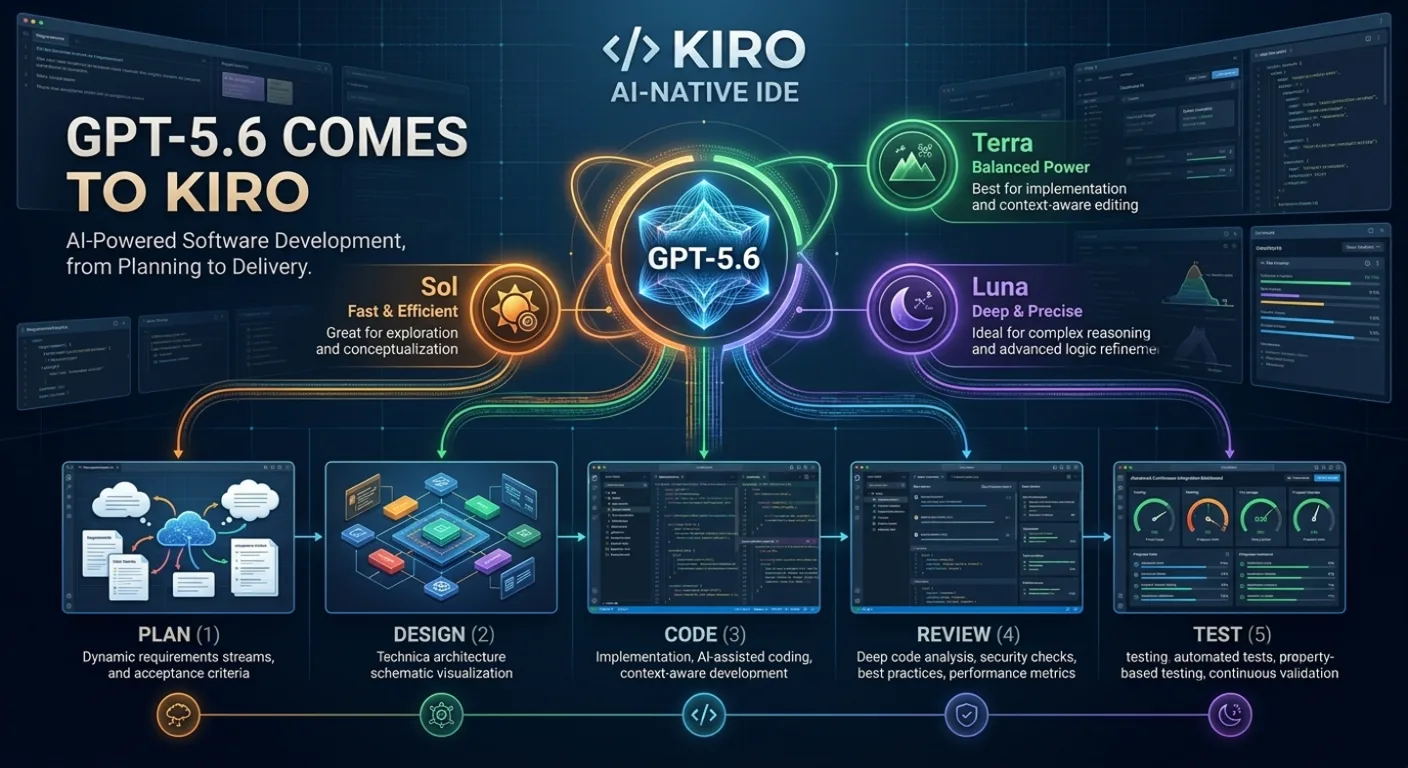
OpenAI has announced the availability of its GPT-5.6 model family in Kiro, an AI-powered software development agent designed for structured, long-running engineering work.
The integration brings OpenAI's latest GPT-5.6 models, including Sol, Terra and Luna, into Kiro's development workflows. According to OpenAI, developers can use the models across several stages of software development, from turning requirements into implementation plans to writing, reviewing and testing code.
The announcement was published by OpenAI on August 24, 2026.
GPT-5.6 enters Kiro's development workflow
Kiro is designed around a structured approach to AI-assisted software development. Instead of relying only on a high-level coding prompt, the platform turns an idea or requirement into structured requirements, technical designs and executable tasks.
OpenAI says this context allows GPT-5.6 models to work with a clearer understanding of what a development team is building, how the system is expected to operate and what the implementation needs to achieve.
This is particularly relevant for larger development tasks where an AI coding system needs to work across multiple steps rather than simply generate an isolated code snippet.
With GPT-5.6 in Kiro, developers can:
Turn product ideas and requirements into structured implementation plans.
Work on complex, multi-step coding tasks.
Use spec-driven development to provide additional structure to AI-assisted coding.
Give the models context from across a codebase and established team standards.
Review and refine AI-generated work at key checkpoints.
Use property-based testing to check implementation correctness.
How the workflow works
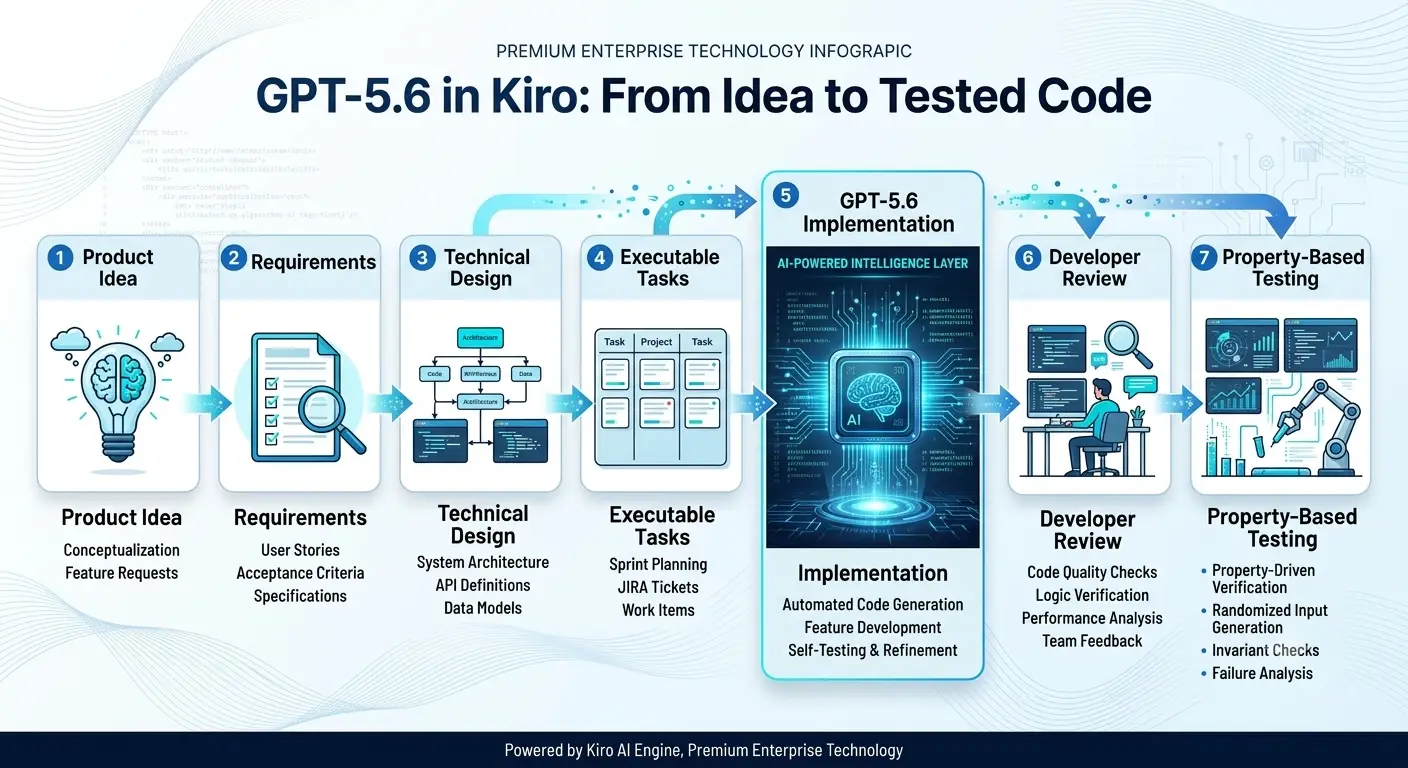
The combination of Kiro's structured development process and GPT-5.6 can be understood as a workflow rather than simply an AI code-generation feature.
Product idea
↓
Requirements
↓
Technical design
↓
Executable development tasks
↓
GPT-5.6-assisted implementation
↓
Developer review
↓
Testing and refinement
The approach gives developers defined checkpoints where AI-generated changes can be reviewed before they become part of the implementation.
Three GPT-5.6 models for different development needs
OpenAI describes the GPT-5.6 family as providing developers with more choice when balancing intelligence, speed and cost across different stages of software development.
The Kiro integration includes Sol, Terra and Luna, giving developers access to the GPT-5.6 family within the same development environment.
OpenAI's announcement does not provide a detailed model-by-model breakdown of which development tasks should specifically use Sol, Terra or Luna.
Additional details were not disclosed in the announcement.
The broader positioning is that developers can select from the GPT-5.6 family according to the needs of a particular stage of their workflow.
Focus on long-running development tasks
A central theme of the announcement is the use of GPT-5.6 for long-running development work.
Traditional AI coding interactions often involve a developer asking for a particular function, component or change. Kiro's approach is aimed at giving the model more context around the broader engineering task.
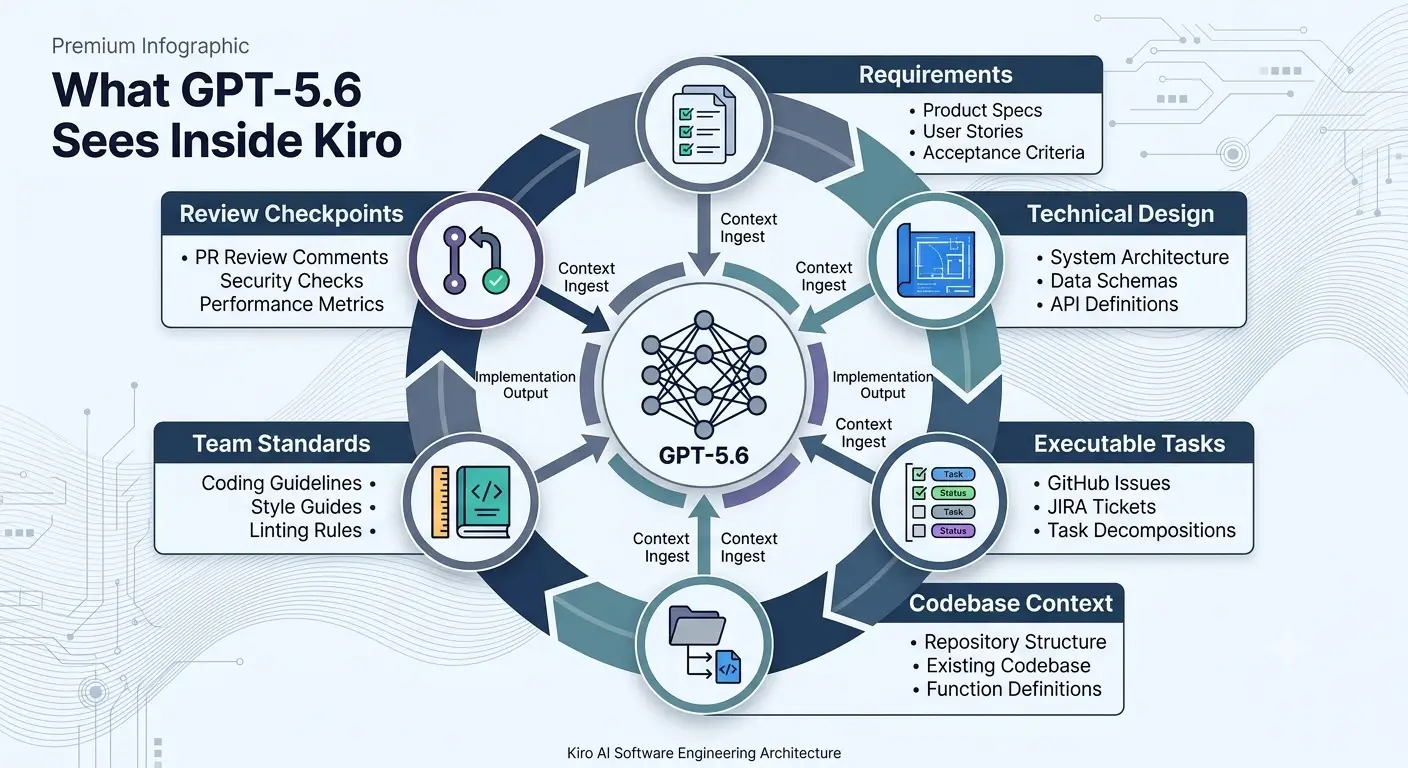
That context can include:
Project requirements
Technical designs
Executable tasks
Existing codebase context
Team development standards
Review checkpoints
OpenAI says this allows GPT-5.6 to work within a more structured understanding of the software being developed.
For development teams, the distinction is important. AI-assisted programming is moving beyond isolated code completion towards workflows where models participate in multiple stages of the engineering process.
OpenAI and AWS report an 82% cost reduction in testing
OpenAI says it worked with AWS to optimise the Kiro environment and OpenAI models.
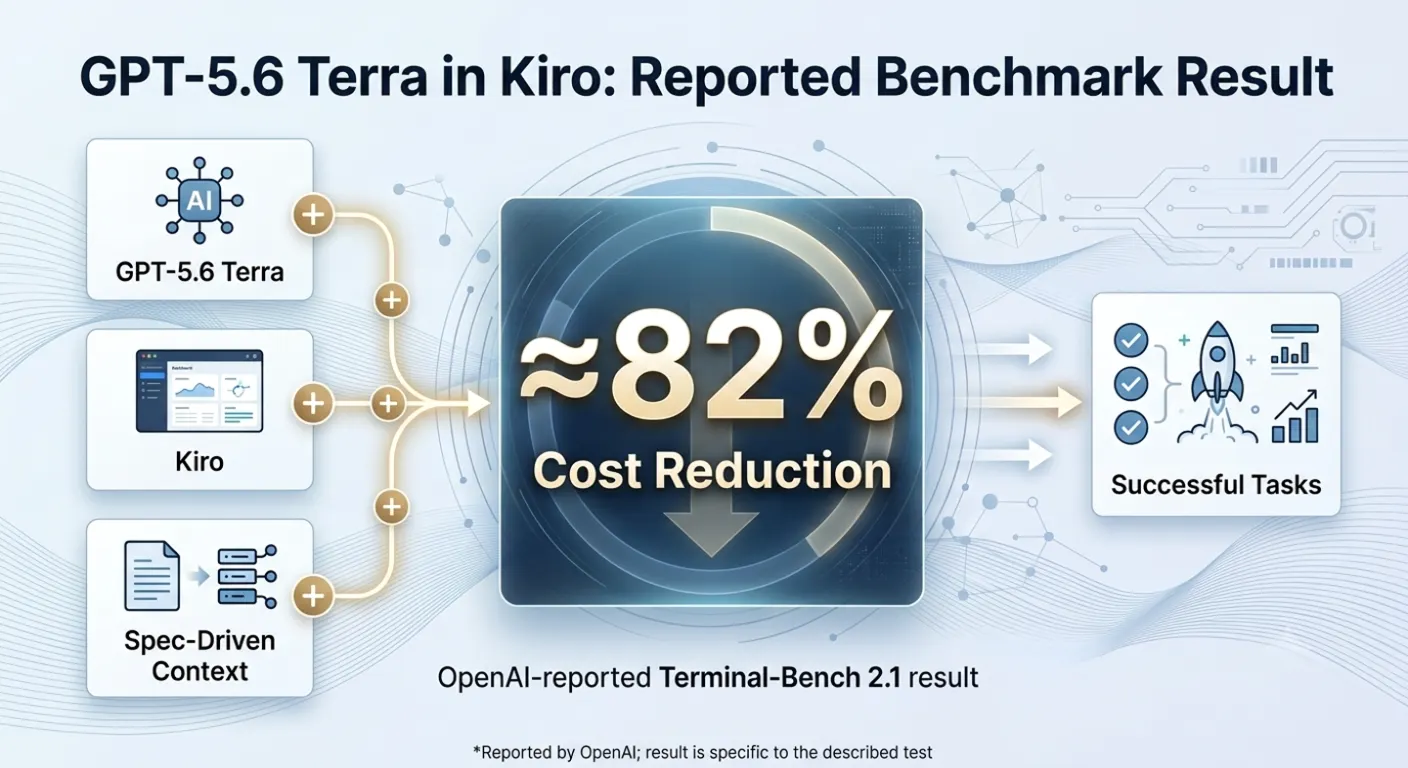
The companies tested GPT-5.6 Terra on Terminal-Bench 2.1 and reported that it completed successful tasks in Kiro at roughly an 82% cost reduction.
This figure is specifically associated with the reported Terminal-Bench 2.1 testing described in OpenAI's announcement. It should not be interpreted as a guaranteed 82% reduction in the cost of every software development workload.
OpenAI attributes the result in part to Kiro's spec-driven approach, which provides the model with requirements, technical designs and task context from the beginning of the workflow.
The announcement does not provide additional benchmark methodology, workload-level breakdowns or a detailed comparison of the testing configuration.
The company did not provide specific information about this area.
Why structured AI development matters
The announcement highlights a broader industry shift toward AI systems that participate in software development as structured agents rather than operating only as code-generation tools.
A developer may still need to define what should be built, review implementation decisions and validate the resulting software. Kiro's workflow places these activities around the AI model rather than treating generated code as the final output.
This distinction could become increasingly important as AI coding tools are used for larger projects.
For enterprises, this could mean greater emphasis on context, requirements, review processes and testing when adopting AI development systems.
The value of an AI coding model is therefore not only determined by how well it can generate code. The surrounding workflow can also affect how effectively developers can use that model in real engineering environments.
GPT-5.6 and the software development lifecycle
OpenAI positions the Kiro integration across multiple parts of the software development lifecycle.
Development stage | Role described in the announcement |
|---|---|
Planning | Turn product ideas and requirements into structured implementation plans |
Design | Work with technical designs and structured context |
Implementation | Complete complex, multi-step coding tasks |
Code review | Review and refine AI-generated work at checkpoints |
Testing | Use property-based testing to check implementation correctness |
These capabilities are presented as part of a connected development workflow rather than separate AI features.
Human review remains part of the workflow
Although GPT-5.6 is being positioned for complex and long-running development tasks, OpenAI's description of Kiro includes review checkpoints.
This means developers can inspect and refine the model's work before changes are implemented.
That approach provides an important control point for AI-assisted engineering. Rather than assuming that generated code is automatically ready for production, the workflow incorporates review and testing into the development process.
The announcement does not claim that GPT-5.6 eliminates the need for developer oversight.
OpenAI and AWS continue their collaboration
OpenAI and AWS said they will continue working together to improve the performance of OpenAI models in Kiro and help developers get more value from AI throughout the software development lifecycle.
OpenAI's announcement does not provide a specific timeline or additional product commitments beyond this statement.
Additional details were not disclosed in the announcement.
What this means for developers
For developers already using AI-assisted programming, GPT-5.6 in Kiro adds another option for integrating advanced models into a structured software engineering workflow.
The most notable elements are not limited to code generation. The integration combines model capabilities with requirements, technical designs, task management, codebase context, review checkpoints and testing.
For teams experimenting with AI-native development, this could make the workflow around the model as important as the model itself.
The development reflects growing demand for AI tools that can work across larger software tasks while remaining grounded in project-specific context.
Bottom line
OpenAI's GPT-5.6 family is now available in Kiro, bringing Sol, Terra and Luna into a structured AI software development environment.
The integration is designed to support planning, implementation, review and testing, while Kiro's spec-driven workflow provides requirements and technical context to the models.
OpenAI and AWS also report an approximately 82% cost reduction for successful GPT-5.6 Terra tasks in Kiro on Terminal-Bench 2.1, although that result is specific to the reported test and should not be generalised to all development workloads.
The announcement highlights a broader industry shift toward AI-assisted software development where models are integrated into structured engineering workflows rather than used only for standalone code generation.
Source: OpenAI
About the Author