
Humanoid Robots Break Human Speed Records, but Real-World Tasks Remain the Bigger Test
Chinese humanoid robots have surpassed human sprint records at Beijing's World Humanoid Robot Games, but practical tasks such as cable connection, warehouse work and autonomous problem-solving may prove more important.
Xcademia Team
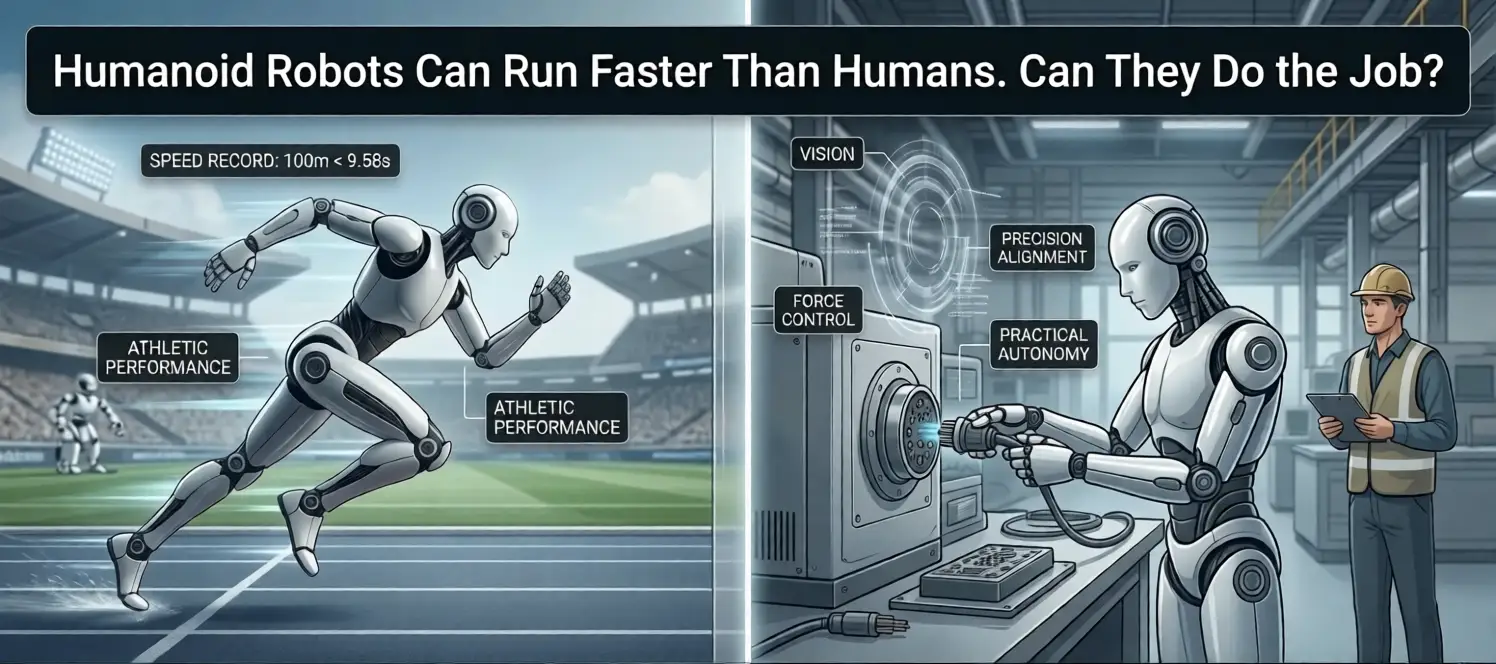
China's humanoid robots are demonstrating impressive physical capabilities at the World Humanoid Robot Games in Beijing. But the most important measure of progress may not be how quickly a robot can run. It may be whether it can reliably perform ordinary physical tasks when conditions are imperfect.
The five-day competition, which began on August 22, combines traditional sports-style events with scenario-based challenges designed around factories, restaurants, offices and emergency situations. Reuters reports that the event includes 51 competitions, comprising 30 sports competitions and 21 scenario-based contests. More than 40% of the events require robots to operate fully autonomously, according to Huawei, a technology partner of the games.
The contrast captures an important stage in humanoid robotics. A robot can demonstrate speed, balance and strength in a controlled competition. Real workplaces require something more complicated: recognising objects, positioning a robotic hand precisely, controlling force and recovering when something does not go as planned.
Robots Outrun Human Sprint Records
The opening events delivered some of the most visible demonstrations of humanoid robot progress.
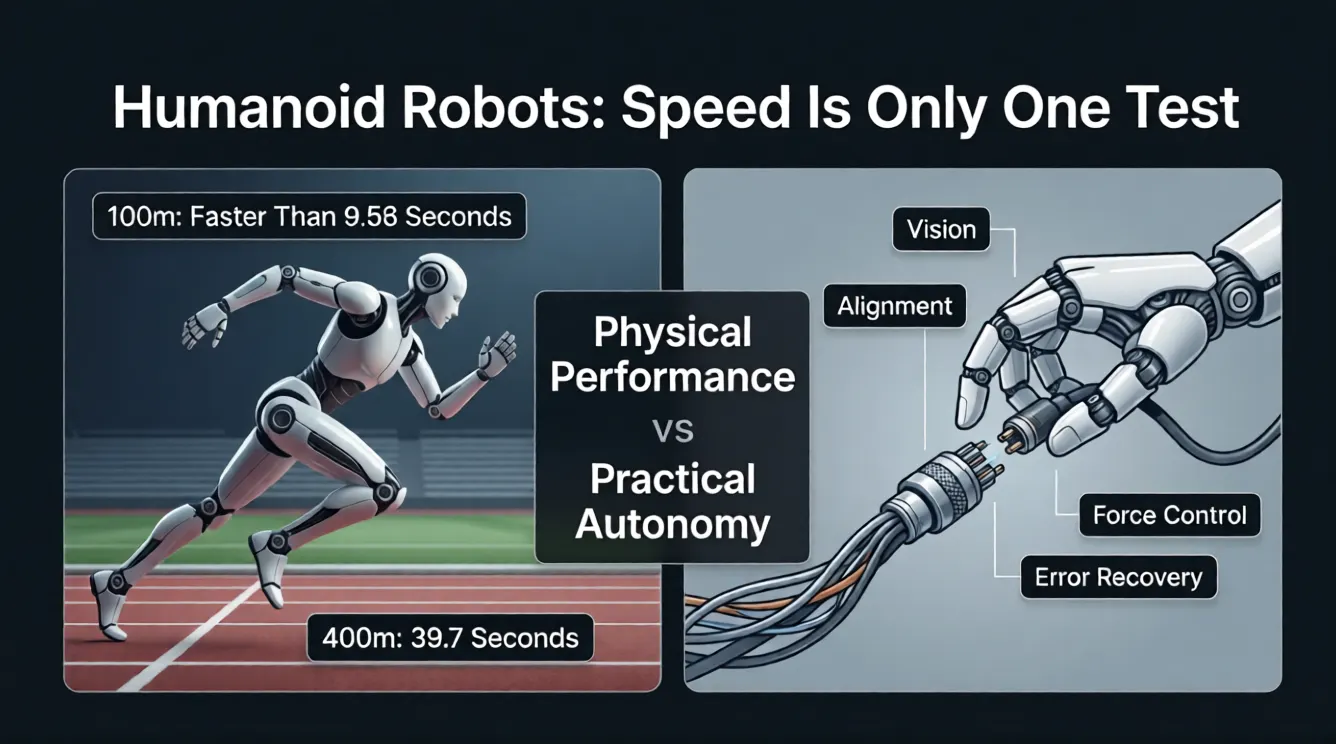
Two robots ran the 100-metre sprint faster than Usain Bolt's 9.58-second world record. Reuters notes that this represents a significant improvement from the 2025 competition, when the winning robot took more than 20 seconds.
Another humanoid robot, using the same model as the 100-metre champion, completed 400 metres in 39.7 seconds. That was faster than South African athlete Wayde van Niekerk's human world record of 43.03 seconds.
The demonstrations also exposed some of the engineering challenges involved in making fast-moving humanoid robots useful outside a competition environment. During the sprint, braking became an issue, with the machines hitting a thick mat placed several metres beyond the finish line.
The event therefore illustrates an important distinction: achieving a particular physical performance in a controlled setting is not the same as reliably operating in an unpredictable environment.
The More Difficult Challenge Is in the Details
The event's scenario-based competitions may provide a more revealing indication of how humanoid robots could eventually perform in real workplaces.
Reuters highlights seemingly small imperfections as important tests. A cable may be positioned at the wrong angle. An object may be slightly out of reach. A package may shift. A robot may miss a step.
These situations require more than movement.
A capable system needs to identify the relevant object, position its body and hands accurately, apply an appropriate amount of force and respond when its initial attempt does not work. Reuters specifically identifies these abilities as important parts of the practical challenges being tested.
This is where humanoid robotics moves from a demonstration of physical capability towards a test of autonomous decision-making and control.
Cable Connection Becomes a Serious Robotics Test
One of the event's practical challenges involves connecting a cable.
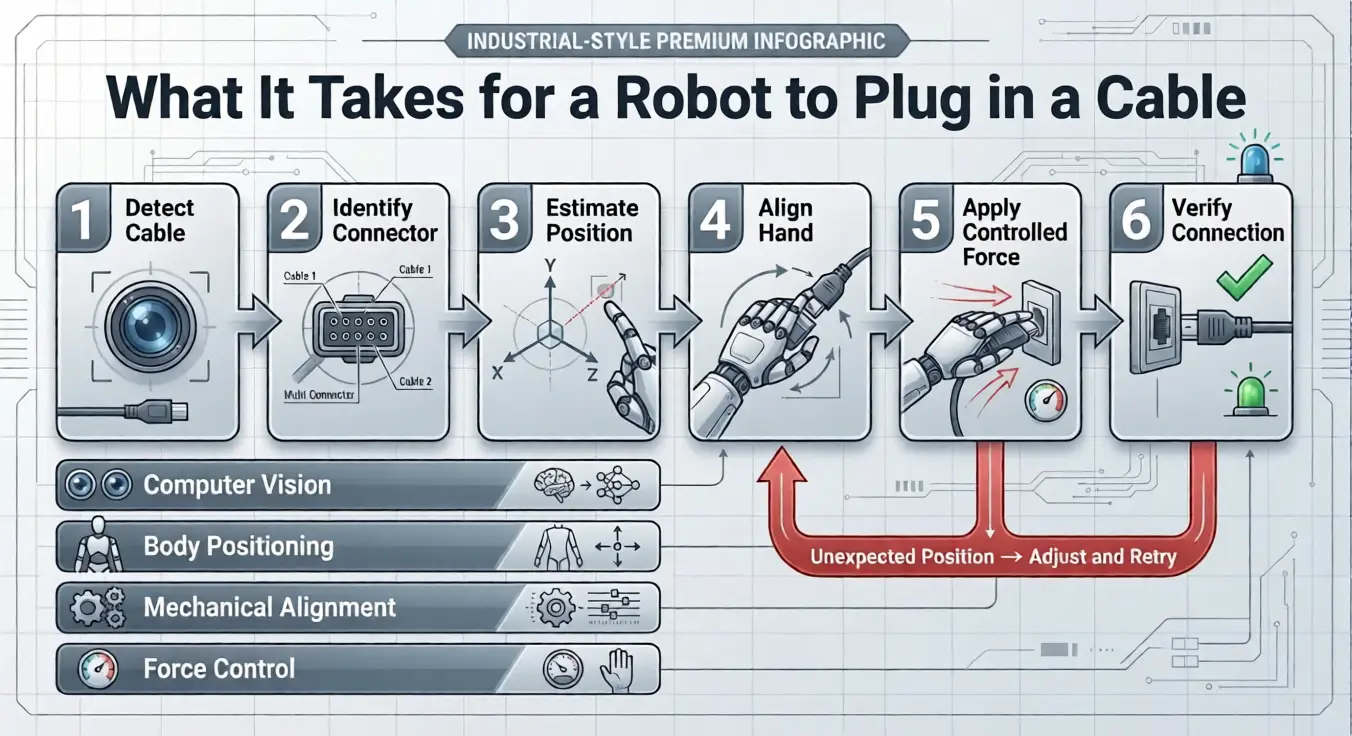
At first glance, plugging in a cable appears considerably less impressive than running 100 metres. From a robotics perspective, however, the task can require several capabilities to work together.
The robot needs to see the cable and connection point. It must determine their positions and orientation, move its hand accurately, align the components and apply controlled force.
If the cable is not positioned exactly as expected, the robot must also respond to that variation.
Reuters describes the challenge as a test of vision, mechanical alignment and force control.
That makes the task representative of a broader robotics problem. Human workers routinely compensate for small changes in physical environments without consciously thinking about each adjustment. Robots need systems capable of handling those variations explicitly.
From Sports to Industrial Work
The World Humanoid Robot Games are not limited to athletics.
Robots are also competing in activities related to EV charging, restaurant work, emergency incident handling, hand dexterity, industrial assembly and material loading. The games also include warehouse-related tasks and an autonomous humanoid tennis demonstration.
These scenarios shift the focus from what a robot can physically do to whether it can complete a sequence of useful actions.
For example, industrial assembly can require accurate positioning and repeatable movements. Material loading can involve handling objects in changing positions. Restaurant work can require interaction with objects and an environment that is less predictable than a laboratory.
The competition is therefore testing different aspects of embodied robotics rather than focusing on a single performance metric.
Autonomy Is Central to the Competition
More than 40% of the events require full autonomy, according to Huawei.
That detail is significant because autonomy changes the nature of the task.
A remotely controlled or closely supervised robot can rely on a human operator when something unexpected happens. A fully autonomous system needs to perceive the situation, determine an appropriate action and execute it without continuous human intervention.
For practical deployment, this distinction matters.
A robot working in a factory, warehouse or other operational environment may encounter variations that were not present in its training or testing conditions. The ability to handle those variations can become as important as raw movement speed.
Hardware Improvements Are Only Part of the Equation
The competition also highlights the hardware demands created by faster and more complex humanoid robots.
Reuters reports that robotics investor Xu Qiaosheng pointed to increased demands on battery management and thermal dissipation as the intensity of the competition rises.
This demonstrates that humanoid robotics is a multidisciplinary engineering problem.
Speed requires physical power and control. Sustained operation requires energy management. Precise manipulation requires sensors, mechanical systems and control mechanisms. Autonomous operation requires software capable of interpreting the environment and responding appropriately.
Improving one part of the system does not automatically solve the others.
Why Real-World Reliability Matters
The central question emerging from the competition is straightforward: Can humanoid robots solve useful problems consistently outside a demonstration environment?
Reuters quotes robotics executives who emphasise that practical value depends on solving real-world problems rather than simply demonstrating athletic abilities.
This distinction is particularly relevant for enterprises considering robotics deployments.
A company evaluating a humanoid robot would likely need to look beyond headline performance and examine whether the system can repeatedly complete the specific tasks required in its operating environment.
That means questions around accuracy, autonomy, error recovery, physical interaction and operational reliability become important.
The announcement does not provide specific information about commercial deployment performance across these areas.
The Broader Industry Shift
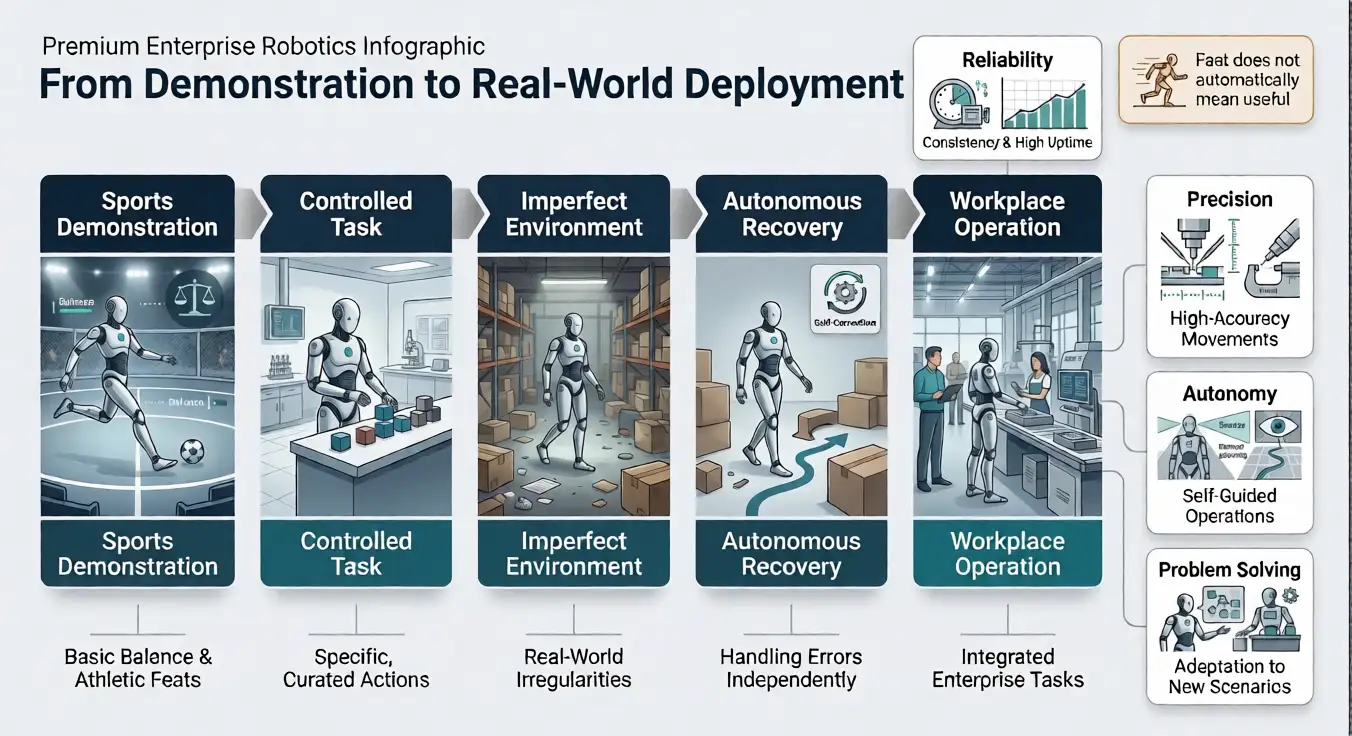
The World Humanoid Robot Games reflect a broader shift in how advanced robotics can be evaluated.
Athletic demonstrations are easy to understand and visually compelling. They provide clear benchmarks for speed, balance and physical capability.
Workplace scenarios are harder to measure but potentially more relevant to businesses.
A robot that can run exceptionally fast may attract attention. A robot that can repeatedly perform a useful industrial task, deal with variations and recover from errors could provide a more meaningful demonstration of practical value.
The competition's combination of sports and workplace scenarios therefore provides two different perspectives on progress in humanoid robotics.
Original analysis: The development highlights a broader industry shift toward evaluating AI-powered machines through their ability to operate in physical environments rather than through isolated laboratory benchmarks. For enterprises, this could mean that future robotics assessments will increasingly focus on task completion, autonomy and reliability alongside traditional measures such as speed and strength.
What Comes Next for Humanoid Robotics?
The Beijing competition does not establish that humanoid robots are ready for widespread deployment across workplaces. It does, however, show how developers and robotics companies are increasingly testing systems against tasks that resemble practical work.
The important benchmark may gradually move from:
"How fast can the robot move?"
to:
"Can the robot reliably complete the job?"
That shift puts greater emphasis on perception, precision, physical control and autonomous recovery.
The companies participating in these demonstrations will ultimately need to show how such capabilities perform beyond competition settings. As one robotics executive cited by Reuters put it, the test comes after products are sold and whether they can solve users' problems.
For now, the World Humanoid Robot Games offer a useful snapshot of that transition. Robots can already produce extraordinary athletic demonstrations. The harder engineering challenge is making them dependable when the cable is misaligned, the package moves or the environment does not behave exactly as expected.
Summary
China's World Humanoid Robot Games feature 51 events, including sports and scenario-based competitions.
Two robots reportedly beat Usain Bolt's 9.58-second 100-metre record.
Another humanoid completed 400 metres in 39.7 seconds, faster than Wayde van Niekerk's 43.03-second record.
More than 40% of the events require full autonomy, according to Huawei.
Practical challenges include cable connection, EV charging, restaurant work, industrial assembly and material loading.
Cable connection tests vision, mechanical alignment and force control.
The competition highlights the difference between physical demonstrations and reliable real-world problem solving.
Source: Reuters
About the Author