
Google Expands Antigravity With Enterprise AI Coding and Security Controls
Google is expanding Antigravity across Gemini Enterprise with enterprise governance, spend controls, audit logging and IDE integrations designed to give developers agentic coding tools without sacrificing centralized oversight.
Xcademia Team
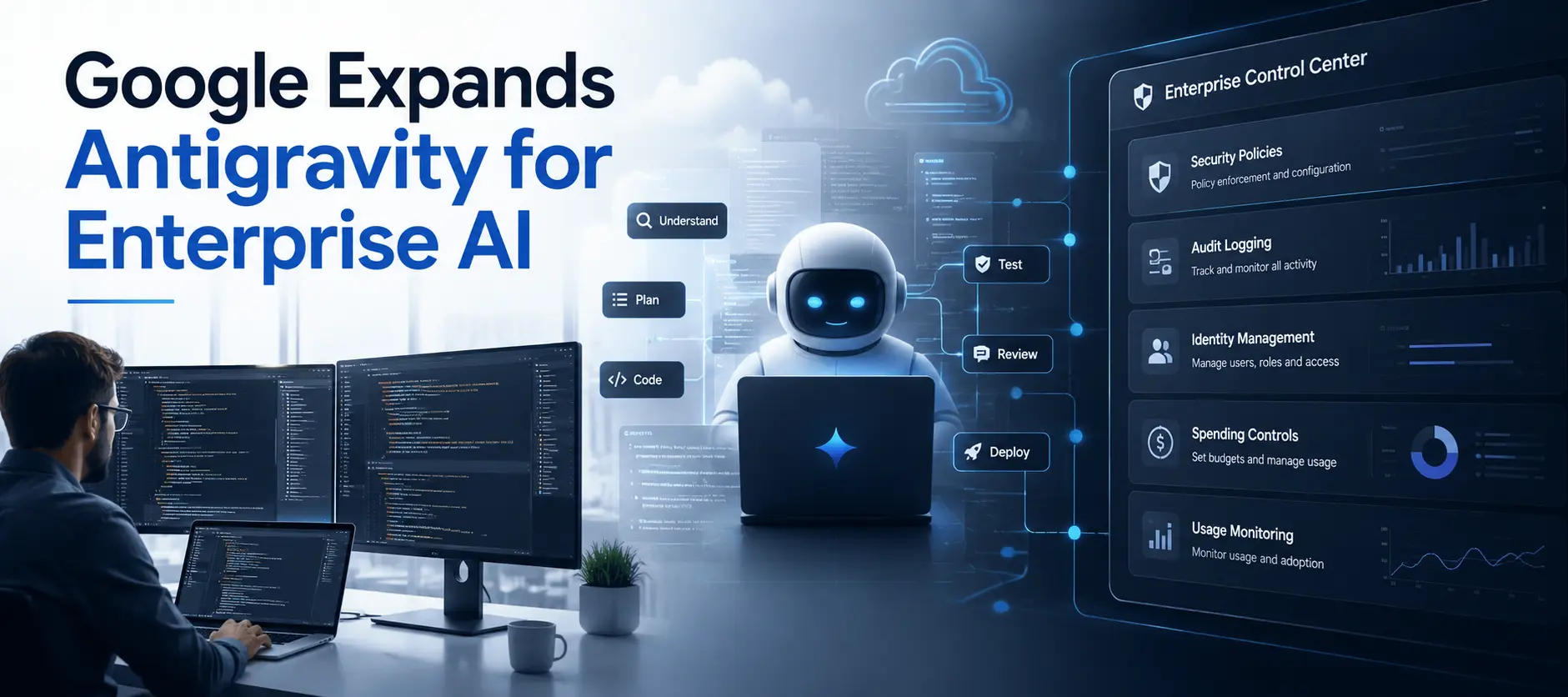
Google Expands Antigravity With Enterprise AI Coding and Security Controls
Google is expanding its Antigravity agentic coding platform for enterprise customers, bringing the technology into eligible Gemini Enterprise subscriptions alongside new administrative, security, spending and usage controls.
The move is aimed at a growing enterprise challenge: giving developers access to AI agents while allowing IT, security and finance teams to retain centralized control.
According to Google Cloud, Antigravity is now available as part of eligible Gemini Enterprise Standard, Plus and Standard Emerging Market licenses. Google is also introducing IDE extensions that allow developers to use Antigravity within familiar development environments, including Visual Studio Code.
The announcement positions Antigravity not simply as an AI coding tool, but as part of a broader enterprise AI management environment.
Antigravity Moves Into Gemini Enterprise
Google first announced Antigravity as part of the Gemini Enterprise Agent Platform at Google I/O in May.
The latest expansion brings Antigravity into eligible Gemini Enterprise subscriptions instead of requiring organizations to manage it as a separate developer tool.
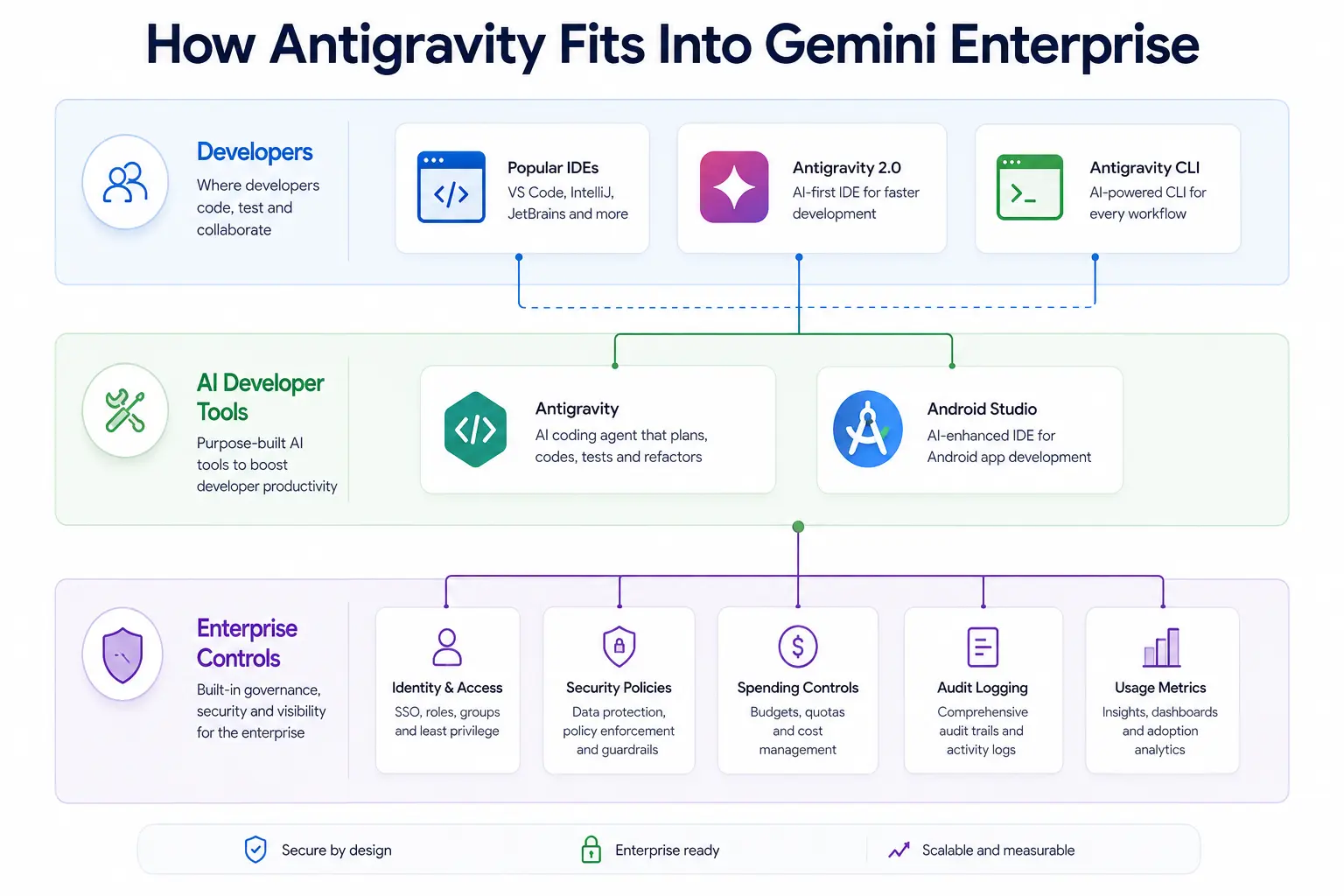
Google says administrators can enable Antigravity and Android Studio for eligible users while managing spending, security, observability and usage metrics through the Gemini Enterprise admin console.
For organizations deploying AI coding agents across multiple development teams, this consolidation is significant because it places developer access and administrative controls within the same enterprise management structure.
The company has not disclosed additional details about pricing structures beyond the subscription and licensing information described in the announcement.
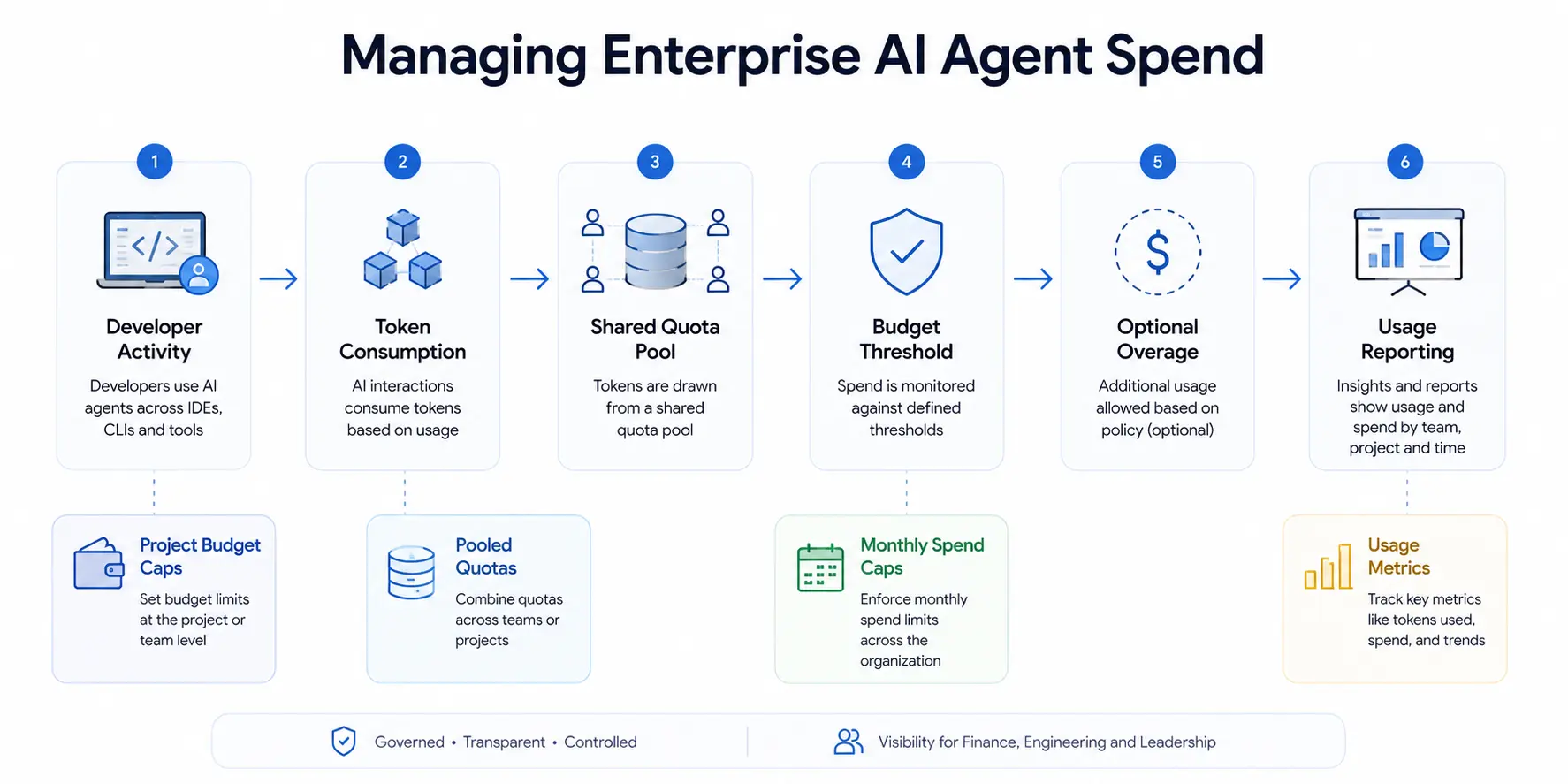
New Controls Focus on AI Spending
One of the most notable parts of Google's announcement is the addition of centralized spending and quota management.
Organizations using Gemini Enterprise can use project-level monthly budget caps through the Billing console. Google says additional per-user and team controls are planned to roll out later this year.
The platform also introduces pooled quotas.
Instead of assigning usage strictly to individual users or teams, shared token pools can provide flexibility when demand varies across an organization. Google says this is intended to reduce the possibility of purchased quota remaining unused in one part of an organization while another team needs additional capacity.
Google is also providing an overage option. Administrators can choose to allow usage beyond pooled quotas while applying monthly spending caps. Additional consumption then moves to standard consumption-based rates, according to the company.
Centralized usage metrics provide visibility into token consumption, API calls and developer activity.
This gives finance and technology teams a clearer view of how AI developer tools are being consumed across the organization.
Why AI Cost Governance Matters
Original analysis: The announcement highlights a broader industry shift toward treating AI agents as managed enterprise workloads rather than isolated developer experiments.
As AI coding agents become capable of handling more complex tasks, organizations need to understand not only whether developers are using them, but also how much AI infrastructure they are consuming and where that usage is occurring.
Google's approach puts spending controls alongside developer access, suggesting that financial governance is becoming an increasingly important part of enterprise AI deployment.
However, Google did not provide specific usage or cost figures demonstrating the financial impact of these controls.
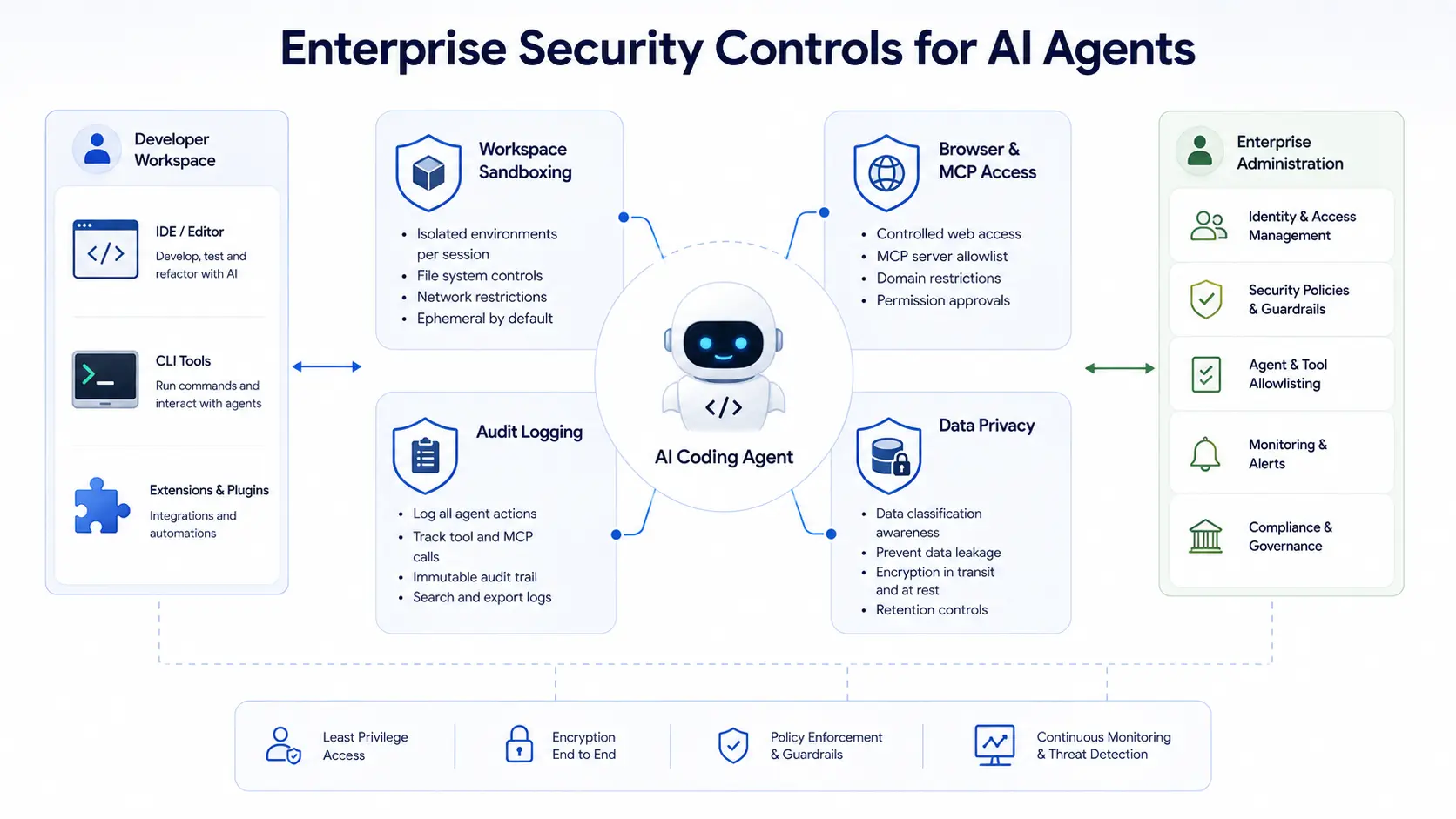
Security and Privacy Controls Move Into the Enterprise Console
Google is also emphasizing security and privacy as part of the enterprise expansion.
According to the announcement, Antigravity within Gemini Enterprise comes under Google Cloud's standard security and compliance protections.
Administrators can configure security policies around areas such as workspace sandboxing, browser access and MCP server access. These controls are designed to establish boundaries for where AI agents can operate within enterprise environments.
Google is also making central audit logging available.
With audit logging enabled, organizations can capture prompts, agent responses and related metadata for compliance reporting.
This is particularly relevant for companies that need visibility into AI-assisted development activity for internal governance or compliance purposes.
Google also states that data ownership remains subject to Google Cloud's Terms of Service and that agent activity executes within the customer's secure cloud boundary.
The announcement does not provide detailed information about every security configuration available to enterprises.
Antigravity Expands Across Developer Environments
Google is also trying to reduce friction for developers by allowing Antigravity to operate across several development environments.
The company says Antigravity is now available through new IDE extensions for Visual Studio Code, with Visual Studio, JetBrains and Zed integrations listed as previews. Developers can also use Antigravity through the Antigravity 2.0 desktop application and Antigravity CLI.
This means organizations do not necessarily have to force developers into a single development environment to adopt the agentic coding platform.
Google also highlights support for Workforce Identity Federation and Application Default Credentials across these surfaces.
The stated goal is to help administrators enforce corporate identity standards while reducing setup requirements for technical teams.
For enterprises with multiple development teams and different technology preferences, IDE flexibility can be an important part of adoption.
Enterprise Customers Are Already Using Antigravity
Google's announcement includes comments from several enterprise customers and partners, including Accenture, AirAsia, CGI, Cognizant, Datamatics, Deloitte and Wipro.
Their comments describe use cases ranging from software engineering and application development to business workflows and automation.
Google says these organizations are using Antigravity and related Gemini Enterprise capabilities to support activities such as code generation, application development, task automation and AI-assisted business processes.
The company also presents Antigravity as part of a broader move from AI experimentation toward production-oriented enterprise adoption.
However, the customer statements are supplied by Google and should be viewed in that context. The announcement does not provide independently verified performance benchmarks comparing Antigravity with other AI coding tools.
What Google's Expansion Means for Enterprise AI
Original analysis: Google's latest Antigravity expansion reflects a wider movement in enterprise AI: organizations increasingly want autonomous or agentic tools, but they also want centralized controls around identity, security, spending and auditing.
That creates a balance between developer autonomy and organizational governance.
Developers benefit from access to AI agents within familiar tools. IT teams receive centralized administrative controls. Security teams gain mechanisms for managing workspace and access policies. Finance teams receive visibility into consumption and spending.
The practical value of this model will depend on how organizations configure these controls and how developers use the technology in real production environments.
The announcement itself does not provide enough independent data to determine how much productivity improvement enterprises should expect.
Availability
Google says Antigravity in Gemini Enterprise is currently available for eligible Gemini Enterprise Standard, Plus and Standard Emerging Market licenses, with broader support coming soon.
Administrators can enable AI Developer tools for Antigravity and Android Studio through Google's enterprise setup process.
Developers can access Antigravity 2.0, the Antigravity CLI and supported IDE extensions.
Additional details were not disclosed in the announcement regarding the timing or scope of broader license support.
The Bigger Picture
Google's expansion of Antigravity is less about adding another AI coding interface and more about connecting agentic development with the management systems enterprises already rely on.
The combination of AI coding agents, familiar IDEs, pooled usage, spending controls, identity management and audit logging points toward a model where organizations can deploy AI agents while maintaining centralized oversight.
For enterprises evaluating agentic development tools, the key question is therefore not only what an AI agent can build. It is also how the organization can control where the agent operates, what it can access, how its activity is monitored and how its usage is paid for.
Google's latest Antigravity update brings those concerns directly into the Gemini Enterprise environment.
Source: Google Cloud Blog
About the Author