
Google Cloud Outlines Dynamic Capacity Management for AI Infrastructure
Google Cloud outlines a dynamic capacity strategy for AI infrastructure, combining scheduled capacity, automated hardware fallbacks and GKE-based resource allocation to improve flexibility, utilization and cost control.
Xcademia Team
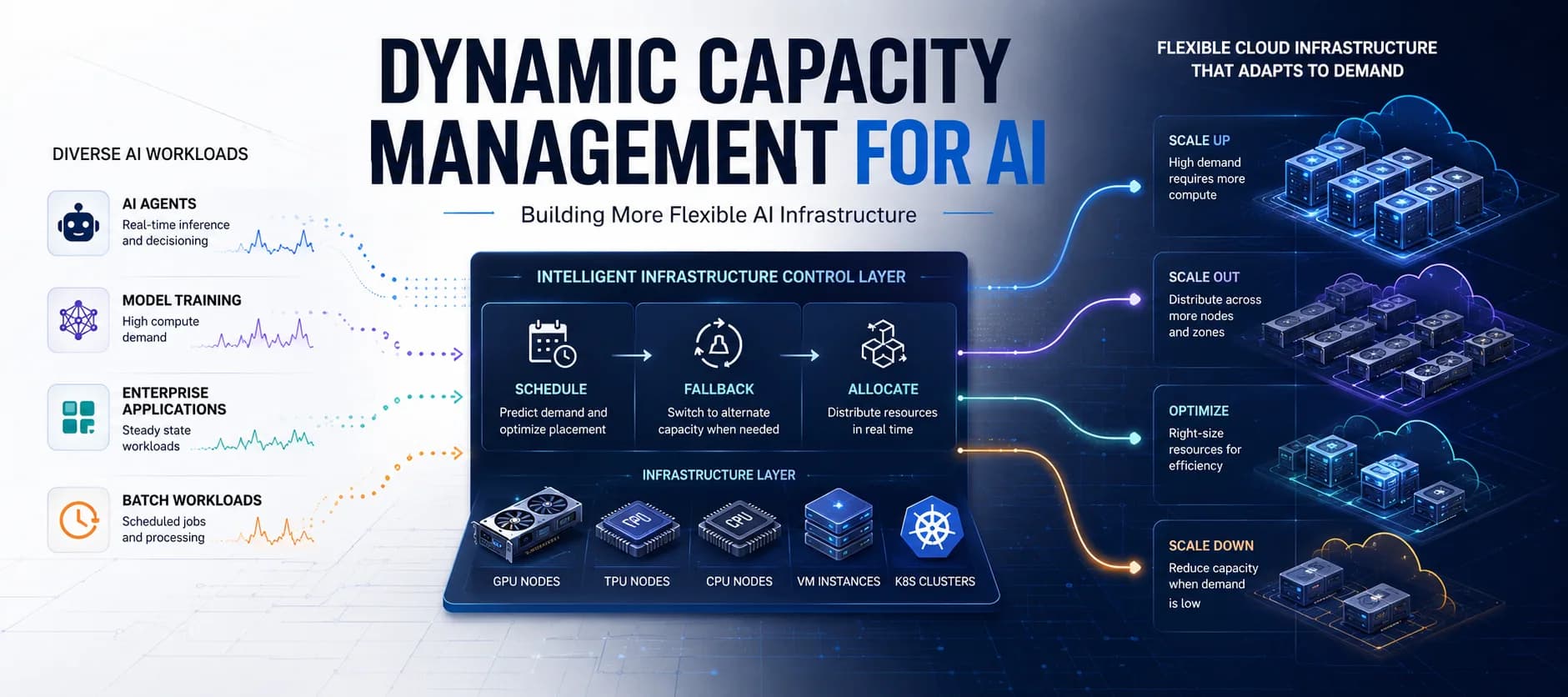
The rapid growth of agentic AI is creating a new infrastructure challenge for enterprises: how to provide enough compute capacity for workloads that can be resource-intensive, bursty and difficult to predict.
In a new Google Cloud blog post, Drew Bradstock, Senior Director of Product for Orchestration & Kubernetes, outlines a strategy for dynamic capacity management that combines scheduled capacity, automated hardware fallback and adaptive resource allocation.
The approach is designed to help organizations run enterprise and AI applications on a flexible infrastructure foundation while managing cost and performance.
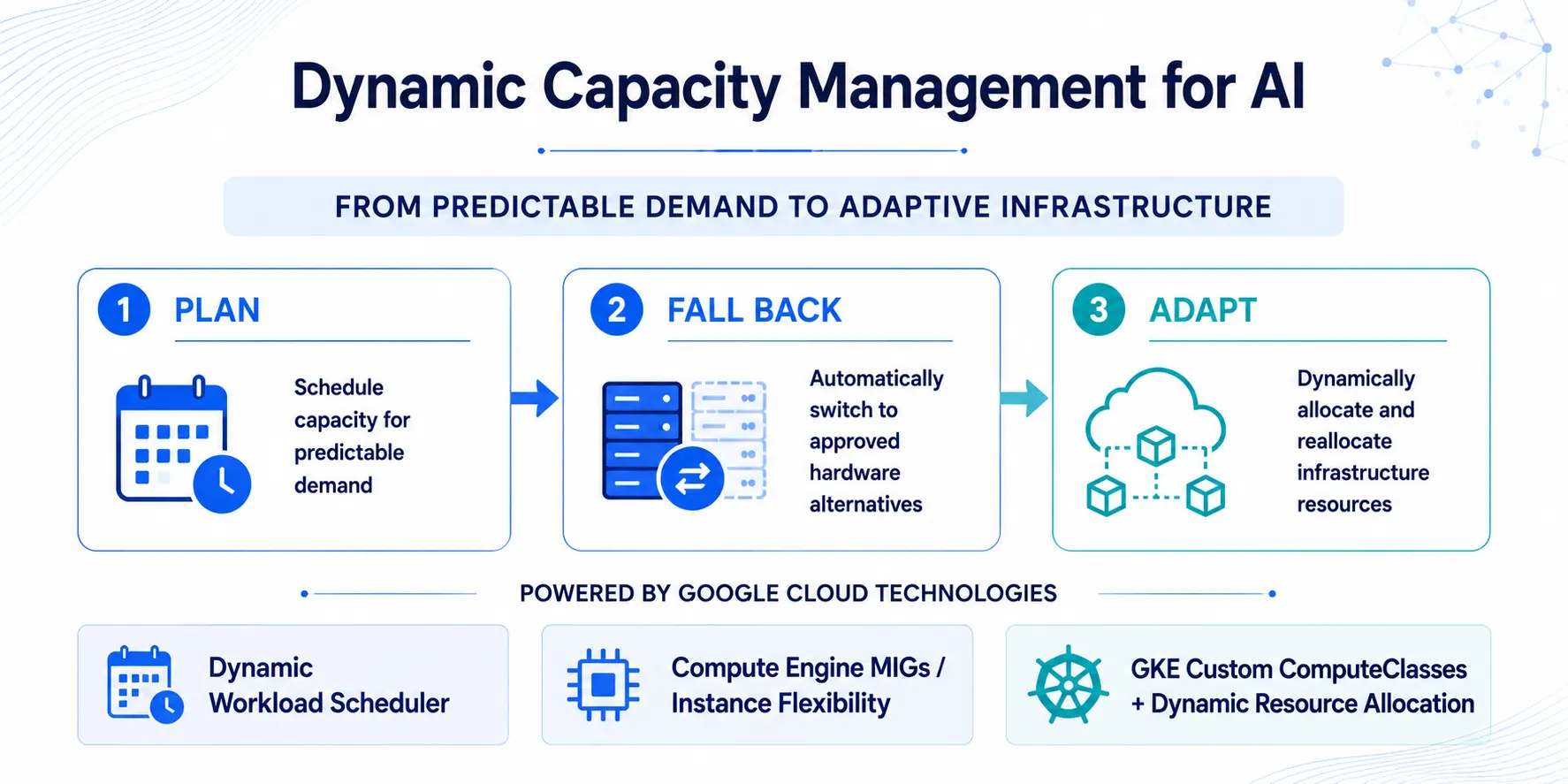
Google Cloud's strategy centers on three approaches:
Schedule capacity for planned events
Create automated fallback plans for unexpected demand
Use GKE as an adaptive control plane for capacity management
The recommendations are particularly relevant as organizations deploy AI agents alongside traditional enterprise applications and increasingly depend on GPUs, TPUs and specialized compute resources.
Why Dynamic Capacity Management Matters for AI
AI workloads can behave differently from conventional enterprise applications.
They can require specialized accelerators, generate sudden bursts of demand and interact with enterprise applications and databases at volumes that may exceed typical human-driven workloads.
Google Cloud says these characteristics can create scaling bottlenecks and pools of compute resources that are underutilized or misutilized.
The infrastructure challenge therefore extends beyond simply acquiring more hardware.
Organizations also need mechanisms that can determine when resources are required, secure capacity ahead of known events and automatically adapt when preferred resources are unavailable.
Google Cloud describes this as a two-part approach:
Predictable demand: Secure resources in advance.
Unpredictable demand: Automate the infrastructure response.
This combination is intended to provide more flexibility than relying on a fixed infrastructure configuration.
Three Ways to Manage Dynamic Capacity
Google Cloud's recommendations can be summarized into three layers.
1. Schedule capacity for planned events
Organizations can use Dynamic Workload Scheduler to schedule mission-critical resources, including GPUs, TPUs and select VM families.
Two scheduling modes are highlighted:
Flex-start mode: Designed for workloads where the exact start time can vary, such as batch processing, model training and offline fine-tuning.
Calendar mode: Designed for time-bound events where capacity needs to be available at a specified future time.
The distinction allows organizations to approach predictable workloads differently depending on whether the workload has a fixed start time.
2. Build automated fallback plans
Capacity is not always predictable.
A preferred VM configuration may be temporarily unavailable when demand increases or capacity constraints occur.
Google Cloud recommends creating prioritized lists of acceptable hardware configurations so workloads can automatically move to alternatives rather than depending on a single machine type.
3. Automate capacity management with GKE
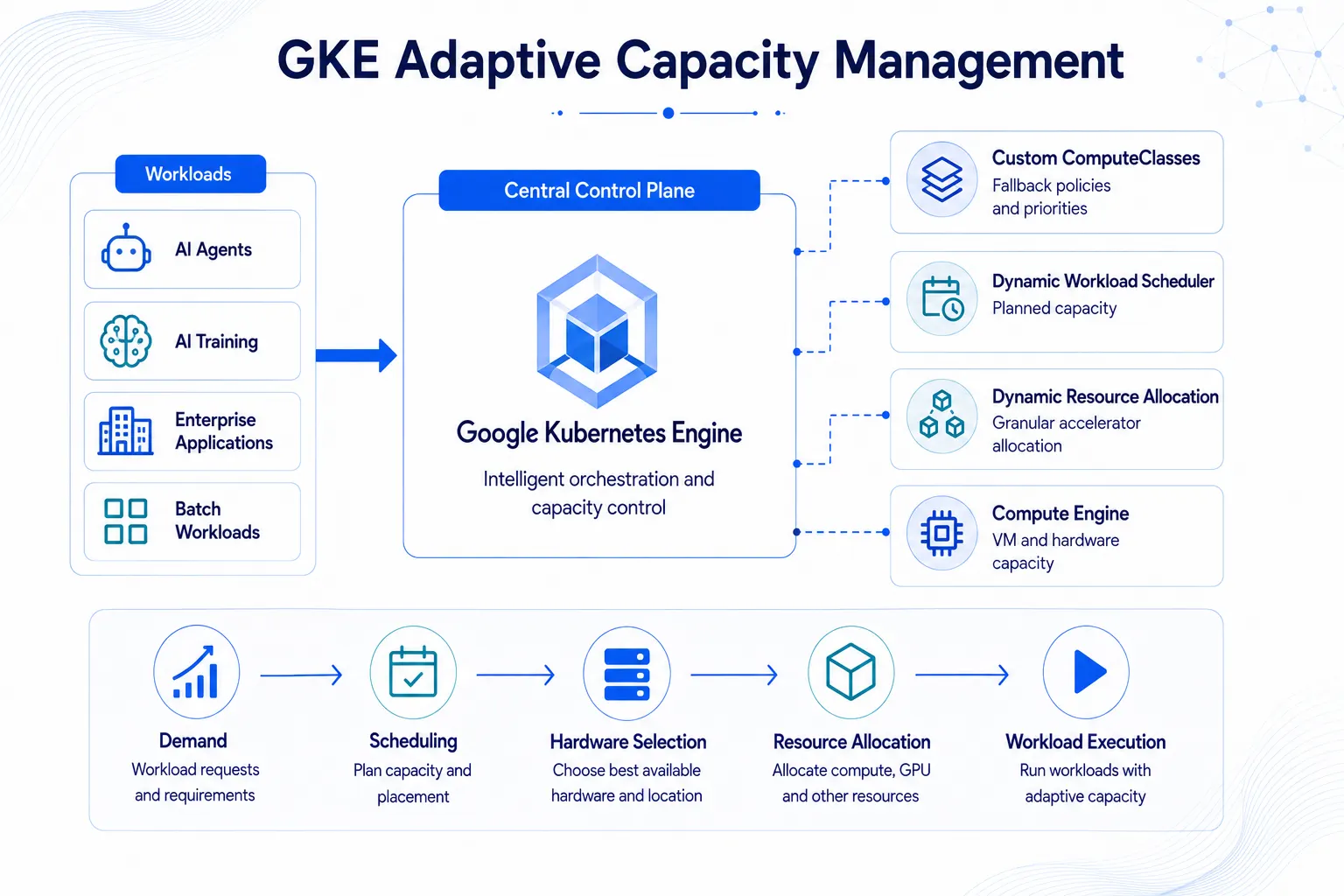
For containerized workloads, Google Cloud positions Google Kubernetes Engine (GKE) as a control plane that can coordinate different parts of the capacity management lifecycle.
The source highlights GKE Custom ComputeClasses for defining fallback policies and dynamic resource allocation for more granular hardware utilization.
Together, these capabilities are presented as mechanisms for adapting infrastructure to changing workload requirements.
Scheduling Capacity Before Demand Arrives
The first part of the strategy focuses on workloads where demand can be predicted.
Google Cloud's Dynamic Workload Scheduler supports GPUs, TPUs and selected CPUs.
Flex-start mode
Flex-start mode is intended for workloads that can tolerate some flexibility around when they begin.
Examples provided by Google Cloud include:
Batch processing
Model training
Offline fine-tuning
Instead of requiring resources immediately, an organization submits a request with a defined duration. The system queues the request and provisions resources when capacity becomes available.
This approach is designed to improve the ability to obtain high-demand accelerators while supporting cost efficiency.
Calendar mode
Calendar mode addresses a different requirement.
For events such as a product launch, scheduled migration or seasonal traffic surge, organizations can specify when resources should be available.
The resulting future reservation is intended to provide the required capacity when the event begins.
The distinction is straightforward:
Flex-start: The workload can wait for capacity.
Calendar: The capacity must be available at a defined time.
Automated Fallbacks for Unpredictable Demand
Scheduling alone cannot address every infrastructure challenge.
A sudden increase in user activity can occur because of an unexpected event, a change in market conditions or another external factor.
Google Cloud therefore recommends creating an automated fallback plan for each application.
The objective is to avoid tightly coupling workloads to a single VM shape, size or configuration.
With multiple approved alternatives, infrastructure can move to another configuration when the preferred option is unavailable.
This also provides a mechanism for technology refreshes.
Organizations can designate newer VM generations as their preferred configuration while retaining older generations as fallback options.
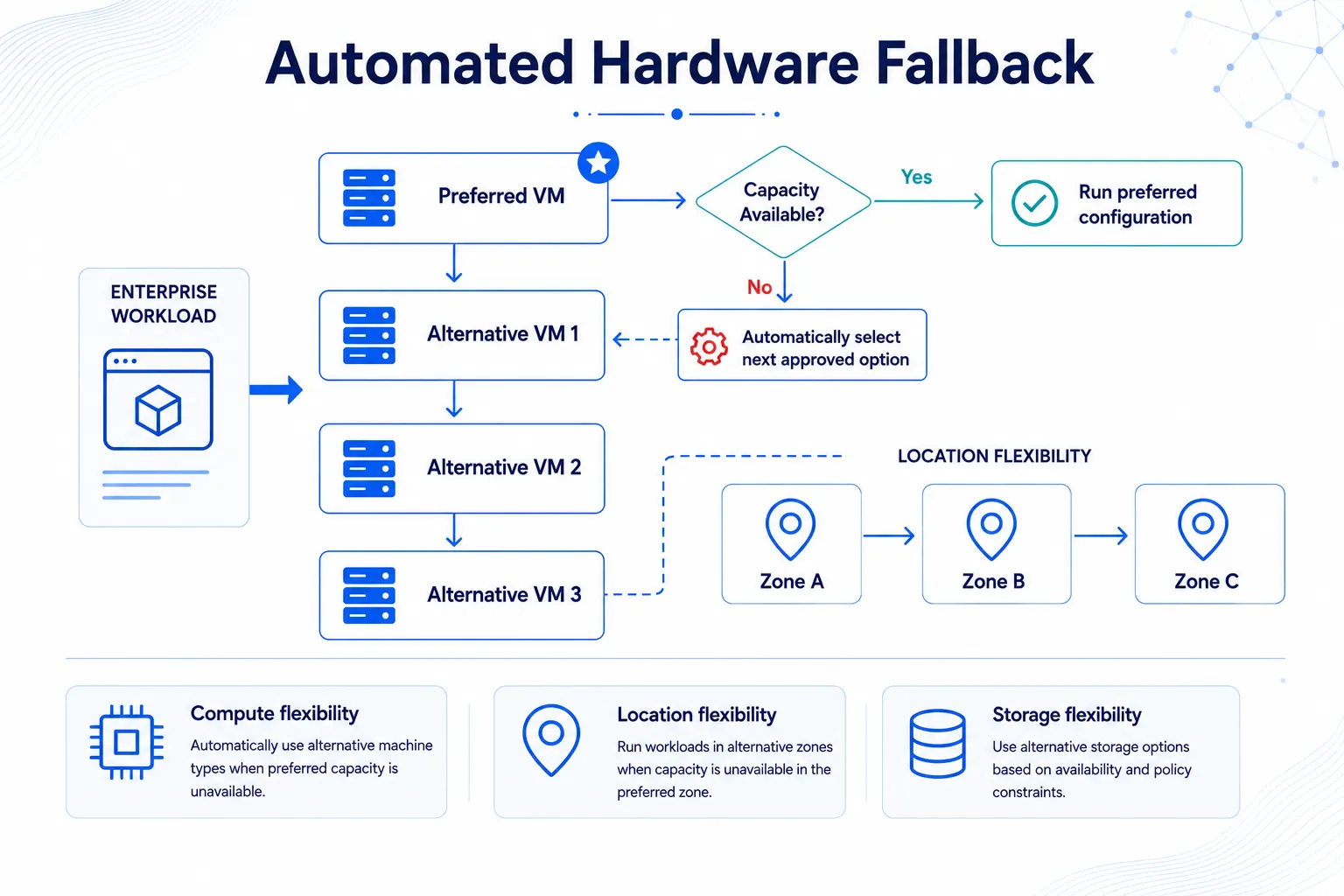
Compute Engine Instance Flexibility
For non-containerized workloads running on Google Compute Engine, Google Cloud highlights instance flexibility in managed instance groups (MIGs) and bulk VM creation.
Instance flexibility allows organizations to specify multiple machine types instead of restricting a workload to a single machine type.
If the preferred machine type is unavailable, a MIG can provision an alternative from the configured list based on available capacity.
Google Cloud also highlights location flexibility, which allows MIGs to search across multiple zones within a region.
For workloads using Spot VMs, the source says Compute Engine can use Spot capacity signals to prioritize machine types based on estimated uptime and pre-emption risk.
The approach is intended to improve provisioning flexibility without requiring teams to manually change infrastructure configurations.
Storage Needs to Adapt Too
Hardware fallback can create another consideration: storage.
Different VM configurations can have different storage requirements.
Google Cloud says organizations can extend instance flexibility to block storage by establishing baseline disk defaults and configuring disk overrides.
For data disks that outlive their associated VMs, the source highlights the use of Hyperdisk across multiple VM generations.
For short-lived boot disks, default options can often be used instead.
The broader principle is that capacity flexibility should not stop at compute.
Storage configuration also needs to account for infrastructure changes when workloads move between machine types.
GKE Takes the Strategy Further
Google Cloud says GKE can automate more of the capacity management lifecycle from a single control plane.
With GKE Custom ComputeClasses, platform teams can define multidimensional fallback policies.
These can combine:
Different VM machine families
Different machine sizes
Different resource ratios
Multiple zones
On-demand VMs
Spot VMs
Dynamic Workload Scheduler can serve as a capacity target while Custom ComputeClasses define the preferred configurations and fallback priorities.
When a preferred node configuration is unavailable, GKE can move through the pre-approved alternatives.
The source also describes active migration, which can move workloads back toward higher-priority node configurations when capacity becomes available again.
This creates a more dynamic relationship between workload requirements and infrastructure availability.
Dynamic Resource Allocation Targets Hardware Waste
Google Cloud also highlights dynamic resource allocation as another mechanism for improving infrastructure utilization.
The concept addresses situations where workloads do not need an entire GPU or TPU.
Instead of assigning all available hardware to a workload, applications can specify resource requirements such as memory or cores.
The infrastructure can then allocate an appropriate portion of the available hardware.
This provides a more granular approach to resource assignment than an all-or-nothing allocation model.
For AI infrastructure, where accelerators can represent significant compute resources, this type of allocation can help organizations use available hardware more efficiently.
Dynamic Infrastructure for Agentic AI
The need for dynamic capacity management becomes more significant as organizations begin deploying autonomous AI agents.
Google Cloud cites research indicating that 90% of enterprises want to deploy agents within the next three years, while only 17% of IT leaders feel confident that their current IT setup can handle the load.
The source uses these figures to illustrate the gap between anticipated agent adoption and infrastructure readiness.
Agentic workloads can require specialized accelerators while also interacting with enterprise systems, applications and databases.
This combination creates an infrastructure challenge that cannot necessarily be addressed through hardware expansion alone.
Organizations also need mechanisms for allocating resources dynamically and responding to changes in workload demand.
AI Infrastructure Requires More Than Specialized Hardware
Google Cloud highlights processors such as its Axion CPUs as one option for addressing different infrastructure requirements.
However, the company argues that hardware alone does not solve the broader capacity management problem.
Infrastructure teams also need to determine how resources are allocated and how workloads respond when preferred capacity is unavailable.
This is where scheduling, fallback policies and dynamic allocation become important components of the overall strategy.
The broader approach is therefore based on infrastructure flexibility rather than dependence on a single hardware configuration.
Three Steps Enterprises Can Take
Google Cloud closes its recommendations with three practical steps.
1. Audit workloads for immediate opportunities
Organizations can identify applications that are tightly coupled to a particular:
VM family
Machine type
Availability zone
Teams can then identify alternative hardware configurations that could support the same workloads.
Google Cloud recommends incorporating those alternatives into fallback lists using Compute Engine MIGs, bulk VM creation or GKE Custom ComputeClasses.
2. Consider committed capacity
Google Cloud also recommends committed use discounts for organizations with sustained infrastructure requirements.
The source says Compute flexible committed use discounts can provide discounts of up to 63%, with the discount tied to resource usage rather than a specific machine type or location.
The appropriate pricing model will depend on an organization's workload and capacity requirements.
3. Develop a capacity management strategy
Google Cloud recommends working with its account team to develop a tailored capacity management strategy and configure automated fallback lists.
The source does not provide a universal configuration that applies to every organization.
What Dynamic Capacity Management Means for Enterprises
Google Cloud's recommendations highlight a broader shift in AI infrastructure design.
Instead of treating infrastructure as a fixed collection of compute resources, organizations can design systems that respond to changing availability and workload requirements.
The strategy can be viewed as three complementary controls:
Predict demand where possible.
Schedule capacity for known events and workloads.
Prepare for uncertainty.
Create prioritized hardware alternatives when preferred capacity is unavailable.
Allocate resources more precisely.
Use infrastructure controls that can match resource allocation to actual workload requirements.
For enterprises running both AI and conventional applications, this approach could provide a way to share infrastructure while maintaining different capacity strategies for different workloads.
This is an interpretation of the source rather than a claim that every organization should adopt the same architecture.
The Bigger Infrastructure Challenge
The growth of agentic AI introduces a difficult infrastructure equation.
Organizations want to increase AI adoption without simply increasing infrastructure costs at the same rate.
At the same time, AI workloads can have unusual resource requirements and unpredictable demand patterns.
Google Cloud's dynamic capacity management strategy addresses this challenge through flexibility.
Rather than relying exclusively on more hardware, organizations can combine:
Planned capacity
Hardware fallback
Location flexibility
Adaptive scheduling
Granular resource allocation
The goal is to make infrastructure more responsive to workload requirements.
As AI workloads become more deeply integrated into enterprise systems, the ability to manage capacity dynamically may become an increasingly important part of infrastructure planning.
Key Takeaways
Area | Google Cloud's Approach |
|---|---|
Planned demand | Dynamic Workload Scheduler |
Flexible scheduling | Flex-start mode |
Time-bound events | Calendar mode |
Hardware availability | Instance flexibility |
Multi-zone resilience | Location flexibility |
Containerized workloads | GKE Custom ComputeClasses |
Granular accelerator usage | Dynamic resource allocation |
Storage flexibility | Disk defaults, overrides and Hyperdisk |
AI infrastructure | Dynamic capacity management |
Cost management | On-demand, Spot and committed use models |
Conclusion
Google Cloud's latest guidance presents dynamic capacity management as an important infrastructure strategy for the agentic AI era.
The approach combines scheduled capacity, automated hardware fallback and adaptive resource allocation rather than relying on a single infrastructure configuration.
Dynamic Workload Scheduler addresses predictable demand, while Compute Engine instance flexibility and GKE Custom ComputeClasses can help workloads respond when preferred capacity is unavailable.
Dynamic resource allocation adds another layer by allowing applications to request more granular portions of available accelerator resources.
The larger message is straightforward: scaling AI infrastructure is not only about adding compute.
It is also about how intelligently that compute is scheduled, selected, allocated and reused.
As enterprises deploy more AI agents and increasingly demanding workloads, flexible capacity management could become an important part of keeping infrastructure responsive while managing utilization and cost.
Source: Google Cloud Blog
About the Author