
Google Cloud Introduces TabFM for Predictive ML in BigQuery
Google Cloud introduces TabFM in BigQuery, a pre-trained foundation model for tabular regression and classification that uses in-context learning to generate predictions through SQL without a separate training and deployment workflow.
Xcademia Team
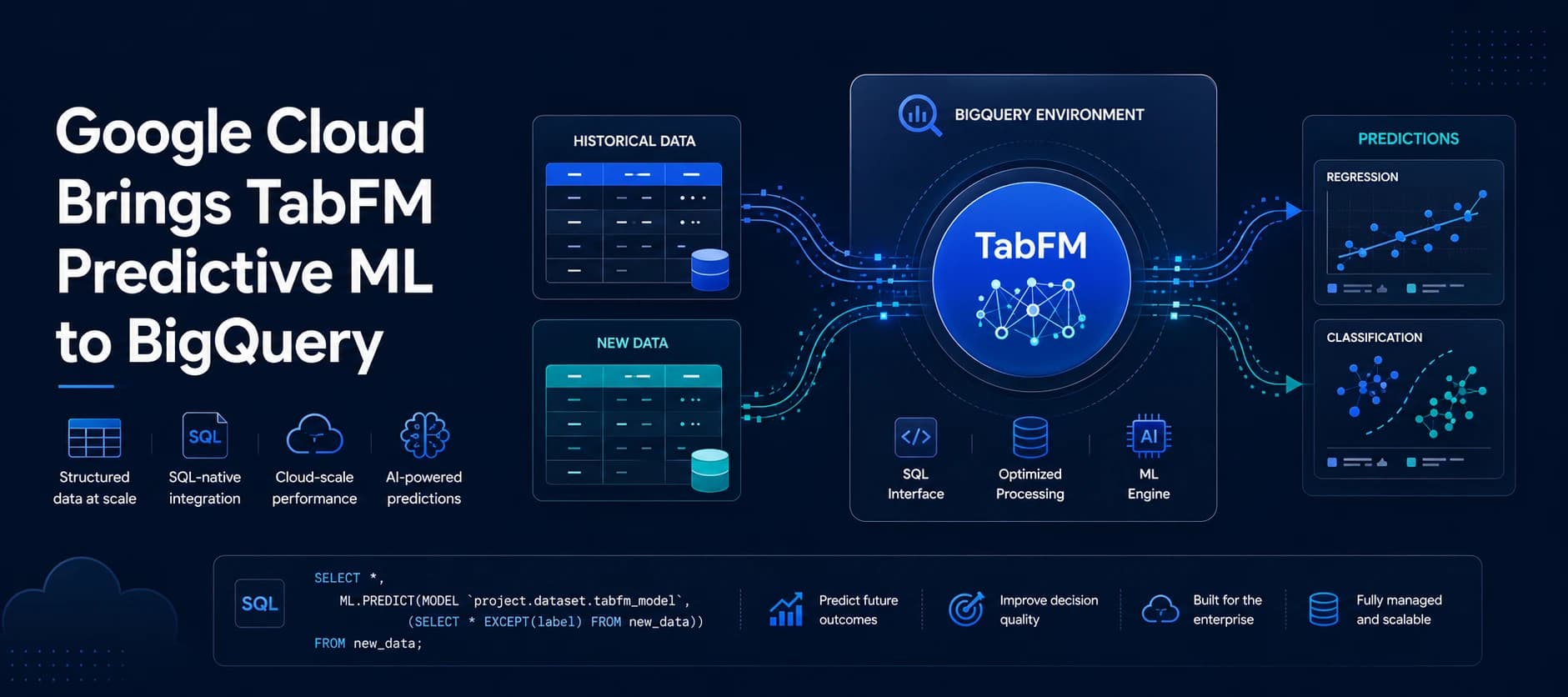
Google Cloud is bringing a new approach to predictive machine learning into BigQuery with TabFM, a pre-trained foundation model designed for regression and classification on tabular data.
Developed by Google Research, TabFM uses in-context learning (ICL) to generate predictions from labeled historical data and new data without requiring the conventional model training workflow.
The capability is currently available in preview.
Rather than building a separate machine learning pipeline for every predictive task, users can provide historical examples and prediction data through SQL functions in BigQuery. The approach is designed to make predictive analytics more accessible to developers, data scientists and analysts working directly with enterprise data.
Why Predictive Analytics Has Traditionally Required More Work
Predictive analytics is widely used for tasks such as customer churn prediction, purchase-intent modeling and fraud scoring.
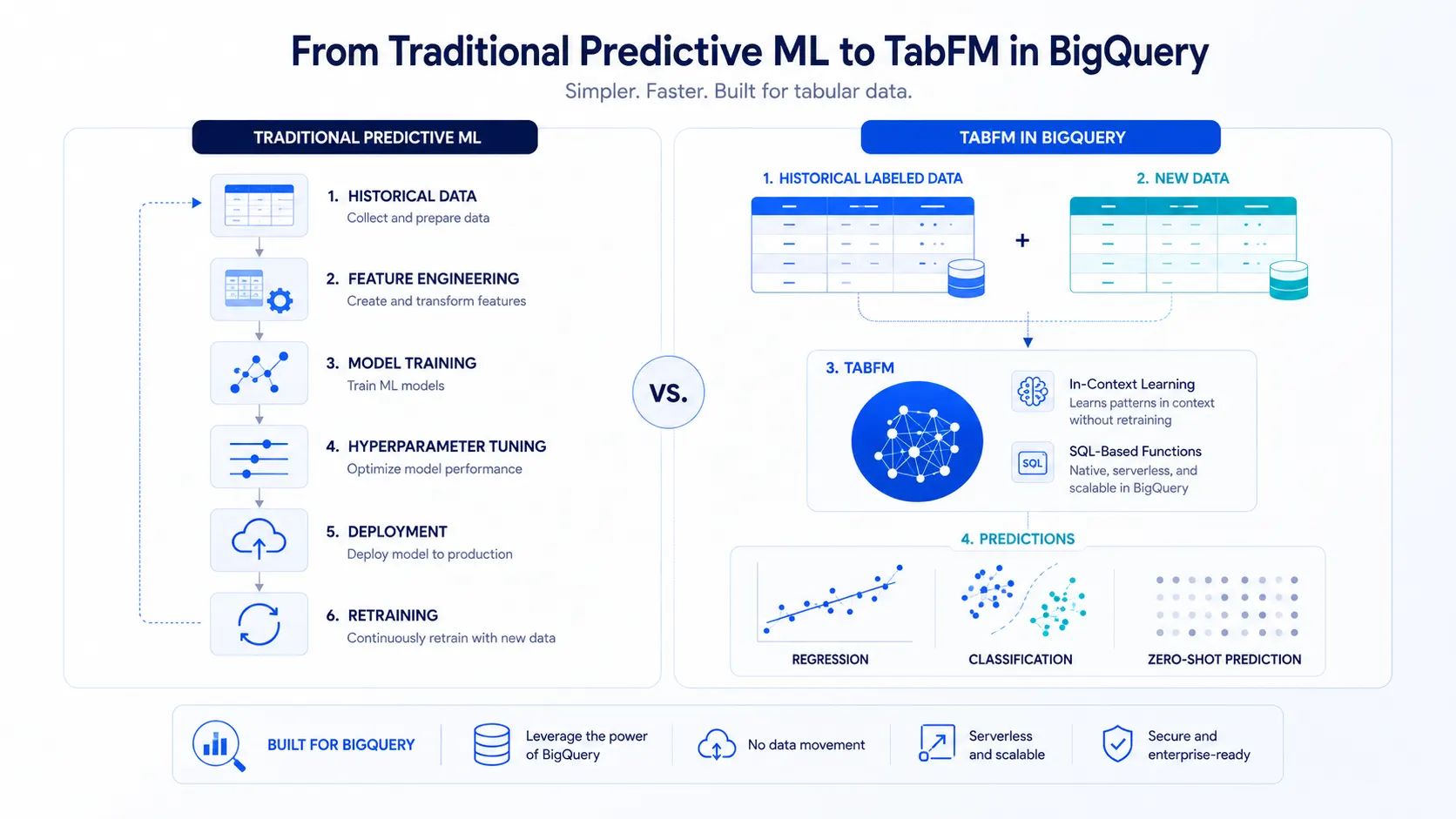
Traditional approaches often involve models such as XGBoost, Random Forest and deep neural networks. Building these systems typically requires several stages, including feature engineering, model training, hyperparameter tuning, deployment and retraining as data changes.
For organizations, this can introduce operational complexity and require specialized machine learning expertise.
The Google Cloud announcement positions TabFM as an alternative for certain tabular prediction workloads by moving more of the workflow directly into BigQuery.
What Is TabFM?
TabFM is a pre-trained foundation model for tabular data developed by Google Research.
It supports both:
Classification, where the goal is to predict categories or labels
Regression, where the goal is to predict numerical values
Instead of training a new model for each dataset, TabFM uses in-context learning. Historical labeled records act as examples that help the model understand the prediction task.
Google Cloud says this allows users to generate predictions using a single SQL statement.
For the workflow described in the announcement, this removes the need for separate model training and deployment steps.
What TabFM Brings to BigQuery
Google Cloud highlights several capabilities.
1. Zero-Shot Predictions
TabFM can generate predictions without users first training and tuning a separate model.
Users provide:
Labeled historical data
New data requiring predictions
The target label column
These inputs are passed to the AI.PREDICT SQL function.
This approach is designed to reduce the amount of manual machine learning infrastructure required for predictive workloads.
2. Predictive ML for Agentic Applications
Google Cloud also highlights TabFM for agentic applications.
TabFM can be combined with the BigQuery MCP server, allowing predictive machine learning capabilities to be incorporated into agentic workflows.
The source describes this approach as requiring no separate runtime or infrastructure to manage. Data is supplied to BigQuery and predictions are returned through the platform.
3. State-of-the-Art Accuracy
Google Cloud says TabFM delivers state-of-the-art accuracy and can outperform custom-trained, out-of-the-box traditional machine learning models on complex datasets.
The company also reports superior accuracy on industry benchmarks.
These are claims from Google Cloud, and the announcement does not independently establish the results beyond the evaluations it describes.
4. A Simple SQL-Based Experience
TabFM runs natively inside BigQuery.
The announcement says it can automatically handle data preparation tasks such as:
Missing-value handling
Categorical encoding
This reduces the need to construct separate feature-engineering pipelines for the described workflows.
5. Scalable Inference
Google Cloud says TabFM can process inference tables containing up to millions of rows in minutes through BigQuery's distributed inference architecture.
The company says this architecture parallelizes inference across BigQuery infrastructure.
Additional details were not disclosed in the announcement.
TabFM Uses In-Context Learning Instead of Traditional Training
The key technical difference in the approach is in-context learning.
Traditional machine learning generally fits model parameters using a training dataset. The trained model is then used to make predictions on new data.
TabFM takes a different approach.
Google describes its method as similar to how large language models can learn a task from examples provided in a prompt.
In this case, the historical table acts as a collection of examples.
TabFM reads the historical training table as in-context examples and uses those examples to generate predictions for the target table.
The result is a predictive workflow that does not require users to first create a separately trained model for the described use case.
Getting Started With TabFM in BigQuery
Google Cloud introduces two built-in SQL functions for working with TabFM:
AI.PREDICTAI.EVALUATE
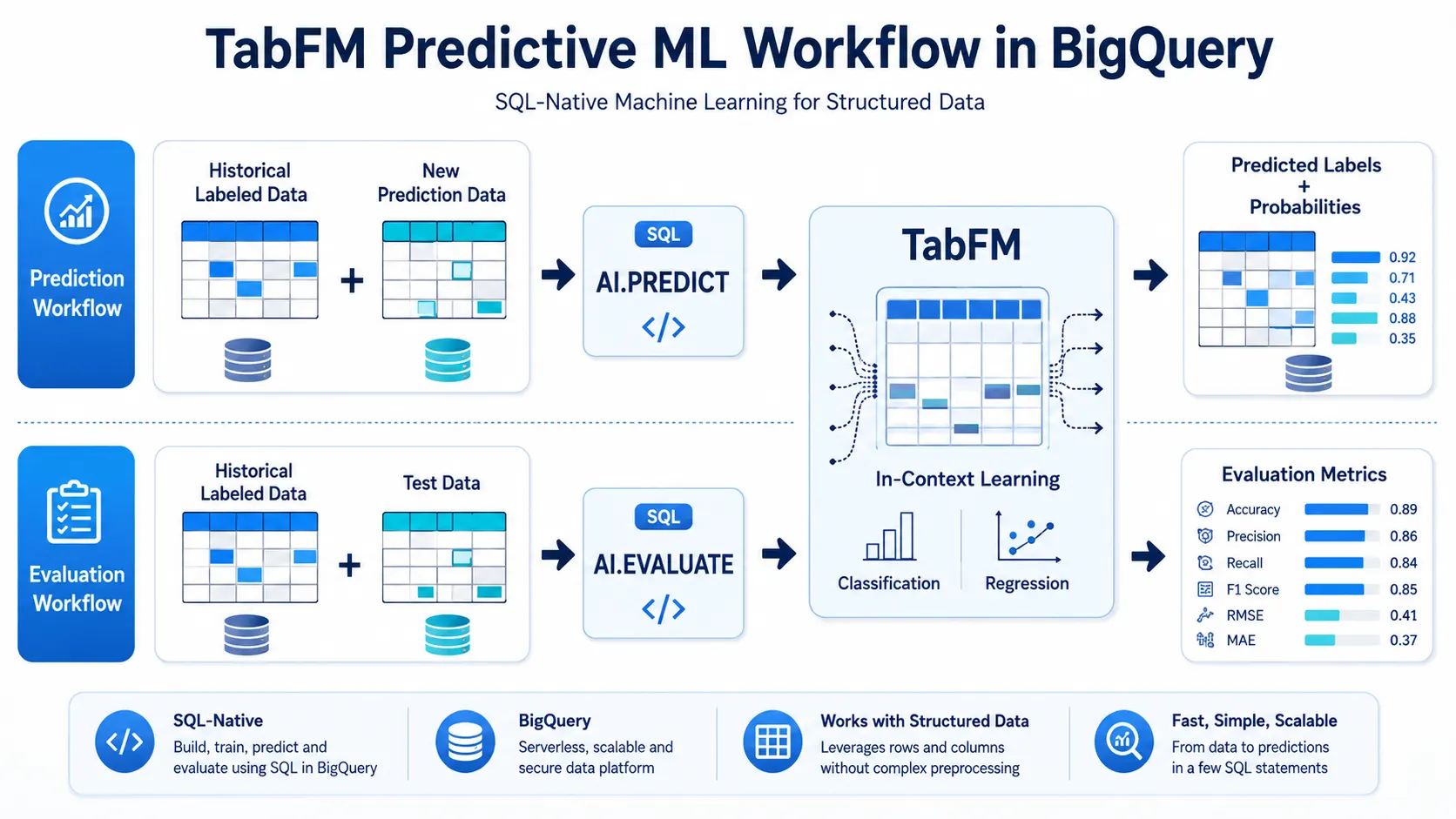
AI.PREDICT generates predictions, while AI.EVALUATE provides evaluation metrics for predictive results.
1) Using AI.PREDICT
Google Cloud provides the following example for classifying transactions as fraudulent or legitimate:
-- Classifying transactions as fraudulent or not

SELECT *
FROM AI.PREDICT(
  TABLE `my_project.my_dataset.historical_transactions`, -- Training data (in-context examples)
  TABLE `my_project.my_dataset.new_transactions`, -- Prediction data
  label_col => 'is_fraud' -- Target column to predict
);
The historical transaction table provides labeled examples, while the new transaction table contains the records requiring predictions.
The output includes the original columns from the prediction table along with predicted label and probability columns, such as predicted_is_fraud.
The example does not require users to manually create a model or build a separate feature-engineering pipeline.
2)Evaluating Predictions With AI.EVALUATE
BigQuery also provides AI.EVALUATE for evaluating predictive performance.
Google Cloud demonstrates the function using customer lifetime value regression:
-- Regression Evaluation for Customer Lifetime Value (LTV)

SELECT *
FROM AI.EVALUATE(
  TABLE `my_project.my_dataset.historical_customer_ltv`,
  TABLE `my_project.my_dataset.test_customer_ltv`,
  label_col => 'ltv'
);
For regression tasks, the function can return metrics such as:
r2_scoremean_absolute_error
For classification tasks, evaluation can include:
Precision
Recall
F1
This gives users a way to evaluate predictions within the same BigQuery environment.
The TabFM SQL Workflow
The workflow can be summarized as:
Historical labeled data
↓
New prediction data
↓
AI.PREDICT
↓
TabFM in BigQuery
↓
Predictions + probability values
For evaluation:
Historical labeled data
↓
Test data
↓
AI.EVALUATE
↓
Model evaluation metrics
This keeps both prediction and evaluation close to the underlying data.
TabFM Under the Hood
The technical architecture behind TabFM differs from a conventional model-training workflow.
Traditional machine learning typically uses training data to fit model parameters. Once trained, the model can be deployed for inference.
TabFM instead uses the training table as in-context examples.
The model processes those examples and generates predictions for the target table in a single forward pass, according to Google Cloud's explanation.
BigQuery then performs distributed and parallelized inference to handle the computational requirements and memory footprint associated with the workload.
The announcement also describes the use of intelligent training-data sampling and distributed execution to improve resource utilization.
Google Cloud says this architecture allows TabFM to work with large input training tables while supporting fast inference across millions of rows.
TabArena Evaluations and Model Performance
Google Cloud also highlights TabArena, a benchmark used to evaluate tabular machine learning models.
According to the announcement, TabFM consistently outperforms classic machine learning models and other tabular foundation models across the benchmark.
The source includes ELO ratings for the top 10 models across TabArena classification and regression evaluations.
The benchmark visualization distinguishes between default configurations and tuned plus ensemble configurations.
Higher ELO ratings represent stronger performance in the benchmark.
These results are presented by Google Cloud as evidence supporting its claim that TabFM provides industry-leading accuracy across a broad range of tabular datasets.
Choosing TabFM or Traditional Machine Learning
TabFM is not presented as a replacement for every traditional machine learning workflow.
Google Cloud identifies several situations where conventional approaches can remain appropriate.
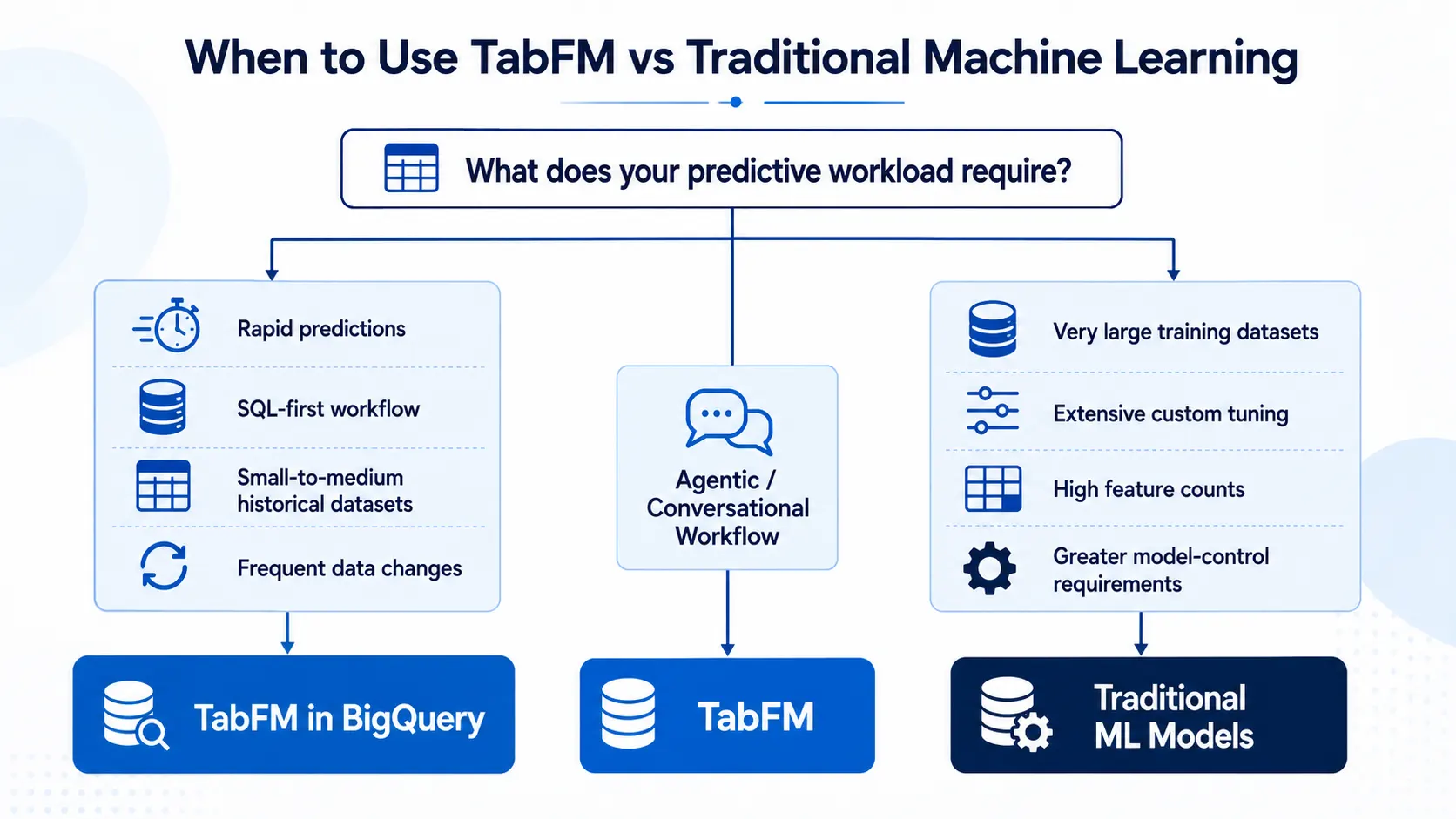
TabFM May Be Suitable When:
Rapid predictive insights are required
Users want to avoid a separate model-training workflow
Historical datasets are small to medium in size
Data changes frequently
Frequent retraining would otherwise be required
Predictive capabilities need to be incorporated into conversational or agentic workflows
Teams want to work directly through SQL in BigQuery
Traditional Models May Be Preferable When:
Historical datasets are very large
Teams require extensive custom hyperparameter tuning
Datasets contain a high number of features beyond current TabFM limits
Detailed feature-importance explainability is required
Teams need more direct control over the model-building process
The right approach therefore depends on the characteristics of the workload and the level of control required.
TabFM vs Traditional ML
Area | TabFM in BigQuery | Traditional ML |
|---|---|---|
Model training | Uses in-context learning | Typically requires model training |
Workflow | SQL-based | Often requires multiple ML pipeline stages |
Feature preparation | Handles certain tasks automatically | Often requires explicit feature engineering |
Deployment | No separate deployment step for the described workflow | Commonly requires model deployment |
Custom tuning | More limited | Greater control |
Explainability | Not positioned as the primary strength | Can support feature-importance workflows |
Data scale | Suited to the use cases described by Google Cloud | Can support very large training datasets depending on the model |
Agentic workflows | Designed to integrate with BigQuery-based agentic workflows | Usually requires additional integration |
Predictive ML for Agentic Applications
One of the broader use cases highlighted by Google Cloud is the combination of predictive machine learning and agentic applications.
TabFM can be combined with the BigQuery MCP server to bring predictive capabilities into agentic workflows.
The source emphasizes that users do not need to manage separate runtimes or infrastructure for this workflow.
Instead, the agent can work with data in BigQuery and invoke predictive functionality through the platform.
This creates a connection between structured enterprise data, SQL-based analytics and machine learning predictions.
The announcement does not provide specific customer examples or production deployment metrics for these agentic workflows.
Availability
TabFM in BigQuery is currently available in preview.
The announcement introduces the capability through the new AI.PREDICT and AI.EVALUATE SQL functions.
The source does not provide additional availability details beyond the preview status.
Conclusion
Google Cloud's introduction of TabFM adds a new approach to predictive machine learning in BigQuery.
The pre-trained tabular foundation model uses in-context learning instead of the conventional model-training workflow described in the announcement. Through AI.PREDICT and AI.EVALUATE, users can perform prediction and evaluation directly through SQL.
Google Cloud also highlights TabFM's benchmark performance, automatic handling of certain data preparation tasks, distributed inference architecture and potential use in agentic applications.
The approach does not replace traditional machine learning across all workloads. Teams requiring extensive tuning, very large training datasets, higher feature counts or specific explainability capabilities may still prefer conventional models.
The broader development reflects growing demand for simpler ways to connect enterprise data with machine learning and AI capabilities.
For organizations already working in BigQuery, TabFM provides another path from structured data to predictive results without requiring a separate model-training workflow for the use cases described by Google Cloud.
Source: Google Cloud Blog
About the Author