
Google Cloud Introduces IAM Helper to Secure AI Agent Access
Google Cloud introduces IAM Helper Agent Skills and MCP tools to streamline identity management, troubleshoot permissions, simulate policy changes and support human-approved access controls for AI-driven workflows.
Xcademia Team
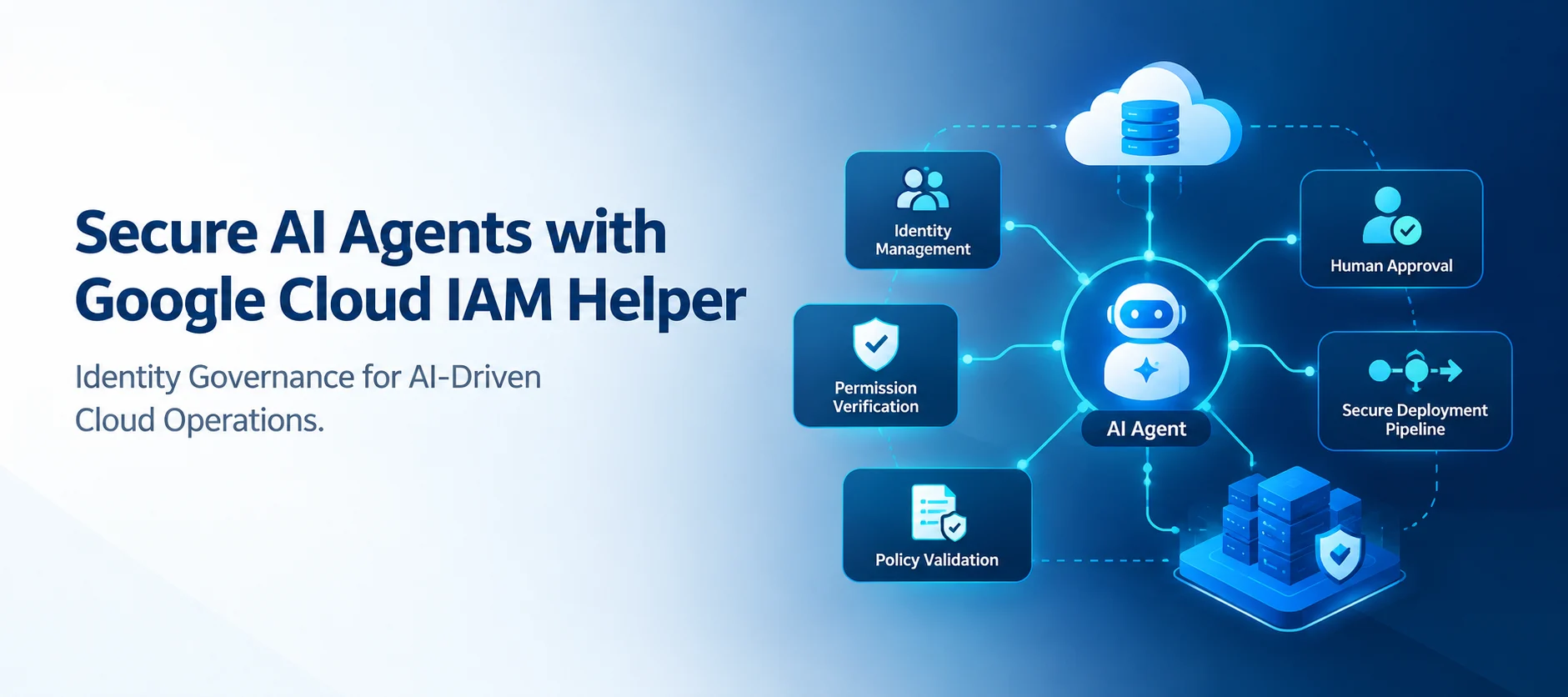
As organisations deploy AI agents to write infrastructure code, provision cloud resources and manage software deployments, controlling what those agents can access is becoming a critical security challenge.
Google Cloud has introduced IAM Helper, a collection of agent-facing skills and Model Context Protocol (MCP) tools designed to simplify Identity and Access Management (IAM) workflows. The announcement focuses on helping AI agents diagnose permission problems, prepare least-privilege policies and coordinate access changes while retaining human approval for policy modifications.
The announcement addresses a growing operational tension: development teams want AI agents to resolve infrastructure problems quickly, but granting agents excessive permissions can expose cloud environments to unnecessary risk.
Google's approach connects existing IAM capabilities to AI agents through structured workflows and tools, with policy evaluation handled by Google Cloud services rather than relying entirely on an AI model to interpret complex permission configurations.
What is Google Cloud IAM Helper?
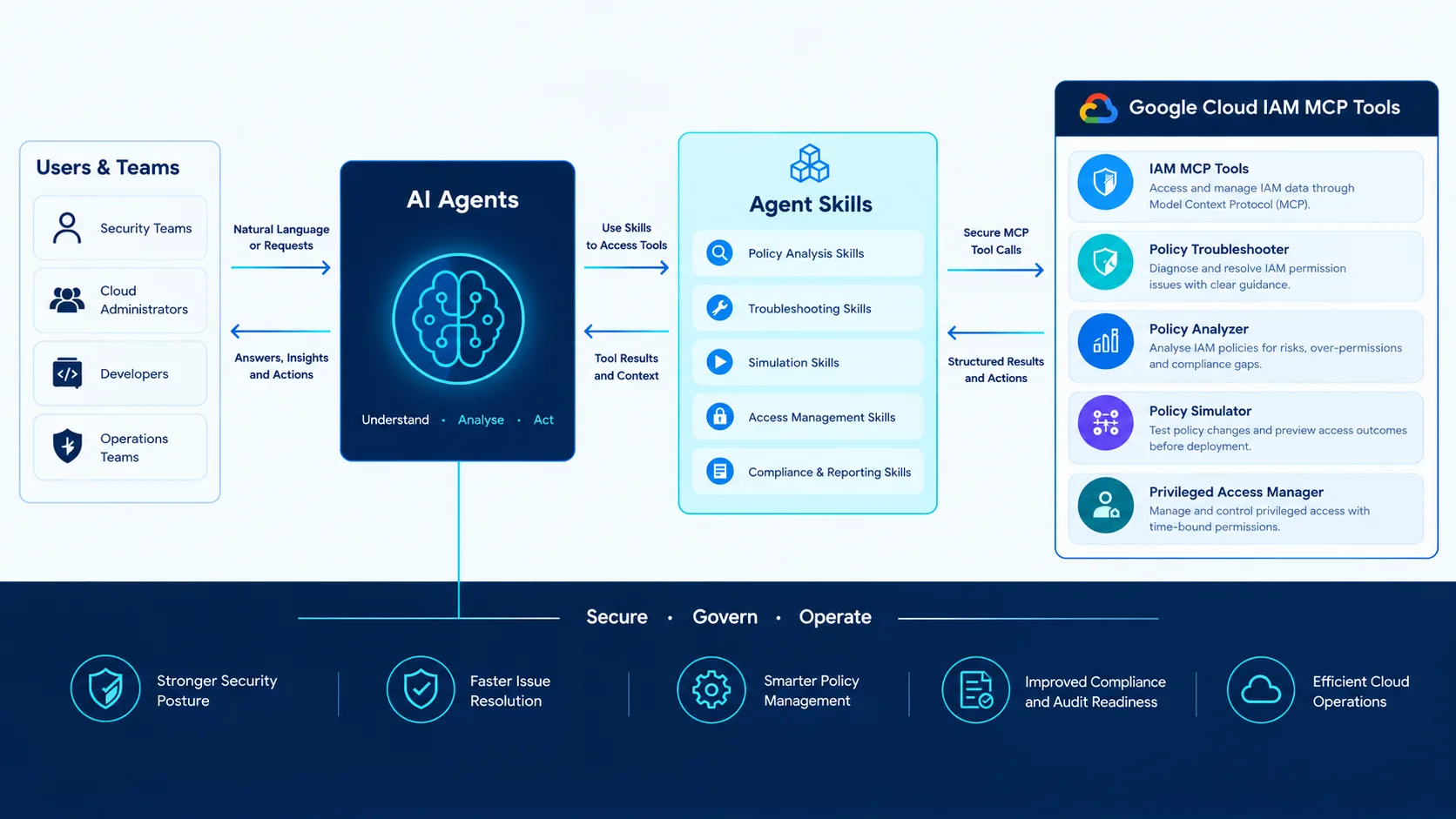
IAM Helper is an agent-oriented orchestration and interface layer for Google Cloud IAM. It builds on existing services, including Policy Intelligence and Privileged Access Manager (PAM), to make identity and access management operations available to compatible AI agents, deployment pipelines and custom automation systems.
The announcement describes two complementary components:
IAM Helper Agent Skills: Higher-level workflows that guide agents through multi-step identity and access management tasks.
Google Cloud IAM MCP tools: Read-only functions that connect agents to Google-managed MCP servers and underlying IAM services.
The skills follow the open Agent Skills standard and are designed to work with Gemini CLI, Gemini Cloud Assist, the Agent Development Kit (ADK), Claude Code and Cursor, according to Google.
Rather than requiring developers to build separate integrations for every IAM task, the approach provides reusable workflows and standardised access to relevant Google Cloud functions.
How IAM Helper Agent Skills work
Google describes four principal workflows that address common challenges in cloud identity management.
1. Generate and validate least-privilege policies
Least privilege means granting an identity only the permissions required to perform its assigned tasks.
Developers often express infrastructure requirements through JSON, YAML or Terraform configuration. Translating those requirements into secure IAM policies can be complicated, particularly when applications span multiple services and projects.
Google's iam-helper-for-policy-management skill generates and validates IAM v1 allow bindings and IAM v2 deny rules. According to the announcement, it identifies and blocks risky configurations before application, including public access through allUsers and broad basic roles such as roles/owner and roles/editor.
The objective is to help teams address permission requirements without defaulting to unnecessarily broad access.
2. Diagnose and resolve permission errors
A deployment can fail when an identity lacks a required permission or encounters a restrictive policy. These failures can interrupt development and require administrators to investigate inherited permissions across an organisation's cloud hierarchy.
The iam-helper-for-troubleshooting skill helps identify missing permissions or blocking rules behind 403 PERMISSION_DENIED errors.
Google describes two workflows:
Requester flow: Developers investigate whether they can resolve the issue themselves or prepare a structured request for an administrator.
Resolver flow: Security administrators trace inherited allow and deny policies across organisation, folder and project levels.
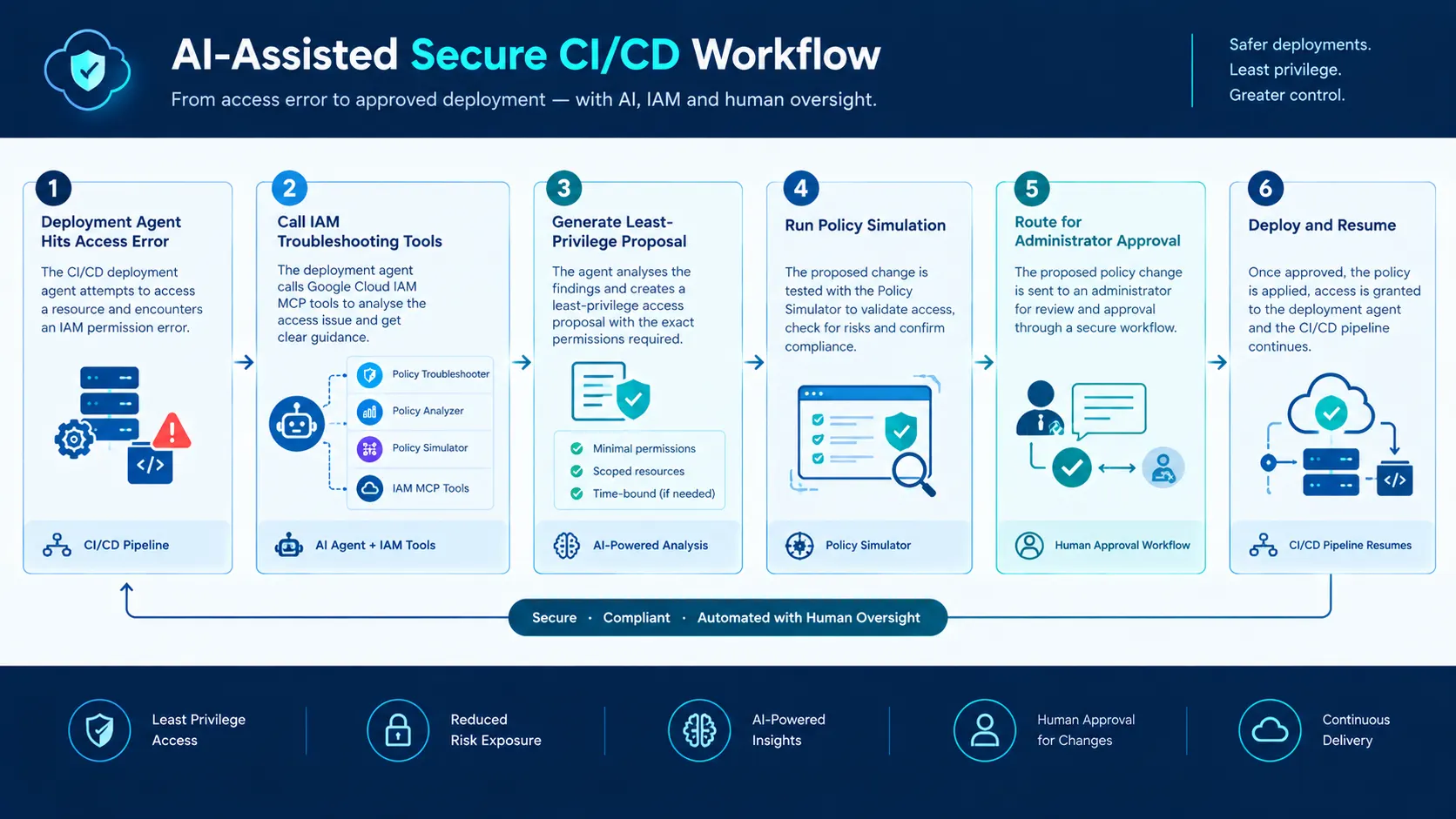
In the example provided by Google, a coding agent encounters a missing Pub/Sub permission during deployment. IAM Helper identifies the issue and can request temporary access through Privileged Access Manager instead of requiring the developer to navigate the entire troubleshooting process manually.
3. Simulate policy changes before applying them
A policy that removes unnecessary permissions can still disrupt production if a running service depends on one of those permissions.
Google's iam-helper-for-policy-simulator skill supports a structured workflow to plan, simulate, analyse and apply proposed changes. The announcement says it can test policy changes against 90 days of historical access logs to help determine whether existing traffic would be disrupted.
This gives administrators an opportunity to investigate potential operational effects before approving a change.
Historical simulation is a risk-reduction measure, not a guarantee that every future workload or access pattern will remain unaffected. That distinction is important when applying policy changes to production systems.
4. Grant temporary elevated access
Some maintenance tasks and incident investigations require privileges that an agent or engineer does not ordinarily possess.
Google's iam-helper-for-privileged-access-management skill uses Privileged Access Manager to coordinate just-in-time (JIT) access. The described workflows support requesters, administrators and approvers, with elevated permissions time-bound, audited and automatically revoked when the task is complete.
This model differs from permanent privilege assignment. Instead of retaining elevated access indefinitely, an eligible identity can request the permissions needed for a specific task.
Human approval remains a central safeguard
One of the announcement's most significant design choices is the separation between read-only investigation and changes to access policies.
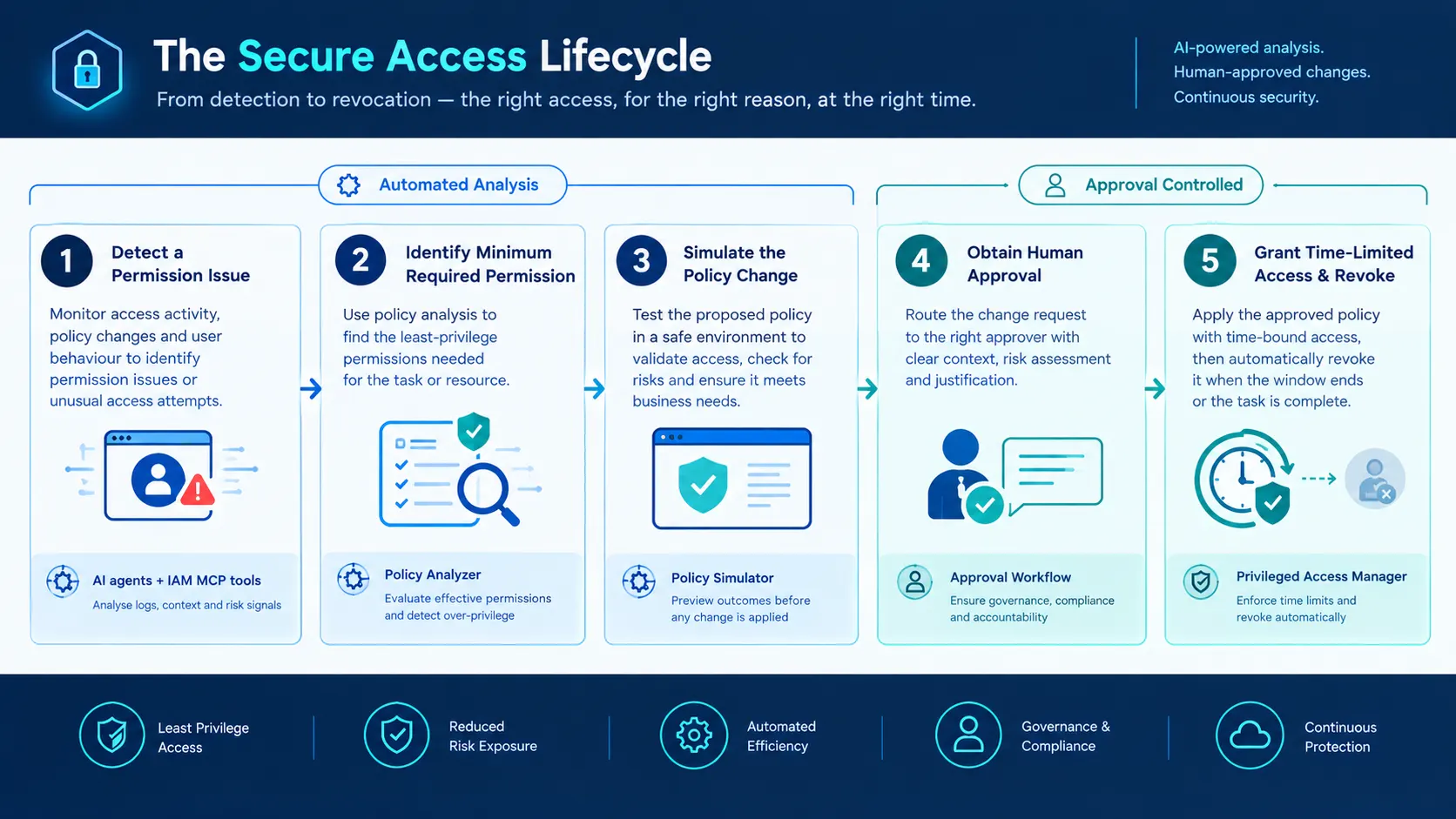
Google says IAM Helper skills can run diagnostics and simulations automatically, but policy changes pause for human-in-the-loop confirmation according to configurable risk tiers.
This separation matters because AI-generated recommendations and changes can be incorrect, incomplete or inappropriate for a particular environment.
Under the described model, an agent can investigate a permission failure and prepare a proposed solution without automatically receiving unrestricted authority to modify access policies.
For enterprise security teams, this provides a clearer distinction between three activities:
Investigation: Collecting permission information and diagnosing policy issues.
Recommendation: Preparing a proposed policy or access request.
Authorisation: Obtaining the required human approval before a policy change proceeds.
The announcement does not disclose a single universal approval threshold. Instead, it describes configurable risk tiers, allowing the approval process to reflect an organisation's governance requirements.
What role do MCP tools play?
The Model Context Protocol provides a standardised way for AI applications to interact with external tools and services.
In IAM Helper, the skills supply the workflow logic, while the MCP tools provide the underlying connection to Google Cloud IAM functions.
Google says its IAM MCP tools expose atomic, read-only functions through Google-managed MCP servers covering:
Policy Troubleshooter
Policy Analyzer
Policy Simulator
IAM v1 and v2 APIs
These tools let compatible agents query cloud services for permission checks, role information and policy-related answers without requiring developers to build custom API wrappers for each operation.
Google also explains that operations such as policy evaluation, group expansion and hierarchy traversal are handled by dedicated IAM endpoints. This reduces the need to place large policy documents into an AI model's context merely to answer an access-related question.
Teams can also use the underlying MCP tools directly when developing custom Agent Skills, including workflows that connect IAM functions with internal ticketing systems, compliance checks and deployment pipelines.
The distinction is important: the MCP tools provide a reusable interface to cloud capabilities, while the skills coordinate those capabilities into a more complete operational process.
Implications for DevOps and cloud security teams
IAM Helper is relevant to teams that use AI agents in infrastructure automation, cloud administration and continuous integration and continuous delivery (CI/CD).
Its documented workflows point to several practical implications.
Fewer manual permission investigations. Agents can help diagnose access failures and prepare structured remediation requests, reducing the amount of manual investigation required for routine issues.
More consistent policy reviews. Reusable workflows can help teams identify risky role assignments and evaluate proposed changes before applying them.
A clearer separation of duties. Automated investigation can be separated from approval-controlled policy modification, supporting existing administrative review processes.
More controlled temporary access. Just-in-time access workflows can reduce reliance on persistent elevated privileges for maintenance and incident response.
These are intended operational benefits described by Google's approach, not independently verified performance results. The company has not disclosed a quantified reduction in deployment failures, administrative workload or security incidents in the announcement.
Security considerations organisations should evaluate
IAM Helper introduces reusable workflows for managing access, but adopting agent-based administration still requires careful governance.
Organisations should assess how agent identities are provisioned, which resources they can access, who can approve policy changes and how actions are audited. They should also validate the proposed policies and ensure that simulations reflect the workloads and permissions relevant to their environments.
Google's separate MCP authentication documentation recommends using a dedicated agent or workload identity for production rather than automatically reusing an employee's identity. It also recommends granting only the minimum IAM roles needed for the task.
These recommendations reinforce a broader security principle: an agent should not inherit more authority than its operational purpose requires.
The organisation remains responsible for determining acceptable risk, setting approval policies and monitoring the resulting activity. IAM Helper can support those processes, but its introduction does not remove the need for security review or operational oversight.
How to get started with IAM Helper
Google directs developers to the Google Cloud Agent Skills Catalog and the official IAM documentation for further information.
Organisations evaluating the approach can begin by identifying recurring IAM problems, such as failed deployments caused by missing permissions, and assessing whether structured troubleshooting workflows would fit their existing development processes.
They should then review the required identities and permissions, establish approval requirements for policy modifications, and test proposed workflows in an appropriate environment before incorporating them into production operations.
The announcement does not provide a complete account of pricing, regional availability or all deployment prerequisites. Additional details were not disclosed in the announcement.
What this means for the future of AI-driven security
Google Cloud's IAM Helper announcement highlights a broader industry shift towards embedding identity governance directly into AI-assisted development and infrastructure operations.
As AI agents take on more operational tasks, security controls need to govern not only human users and applications but also automated systems that can request access, investigate failures and propose changes.
The important distinction is between giving agents more autonomy and giving them more unrestricted authority. IAM Helper's combination of reusable skills, backend policy evaluation, simulation and human-approved policy changes offers one approach to managing that balance.
For enterprises, the practical value will depend on how well these workflows fit existing IAM policies, approval processes and operational requirements. The announcement establishes Google's intended capabilities, but does not independently demonstrate organisation-wide security or productivity outcomes.
Source: Google Cloud Blog
About the Author