
AWS Fixes SSRF Flaw in MCP Gateway Registry That Could Expose Internal Services
AWS has disclosed CVE-2026-125926, an SSRF vulnerability in mcp-gateway-registry that could let authorized users route gateway requests to internal network services. Version 1.35.0 contains the fix.
Xcademia Team
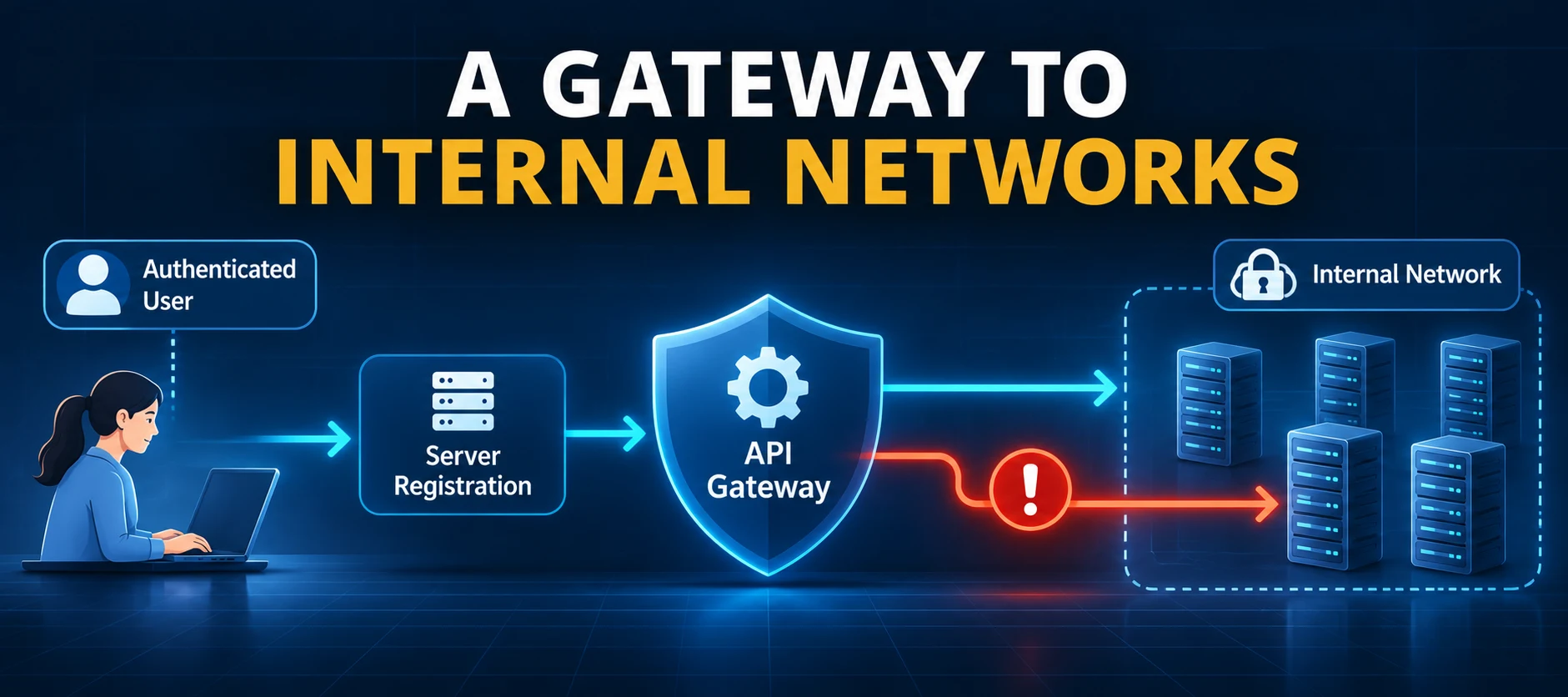
Amazon Web Services (AWS) has published a security bulletin for CVE-2026-125926, a server-side request forgery (SSRF) vulnerability affecting the server registration and update API in the open-source mcp-gateway-registry project.
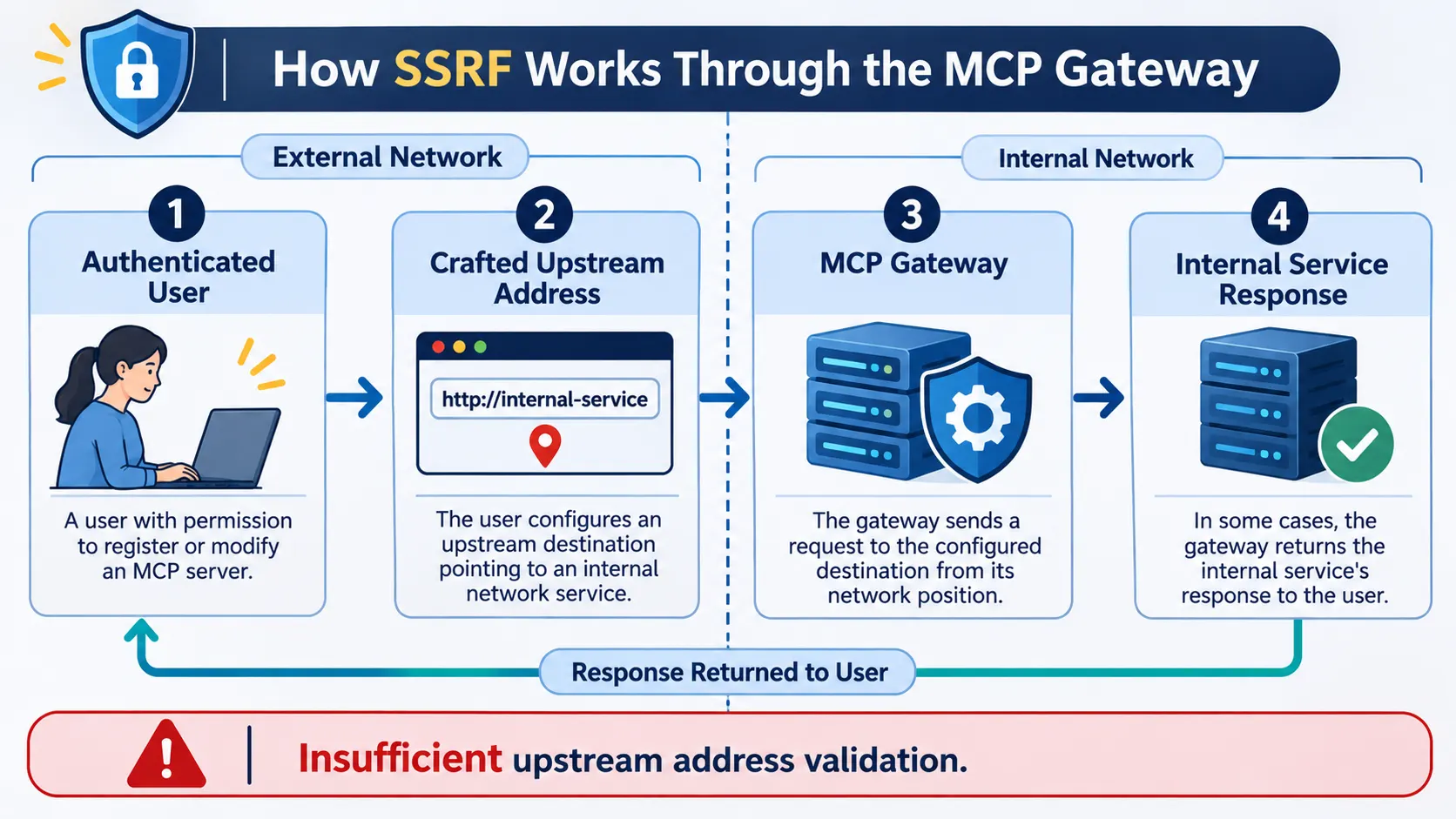
The vulnerability involves insufficient validation of upstream addresses assigned to registered servers. An authenticated user with permission to register or modify a server could configure an address that causes the gateway to send requests to services on the deployment's internal network.
In some cases, the gateway could return the responses from those internal services to the requesting user.
The issue affects mcp-gateway-registry versions 1.0.3 through 1.34.0 and is fixed in version 1.35.0.
AWS classified the bulletin as Important (requires attention) and recommends upgrading to the latest release. Organisations using forked or derivative versions should also incorporate the relevant fixes.
How the SSRF Vulnerability Works
The issue stems from how the registry handles upstream addresses when users register or update MCP servers.
An upstream address tells the gateway where to forward requests for a registered server. If the registry does not adequately validate that address, a user with permission to manage server configurations could supply a destination inside the deployment's internal network.
The gateway then requests its own network position. This matters because the gateway may be able to reach internal services that are not directly accessible to the user.
AWS also states that, in some cases, responses from those internal services could be returned to the user.
This creates a potential path for an authenticated user to use the gateway as an intermediary to interact with internal network services.
The vulnerability does not require an unauthenticated person to access the management API. The bulletin specifically identifies an authenticated user who already has permission to register or modify servers as the relevant threat scenario.
Why Internal Network Access Matters
An SSRF vulnerability can create a security boundary problem because a server may have access to destinations that an external user cannot reach directly.
In this case, the registry gateway can be induced to send requests to internal network services through a user-controlled upstream address. If the application returns the responses, the user may receive information from services intended to remain inside the deployment's network boundary.
The potential exposure depends on the services reachable from the gateway and the responses they provide. AWS does not identify specific internal services or disclose how many deployments may be affected.
The bulletin also recommends requiring Instance Metadata Service Version 2 (IMDSv2) on Amazon EC2 and limiting the permissions of roles attached to the registry and authentication-server components. These recommendations are relevant to reducing the risk associated with the deployment's cloud environment.
Additional details were not disclosed in the announcement.
Affected Versions and Security Fix
AWS confirms that the affected version range is:
First affected version:
1.0.3Last affected version:
1.34.0Fixed version:
1.35.0CVE:
CVE-2026-125926Bulletin ID:
2026-180-AWS
The issue has been addressed in mcp-gateway-registry version 1.35.0. The update validates upstream addresses when a server is registered or modified.
AWS recommends upgrading to the latest version and applying the corresponding changes to forked or derivative code.
Important: Version 1.25.0 Does Not Fix This Vulnerability
AWS specifically highlights a version-sequencing detail because the same project recently received a separate security update.
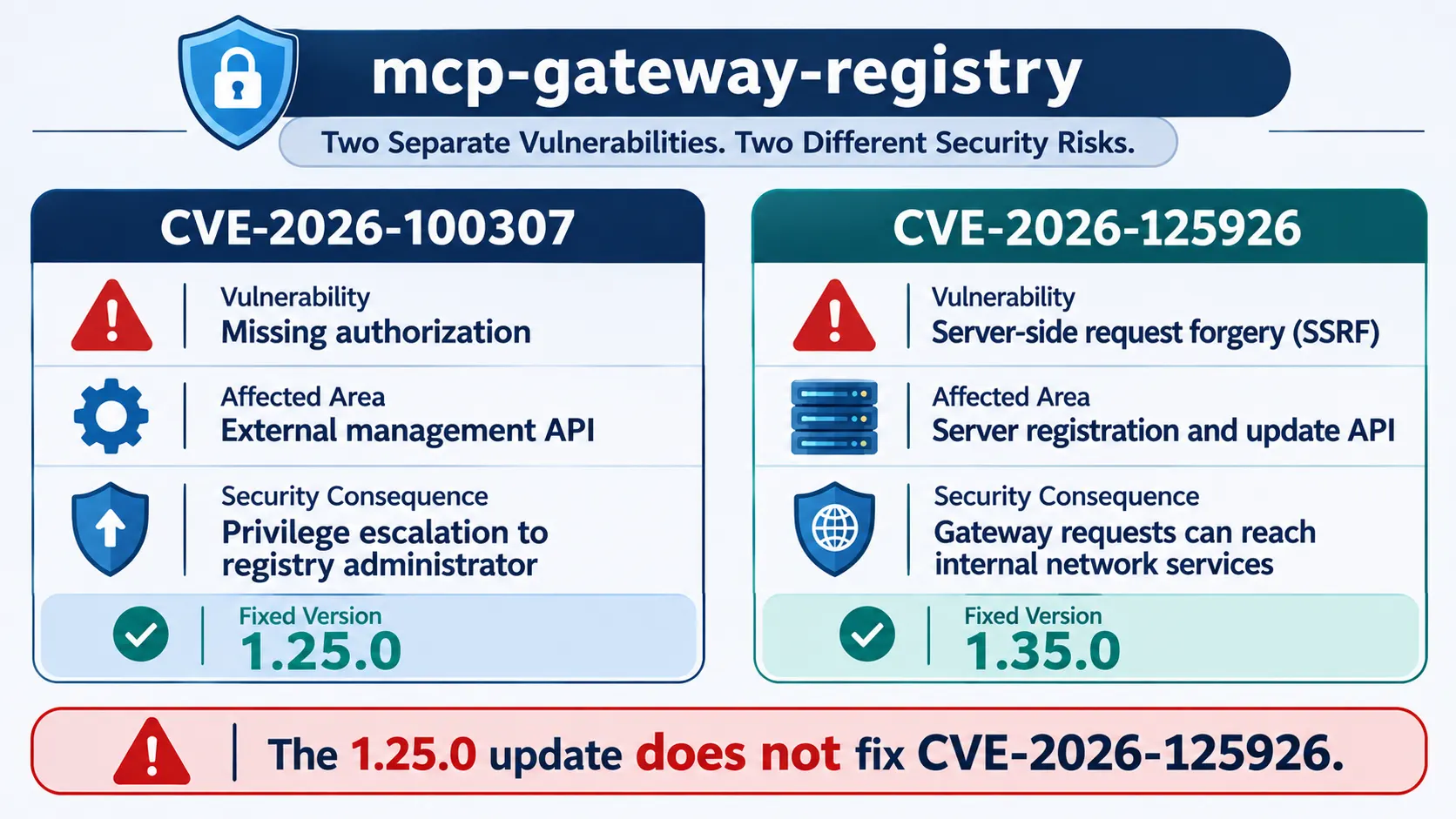
The earlier CVE-2026-100307 involved missing authorization checks in the external management API. That issue was fixed in version 1.25.0.
However, CVE-2026-125926 is an unrelated SSRF vulnerability in the server registration and update API. A deployment running version 1.25.0 or later may include the earlier authorization fix while remaining vulnerable to this SSRF issue if it is running a version before 1.35.0.
Organizations should therefore verify that their deployment runs version 1.35.0 or later rather than assuming the earlier update addressed both vulnerabilities.
What Organizations Must Do After Upgrading
AWS warns that version 1.35.0 does not automatically modify server configurations stored before the update.
This means upgrading closes the vulnerable registration and modification path, but it does not correct potentially unsafe upstream addresses that may already have been saved.
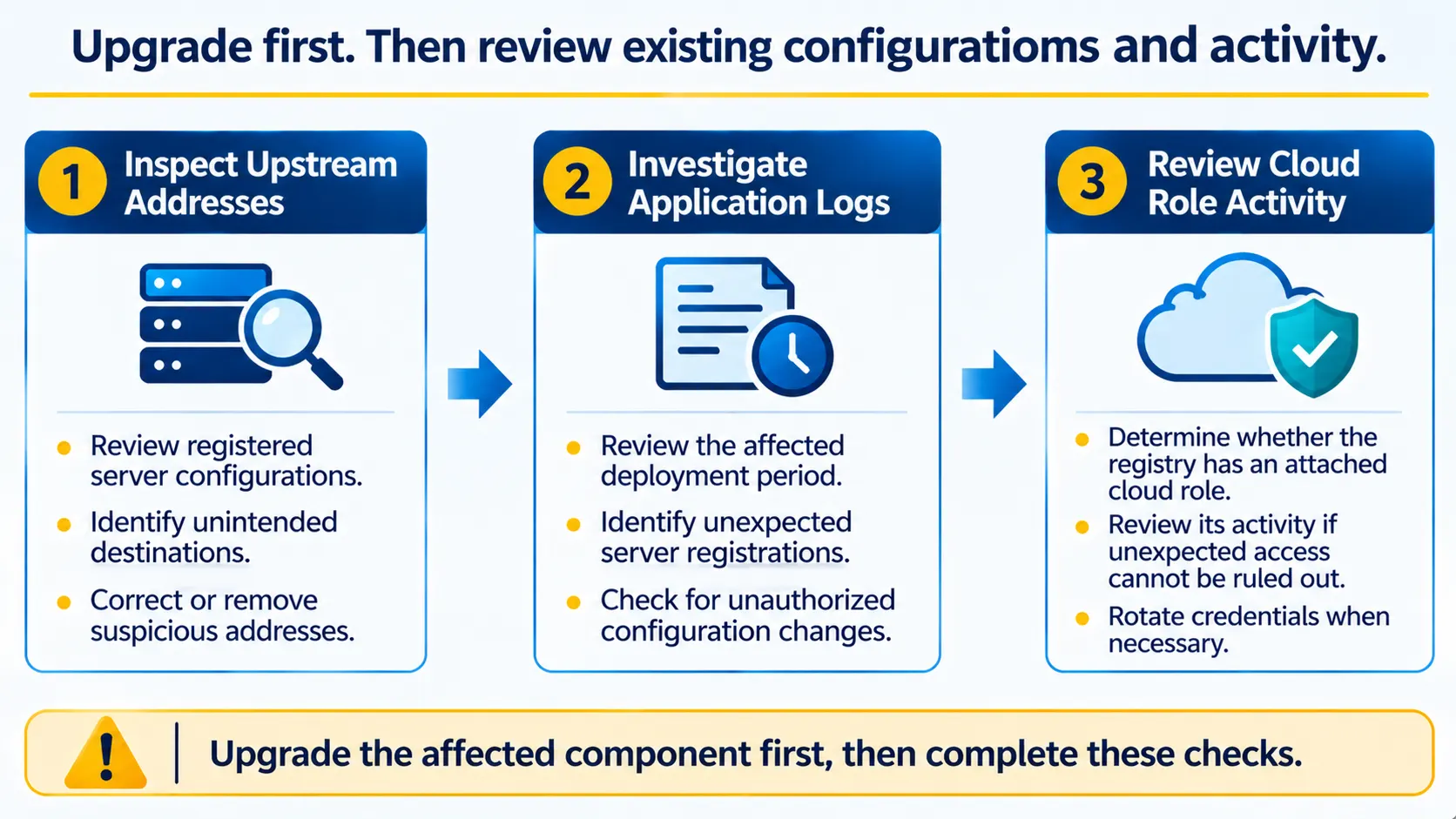
Organizations that operated an affected version should complete three post-upgrade checks.
1. Review Registered Server Upstream Addresses
Inspect the upstream addresses configured for registered servers.
Identify any destination that was not intentionally configured and correct or remove it. This review is necessary because version 1.35.0 leaves existing server configurations unchanged.
2. Investigate Application Logs
Review application logs covering the period during which an affected version was deployed.
Look for unexpected server registrations and configuration changes. The purpose is to identify whether an unauthorized or suspicious upstream address may have been introduced before the update.
3. Review Attached Cloud Roles and Rotate Credentials if Necessary
If the registry operates with an attached cloud role and the log review cannot rule out unexpected activity, AWS recommends reviewing that role's activity and rotating its credentials.
This step helps address potential exposure or misuse involving the permissions available to the affected deployment.
Temporary Mitigations for Deployments That Cannot Upgrade
For organizations that cannot immediately install version 1.35.0, AWS recommends interim controls to reduce exposure.
These measures do not replace the security update or the required post-upgrade review.
Restrict server registration and modification permissions. Limit the ability to register or modify servers to trusted accounts. This reduces the number of users who can configure upstream addresses.
Control outbound network access. Restrict outbound connections from the registry and authentication-server components to the destinations they actually need. This limits the network locations those components can contact.
Require IMDSv2 on Amazon EC2. AWS recommends requiring Instance Metadata Service Version 2 on EC2 deployments.
Apply least privilege to attached roles. Grant the role attached to each component only the permissions required for its operation.
Together, these controls can reduce the potential impact of an SSRF issue by limiting who can change server destinations, where the gateway components can connect and what permissions their cloud roles possess.
Securing MCP Gateway Deployments Against SSRF
CVE-2026-125926 highlights the importance of validating upstream destinations in systems that act as gateways between users and other services.
MCP registries centralize the discovery and management of connected tool servers. Their network position and ability to proxy requests make upstream address validation an important part of their security controls.
For organizations using mcp-gateway-registry, the immediate action is to upgrade to version 1.35.0 or later. They should then review existing upstream addresses, investigate application logs and assess attached cloud-role activity where unexpected access cannot be ruled out.
The earlier authorization fix in version 1.25.0 should not be treated as remediation for this issue. Both vulnerabilities affect different API functions and require their respective fixes.
The broader security lesson is that protecting a gateway requires more than controlling who can access its management interface. The destinations it is allowed to contact and the permissions available to its components also need careful restriction.
Source: AWS Security Bulletins
About the Author