
AWS Warns of Two Babelfish Vulnerabilities Affecting Aurora PostgreSQL
AWS has disclosed two memory-safety vulnerabilities in Babelfish for Aurora PostgreSQL. CVE-2026-119923 affects unauthenticated TDS handshakes, while CVE-2026-119924 could expose adjacent process memory or cause denial of service.
Xcademia Team
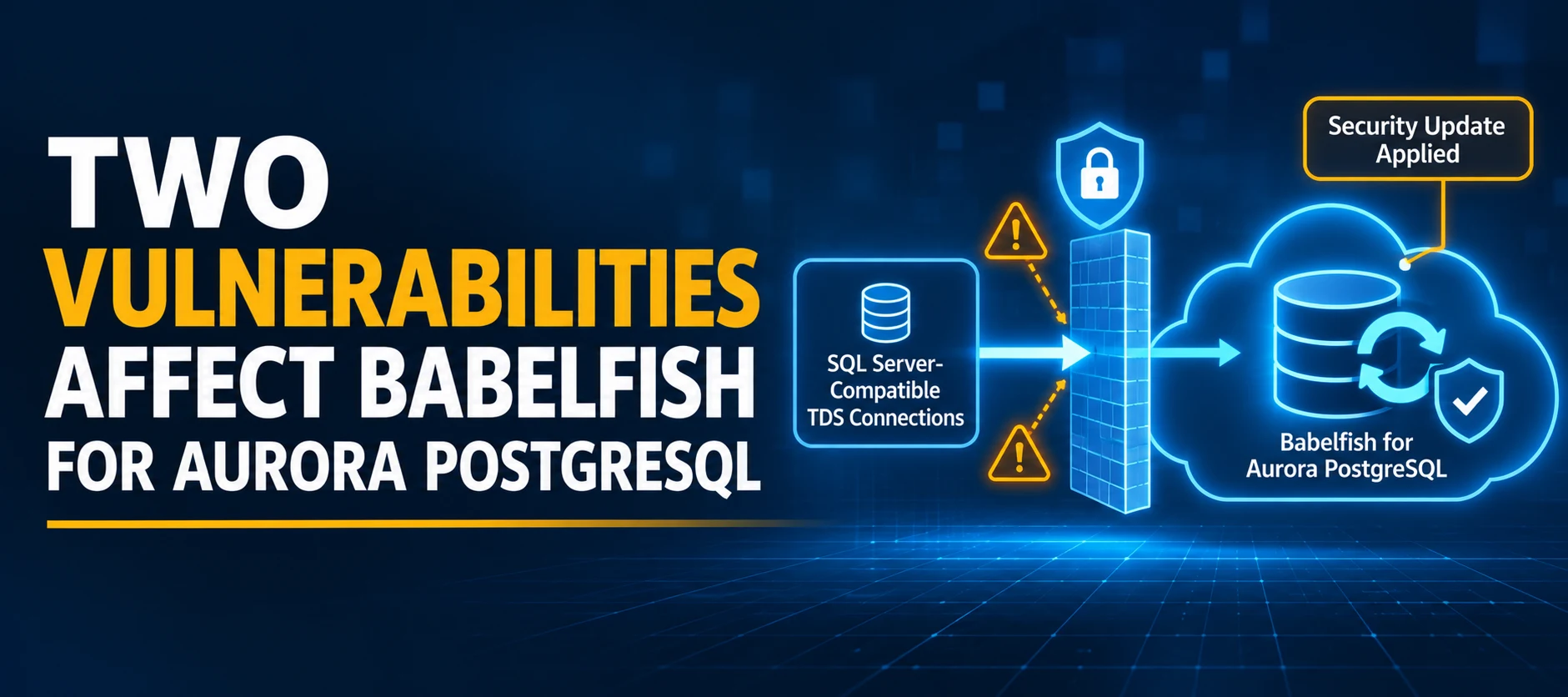
Amazon Web Services (AWS) has disclosed two security vulnerabilities affecting Babelfish for Aurora PostgreSQL, an extension that enables applications built for Microsoft SQL Server to work with PostgreSQL without requiring application code or driver changes.
Published on November 6, 2026, AWS Security Bulletin 2026-166-AWS identifies two memory-safety issues in the Tabular Data Stream (TDS) protocol layer. The vulnerabilities, tracked as CVE-2026-119923 and CVE-2026-119924, could expose database processes to security risks, including unauthorized memory access, denial of service, and potential impacts on confidentiality and integrity.
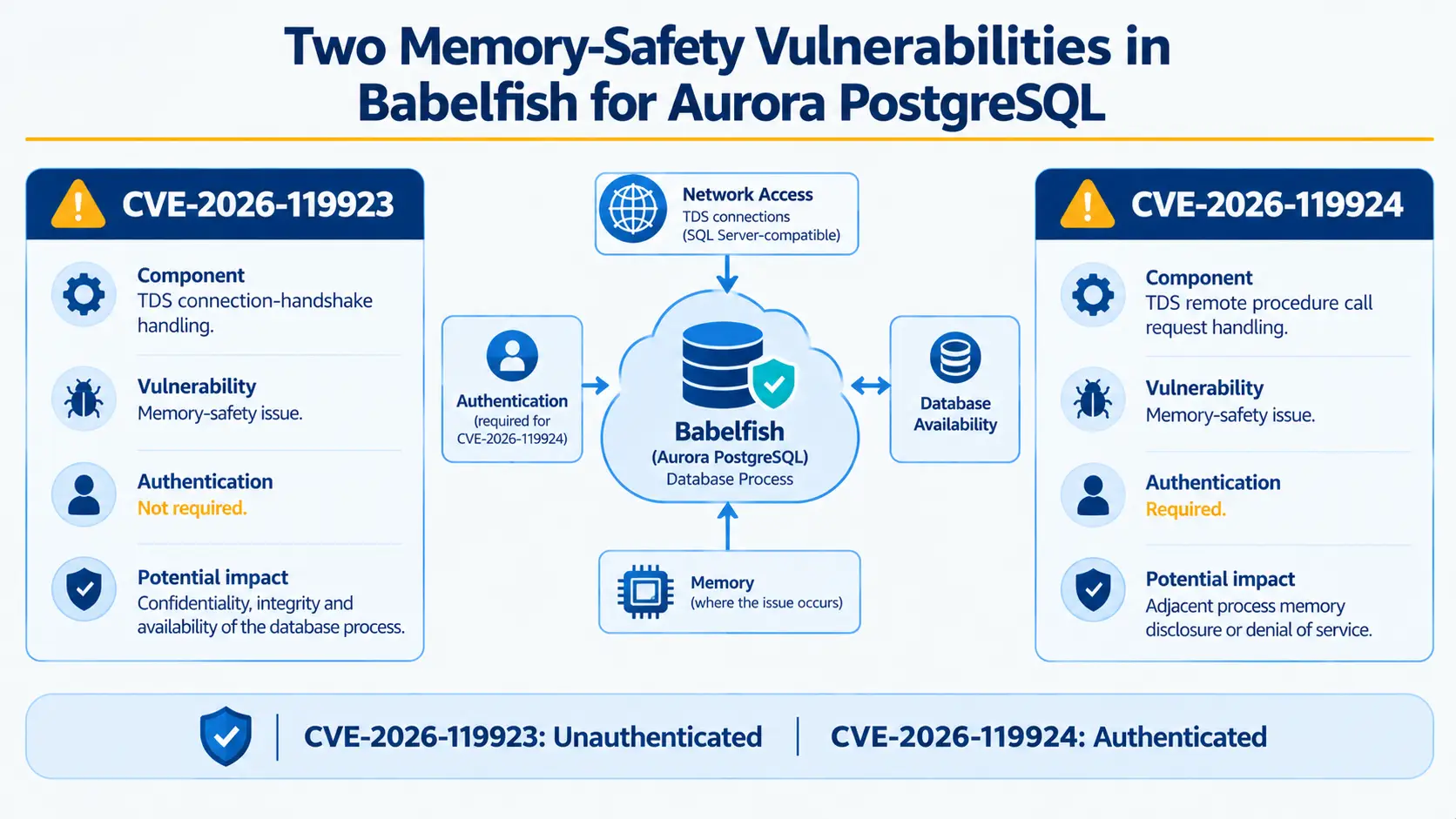
The two vulnerabilities have different authentication requirements. CVE-2026-119923 could be exploited by a remote unauthenticated actor through the TDS connection-handshake handling. CVE-2026-119924 affects TDS remote procedure call request handling and requires the attacker to be authenticated.
AWS has released fixed versions of the Babelfish PostgreSQL extension and provided corresponding Amazon Aurora PostgreSQL upgrade versions. Until the updates are applied, customers should restrict network access to the TDS port, which uses port 1433 by default, to trusted sources through VPC security groups.
What Is Babelfish for Aurora PostgreSQL?
Babelfish for Aurora PostgreSQL is an AWS-supported database capability designed to help organizations run applications originally developed for Microsoft SQL Server on PostgreSQL.
It enables Amazon Aurora PostgreSQL to understand the SQL Server wire protocol, known as Tabular Data Stream (TDS).
TDS is the communication protocol used by SQL Server clients and applications to exchange database requests and responses with a database server.
By supporting this protocol, Babelfish allows applications built for SQL Server to connect to Aurora PostgreSQL without changing their database drivers or rewriting their application code.
Babelfish is developed as an open-source PostgreSQL extension using PostgreSQL's extension model. AWS owns and maintains the Babelfish for PostgreSQL project.
The two vulnerabilities disclosed in AWS bulletin 2026-166-AWS affect the TDS protocol layer, which handles communication between SQL Server-compatible applications and Babelfish.
CVE-2026-119923: Unauthenticated TDS Connection-Handshake Vulnerability
The first vulnerability, CVE-2026-119923, is a memory-safety issue in the handling of TDS connection handshakes.
According to AWS, a remote unauthenticated actor could exploit this issue to affect the confidentiality, integrity, and availability of the database process.
The unauthenticated nature of the vulnerability is an important distinction. An attacker does not need to successfully authenticate to the database before attempting to exploit the affected connection-handshake functionality.
Because the issue involves memory safety, improper handling of connection data could affect the database process.
AWS does not disclose additional technical details about the specific memory corruption condition, exploitation method, or whether exploitation has been observed in the wild.
For organizations operating Babelfish-enabled Aurora PostgreSQL clusters, the issue makes restricting access to the TDS endpoint particularly important until the affected versions are upgraded.
CVE-2026-119924: Authenticated TDS Remote Procedure Call Vulnerability
The second vulnerability, CVE-2026-119924, affects memory handling during TDS remote procedure call (RPC) request processing.
Unlike CVE-2026-119923, exploitation requires a remote authenticated actor.
AWS states that successful exploitation could allow the attacker to read adjacent process memory or cause a denial of service.
Reading adjacent process memory can expose information held within the database process. A denial-of-service condition could affect database availability.
The vulnerability is associated with the handling of TDS RPC requests, which allow clients to invoke database procedures through the SQL Server-compatible protocol.
Although authentication is required, the issue remains relevant to organizations because an attacker with access to a database account could potentially target the affected request-handling functionality.
AWS does not disclose the specific memory contents that could be exposed or the exact conditions required to trigger a denial of service.
Babelfish Versions Affected by the Vulnerabilities
AWS identifies affected versions across both the open-source Babelfish for PostgreSQL extension and Babelfish for Aurora PostgreSQL.
The affected version ranges differ between the two distributions. Customers should identify which implementation they use before determining whether they need to upgrade.
Babelfish for PostgreSQL Extension
AWS lists the following affected extension version ranges:
Babelfish extension branch | Affected versions |
|---|---|
1.x | 1.0 to 1.5 |
2.x | 2.1 to 2.15 |
3.x | 3.1 to 3.12 |
4.x | 4.0 to 4.8 |
5.x | 5.1 to 5.4 |
AWS states that the issues are addressed in the following Babelfish for PostgreSQL extension releases:
Version 4.10
Version 5.6
Version 6.1
Customers using the open-source extension should upgrade to an appropriate fixed release.
Babelfish for Aurora PostgreSQL
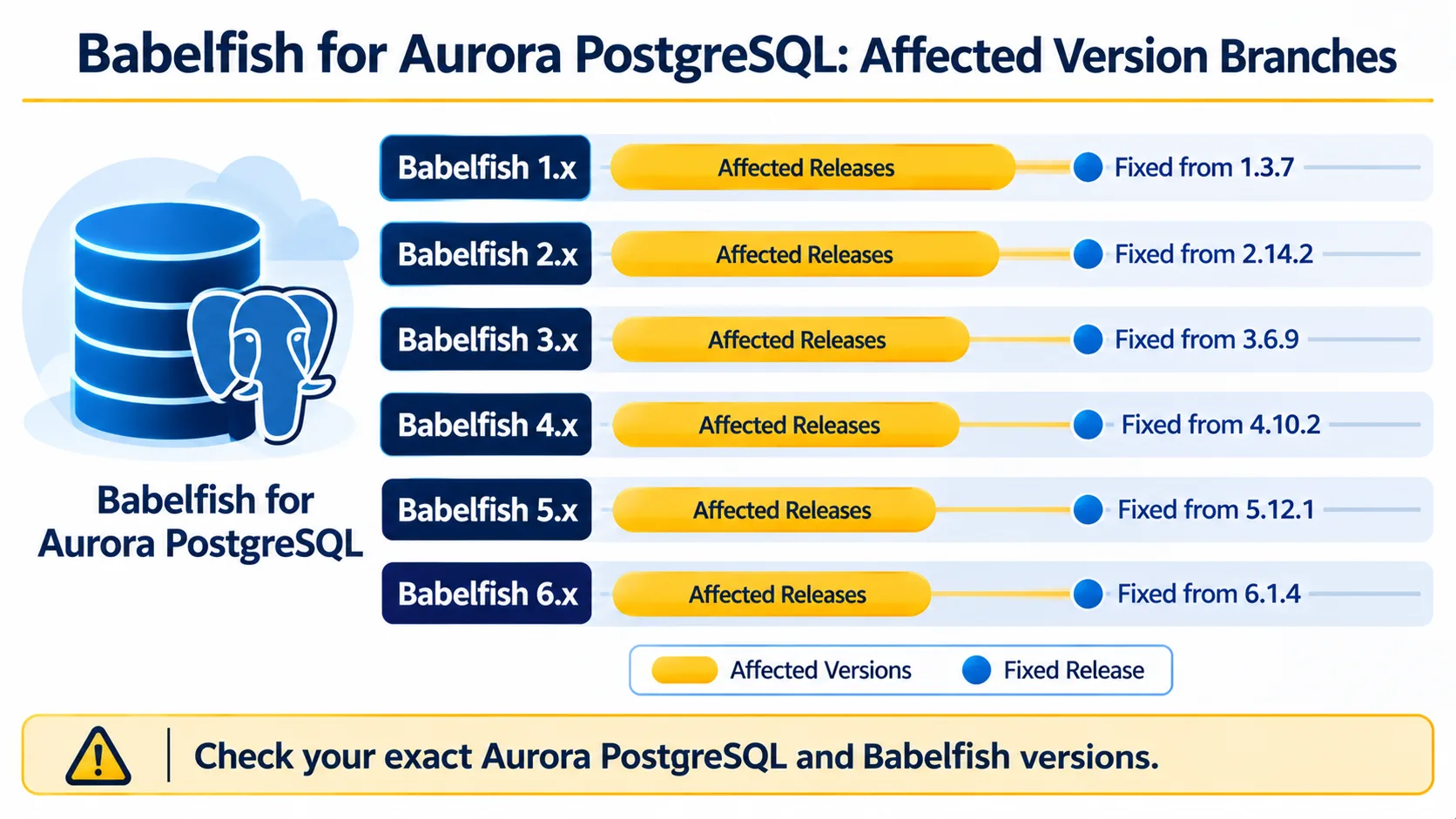
For Amazon Aurora PostgreSQL customers, AWS provides affected version ranges across Aurora major release branches.
The affected ranges listed in the bulletin are:
Aurora PostgreSQL branch | Affected Babelfish versions |
|---|---|
1.x | Below 1.5.5; 1.6.0 to below 1.17.2 |
2.x | Below 2.3.5; 2.4.0 to below 2.12.4; 2.13.0 to below 2.13.3; 2.14.0 to below 2.14.2; 2.15.0 to below 2.15.2; 2.16.0 to below 2.16.1 |
3.x | Below 3.8.4; 3.9.0 to below 3.9.4; 3.10.0 to below 3.10.3; 3.11.0 to below 3.11.2; 3.12.0 to below 3.12.2; 3.13.0 to below 3.13.1 |
4.x | Below 4.5.5; 4.6.0 to below 4.6.3; 4.7.0 to below 4.7.2; 4.8.0 to below 4.8.2; 4.9.0 to below 4.9.1 |
5.x | Below 5.1.4; 5.2.0 to below 5.2.3; 5.3.0 to below 5.3.2; 5.4.0 to below 5.4.2; version 5.5.0 |
6.x | 6.0.0 to below 6.0.2 |
Customers should compare their current Aurora PostgreSQL and Babelfish versions against the affected ranges published in the AWS bulletin.
AWS Releases Fixed Babelfish Versions
AWS confirms that the vulnerabilities have been addressed in Babelfish for PostgreSQL extension versions 4.10, 5.6, and 6.1.
For customers using Babelfish with Amazon Aurora PostgreSQL, AWS recommends upgrading their database clusters to one of the specified Aurora PostgreSQL versions or later.
The corresponding Aurora PostgreSQL and included Babelfish versions are listed below.
Aurora PostgreSQL version | Included fixed Babelfish version |
|---|---|
13.9.16 | 1.5.5 |
13.23.3 | 1.17.2 |
14.6.16 | 2.3.5 |
14.17.8 | 2.12.4 |
14.18.6 | 2.13.3 |
14.19.5 | 2.14.2 |
14.20.5 | 2.15.2 |
14.22.3 | 2.16.1 |
14.23.1 | 2.17.0 |
15.10.8 | 3.8.4 |
15.12.8 | 3.9.4 |
15.13.6 | 3.10.3 |
15.14.5 | 3.11.2 |
15.15.5 | 3.12.2 |
15.17.3 | 3.13.1 |
15.18.1 | 3.14.0 |
16.8.8 | 4.5.5 |
16.9.6 | 4.6.3 |
16.10.5 | 4.7.2 |
16.11.5 | 4.8.2 |
16.13.3 | 4.9.1 |
16.14.1 | 4.10.0 |
17.4.8 | 5.1.4 |
17.5.6 | 5.2.3 |
17.6.5 | 5.3.2 |
17.7.5 | 5.4.2 |
17.9.3 | 5.5.1 |
17.10.1 | 5.6.0 |
18.3.4 | 6.0.2 |
18.4.1 | 6.1.0 |
AWS advises customers to apply any pending maintenance after upgrading to ensure that their database clusters are running the latest patch.
The appropriate upgrade target depends on the Aurora PostgreSQL major version and the Babelfish version currently deployed.
Organizations should therefore verify their database configuration and select a compatible fixed version from the AWS list rather than assuming that a single upgrade applies to every deployment.
AWS Recommends Restricting Access to the TDS Port
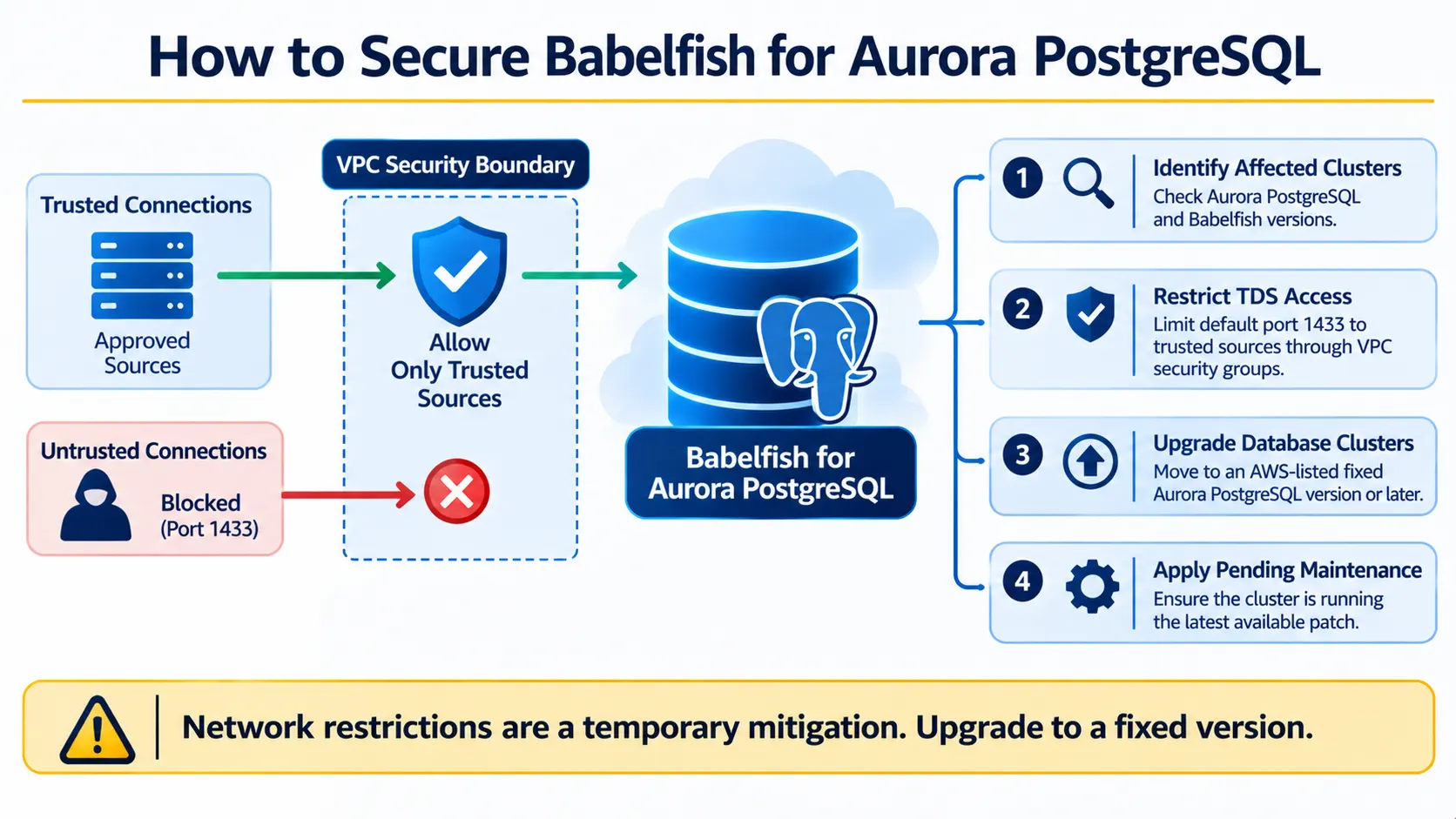
Until the affected database clusters are upgraded, AWS recommends restricting network access to the TDS port using Amazon VPC security groups.
The default TDS port is 1433.
Administrators should allow connections only from trusted sources that require access to the Babelfish database.
This is a temporary mitigation intended to reduce exposure while the database upgrade is pending.
Restricting network access is particularly relevant to CVE-2026-119923 because the vulnerability can be targeted by a remote unauthenticated actor.
It also reduces the number of sources that can reach the TDS request-handling functionality affected by CVE-2026-119924.
Network restrictions do not replace the security update. AWS recommends upgrading to the fixed versions to address both vulnerabilities.
What the Babelfish Vulnerabilities Mean for Database Security
The two vulnerabilities highlight the security importance of protocol-handling components in database systems.
Babelfish provides compatibility between SQL Server applications and PostgreSQL by supporting the TDS protocol. This compatibility layer processes incoming client connections and database requests, making its security relevant to applications that depend on it.
CVE-2026-119923 is particularly notable because it does not require authentication. A remote unauthenticated actor could affect the confidentiality, integrity, and availability of the database process through the connection-handshake handling.
CVE-2026-119924 has a different prerequisite, requiring an authenticated actor. Its potential impact includes adjacent process memory disclosure or denial of service through RPC request handling.
For organizations using Babelfish, the practical response is to identify affected deployments, restrict access to the TDS endpoint, and upgrade to the fixed versions specified by AWS.
The bulletin also reinforces the importance of tracking both the database engine version and the Babelfish extension version. Customers should verify that their deployed combination meets the fixed-version requirements rather than checking only the Aurora PostgreSQL major version.
Security Update: What Customers Should Do Next
AWS has addressed CVE-2026-119923 and CVE-2026-119924 in updated Babelfish releases and corresponding Aurora PostgreSQL versions.
Customers should review their Babelfish deployments, identify affected versions, and upgrade their Aurora PostgreSQL clusters to an appropriate fixed release or later.
Until the upgrade is complete, administrators should restrict access to the default TDS port 1433 to trusted sources using VPC security groups.
The two vulnerabilities have different authentication requirements and potential impacts, but both affect the TDS protocol layer. Applying the AWS-recommended updates is the primary step for addressing the disclosed issues.
Source: AWS Security Bulletins
About the Author