
Cloudflare Makes Private Origins Generally Available, Bringing Enterprise Security to Private Infrastructure
Cloudflare has made Private Origins generally available, allowing organisations to route public traffic to private origin servers while retaining WAF, bot management, caching and other application security controls without exposing origin IPs.
Xcademia Team

Cloudflare has announced the general availability of its Private Origins service, introducing a way for organisations to connect publicly accessible applications to private origin infrastructure without exposing their origin servers directly to the public internet.
Announced on 30 October 2026, the capability allows customers to point a proxied DNS record towards a private IP address and route traffic through their existing Cloudflare One connectivity.
The announcement addresses an infrastructure challenge faced by organisations operating internal APIs, AI agent backends, Model Context Protocol (MCP) servers and operational tools. These services often need to receive requests from external users, partners or automated agents, even though their underlying infrastructure was not designed for direct internet exposure.
1. Why Private Origins Matter for Enterprise Security
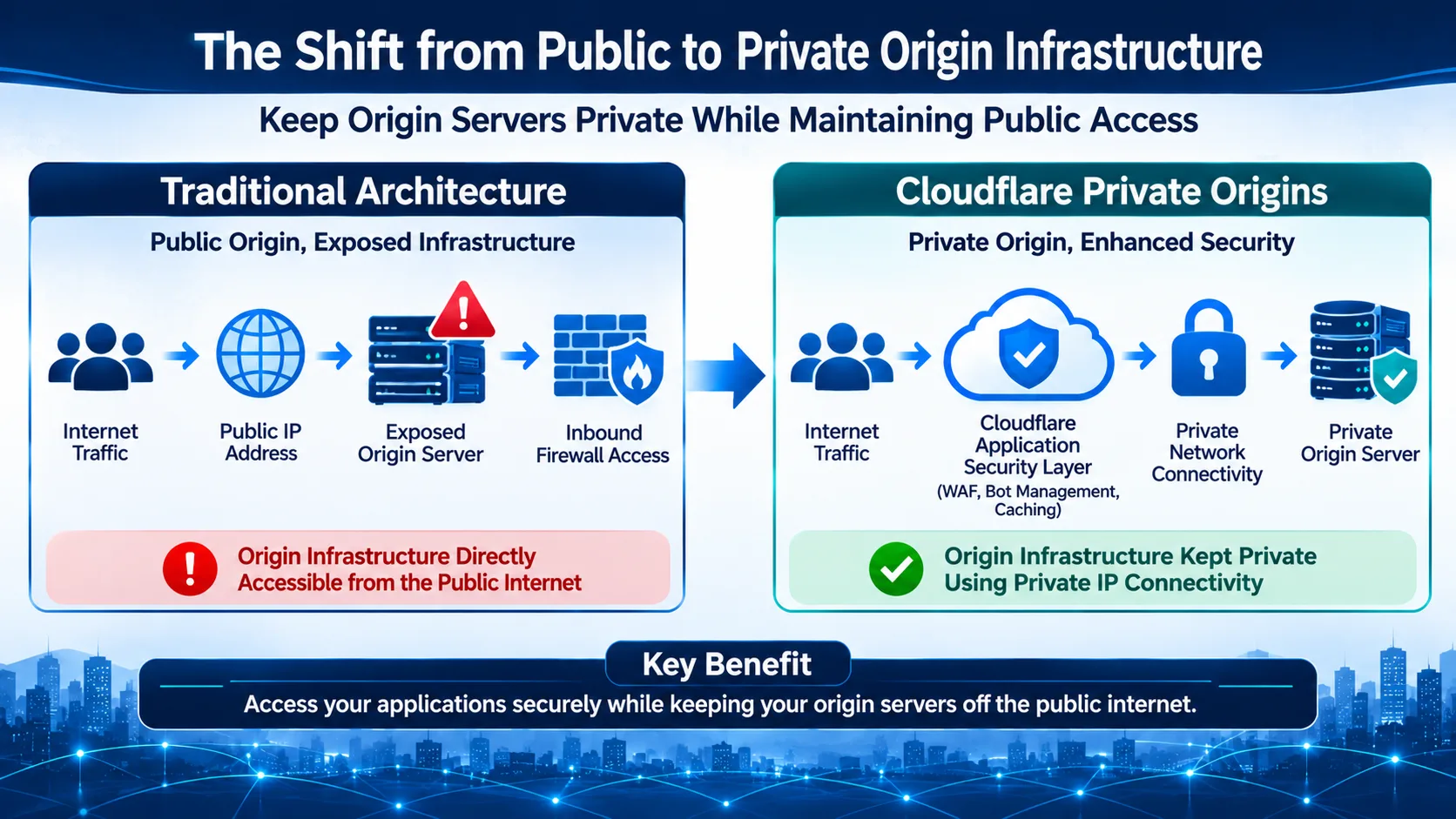
Traditionally, organisations connecting private applications to Cloudflare's application services faced several infrastructure requirements.
These included exposing a public IP address, opening an inbound firewall port or running cloudflared alongside the origin server.
Such requirements could create additional complexity for organisations attempting to maintain private infrastructure while providing controlled external access.
Another challenge was ensuring that private applications received the same security and traffic-management protections available to public-facing applications.
Cloudflare's announcement identifies several capabilities that organisations previously struggled to apply
consistently to private applications:
Web Application Firewall (WAF).
Bot management.
Rate limiting.
Caching.
Traffic acceleration.
Request transformation and rewriting.
Cloudflare Workers.
Private Origins aims to bridge this gap by allowing Cloudflare's application services to operate with privately addressed origin infrastructure.
2. How Cloudflare Private Origins Works
The new capability uses Cloudflare's existing private network connectivity to route requests between its application services and private origin infrastructure.
The configuration begins with a standard proxied DNS record.
Customers create a proxied A or AAAA record pointing towards their origin's private IP address. For supported private IP ranges, private network routing is enabled automatically.
Cloudflare then handles the incoming request through its existing application infrastructure.
The request flow continues to include TLS termination, WAF inspection, configured rules and caching before traffic reaches the origin through the private networking layer.
Supported private address ranges
Cloudflare identifies three address categories for automatic private routing:
Address category | Supported range |
|---|---|
RFC 1918 private IPv4 | Private IPv4 address ranges |
RFC 6598 CGNAT | 100.64.0.0/10 |
RFC 4193 unique local IPv6 | fc00::/7 |
For these address ranges, private routing is automatically enabled and cannot be disabled through the API.
Cloudflare also supports manually enabling private routing when an origin uses a public IP address that is reachable only through the organisation's private network.
Understanding the routing mechanism
A key component of the implementation is the private_routing attribute associated with the DNS record.
For organisations automating deployments through Cloudflare's API, the configuration can include this additional attribute:
{
  "type": "A",
  "name": "app.example.com",
  "content": "10.0.0.50",
  "ttl": 300,
  "proxied": true,
  "private_routing": true
}
When Cloudflare's proxy platform processes the request, it retrieves origin information through the Cloudflare Origin API.
The private_routing flag signals that the destination should be reached through private network connectivity rather than through a direct public internet connection.
Cloudflare's private networking layer then routes the connection using the customer's existing connectivity infrastructure.
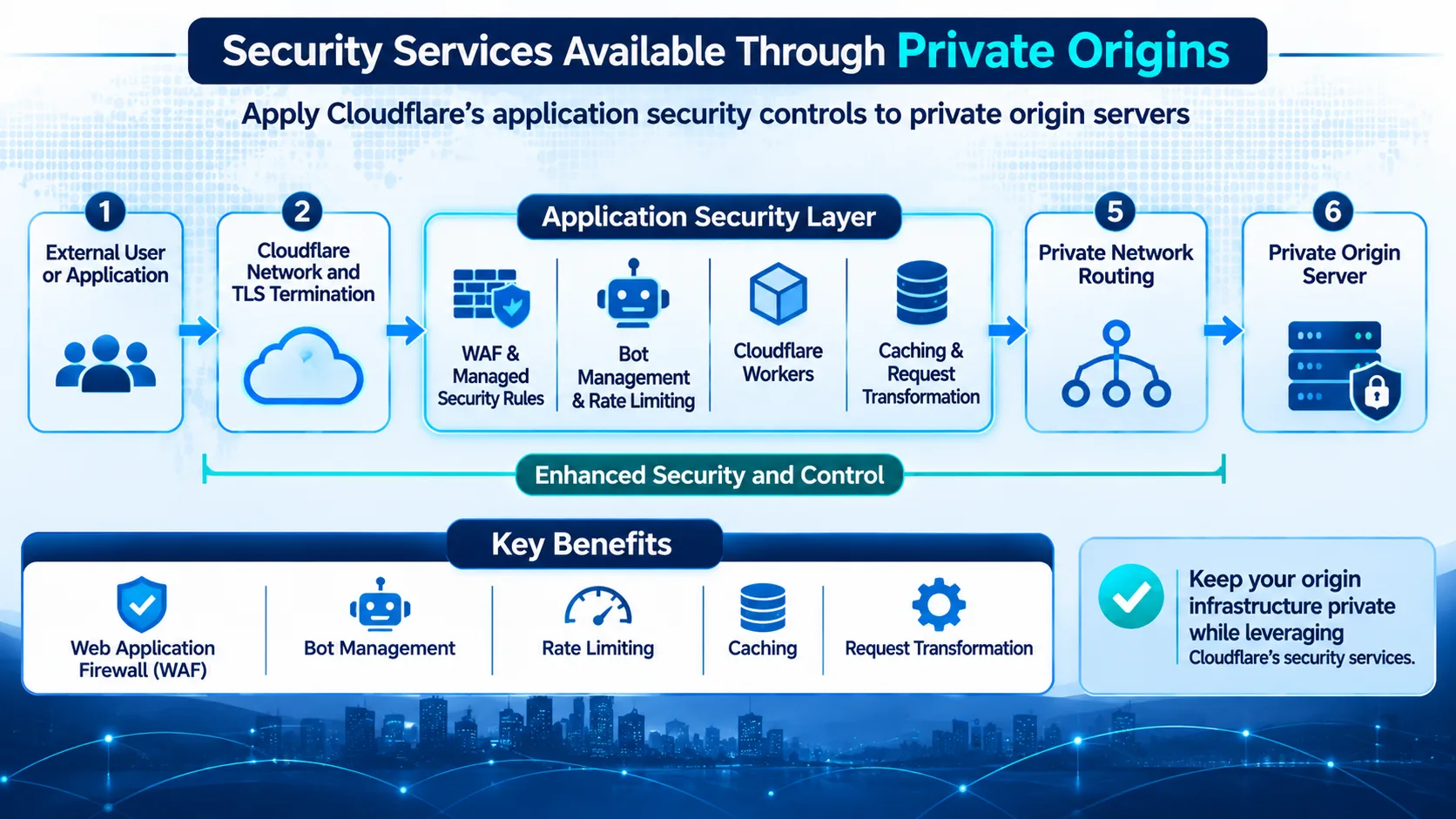
3. Existing Cloudflare Application Security Services Remain Available
One of the central aspects of this announcement is that private origins can use several of the same application services available to public origins.
Cloudflare confirms support for:
Security and application service | Availability |
|---|---|
Web Application Firewall | Supported |
Managed WAF rules | Supported |
Bot management | Supported |
Rate limiting | Supported |
Caching | Supported |
Transform and rewrite rules | Supported |
Cloudflare Workers | Supported |
This means organisations do not necessarily need to expose their origin infrastructure publicly to apply these Cloudflare application services.
However, the release has some limitations.
Argo Smart Routing and Dedicated CDN Egress IPs are not supported. Origin health checks require Cloudflare Load Balancing.
The company directs customers to its developer documentation for the complete list of limitations.
4. Connectivity Options and Deployment Requirements
Cloudflare Private Origins uses existing Cloudflare One connectivity rather than requiring every origin server to become directly accessible from the public internet.
The announcement identifies several supported connectivity options:
IPsec.
GRE.
Cloudflare Tunnel.
Cloudflare Network Interconnect (CNI).
Cloudflare Mesh.
There are also differences in how these connectivity options are deployed.
With Cloudflare WAN, no connector software is required on the origin itself.
With Cloudflare Mesh, a connector operates within the private network and can serve multiple origins.
What organisations need before deployment
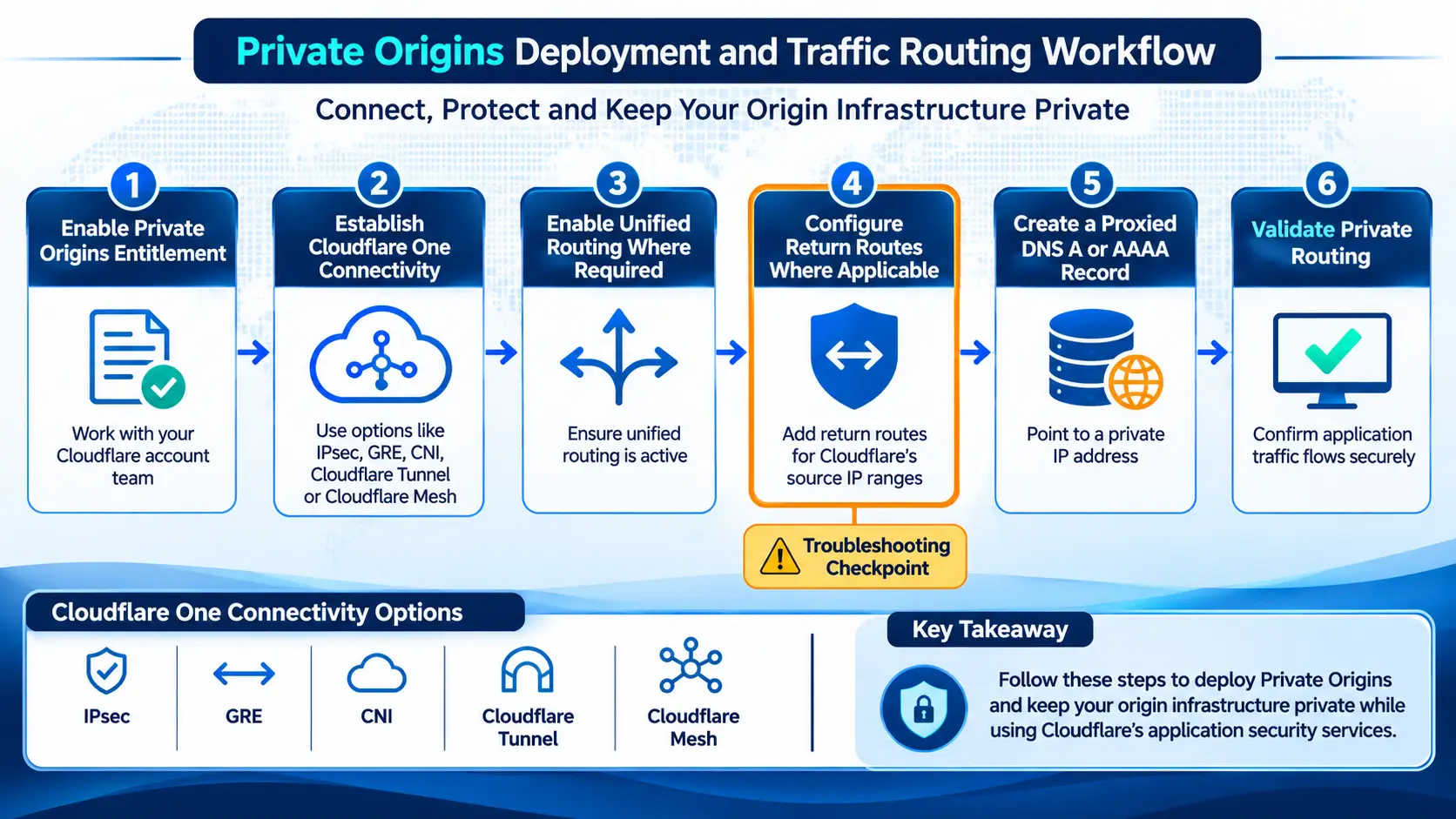
Cloudflare identifies the following prerequisites:
Private Origins entitlement: The feature must be enabled for the customer's account through their Cloudflare account team.
Cloudflare One connectivity: An existing connection through IPsec, GRE, CNI, Cloudflare Tunnel or Cloudflare Mesh is required.
Unified Routing: This must be enabled unless the organisation connects through Cloudflare Tunnel.
Return routing configuration: Organisations using Cloudflare WAN or Cloudflare Mesh must configure return routes for Cloudflare's specified source IP ranges.
The documented return routes are:
IPv4:
100.64.0.0/12IPv6:
2606:4700:cf1:5000::/64
After the required configuration, customers create a proxied A or AAAA record for the private IP and confirm that private network routing is enabled.
Cloudflare also highlights an important deployment consideration from its closed beta.
If requests time out and traffic does not reach the origin, administrators should check the return route configuration. The company identified missing return routes for Cloudflare's source ranges as its most common setup failure during the beta.
5. What Comes Next: Private-to-Private Connectivity
The current general availability release focuses on public traffic reaching private origins.
However, Cloudflare has also outlined its next development objective: enabling private-to-private traffic through its application services.
The proposed capability would allow users, services and AI agents operating on private networks to reach applications hosted on other private networks.
Cloudflare describes potential use cases including employees accessing internal applications, such as company wikis, with application security controls applied to the traffic.
It also identifies service-to-service communication between cloud environments and data centres as another potential application.
Engineering work is underway, with Cloudflare targeting a closed beta in early 2027. Organisations interested in participating are advised to contact their Cloudflare account teams.
Importantly, private-to-private connectivity is a planned development, not part of the currently announced general availability release.
6. What This Means for Enterprise Cloud Security
Editorial analysis
Cloudflare's announcement highlights a broader infrastructure security trend: organisations increasingly need to make internal services accessible without making their underlying infrastructure directly public.
This requirement is becoming particularly relevant as enterprises deploy internal APIs, AI agents, MCP servers and interconnected services across distributed environments.
Private Origins reflects an approach in which public-facing access and private infrastructure connectivity can operate together.
For security and infrastructure teams, several considerations emerge:
Reduced direct origin exposure: Organisations can retain private IP addressing for supported origins rather than making them directly accessible through public IPs.
Consistent application controls: Private applications can use supported WAF, bot management and rate-limiting services.
Infrastructure flexibility: Existing private network connectivity can be used instead of introducing a separate connector on every origin.
Deployment automation: The
private_routingattribute provides an API-based configuration option for infrastructure automation workflows.AI infrastructure considerations: Private AI agent backends and MCP servers are among the use cases identified by Cloudflare.
However, private routing should not be confused with complete application security. Organisations still need appropriate identity controls, application authorisation, network segmentation, secure configuration and monitoring.
The announcement does not claim that Private Origins eliminates all origin-related security risks.
For enterprises, the development reflects growing demand for architectures that combine private infrastructure with centrally managed application security services.
Conclusion
Cloudflare's move to make Private Origins generally available introduces another option for organisations that need public access to applications without directly exposing their origin infrastructure.
By combining proxied DNS records, private network routing and existing Cloudflare application services, the company aims to bring WAF, bot management, caching and other controls to privately addressed origins.
The current release focuses on public-to-private traffic, while private-to-private connectivity remains under development, with a closed beta targeted for early 2027.
For enterprise security and infrastructure teams, the announcement is particularly relevant when evaluating how internal APIs, AI backends and operational applications can remain privately hosted while supporting controlled external access.
Source: Cloudflare Blog
About the Author