
Cloudflare Launches Zero Wire to Help Security Teams Investigate Critical Vulnerabilities
Cloudflare launches Zero Wire, a public vulnerability intelligence feed on Radar that helps security teams assess critical Internet vulnerabilities through concise briefings, exploitation evidence, remediation guidance and AI-assisted assessment prompts.
Xcademia Team
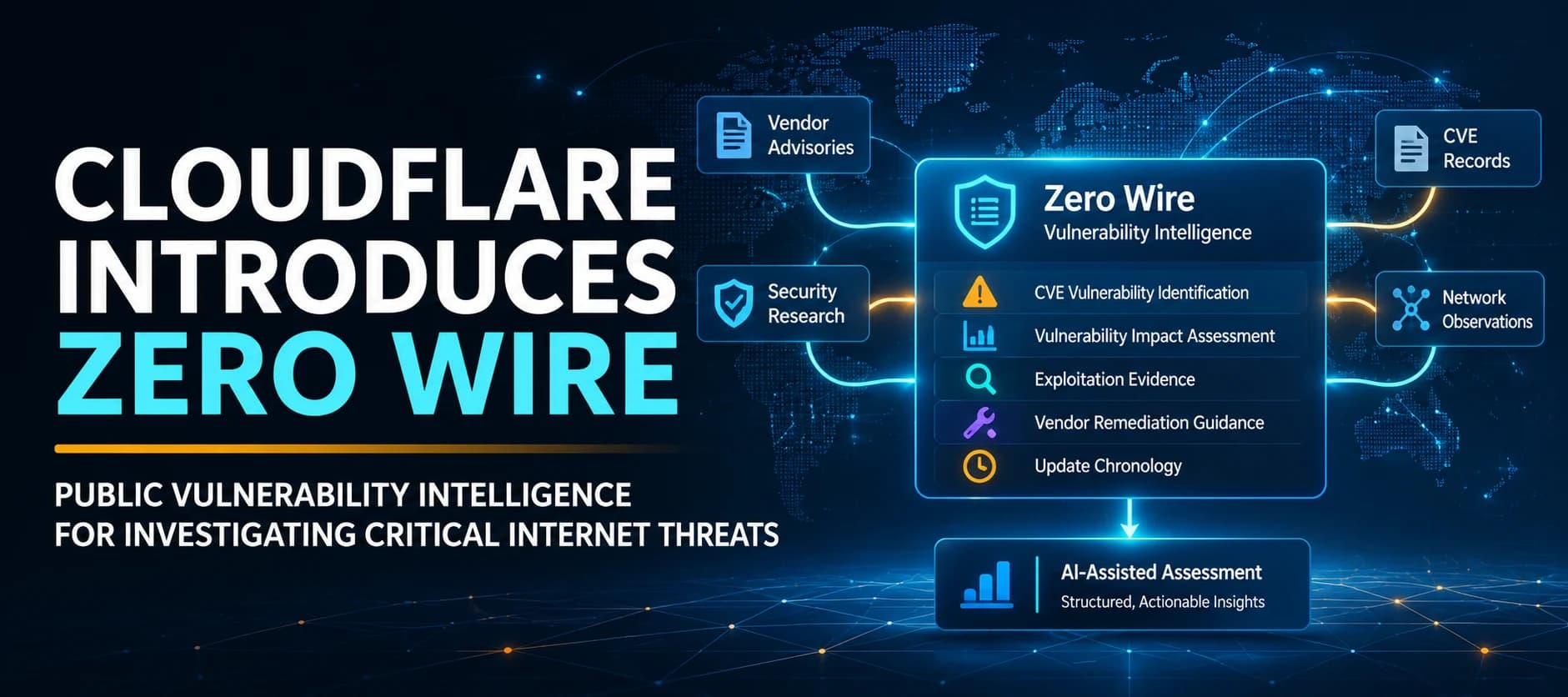
Cloudflare has introduced Zero Wire, a public vulnerability intelligence feed within Cloudflare Radar designed to help security teams investigate critical vulnerabilities affecting Internet-facing software.
The launch addresses a growing challenge for security teams: responding to vulnerability disclosures while discovery and reporting continue to accelerate. Organizations often need to compare vendor advisories, review technical research, identify affected systems and determine appropriate remediation steps, sometimes while other critical disclosures are emerging.
Cloudflare says artificial intelligence is changing the speed and scale of vulnerability discovery. AI can analyze large codebases and identify deeply nested flaws that may have remained undiscovered for years. As a result, security teams may face greater pressure to assess the relevance and potential impact of each disclosure on their infrastructure.
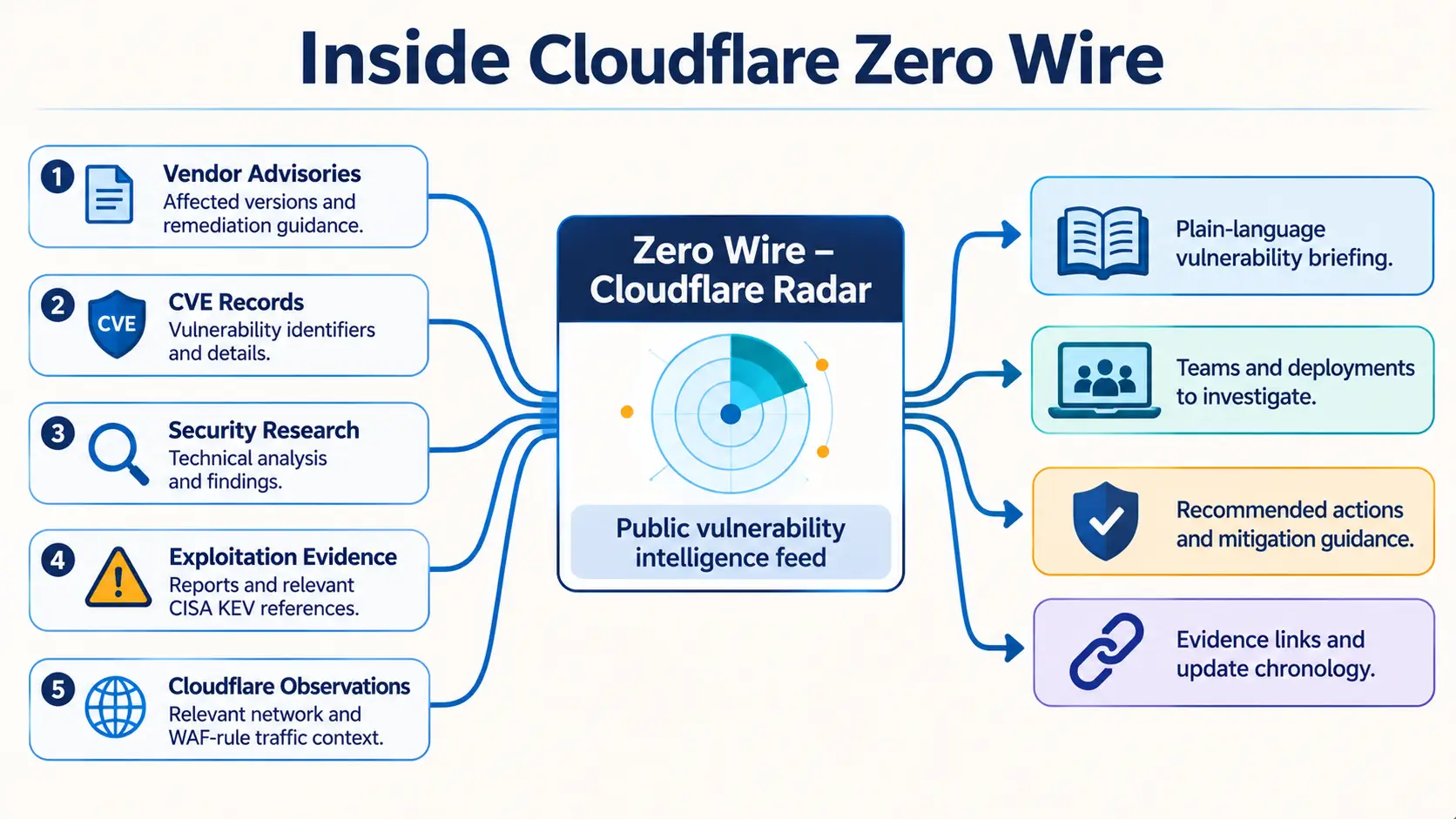
Zero Wire aims to bring the essential information together in a consistent briefing format. Each entry explains the vulnerability in plain language, identifies who should investigate it, outlines recommended actions and links to supporting evidence and vendor guidance.
The feed is intended for both security leaders and technical practitioners. A CISO can use a briefing to understand why an issue matters and ask the right questions, while engineers can follow its technical references to investigate affected systems and plan remediation.
Cloudflare says the information is useful regardless of whether an organization uses its services.
How Zero Wire Works
Zero Wire is available through the security section of Cloudflare Radar.
Each vulnerability briefing uses a concise, index-card-style format. Rather than attempting to replace existing vulnerability databases or vendor advisories, it brings together information that helps teams understand an issue and decide what to investigate next.
A briefing can include:
A plain-language explanation of the vulnerability.
Associated CVEs, where applicable.
The potential impact and affected technology.
Guidance on which deployments and teams should investigate.
Available information about exploitation activity.
Recommended mitigation and patching actions.
Links to vendor advisories, vulnerability records and technical research.
Relevant Cloudflare security controls, where available.
An AI-agent prompt for assessing potential exposure within an organization's infrastructure.
One briefing can cover several related CVEs when explaining them together provides a clearer picture of the issue.
Users can also search for published briefings by CVE identifier or issue name and follow technology tags to find related entries.
Zero Wire Focuses on Critical Internet-Facing Vulnerabilities
Cloudflare says Zero Wire is not intended to become a catalog of every disclosed CVE. Instead, it focuses on significant vulnerabilities in Internet-facing software.
This includes vulnerabilities affecting:
Web applications.
Software runtimes and libraries used by applications.
Services exposed directly to the Internet.
Technologies where a proxy may help mitigate exploitation.
The feed complements existing vulnerability databases and vendor advisories by adding practical context about potential impact, affected deployments, exploitation evidence and available mitigation options.
Cloudflare also makes an important distinction between vulnerability severity and evidence of active exploitation. A vulnerability's severity rating does not, by itself, establish whether attackers are exploiting it in real-world environments.
Zero Wire aims to present these aspects separately so security teams can consider both when prioritizing their response.
A dedicated Cloudflare protection, such as a Web Application Firewall (WAF) rule, is not required for a vulnerability to appear in the feed. Some vulnerabilities require vendor updates or changes outside the traffic Cloudflare can inspect. Where Cloudflare controls can help, the briefing explains their scope and configuration requirements.
Finding Vulnerabilities That Need Attention
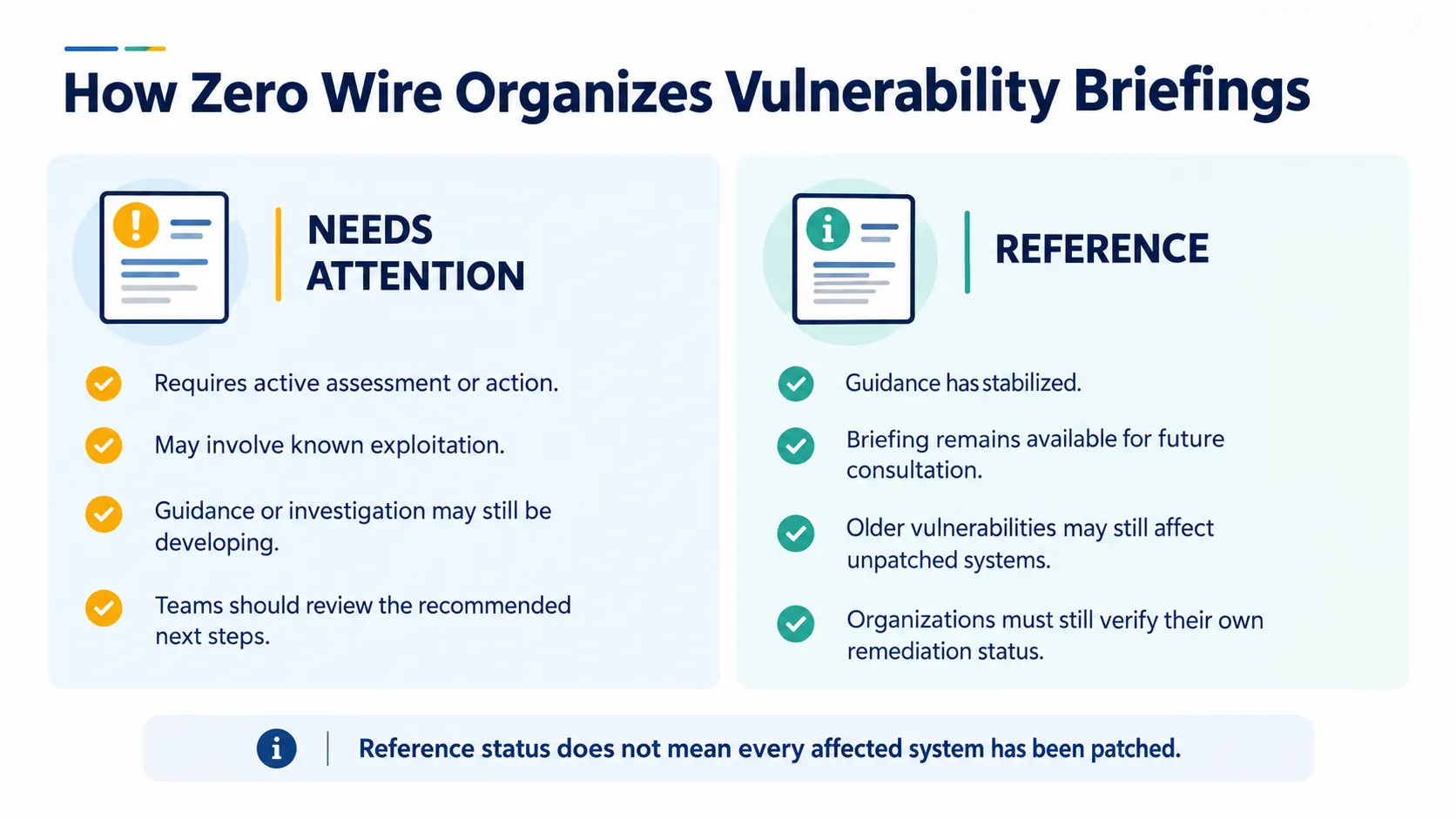
The Zero Wire homepage separates published briefings into two categories: Needs attention and Reference.
Needs attention
This category brings together vulnerabilities that require active assessment or action. It can include issues with known exploitation activity or situations where investigation and remediation guidance is still developing.
Security teams can use these entries to identify vulnerabilities that may require immediate review within their environments.
Reference
The Reference category contains briefings for issues where guidance has stabilized.
However, moving a briefing into Reference does not mean every affected system has been patched. An older vulnerability can remain relevant to an organization that has not completed remediation.
Each briefing card also displays its status and last-checked date. These details help readers understand the current state of the information, but Cloudflare advises interpreting them alongside the evidence in the briefing.
Known exploitation, an ongoing investigation and the availability of a vendor fix describe different aspects of a vulnerability. They should not be treated as interchangeable indicators or as a definitive assessment of an organization's own exposure.
Understanding the Vulnerability and Identifying Responsible Teams
When users open a briefing, the overview explains what happened, why the issue matters and which teams should investigate it.
The explanation connects the technical vulnerability to potential operational consequences, including service disruption and data exposure.
Cloudflare uses the php2shell vulnerability as an example of why identifying the affected software layer matters.
The issue concerns vulnerabilities in the PHP runtime. Organizations running applications such as WordPress or Magento may therefore need to investigate their underlying PHP runtime rather than focusing only on application code or plugins.
Updating a WordPress plugin or Magento application component alone does not repair a vulnerable PHP runtime.
The briefing helps organizations identify the teams responsible for the affected runtime and directs them to PHP security guidance covering affected versions and remediation.
This distinction can help prevent investigation efforts from focusing on the wrong component of a software stack.
Turning a Vulnerability Briefing Into an Action Plan
The What to do now section provides a short set of recommended next steps based on the vulnerability.
Depending on the issue, these actions may include:
Identifying potentially affected software deployments.
Checking installed versions with a hosting provider.
Applying the relevant vendor security updates.
Reviewing systems for suspicious activity.
Maintaining compensating controls while patching is underway.
For a PHP deployment, for example, teams may need to establish which PHP runtime version is actually running, confirm whether the vendor's fix has been applied and identify who is responsible for updating it.
Cloudflare directs readers to the relevant vendor advisories for detailed applicability and remediation instructions. These instructions may change as investigations develop, making the linked source material important for the final technical decision.
The aim is to give security teams a practical starting point for coordinating investigation and remediation rather than leaving them to assemble the basic information from multiple sources.
AI-Agent Prompts Help Organizations Assess Their Exposure
Zero Wire also provides a pre-compiled prompt that organizations can use with an AI agent to assess the potential impact of a vulnerability on their infrastructure.
The prompt is designed to support a read-only assessment. It asks the agent to examine:
Deployed software and relevant versions.
Applicable vendor fixes.
Potential exposure across infrastructure assets.
Available compensating controls.
Evidence supporting each asset-level finding.
Unknown information that requires further investigation.
Recommended next actions.
The prompt is intended to help teams organize their investigation and identify where additional evidence is needed.
However, copying the prompt does not automatically scan an organization's infrastructure, inspect its systems or make configuration changes. The assessment depends on the information and access available to the AI agent being used.
Cloudflare presents this as an additional investigation aid within the briefing, rather than a replacement for direct verification by security and infrastructure teams.
Checking Exploitation Evidence and Tracking Updates
Each Zero Wire briefing links to external sources that help readers understand the vulnerability and evaluate the available evidence.
These may include:
CVE records.
Vendor security advisories.
Technical research.
Reports of exploitation activity.
The US Cybersecurity and Infrastructure Security Agency's (CISA) Known Exploited Vulnerabilities (KEV) Catalog.
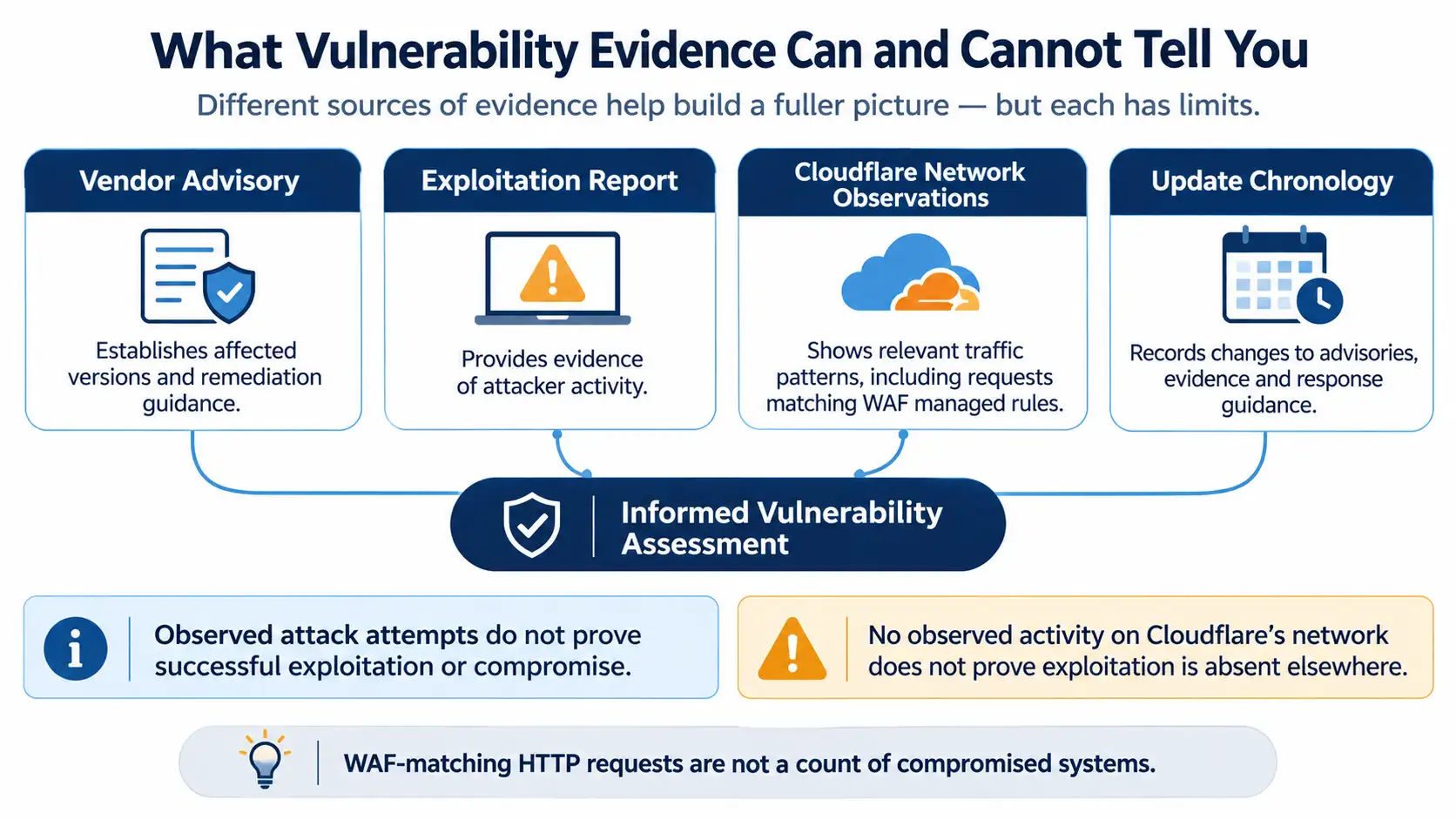
Cloudflare emphasizes that these sources answer different questions.
A vendor advisory establishes affected versions and provides remediation guidance. An exploitation report provides evidence of attacker activity. Neither should be treated as a substitute for assessing an organization's own systems.
Cloudflare Network Observations
Where relevant, Cloudflare may add information from traffic observed across its network.
For example, a briefing can include traffic matching Cloudflare WAF managed rules associated with exploitation attempts against a particular vulnerability.
These observations provide additional context, but they have important limitations.
A request matching a WAF rule indicates an observed request associated with the rule. It does not establish that a particular organization was compromised or that an exploit succeeded.
Similarly, the absence of observed attempts on Cloudflare's network does not prove that exploitation is absent elsewhere.
Cloudflare says its briefings distinguish what the available sources establish from what remains unknown.
Charts and Exploitation Activity
Some briefings include charts to provide additional context about observed activity.
The php2shell briefing, for example, includes the volume of HTTP requests matching Cloudflare WAF managed rules over time.
Cloudflare clarifies that these requests are not a count of compromised systems or successful exploits. The chart is intended to help practitioners understand the level of activity focused on a particular vulnerability.
Update Chronology
Zero Wire also records important developments in a briefing's update chronology.
This can include new vendor advisories, changes in exploitation evidence and revisions to response guidance.
Combined with the last-checked date, the chronology helps returning readers identify what has changed since their previous visit.
How Cloudflare Protections Fit Into Zero Wire
Each briefing includes a Cloudflare section explaining whether the company offers a compensating control or another way to help mitigate the vulnerability's impact.
Where a vulnerability can be addressed through a WAF rule, the briefing identifies its availability and relevant configuration requirements.
For applicable protections, links for free and paid plans can direct customers to the relevant Cloudflare dashboard configuration.
The next step is made explicit: users are asked to review their WAF configuration to determine whether the protection is in place.
However, opening a configuration link does not automatically enable a rule or verify that a deployment is protected. Organizations must review their own settings.
WAF Mitigation Does Not Replace Patching
Cloudflare also highlights an important limitation of WAF-based mitigation.
A WAF rule acts as a compensating control for the traffic it covers. It does not replace fixing the vulnerable software.
Blocking malicious requests may help prevent exposed data from reaching an attacker, but it cannot reverse actions that have already taken place on the origin system.
Security teams should therefore continue following vendor remediation guidance and apply the necessary software updates.
The distinction is particularly important when organizations rely on perimeter protections while waiting to patch affected applications, runtimes or services.
What Zero Wire Means for Security Teams
Cloudflare's launch reflects a broader challenge in vulnerability management: security teams need more than a severity score or a list of affected software versions to make informed decisions.
They also need to understand which systems may be exposed, whether exploitation has been observed, which teams are responsible for remediation and what actions can reduce risk while a permanent fix is being applied.
Zero Wire brings these elements together through a public briefing format that connects vulnerability explanations with technical evidence, vendor guidance, Cloudflare network observations and optional AI-assisted assessment prompts.
It does not replace vendor advisories, vulnerability databases, internal asset discovery or direct security investigation. Instead, it provides a common starting point for understanding significant Internet-facing vulnerabilities and coordinating the response.
Organizations can access Zero Wire through Cloudflare Radar, search for relevant CVEs or issue names, and share briefings with the teams responsible for their infrastructure.
Cloudflare also encourages readers to follow Cloudflare Radar on X and Bluesky for updates.
Source: Cloudflare Blog
About the Author