
AWS Warns of Brotli Vulnerability Enabling Code Execution and Memory Disclosure
AWS has issued an important security bulletin for CVE-2026-111497, a Brotli decompression vulnerability that could enable code execution or memory disclosure. The advisory outlines patching and mitigation steps for multiple AWS services and customer-managed environments.
Xcademia Team
Amazon Web Services (AWS) has published an important security bulletin warning about CVE-2026-111497, a buffer overflow vulnerability in the native Brotli decompression library. According to AWS, decoding specially crafted Brotli-compressed input could allow an attacker to execute code or read process memory in an affected application.
Published on October 28, 2026, the advisory carries bulletin ID 2026-155-AWS and calls for attention from organizations operating affected workloads. AWS also warns that the issue extends beyond Node.js, with fixes from other vendors not yet fully available at the time of publication.
The bulletin covers AWS Lambda, AWS Amplify, AWS App Runner, Amazon CloudWatch Synthetics, AWS CodeBuild, AWS Elastic Beanstalk and AWS Elemental MediaLive, alongside customer-managed environments running on AWS infrastructure.
What Is CVE-2026-111497?
Brotli is a compression format used to reduce the size of data transferred or stored by applications. Decompression libraries process compressed input and reconstruct the original data for use by the application.
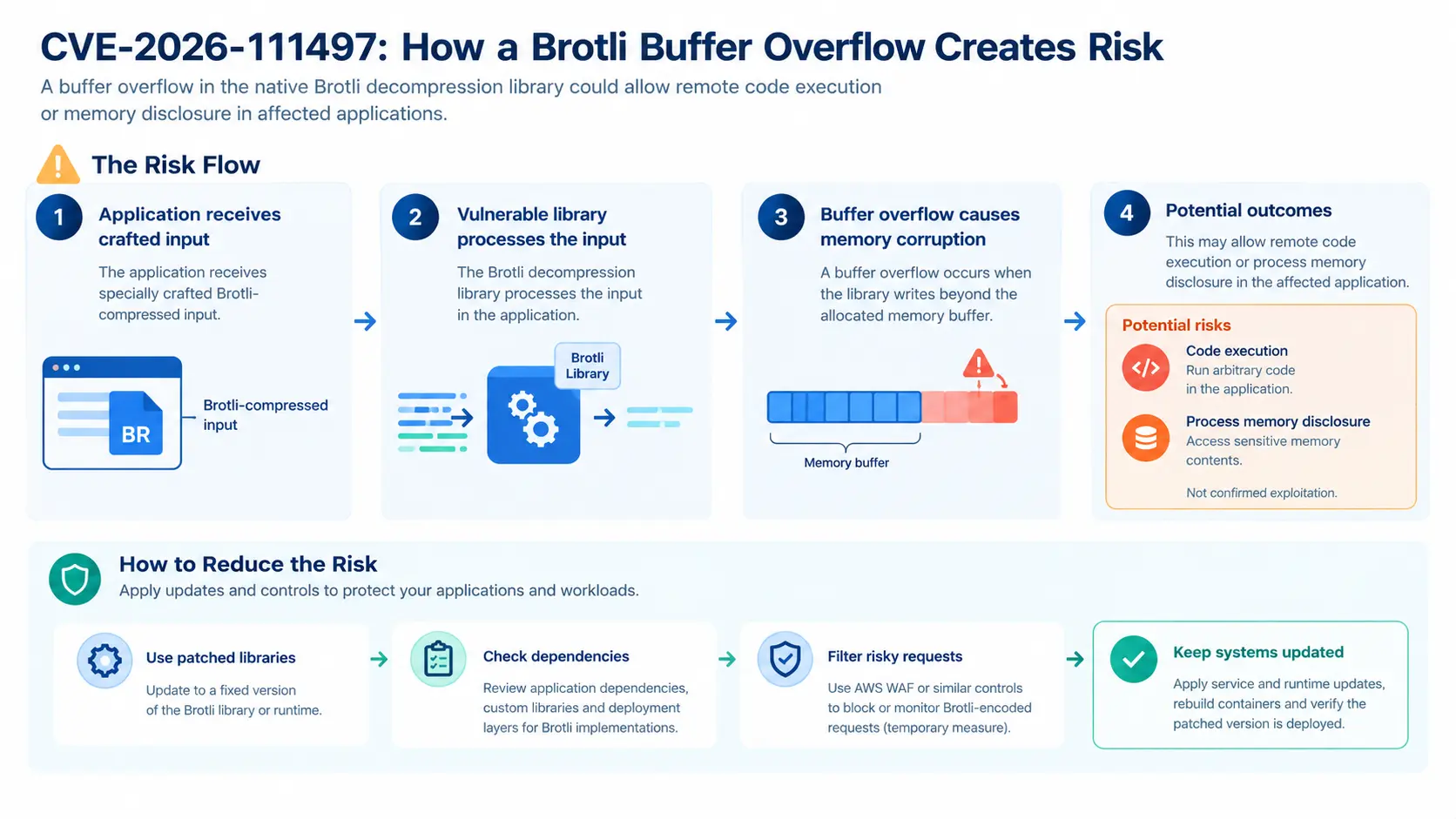
A buffer overflow occurs when software writes beyond the boundaries of an allocated memory buffer. Depending on the vulnerability and the surrounding application, this can cause memory corruption and may create opportunities for code execution or unintended memory disclosure.
AWS identifies CVE-2026-111497 as a buffer overflow in the native Brotli decompression library. The bulletin states that processing specially crafted compressed input could allow a third party to execute code or read process memory in an affected application.
The advisory does not provide a confirmed exploitation status, a severity score or a complete list of all affected third-party products. Additional details were not disclosed in the announcement.
AWS Services Affected and Current Mitigation Status
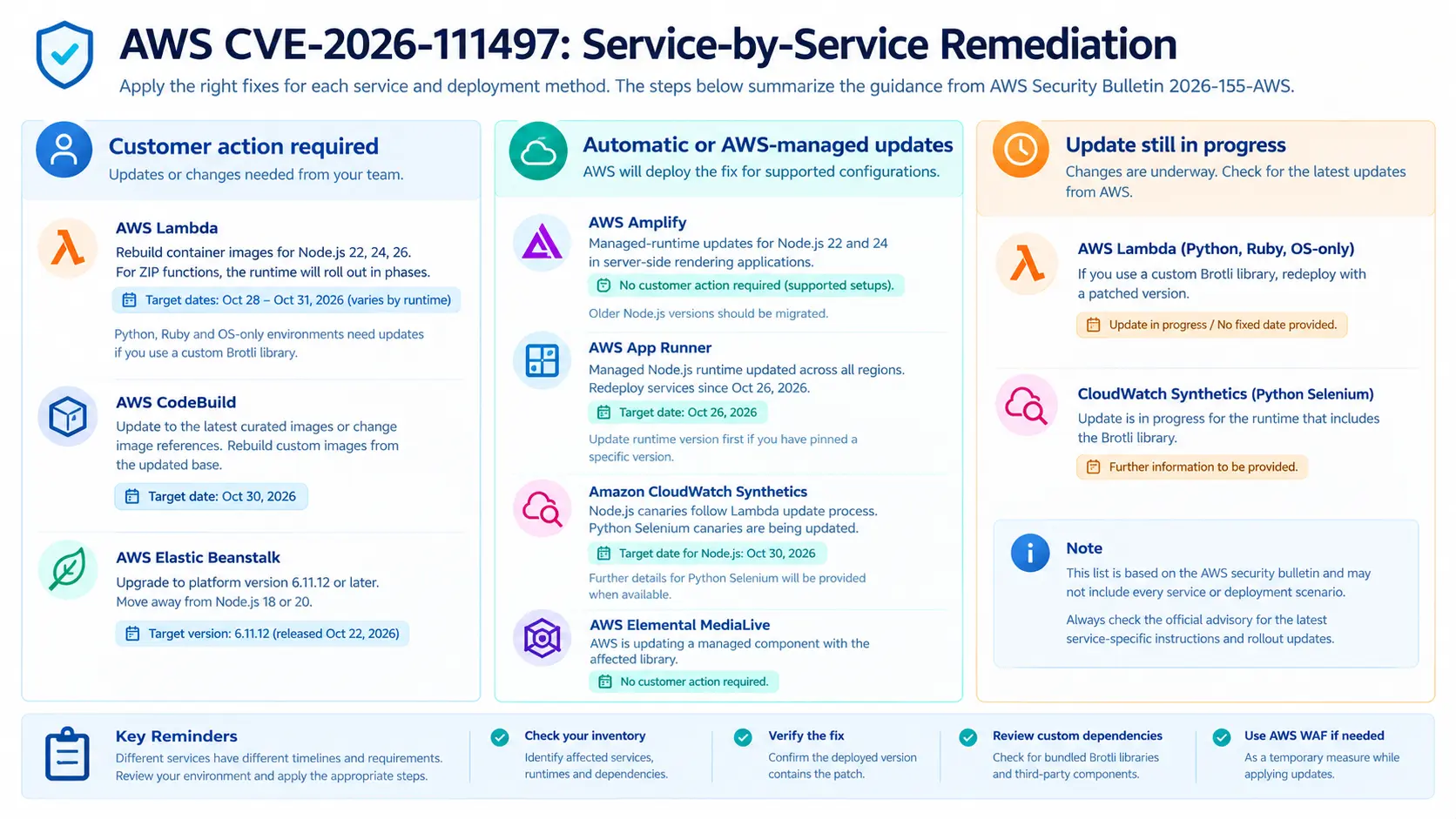
AWS has outlined different remediation paths depending on the service, runtime and deployment method. Some managed services receive updates from AWS, while customer-managed deployments require direct action.
1. AWS Lambda
AWS states that the Lambda managed service itself is not affected, but its Node.js and .NET runtimes are affected by the issue.
Lambda runtimes for Python, Ruby and the OS-only provided.al2023 environment do not include the Brotli library by default. However, customers using their own Brotli library in these environments should redeploy with a patched version.
For Node.js 22, 24 and 26, AWS reports that updated container base images are available. Customers using these images should rebuild and redeploy their container-based functions.
For ZIP-based functions, AWS describes a two-phase rollout:
Phase 1: The updated runtime is applied when a customer creates or updates a function's code or configuration.
Phase 2: Lambda automatically updates functions that use automatic runtime updates and have not already received the patch.
The published schedule lists October 28 and October 30, 2026, for the two phases covering Node.js ZIP packages. For .NET 8, .NET 9 in container deployments, and .NET 10, the corresponding target dates are October 29 and October 31.
AWS notes that rollout occurs in waves across regions, so these dates do not guarantee that every function in every region has already received the update.
The bulletin also warns that deprecated Node.js 18 and Node.js 20 runtimes do not receive security updates. AWS recommends moving to a newer supported runtime.
2. AWS Amplify
AWS Amplify Hosting compute applications using server-side rendering with Node.js 22 and Node.js 24 will receive the security update automatically when the underlying managed runtime is updated. AWS says no customer action is required for these supported configurations.
Applications configured to use Node.js versions earlier than 22 should migrate to a supported version to receive this and future security updates.
3. AWS App Runner
AWS reports that an updated managed Node.js runtime was deployed across all AWS Regions on October 26, 2026.
Services that have not been deployed since that date should be redeployed to pick up the updated runtime. However, applications pinned to an older runtime version must first update that version setting. Redeployment alone will not move a service away from an explicitly pinned older runtime.
4. Amazon CloudWatch Synthetics
Node.js canaries use the Lambda managed runtime and follow the same phased update process. AWS says no action is required for canaries configured for automatic runtime updates, with October 30 listed as the target date.
Python Selenium canaries are a separate case because their runtime includes the Brotli library. AWS says an update is in progress and that further information about the patched runtime and required customer action will be provided when available.
5. AWS CodeBuild
AWS is updating its curated CodeBuild images, with completion targeted for October 30, 2026.
The bulletin lists updated image components that include Node.js 22.23.4, 24.22.1 and 26.12.1, as well as specified patched Brotli packages for Ubuntu and Amazon Linux 2023.
Customer action depends on image configuration:
Builds using the latest image with automatic latest-image selection enabled should use the updated image in the next build.
Builds pinned to a particular image version or digest should update that reference.
Custom images built from CodeBuild curated base images should be rebuilt from an updated base image.
Build specifications selecting Node.js 18 or 20 should be changed to a supported version because the updated images no longer include those runtimes.
6. AWS Elastic Beanstalk
AWS says Elastic Beanstalk Node.js platform version 6.11.12, released on October 22, 2026, includes Node.js 24.22.1 and Node.js 22.23.4.
Environments with managed platform updates enabled are scheduled to receive the fixed platform version during their next weekly maintenance window. Customers who need to update sooner can apply the update through the Managed updates section of the Elastic Beanstalk console.
Other environments should be upgraded to platform version 6.11.12 or later. Environments still using Node.js 18 or 20 should migrate to a supported platform branch.
7. AWS Elemental MediaLive
AWS says it is updating an AWS-managed MediaLive component that includes the affected library. The bulletin states that no customer action is required for this service.
Customer-Managed Node.js Environments Need Direct Updates
Organizations that operate their own Node.js builds on AWS remain responsible for patching those environments.
AWS specifically identifies workloads running on Amazon EC2 and containers deployed through Amazon ECS or Amazon EKS as examples of customer-managed environments. The bulletin recommends upgrading to Node.js 22.23.4, 24.22.1, 26.12.1 or later.
Teams should also review application dependencies, custom libraries and deployment layers to determine whether they contain their own Brotli implementation. This matters because the issue is not limited to Node.js, and fixes from other vendors may not yet be available.
If an affected library or application does not yet have a patch, AWS recommends disabling Brotli decoding until a fix is released.
For teams managing multiple applications, this requires more than checking the primary Node.js version. Dependency inventories and custom container images should also be reviewed.
AWS WAF Offers a Temporary Mitigation Option
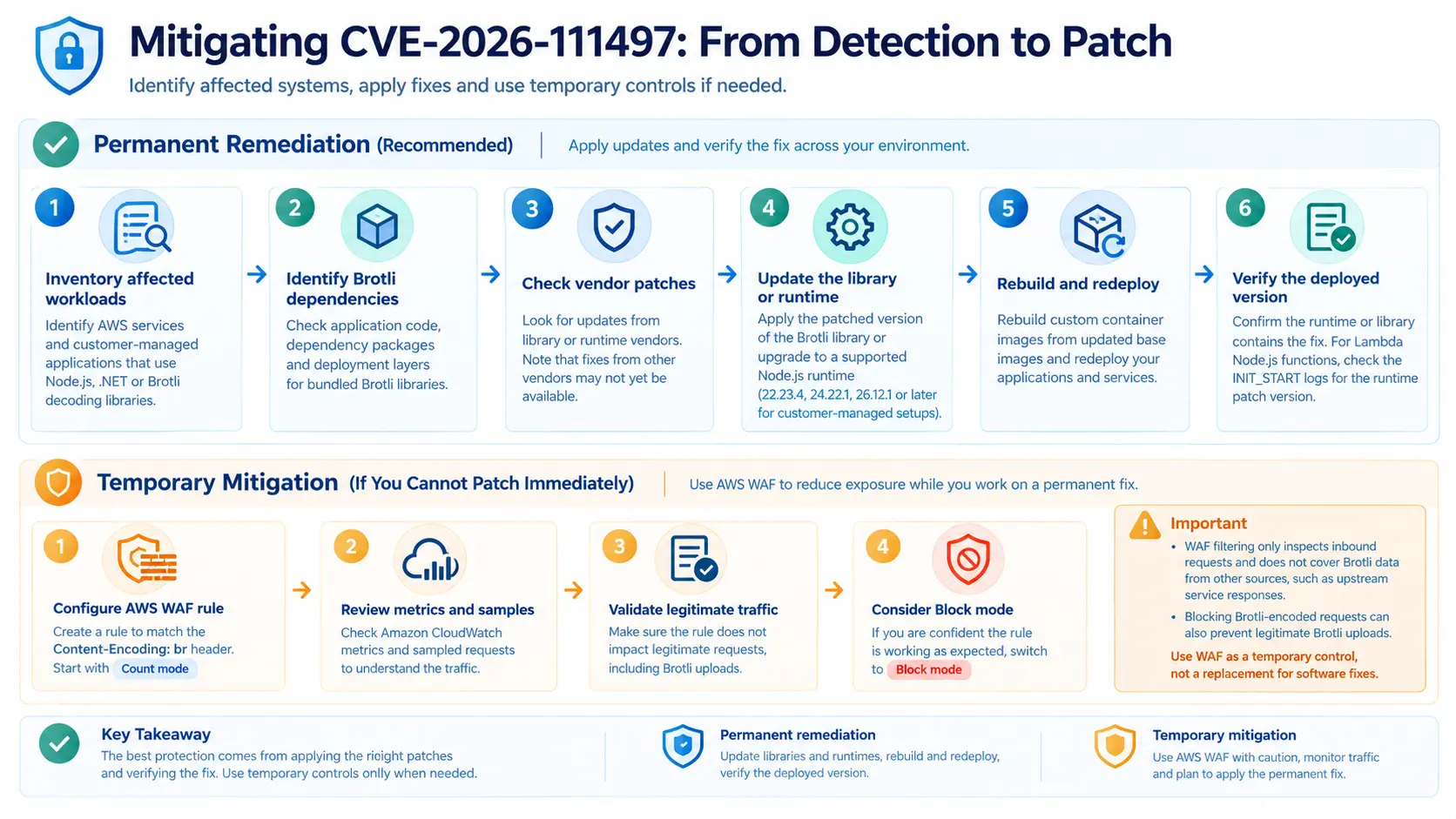
AWS describes an AWS WAF rule that can help mitigate the risk when an immediate software update is not possible.
The example rule identifies inbound requests using the Content-Encoding: br header. Administrators can initially configure the rule with the Count action to observe matching requests and review the results through Amazon CloudWatch metrics and sampled requests.
After verifying that the rule does not interfere with legitimate traffic, administrators can change the action to Block.
However, AWS highlights important limitations. The rule only inspects inbound requests and does not cover Brotli data arriving from other sources, such as upstream service responses. Blocking Brotli-encoded requests also prevents legitimate Brotli-encoded uploads, and the example rule may not match every relevant request.
This makes WAF filtering a potential temporary mitigation rather than a replacement for applying the appropriate software fixes.
Recommended Actions for Security and Engineering Teams
Organizations should use the AWS bulletin to assess their actual deployment configurations and prioritize remediation.
1. Inventory affected workloads. Identify AWS services and customer-managed applications that use Node.js, .NET or Brotli decoding libraries.
2. Check runtime and image versions. Review Lambda runtimes, container base images, CodeBuild image references and Elastic Beanstalk platform versions. Do not assume that a managed service update has reached every deployment.
3. Upgrade supported Node.js environments. For customer-managed environments, move to Node.js 22.23.4, 24.22.1, 26.12.1 or later, as recommended by AWS.
4. Rebuild and redeploy where necessary. Updated base images do not automatically change an existing customer-managed container image. Rebuild and redeploy from the patched base image.
5. Review custom dependencies. Check application code, dependency packages and deployment layers for bundled Brotli libraries. Apply vendor fixes as they become available.
6. Use temporary controls carefully. If patching is not immediately possible, evaluate AWS WAF filtering while accounting for its coverage limitations and possible disruption to legitimate uploads.
7. Verify remediation. Confirm that the deployed runtime or library contains the relevant fix. For Lambda Node.js functions, AWS recommends checking the INIT_START entry in execution logs for the runtime patch version. The bulletin identifies nodejs:22.mainline.v157 or higher for Node.js 22 and nodejs:24.mainline.v114 or higher for Node.js 24.
What This Means for Cloud Security
The AWS advisory highlights a broader operational challenge: vulnerabilities in shared libraries can affect applications across multiple services, runtimes and deployment models.
Managed cloud services can reduce the amount of patching customers must perform themselves, but responsibility varies by service and configuration. Customer-managed containers, pinned build images and custom dependencies may require explicit intervention even when a cloud provider has published a fix.
For enterprises, this reinforces the importance of maintaining an accurate software inventory, tracking vendor security advisories, testing updates and verifying that fixes reach production environments.
The advisory also illustrates why temporary network-level controls should be treated carefully. Filtering certain request formats can reduce exposure in some scenarios, but it may affect legitimate application traffic and cannot address every source of vulnerable input.
These are operational implications drawn from the advisory, not additional claims made by AWS about confirmed attacks or observed exploitation.
Conclusion
AWS Security Bulletin 2026-155-AWS identifies CVE-2026-111497 as a Brotli decompression buffer overflow that could permit code execution or process memory disclosure in affected applications.
The immediate priority is to identify workloads that include the vulnerable library, apply available fixes and verify the result. Customers should pay particular attention to customer-managed Node.js deployments, custom container images, pinned build environments and applications that bundle their own Brotli dependencies.
Source: Amazon Web Services (AWS)
About the Author