
AWS Warns of APT Vulnerability Affecting Ubuntu and Debian Systems
AWS warns of CVE-2026-109518, an APT package manager vulnerability affecting Ubuntu and Debian systems. The flaw could allow a network-positioned attacker to bypass package verification and execute code with elevated privileges.
Xcademia Team
Amazon Web Services has issued a security bulletin warning customers about CVE-2026-109518, a vulnerability in the APT package manager that affects Ubuntu and Debian operating systems.
The vulnerability could allow an attacker positioned between a system and its package mirror to interfere with HTTP package downloads and cause APT to install a package that fails verification. Because package maintainer scripts execute with elevated privileges, successful exploitation could lead to system compromise.
Published on November 5, 2026, AWS Security Bulletin 2026-172-AWS advises customers running Ubuntu or Debian-based Amazon EC2 instances, as well as those using these operating systems in container images, to review their environments and install the updated APT packages.
The issue was addressed through security updates released by Canonical and Debian on November 4, 2026.
What Is CVE-2026-109518?
CVE-2026-109518 is a security vulnerability in APT, the package management system used by Ubuntu, Debian, and related Linux distributions.
APT handles the retrieval and installation of software packages from configured repositories. It normally verifies package integrity and authenticity before installation.
However, under specific conditions, the vulnerability can allow a network-positioned attacker to interfere with the package download process and cause APT to accept a package that has not passed its normal verification checks.
According to Canonical, the issue involves improper handling of hard links when APT follows HTTP redirects and retries package downloads. This can allow an attacker to manipulate a package file after verification.
The affected package can then be installed despite failing signature verification.
This creates a serious security risk because Debian package maintainer scripts execute with root privileges during installation. A malicious package could therefore execute code with elevated system permissions.
Canonical rates the vulnerability High, with a CVSS 4.0 score of 7.7.
The vulnerability requires specific conditions. The attacker must be able to manipulate HTTP traffic between the APT client and the package archive server, and the package download process must involve a retry.
How the APT Vulnerability Works
The issue involves the interaction between HTTP redirects, download retries, and package verification.
Under the affected conditions, an attacker with a suitable network position could interfere with package downloads and exploit APT's handling of the downloaded files.
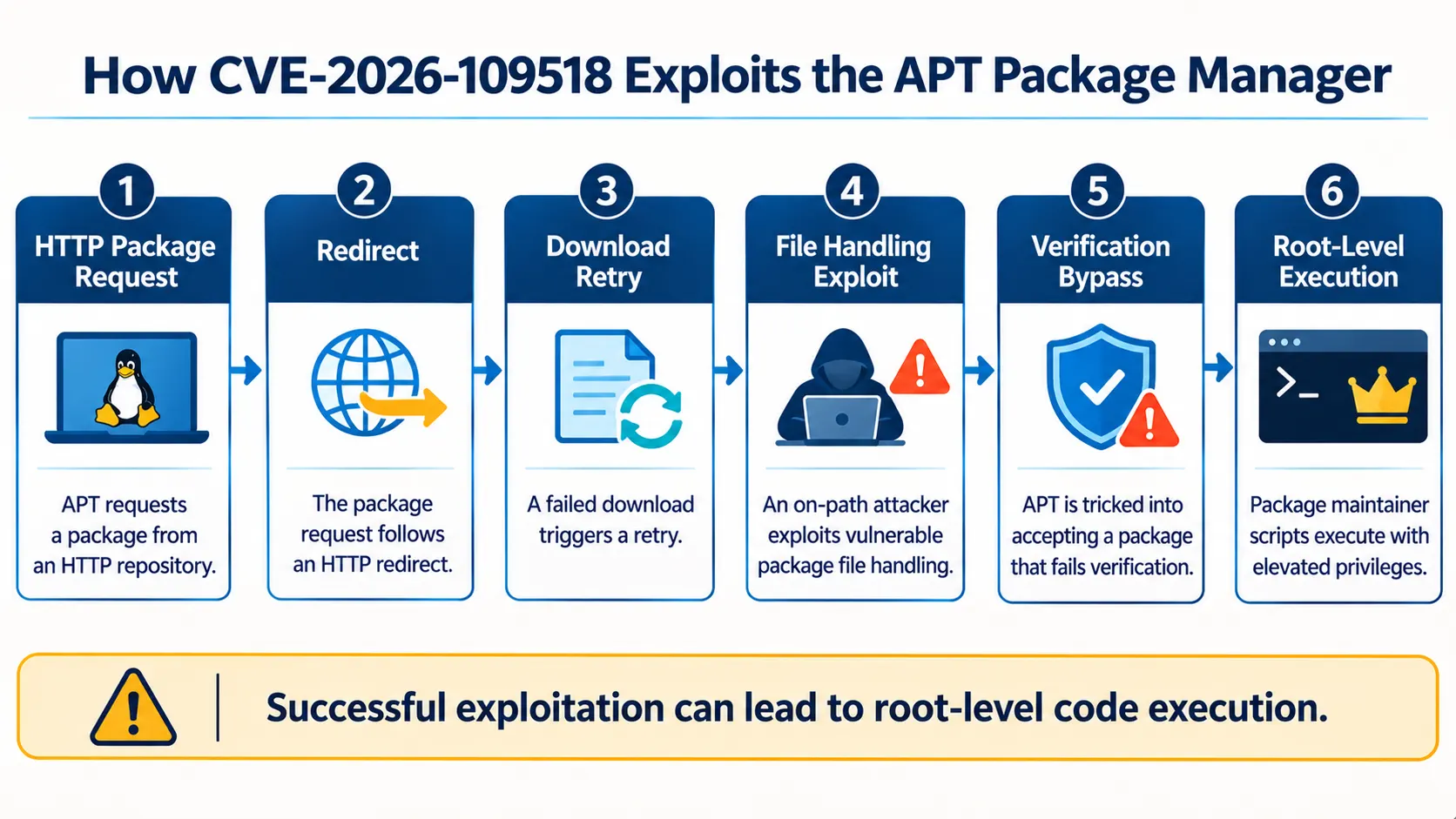
The attack process can be understood through these stages:
Package download begins: A system requests a Debian package from a configured HTTP repository.
HTTP redirect occurs: The download process follows a redirect that affects how the package request is handled.
Download retry is triggered: A failed or interrupted download causes APT to retry the request.
Package handling is manipulated: The attacker exploits the vulnerable file-handling behaviour to interfere with the package after verification.
Unverified package is installed: APT can be tricked into installing a package that did not pass verification.
Elevated code execution: The package's maintainer scripts run with root privileges.
The vulnerability is associated with the APT HTTP backend. Canonical states that it affects APT-based frontends, including apt, apt-get, aptitude, and Ubuntu graphical package-management applications.
The issue does not affect software installation through Snap packages, which use a different package-management system.
Ubuntu and Debian Releases Affected
AWS states that Ubuntu 22.04 LTS and later, along with Debian 12 and later, are affected in their default configurations.
The vulnerability is particularly relevant to systems configured to use HTTP package sources with retry settings enabled.
Canonical explains that the APT configuration option Acquire::Retries controls download retries. The vulnerability requires this setting to have a non-zero value.
Ubuntu 22.04 LTS and newer releases have this setting enabled by default. Older Ubuntu releases are affected only when the setting is configured with a non-zero value.
The following environments should be reviewed:
Ubuntu-based Amazon EC2 instances.
Debian-based Amazon EC2 instances.
Ubuntu container images.
Debian container images.
Systems using APT-based package-management applications.
AWS specifically asks customers who have consumed an Ubuntu 22.04 vended Amazon Machine Image (AMI) to take the recommended remediation steps.
The bulletin does not identify an AWS infrastructure compromise. Its guidance concerns customer-managed systems and workloads running affected operating systems.
Fixed APT Versions for Ubuntu and Debian
Canonical and Debian have released updated APT packages to address CVE-2026-109518.
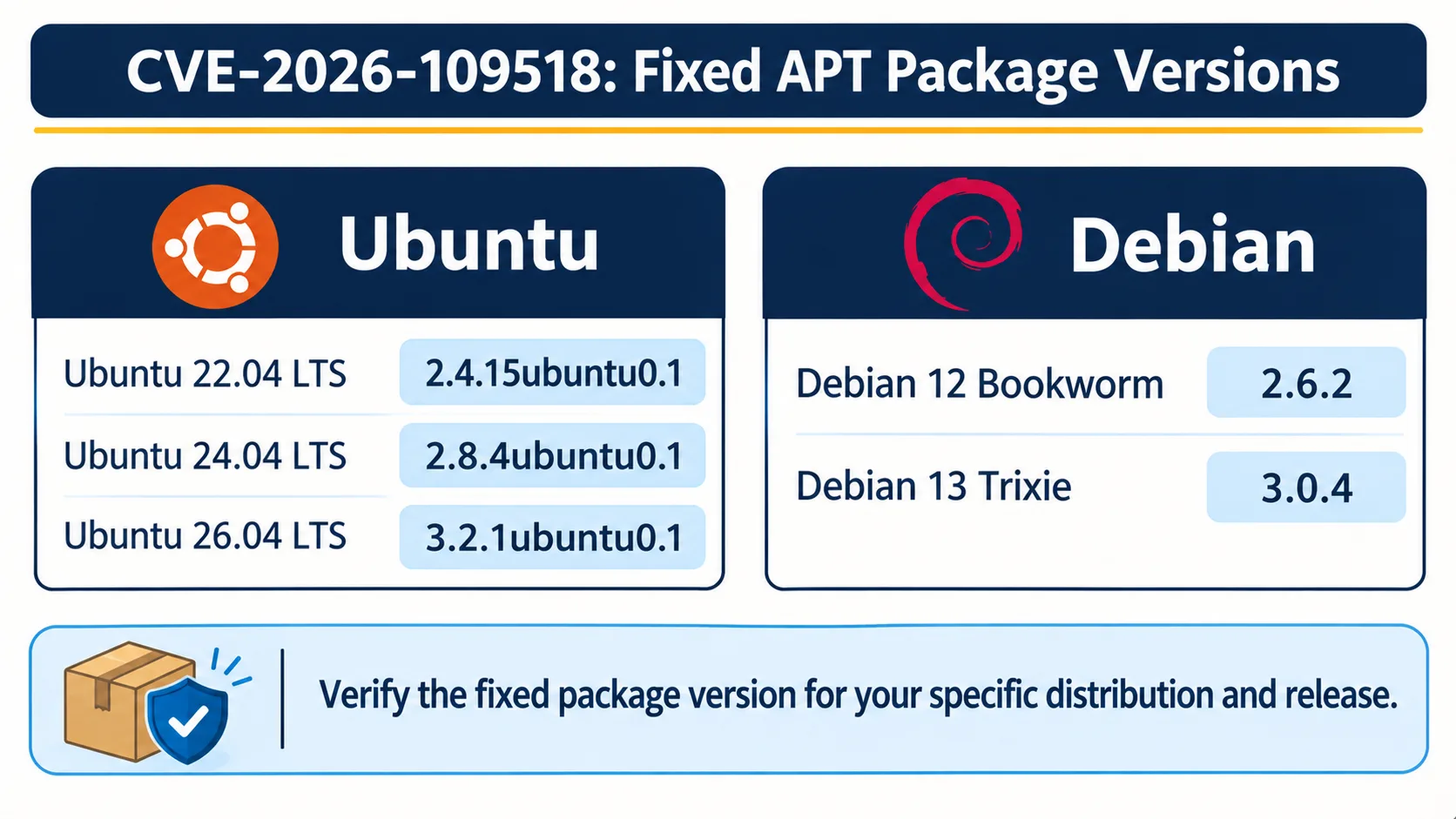
AWS identifies the following fixed Ubuntu package versions:
Operating system | Fixed APT version |
|---|---|
Ubuntu 22.04 LTS |
|
Ubuntu 24.04 LTS |
|
Ubuntu 26.04 LTS |
|
For Debian, AWS directs customers to Debian Security Advisory DSA-6607-1 for version details.
Debian's advisory identifies APT version 3.0.4 as the fix for the stable Trixie release. Debian's security tracker also lists the fixed package version for Bookworm as 2.6.2.
Customers should consult the security advisory for their specific Debian release and verify that the installed package has been updated to the appropriate fixed version.
AWS Recommends Updating APT Packages Immediately
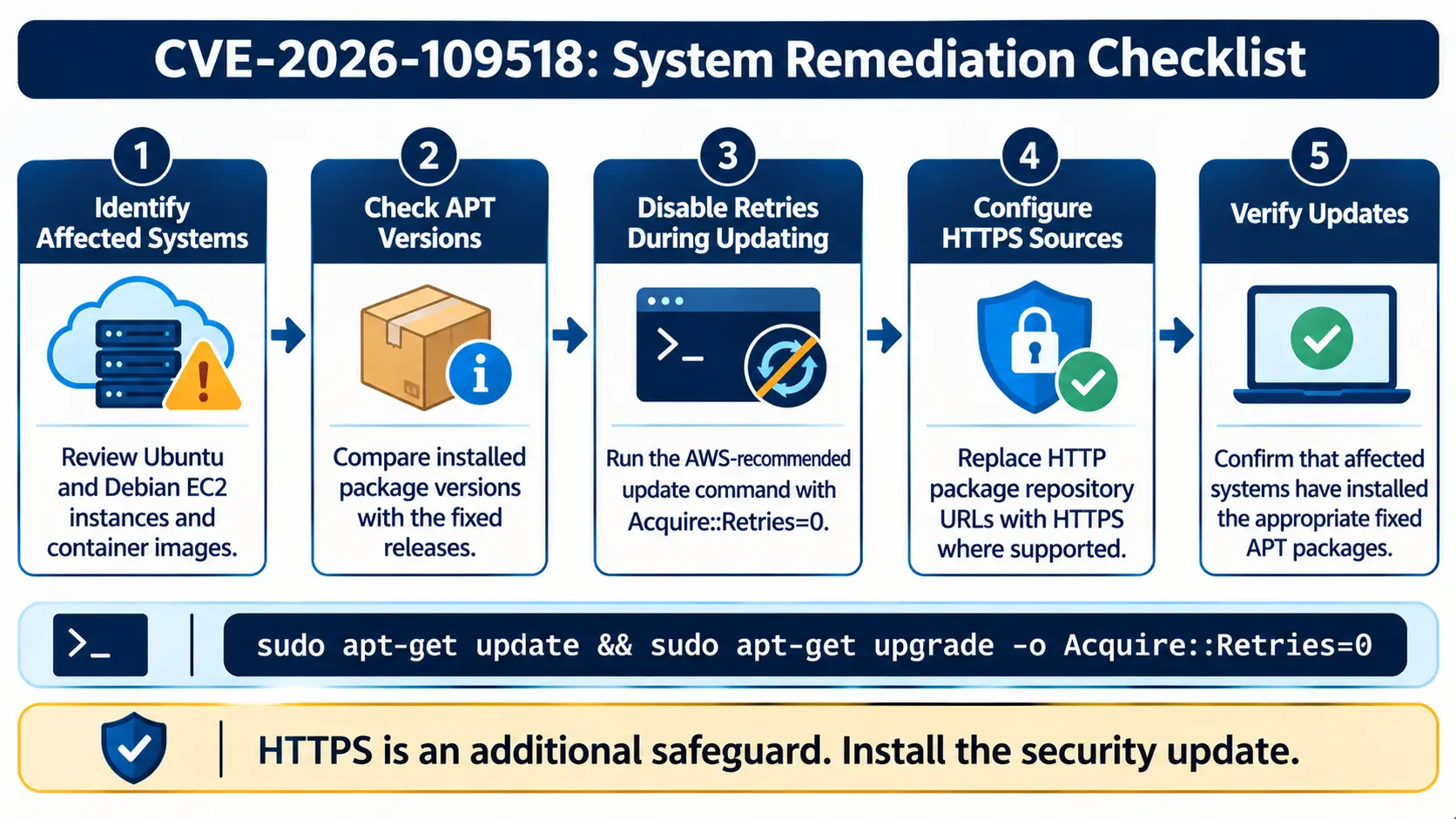
AWS recommends that customers running affected Ubuntu or Debian-based Amazon EC2 instances and container images review their environments and install the updated APT packages.
For affected instances, AWS provides the following update command:
sudo apt-get update && sudo apt-get upgrade -o Acquire::Retries=0The command refreshes the local package information and upgrades installed packages. The Acquire::Retries=0 option temporarily disables download retries during the update operation.
This is important because the vulnerability requires a non-zero retry setting. Temporarily setting it to zero provides mitigation while the security update is being installed.
Canonical also provides a command for upgrading only the affected APT package when a full system upgrade is not possible:
sudo apt update && sudo apt install -o Acquire::Retries=0 --only-upgrade '?source-package(^apt$)'After installing the security update, administrators should verify that the installed APT package matches the fixed version for their operating system release.
AWS Recommends HTTPS for APT Package Sources
Alongside installing the updated packages, AWS recommends configuring APT package sources to use HTTPS instead of HTTP.
HTTPS protects package traffic against an attacker who attempts to manipulate the connection between a system and its package repository.
Canonical confirms that using TLS through HTTPS protects against this vulnerability when the attack depends on manipulating HTTP traffic.
However, HTTPS should be treated as an additional protective measure, not a replacement for installing the security update.
Canonical recommends applying the available APT security updates even when HTTPS is enabled.
Administrators should review their APT repository configuration, including:
/etc/apt/sources.list/etc/apt/sources.list.d/
They should ensure that configured package repositories support HTTPS before changing their source URLs.
Amazon Inspector Can Help Identify Affected EC2 Instances
AWS recommends that customers using Amazon Inspector use the service to identify EC2 instances in their environments that may be affected by CVE-2026-109518.
This can help administrators locate potentially affected instances and prioritise remediation.
Customers should review the findings, confirm the operating system and installed APT package versions, and apply the appropriate security updates.
AWS also directs customers to the following resources for additional guidance:
What This Vulnerability Means for Cloud Administrators
CVE-2026-109518 highlights the importance of securing software supply-chain processes, including the package-management tools used to maintain cloud workloads.
APT is a fundamental component of Ubuntu and Debian environments. A vulnerability in its download and verification process can therefore affect systems that depend on these distributions for application hosting, infrastructure services, and container workloads.
For cloud administrators, the issue is not limited to identifying vulnerable EC2 instances. They should also review container images and deployment pipelines that use affected operating systems.
The recommendation to use HTTPS reinforces the importance of protecting package downloads in transit.
However, the primary remediation remains installing the corrected APT packages.
Organizations should prioritise reviewing affected systems, applying the available updates, and verifying that their package sources use secure transport where supported.
AWS states that it will update Bulletin 2026-172-AWS as more information becomes available.
Security Update: What Customers Should Do Next
CVE-2026-109518 can allow an attacker with a suitable network position to interfere with APT package downloads and cause an unverified package to be installed under specific conditions.
Because package maintainer scripts execute with elevated privileges, successful exploitation could result in serious system compromise.
AWS recommends that customers running affected Ubuntu and Debian environments review their EC2 instances and container images, install the fixed APT packages, and configure package sources to use HTTPS.
Administrators should use the fixed package version appropriate to each distribution and release, rather than relying solely on a successful package-update command.
Source: AWS Security Bulletins
About the Author