
AWS Fixes OAuth Token Validation Bypass in API MCP Server
AWS has patched CVE-2026-115413, an OAuth token audience validation bypass affecting AWS API MCP Server versions 1.3.0 to before 1.6.0. The flaw could allow a token issued to another application in the same tenant to authorize AWS API calls.
Xcademia Team
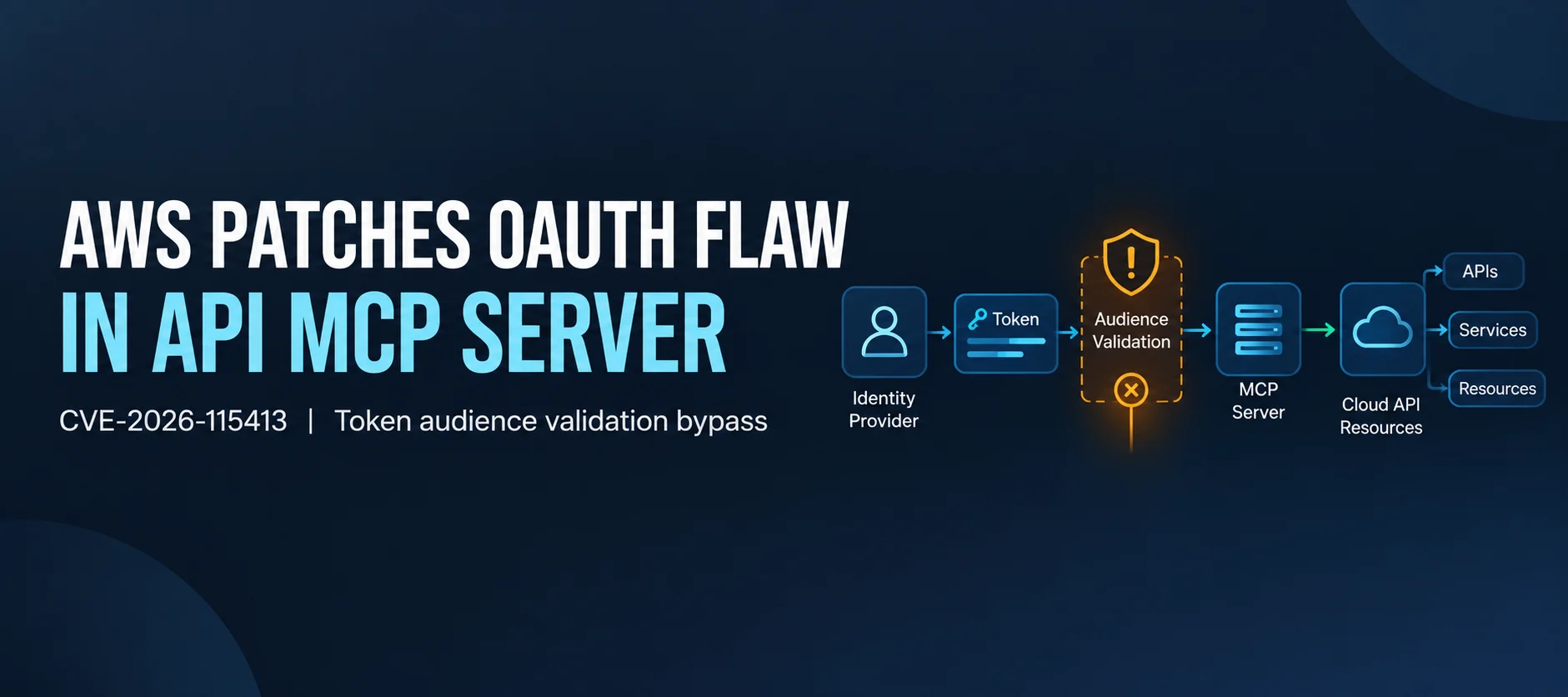
AWS has disclosed a security vulnerability in its open-source AWS API Model Context Protocol (MCP) Server that could allow tokens issued to one application to be accepted by another. The vulnerability, tracked as CVE-2026-115413, affects versions 1.3.0 and later before version 1.6.0 when the server uses streamable HTTP transport with OAuth authentication.
Published on October 27, 2026, AWS Security Bulletin 2026-152-AWS classifies the issue as Important and recommends upgrading to version 1.6.0 or later. Operators using OAuth authentication must also configure the expected token audience or client ID, depending on their identity provider.
The issue concerns how the server validates OAuth bearer tokens. Although affected versions check a token's signature, issuer and expiration, they do not verify the claim that identifies the application for which the token was issued. As a result, a token issued to a different application in the same tenant may be accepted, potentially allowing AWS API calls using credentials configured on the host.
AWS also provides a workaround for operators who cannot upgrade immediately: use the default standard input/output (stdio) transport instead of streamable HTTP.
What Is CVE-2026-115413?
CVE-2026-115413 is an OAuth token audience validation bypass in the AWS API MCP Server.
The server is an open-source implementation of the Model Context Protocol that enables AI assistants to interact with AWS services and resources through AWS CLI commands. It can be configured to use streamable HTTP transport with OAuth authentication, validating bearer tokens against an identity provider selected by the operator.
OAuth tokens contain claims that help a service determine whether a token is valid and intended for the relevant application. One important claim is the audience, which identifies the intended recipient of the token. Some identity providers may instead use a client ID to identify the application associated with an access token.
In affected versions, the server validates the token's signature, issuer and expiry but does not verify the application-identifying claim. This means that a token issued by the configured identity provider to another application in the same tenant may be accepted.
The GitHub security advisory identifies the issue as High severity, with a CVSS v4 score of 7.3. AWS's own bulletin classifies it as Important and requiring attention.
How the OAuth Validation Bypass Works
The problem occurs when the AWS API MCP Server uses streamable HTTP transport with OAuth authentication.
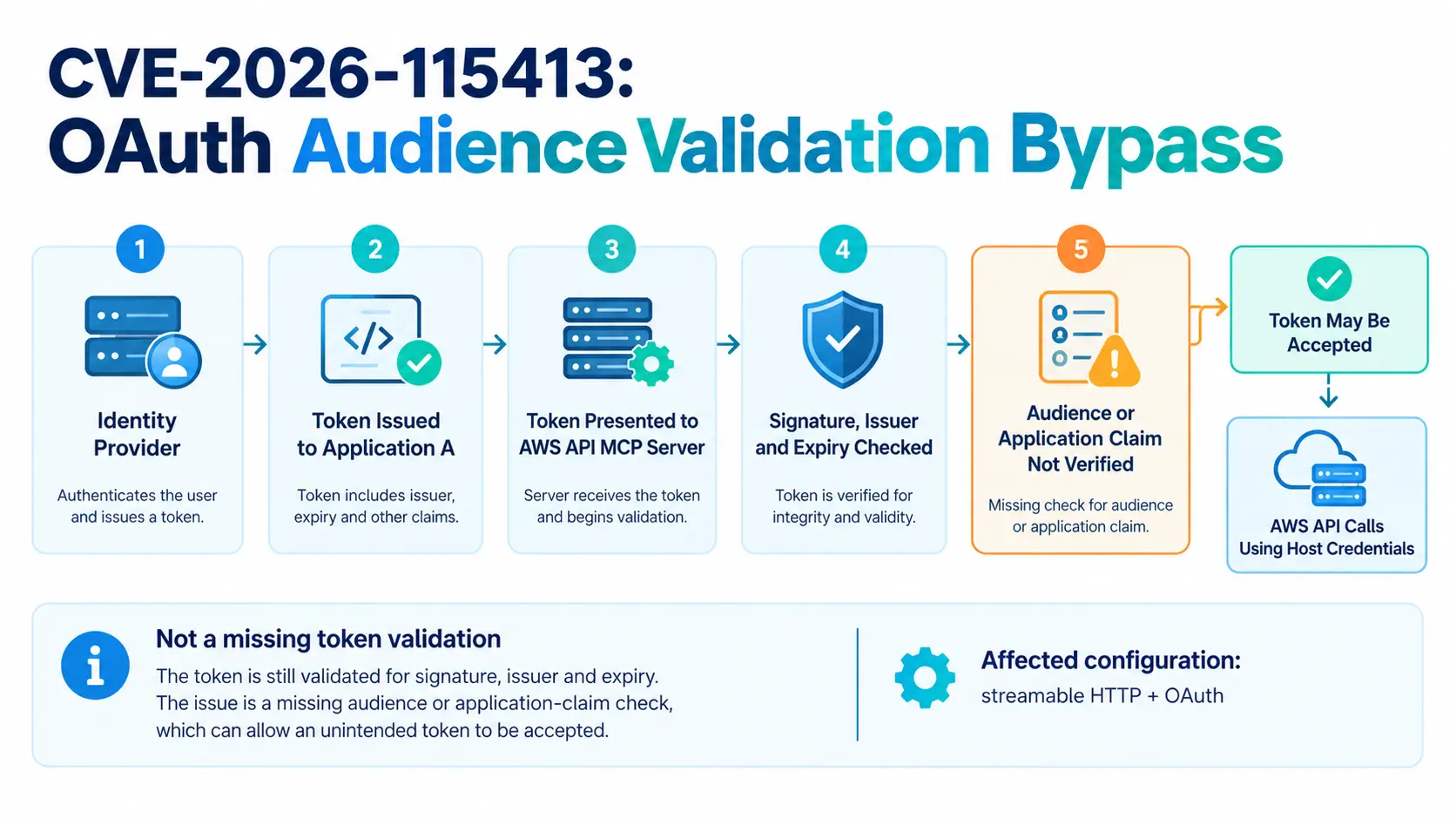
The validation gap can be understood through the following sequence:
An identity provider issues a token. The provider issues an OAuth access token to an application within a tenant.
The token is presented to the MCP server. A local caller holding a token issued to a different application in the same tenant reaches the server.
The server checks selected token properties. In affected versions, it validates the signature, issuer and expiry.
The intended application is not verified. The server does not validate the claim identifying which application the token was issued for.
The token may be accepted. The caller may then make AWS API calls using credentials configured on the host, subject to the permissions of those credentials.
The key issue is not that all OAuth checks are absent. Instead, one important validation step is missing: confirming that the token was issued for the application expected by the server.
The GitHub advisory notes that the affected configuration is limited to deployments using streamable HTTP transport with OAuth authentication. It does not describe this specific vulnerability as affecting every transport or authentication configuration.
Which Versions Are Affected?
AWS lists the impacted version range as 1.3.0 or later and earlier than 1.6.0.
Component | Affected versions | Fixed version |
|---|---|---|
|
|
|
The security fix is available in awslabs.aws-api-mcp-server 1.6.0 on PyPI.
AWS recommends upgrading to the latest available version and ensuring that any forks or derivative implementations are updated to incorporate the fix.
The advisory does not provide a separate list of affected operating systems. The stated version range applies to the named package, and operators should check their installed version and deployment configuration.
How to Fix CVE-2026-115413
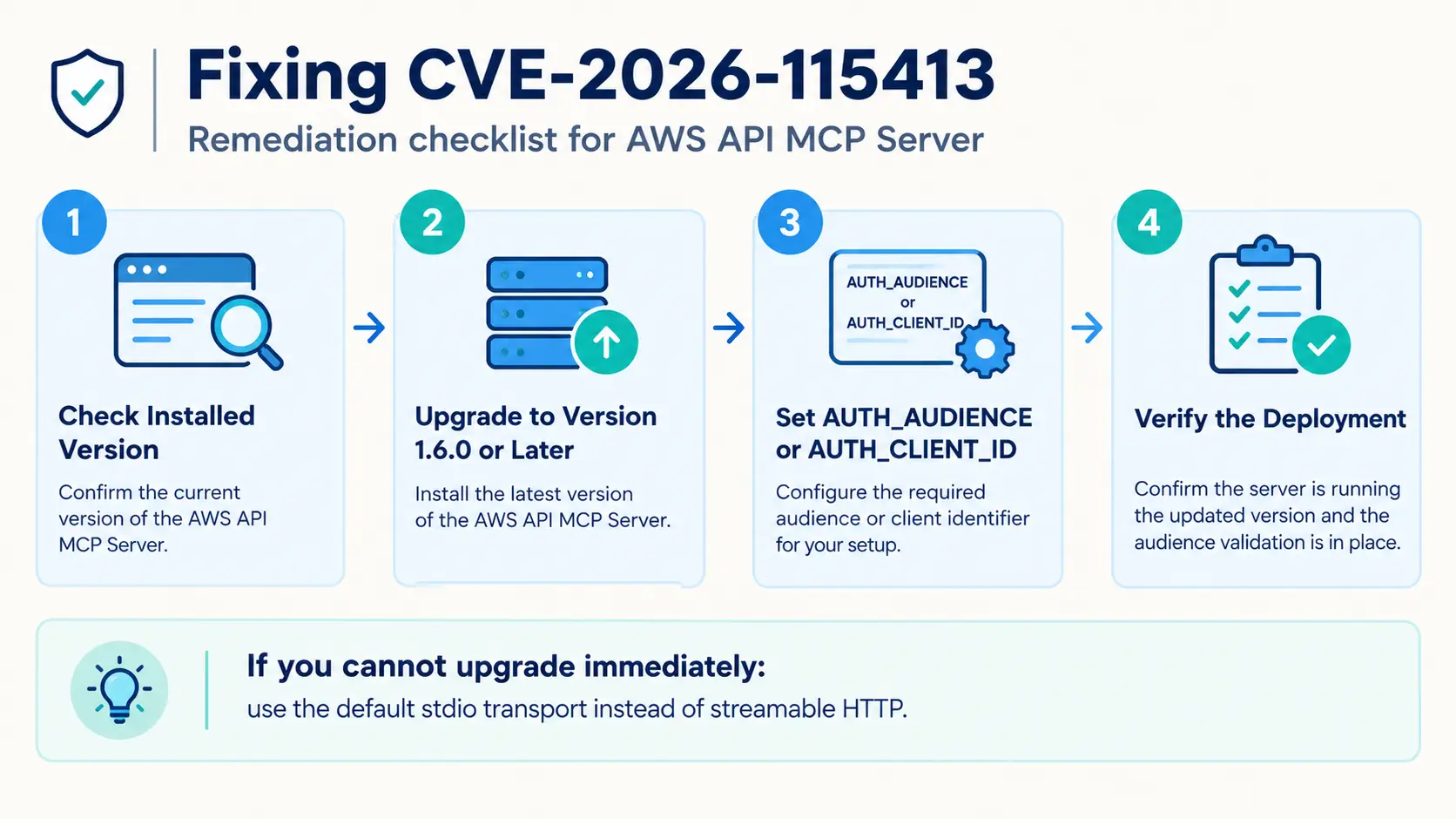
AWS recommends upgrading to version 1.6.0 or later. Operators using OAuth authentication must also configure the expected audience or client ID.
1. Upgrade the AWS API MCP Server
Update awslabs.aws-api-mcp-server to the latest version. Version 1.6.0 addresses the vulnerability.
Organizations using forked or derivative code should ensure that the relevant validation fix has also been incorporated into those implementations.
2. Configure the Expected Token Audience
Operators using AUTH_TYPE=oauth should set AUTH_AUDIENCE to specify the expected token audience.
For identity providers whose access tokens do not carry an audience claim, such as Amazon Cognito, AWS advises using AUTH_CLIENT_ID instead.
These settings help the server verify that a token is intended for the application it is protecting, rather than accepting a token simply because it comes from the same identity provider and tenant.
3. Use the Recommended Workaround if an Upgrade Is Delayed
Operators who cannot upgrade immediately can use the default stdio transport instead of streamable HTTP.
This is the workaround specified by AWS. The bulletin does not provide a separate list of alternative mitigations for keeping the affected streamable HTTP and OAuth configuration in place.
4. Verify the Deployment
After updating, confirm that the deployed package is running a fixed version and that OAuth configuration includes the expected audience or client ID as applicable.
Also review any forked or derivative code and check that it includes the relevant fix.
What This Means for AI Infrastructure Security
Analysis: The disclosure highlights the importance of validating not only whether an OAuth token is authentic, but also whether it was issued for the application receiving it.
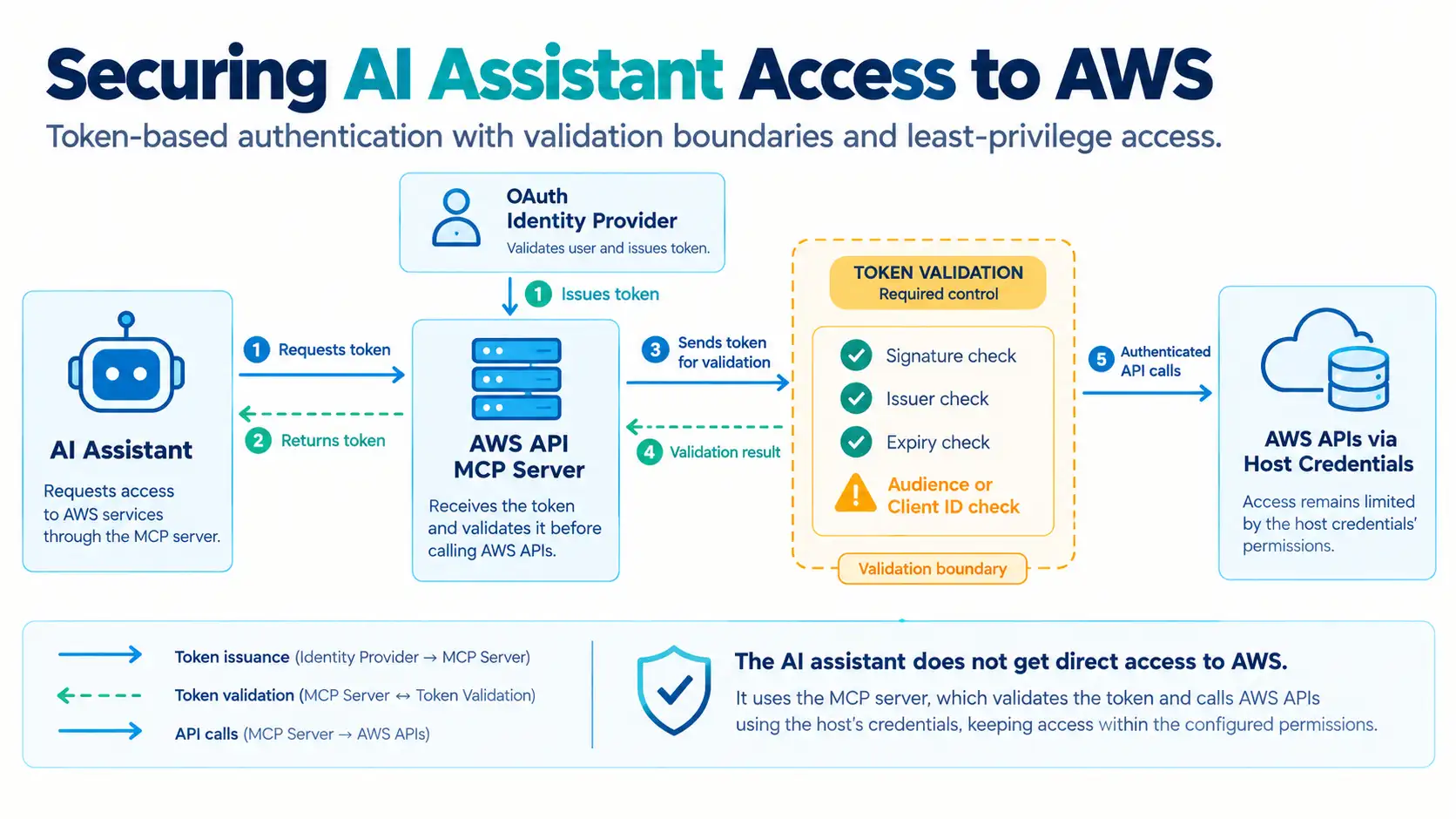
MCP servers can act as a bridge between AI assistants and external systems. In this case, the AWS API MCP Server enables interactions with AWS services through AWS CLI commands, using credentials configured on the host. A token validation weakness can therefore affect the security of the interface through which those API calls are made.
The impact remains dependent on the deployment configuration and the permissions of the credentials available to the server. The GitHub advisory explicitly states that the resulting AWS API calls are bounded by those configured credential permissions.
For organizations adopting AI-assisted infrastructure workflows, this is a reminder to review authentication settings alongside the permissions granted to the underlying cloud credentials. Updating the affected package and verifying token audience or client ID configuration address the specific issue described in the advisory.
AWS has not stated in this bulletin that the vulnerability has been exploited in the wild. Additional details were not disclosed in the announcement.
Conclusion
AWS has disclosed and patched CVE-2026-115413, a High-severity OAuth token audience validation bypass in AWS API MCP Server versions 1.3.0 to before 1.6.0. The issue affects deployments using streamable HTTP transport with OAuth authentication, where the server does not verify the application-identifying claim in the token.
AWS recommends upgrading to version 1.6.0 or later, configuring AUTH_AUDIENCE or AUTH_CLIENT_ID as appropriate, and patching forked or derivative implementations. Operators who cannot upgrade immediately can use the default stdio transport instead of streamable HTTP.
Source: Amazon Web Services (AWS)
About the Author