
AWS Fixes EKS Network Policy Flaw That Could Allow Ingress Restrictions to Be Bypassed
AWS has addressed CVE-2026-122266 in the Amazon EKS Network Policy Agent. The flaw could allow an authenticated adjacent user to bypass NetworkPolicy ingress enforcement on co-located pods.
Xcademia Team
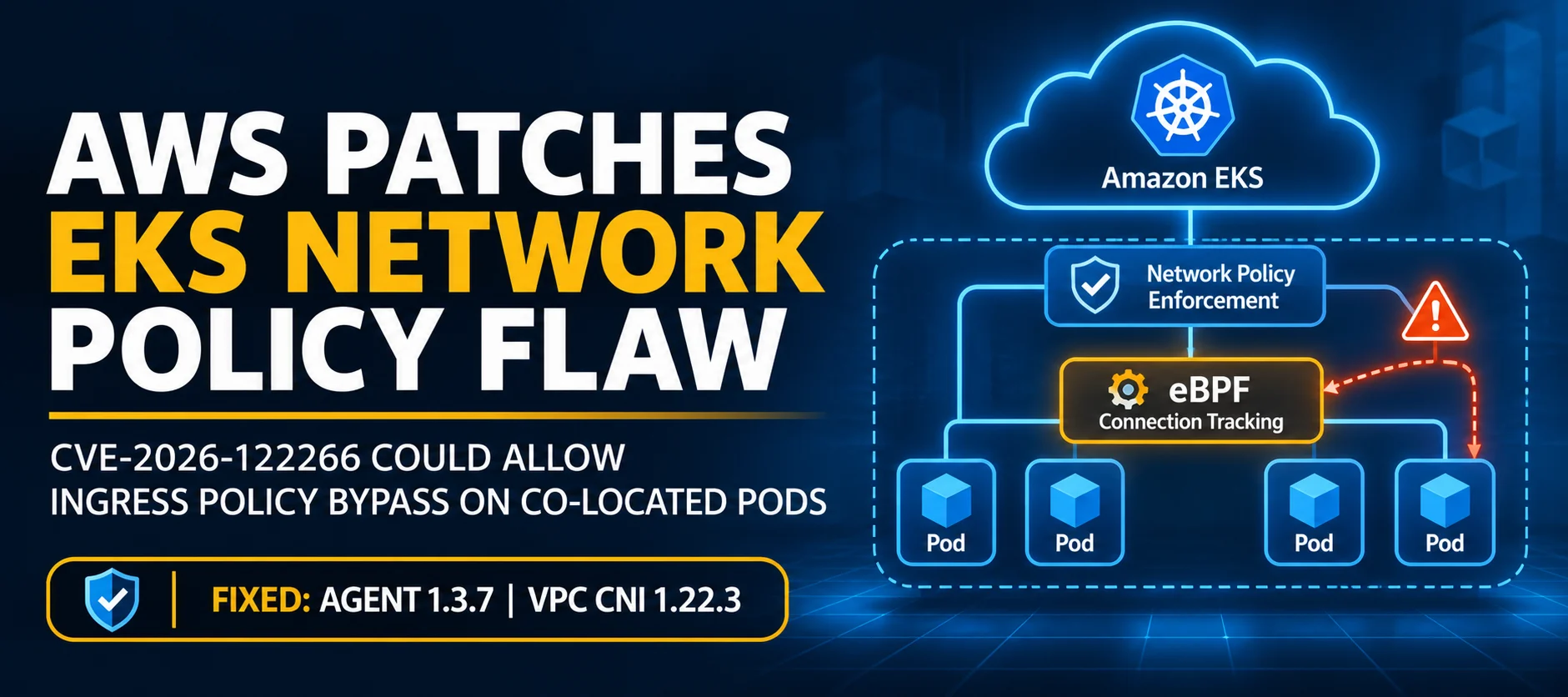
AWS has disclosed a security vulnerability in the Amazon EKS Network Policy Agent that could allow an authenticated adjacent user to bypass Kubernetes NetworkPolicy ingress enforcement on co-located pods.
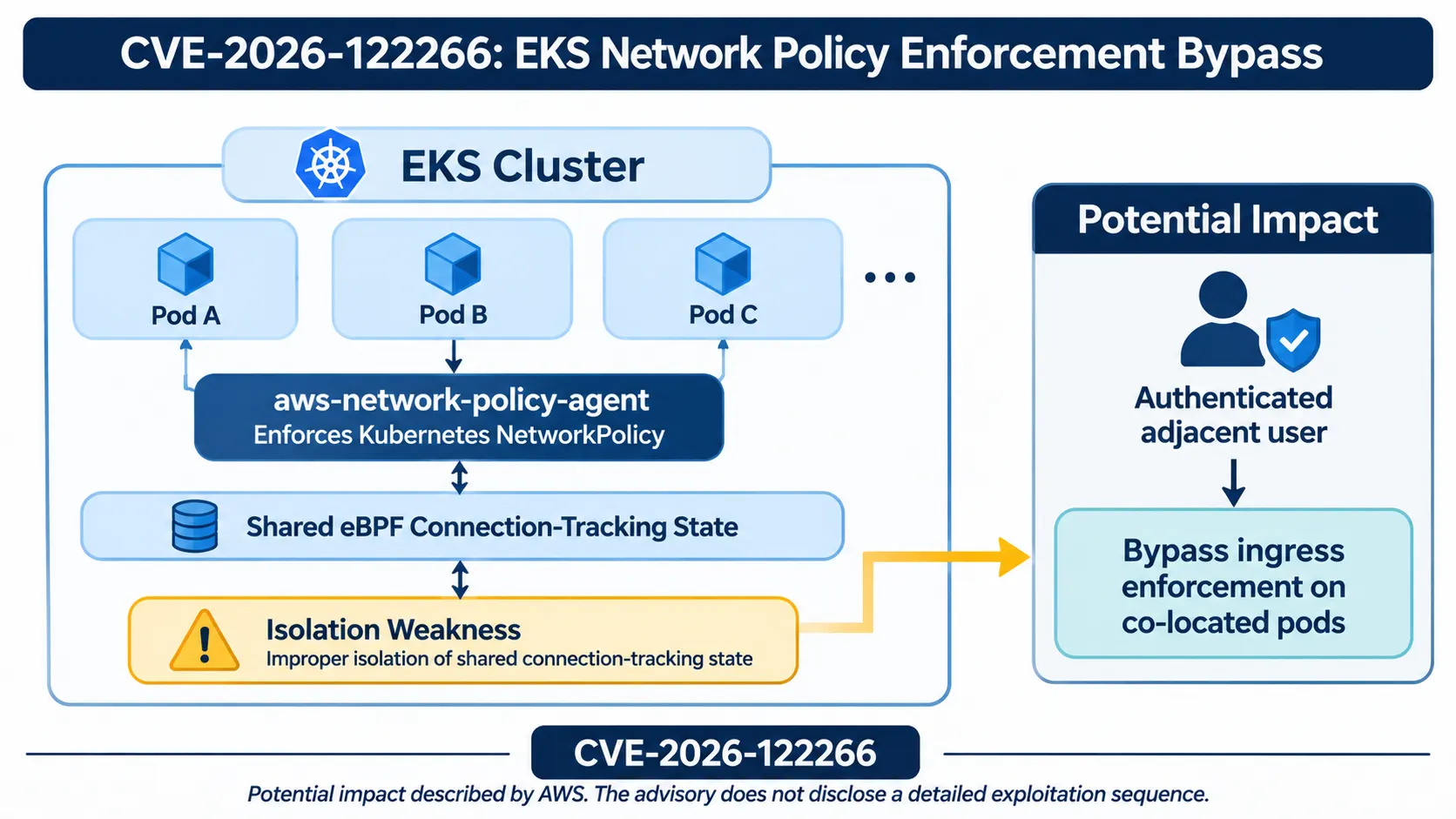
Tracked as CVE-2026-122266, the issue involves improper isolation of shared eBPF connection-tracking state in the aws-network-policy-agent component. Under the conditions described in the advisory, an authenticated adjacent user could potentially bypass network ingress restrictions applied to co-located pods.
AWS published the security bulletin, 2026-170-AWS, on November 4, 2026. The advisory identifies versions of the Network Policy Agent earlier than 1.3.7 and Amazon VPC CNI Managed Add-on versions earlier than 1.22.3 as affected.
The issue has been addressed in aws-network-policy-agent version 1.3.7 and amazon-vpc-cni-k8s version 1.22.3. AWS recommends upgrading to the latest available versions and applying the fixes to any forked or derivative code.
AWS also confirms that no workarounds are available.
What Is CVE-2026-122266?
CVE-2026-122266 is an improper isolation vulnerability affecting the Amazon EKS Network Policy Agent.
The aws-network-policy-agent is an open-source component of the Amazon VPC Container Network
Interface (VPC CNI). It enforces Kubernetes NetworkPolicy rules on Amazon Elastic Kubernetes Service (EKS) clusters.
Kubernetes NetworkPolicy rules help control network communication involving pods. These policies can define which incoming and outgoing connections are permitted, supporting network segmentation within a cluster.
According to AWS, the vulnerability stems from improper isolation of shared eBPF connection-tracking state.
eBPF is a technology used by the Linux kernel to run programs that can support networking and other system-level functions. In this case, the affected component uses eBPF-related connection-tracking state as part of its network policy enforcement.
AWS warns that the isolation issue could allow an authenticated adjacent user to bypass NetworkPolicy ingress enforcement on co-located pods.
The advisory does not provide further technical details about the precise exploitation sequence, affected configurations or conditions required to trigger the issue.
Which Amazon EKS Components Are Affected?
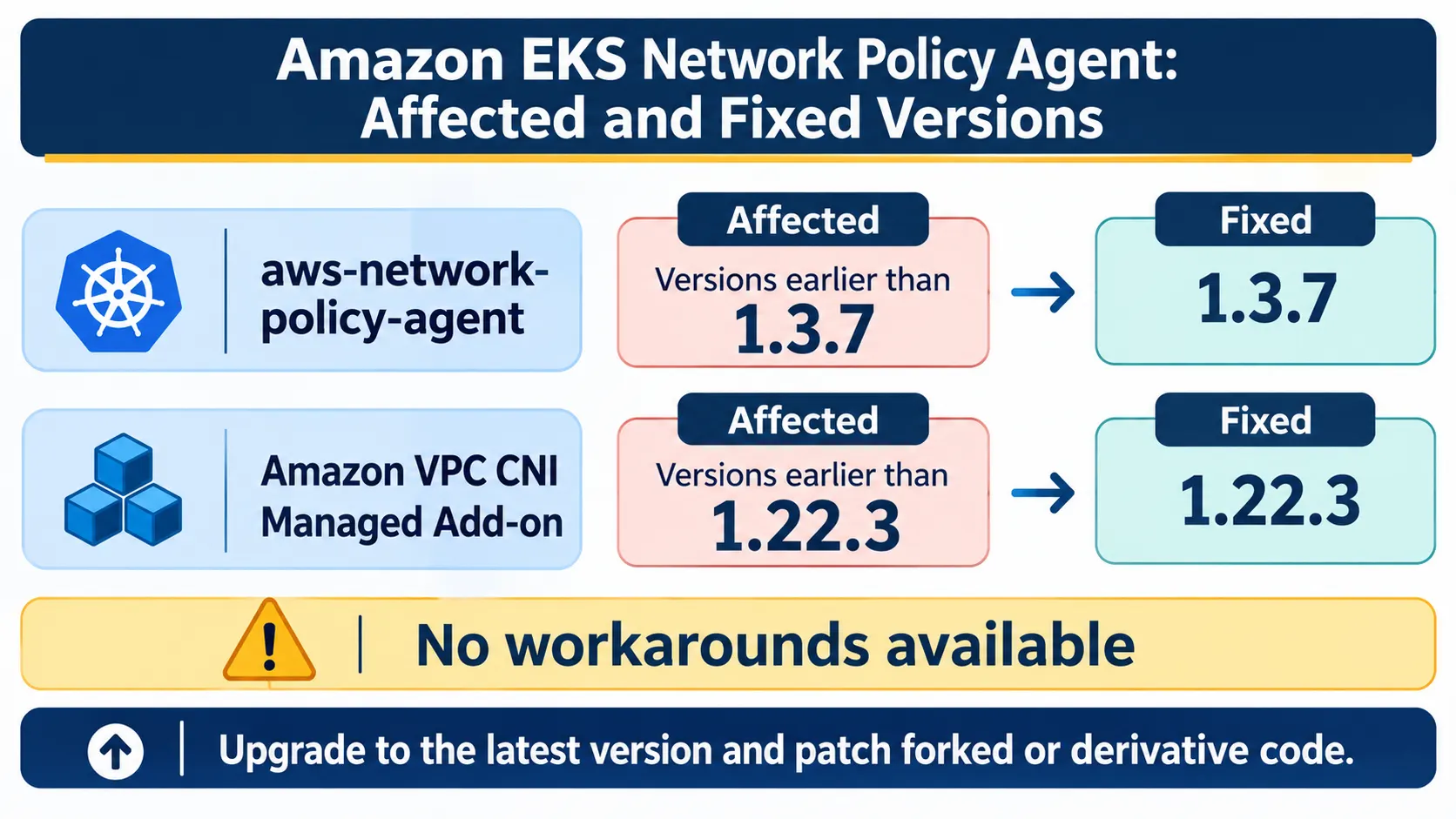
AWS identifies two affected software components and their corresponding fixed versions.
Component | Affected versions | Fixed version |
|---|---|---|
| Earlier than 1.3.7 | 1.3.7 |
Amazon VPC CNI Managed Add-on | Earlier than 1.22.3 | 1.22.3 |
Administrators should check which versions are deployed in their Amazon EKS environments.
The advisory also specifically recommends ensuring that forked or derivative versions of the affected code incorporate the new fixes.
AWS does not provide a detailed list of affected cluster configurations or additional version-specific conditions in the bulletin.
How the Vulnerability Could Affect Kubernetes Network Policies
The issue concerns the isolation of shared eBPF connection-tracking state used by the Amazon EKS Network Policy Agent.
NetworkPolicy enforcement is intended to control traffic between workloads and other network endpoints. When ingress rules are applied, they help restrict which sources can communicate with selected pods.
AWS says the vulnerability could allow an authenticated adjacent user to bypass this ingress enforcement on co-located pods.
For organizations operating multi-workload Kubernetes environments, this makes the issue relevant to network segmentation and workload isolation.
However, the advisory does not state that the vulnerability provides arbitrary code execution, access to the host operating system or a way to compromise an entire EKS cluster. It specifically describes a potential bypass of NetworkPolicy ingress enforcement under the stated access conditions.
AWS has not disclosed whether the vulnerability has been exploited in the wild or reported any confirmed incidents associated with it.
AWS Releases Security Updates
AWS has addressed the vulnerability through updated releases of the affected components.
The fixed versions are:
aws-network-policy-agent 1.3.7
amazon-vpc-cni-k8s 1.22.3
AWS recommends upgrading to the latest version rather than relying only on the minimum fixed release. It also advises organizations maintaining forks or derivative code to incorporate the new fixes.
The bulletin explicitly states that no workarounds are available.
Administrators should therefore prioritize applying the vendor-provided updates to affected deployments.
What Amazon EKS Administrators Should Do
Organizations using the Amazon EKS Network Policy Agent or Amazon VPC CNI should review their deployments and apply the security updates.
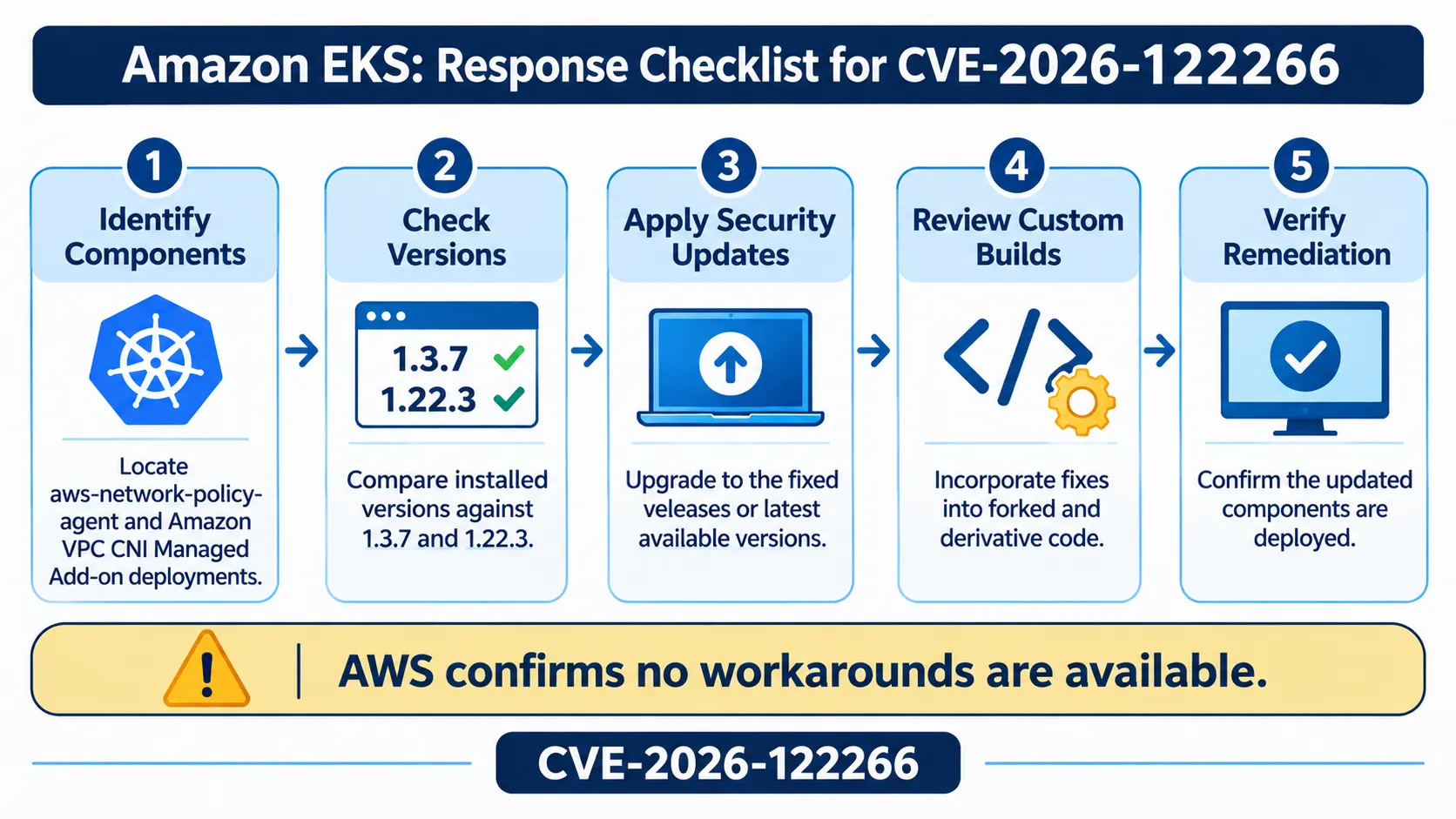
Recommended actions based on the AWS bulletin include:
Check the installed Network Policy Agent version. Determine whether the deployment uses a version earlier than 1.3.7.
Review the Amazon VPC CNI Managed Add-on version. Identify installations earlier than 1.22.3.
Upgrade affected components. Apply the fixed releases or newer versions recommended by AWS.
Review forked and derivative code. Ensure custom builds incorporate the security fixes.
Verify the updated deployment. Confirm that the relevant components are running the corrected versions.
Because AWS states that no workarounds are available, organizations should not treat temporary configuration changes as a substitute for applying the updates.
The bulletin does not provide specific upgrade commands, deployment procedures or additional detection indicators. Administrators should consult the official AWS and GitHub security advisories for implementation guidance.
What the Vulnerability Means for EKS Security
CVE-2026-122266 highlights the importance of maintaining the components responsible for enforcing network segmentation in Kubernetes environments.
The Amazon EKS Network Policy Agent helps enforce traffic policies across workloads. A weakness in the isolation of its shared connection-tracking state could undermine ingress restrictions between co-located pods under the conditions described by AWS.
For organizations operating EKS clusters, the advisory reinforces the need to track updates not only for Kubernetes itself but also for networking components and managed add-ons that enforce workload security.
AWS has released corrected versions and confirmed that no workarounds are available. Administrators should review affected deployments, apply the updates and ensure that any maintained forks include the fixes.
About the Author