
AWS Fixes Certificate Authorization Flaw in Private CA Connector for Kubernetes
AWS has fixed CVE-2026-119115, an authorization flaw that could let authenticated users obtain certificates from unauthorized cluster-scoped issuers. Organizations should upgrade and audit issuer references before deployment.
Xcademia Team
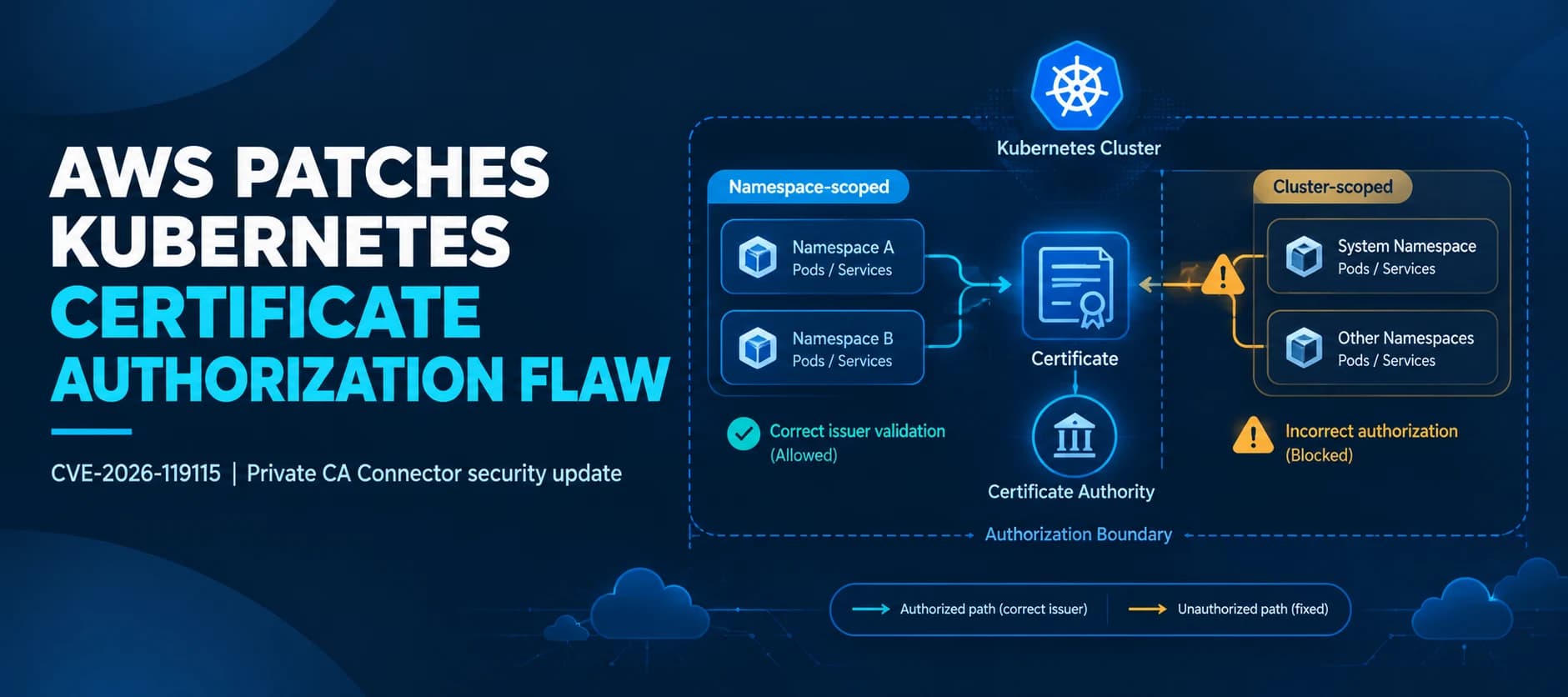
AWS has addressed an authorization vulnerability in AWS Private CA Connector for Kubernetes that could allow authenticated users to obtain certificates from an issuer they were not authorized to use.
Tracked as CVE-2026-119115, the issue affects the issuer resolution logic in aws-privateca-issuer, an external issuer for cert-manager that signs certificate requests using AWS Private Certificate Authority.
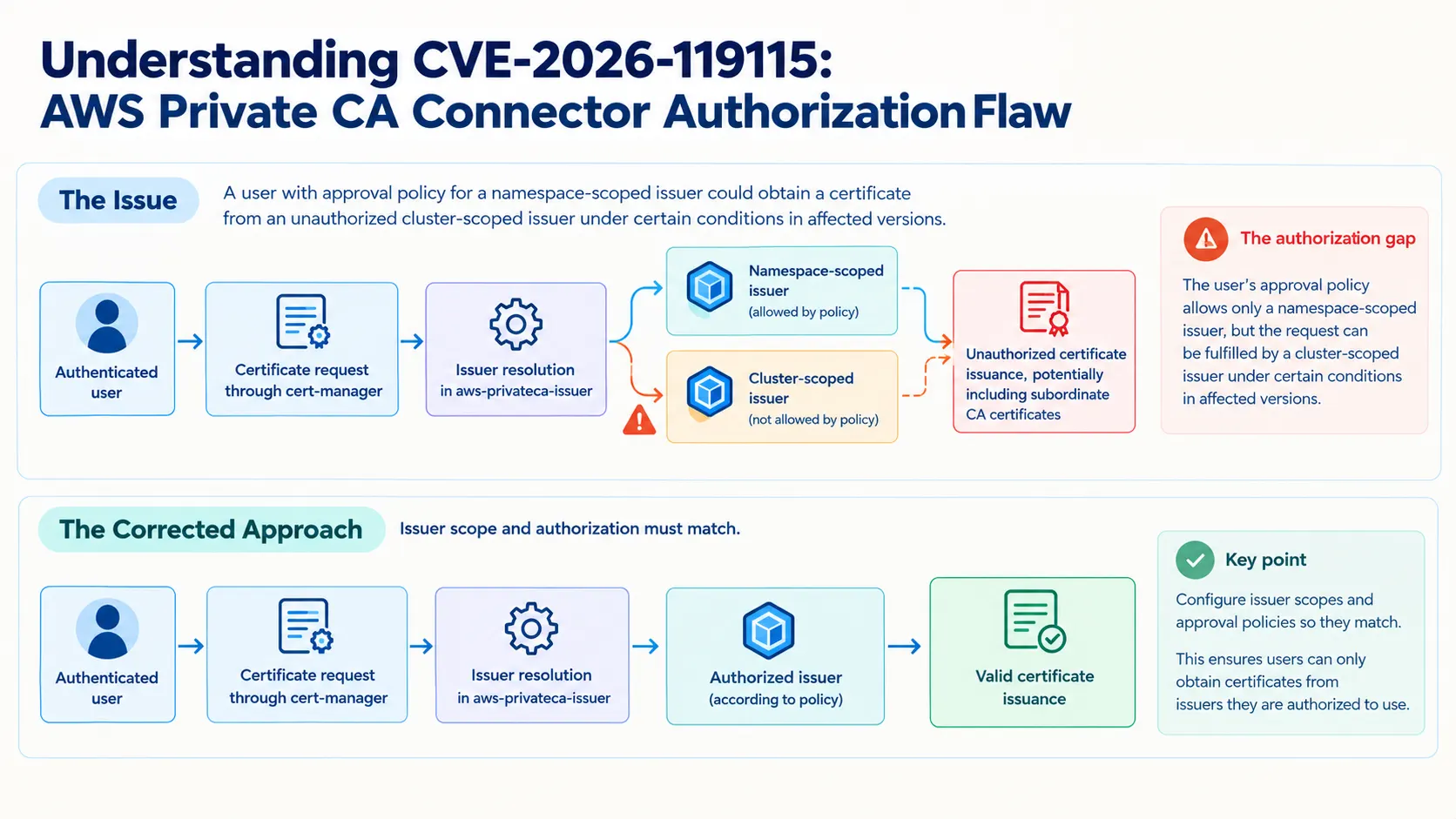
According to AWS Security Bulletin 2026-156-AWS, the vulnerability could affect users whose certificate approval policies authorize only namespace-scoped issuers. Under certain conditions, an authenticated user could obtain certificates, including subordinate CA certificates, signed by a cluster-scoped issuer outside their authorization.
AWS classified the bulletin as Important (requires attention) and published it on October 29, 2026.
The company has released fixes for the affected software and recommends upgrading. However, administrators must review their certificate resources before upgrading because the fixed version enforces stricter issuer reference validation.
What Is CVE-2026-119115?
CVE-2026-119115 is an incorrect authorization vulnerability in the issuer resolution logic of AWS Private CA Connector for Kubernetes.
The connector integrates AWS Private Certificate Authority with cert-manager. It acts as an external issuer, allowing certificate requests managed through cert-manager to be signed using AWS Private CA.
The issue concerns how the connector resolves an issuer when processing a certificate request.
In affected versions, an authenticated user whose approval policy permits access only to a namespace-scoped issuer could, under certain conditions, obtain a certificate signed by a cluster-scoped issuer that the user was not authorized to use.
This could include subordinate CA certificates.
The vulnerability therefore involves an authorization boundary between namespace-scoped and cluster-scoped issuers. The concern is not simply whether a user can submit a certificate request, but whether the request can be resolved against an issuer beyond the user's permitted scope.
Which AWS Private CA Connector Versions Are Affected?
AWS identifies the following affected versions:
Component | Affected versions |
|---|---|
| Versions before |
AWS Private CA Connector for Kubernetes EKS add-on | Versions before |
Organizations using either component should check their deployed versions and determine whether their certificate approval policies and issuer configurations could be affected.
AWS does not provide a CVSS score or a detailed exploitation assessment in the bulletin.
AWS Releases Fixes for the Authorization Issue
AWS has addressed CVE-2026-119115 in the following releases:
aws-privateca-issuer:
v1.10.1AWS Private CA Connector for Kubernetes EKS add-on:
v1.10.1-eksbuild.1
AWS recommends upgrading to the latest version and ensuring that any forked or derivative code is also patched to incorporate the fixes.
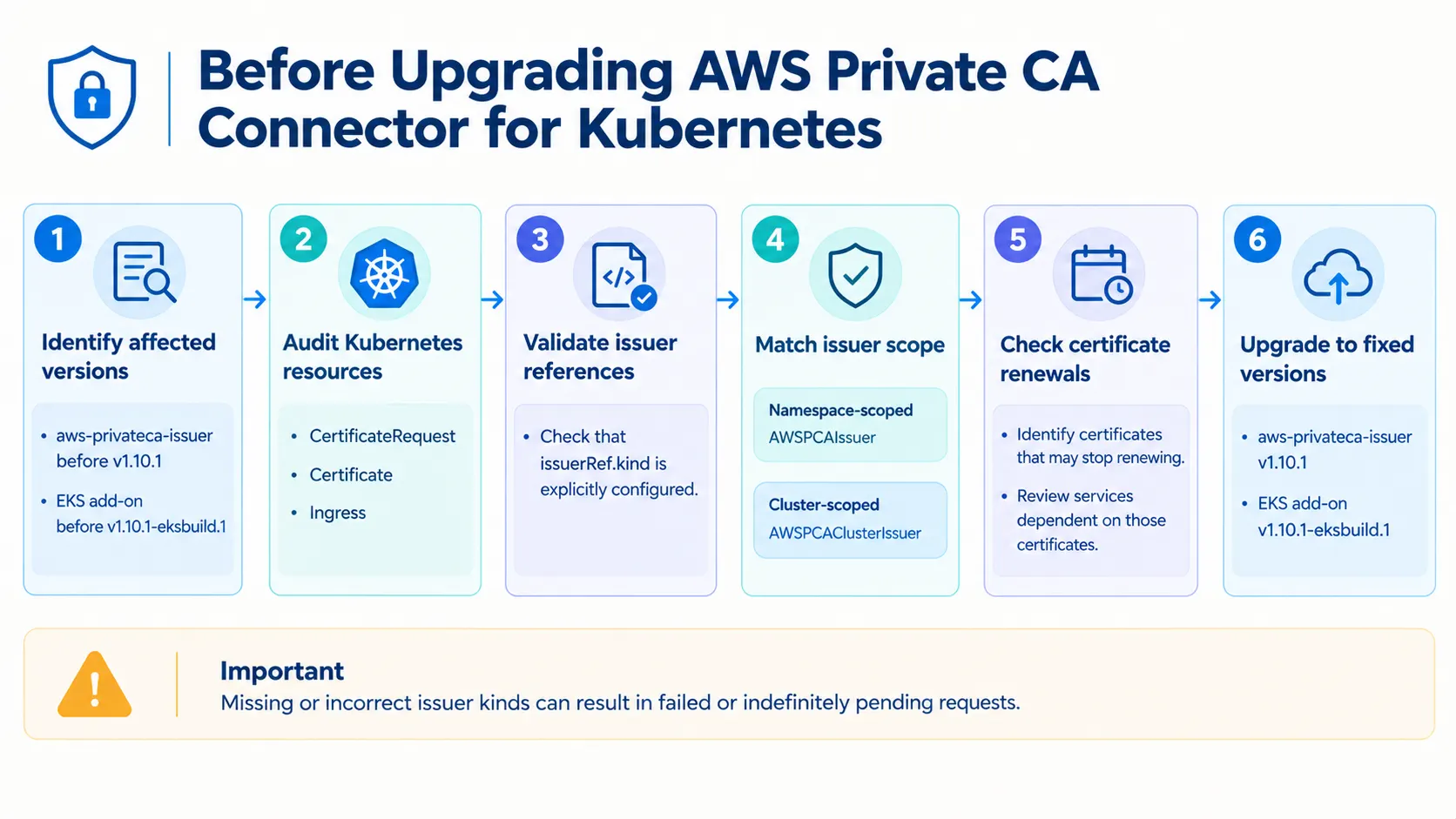
The update changes how issuer references are validated. The fixed version requires issuerRef.kind to be explicitly set to either AWSPCAIssuer or AWSPCAClusterIssuer, and the specified kind must match the type of issuer being referenced.
This stricter validation is important for administrators because some certificate requests that worked under the previous, more lenient resolution behavior may no longer renew successfully after the upgrade.
Administrators Must Audit Certificate Resources Before Upgrading
AWS highlights a compatibility consideration that organizations should address before deploying version v1.10.1.
Certificate requests that relied on the previous issuer resolution behavior will stop renewing after the upgrade. Services that depend on those certificates could be affected when the certificates expire.
AWS identifies two configuration scenarios that can cause problems:
1. Missing or incorrect issuer kind
A certificate request with a missing or incorrect issuerRef.kind will now be marked as Failed.
This includes requests with kind: Issuer, which cert-manager sets for Ingress annotations that do not specify an issuer kind.
2. Namespace-scoped kind referencing a cluster-scoped issuer
A request specifying kind: AWSPCAIssuer but referencing a cluster-scoped issuer will remain Pending indefinitely.
To avoid these issues, AWS recommends auditing the following Kubernetes resources before upgrading:
CertificateRequestCertificateIngress
Administrators should explicitly configure issuerRef.kind to match the referenced issuer.
The required mapping is:
Issuer scope | Required |
|---|---|
Namespace-scoped issuer |
|
Cluster-scoped issuer |
|
This validation should be completed before the updated connector is deployed to avoid certificate renewal failures and potential service disruption when existing certificates expire.
AWS Provides a Workaround for Organizations That Cannot Upgrade Immediately
For organizations that cannot upgrade immediately, AWS provides a workaround involving certificate approval policies and Kubernetes Role-Based Access Control (RBAC).
The company recommends scoping both certificate approval policies and RBAC rules to:
The issuer name.
The issuer kind.
This helps ensure that authorization decisions account for both the identity and scope of the issuer rather than relying on the issuer name alone.
AWS recommends applying this workaround when an immediate upgrade is not possible. It does not replace the need to install the fixed version.
Recommended Actions for Kubernetes Administrators
Organizations using AWS Private CA Connector for Kubernetes should review their deployments and certificate configurations before upgrading.
The following actions reflect AWS's published guidance:
Check deployed versions: Identify installations of
aws-privateca-issuerbeforev1.10.1and EKS add-ons beforev1.10.1-eksbuild.1.Review certificate resources: Audit
CertificateRequest,Certificate, andIngressresources for missing or incorrect issuer references.Set issuer kinds explicitly: Use
AWSPCAIssuerfor namespace-scoped issuers andAWSPCAClusterIssuerfor cluster-scoped issuers.Check renewal dependencies: Identify services relying on certificates that may stop renewing after the upgrade.
Deploy the fixed release: Upgrade to
aws-privateca-issuerv1.10.1or the EKS add-onv1.10.1-eksbuild.1, as applicable.Patch derivative code: Ensure forked or derivative implementations incorporate the security fixes.
Apply the workaround if necessary: If an immediate upgrade is not possible, scope certificate approval policies and RBAC rules to both issuer name and issuer kind.
What the Vulnerability Means for Kubernetes Certificate Management
Industry analysis: CVE-2026-119115 highlights the importance of enforcing authorization boundaries in certificate management workflows.
Kubernetes environments can use different issuer scopes to manage certificate issuance across namespaces and clusters. When issuer resolution does not correctly enforce those boundaries, users may gain access to certificate-signing authority beyond the scope permitted by their approval policies.
The potential impact is particularly important because the bulletin explicitly includes subordinate CA certificates among the certificates that could be obtained under the described conditions.
The upgrade also demonstrates why security fixes involving authorization logic can require configuration reviews. Organizations must address the vulnerability while ensuring that existing certificate requests continue to reference the correct issuer type.
For platform and security teams, the practical priority is to combine the software update with a review of issuer references, approval policies, RBAC rules and certificate renewal dependencies.
Conclusion: Upgrade After Validating Issuer References
AWS has fixed CVE-2026-119115 in AWS Private CA Connector for Kubernetes and its EKS add-on. The vulnerability could allow authenticated users with namespace-scoped issuer approval to obtain certificates, including subordinate CA certificates, from unauthorized cluster-scoped issuers under certain conditions.
The fixed releases introduce stricter issuerRef.kind validation. Administrators should therefore audit their CertificateRequest, Certificate, and Ingress resources before upgrading.
Organizations should deploy the corrected versions, verify issuer scope configuration and review certificate renewal dependencies to reduce the risk of authorization issues and service disruption.
Source: AWS Security Bulletin
About the Author