
AWS Demonstrates European Sovereign Cloud Can Operate Independently Within the EU
AWS says its European Sovereign Cloud continued running during an exercise that switched off two global systems, demonstrating that its workloads and customer data remained accessible without relying on infrastructure outside the EU.
Xcademia Team
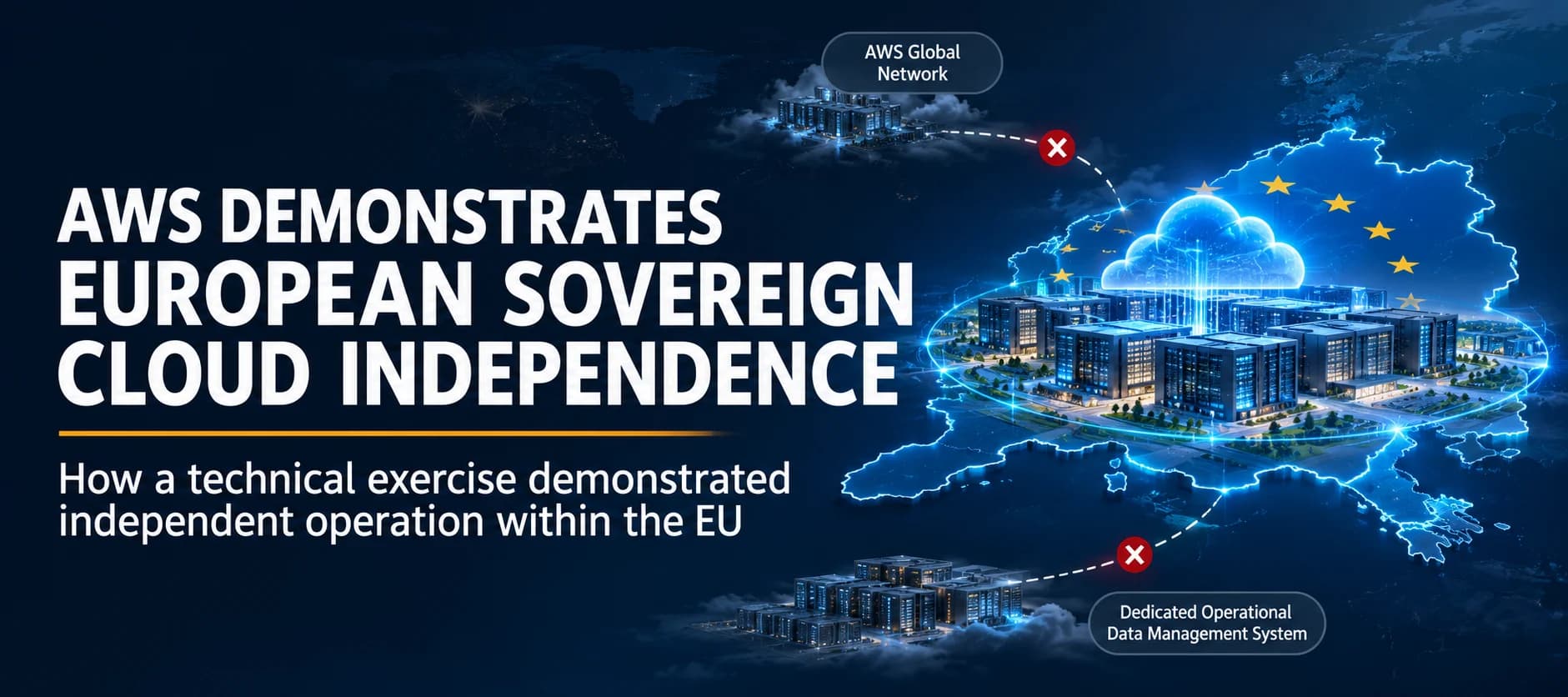
AWS has completed a technical exercise demonstrating that its European Sovereign Cloud can continue operating without depending on infrastructure outside the European Union (EU).
Conducted on October 24, 2026, the exercise involved switching off two global systems normally used during standard operations. AWS reports that workloads continued running, customers retained access to their data, and services within the European Sovereign Cloud remained available throughout the test.
The company described this as the first public technical exercise demonstrating the independence of a sovereign cloud Region. The results were published on November 1, 2026, in the AWS Security Blog by Stéphane Israël.
AWS Tests the European Sovereign Cloud's Operational Independence
The AWS European Sovereign Cloud is a separate cloud partition designed for Europe. It became generally available in January 2026, with its first AWS Region located in Brandenburg, Germany.
According to AWS, the environment is physically and logically separate from other AWS Regions. It has no critical dependencies on infrastructure outside the EU, and customer content and customer-created metadata remain within the EU.
The cloud is managed through dedicated European legal entities established under German law and operated within Europe.
AWS also states that only EU residents located within the EU control its operations and support. The company is gradually transitioning the environment toward exclusive operation by EU citizens located in the EU.
The October exercise was intended to demonstrate how the environment performs when its connections to two global systems are deliberately switched off.
What AWS Switched Off During the Exercise
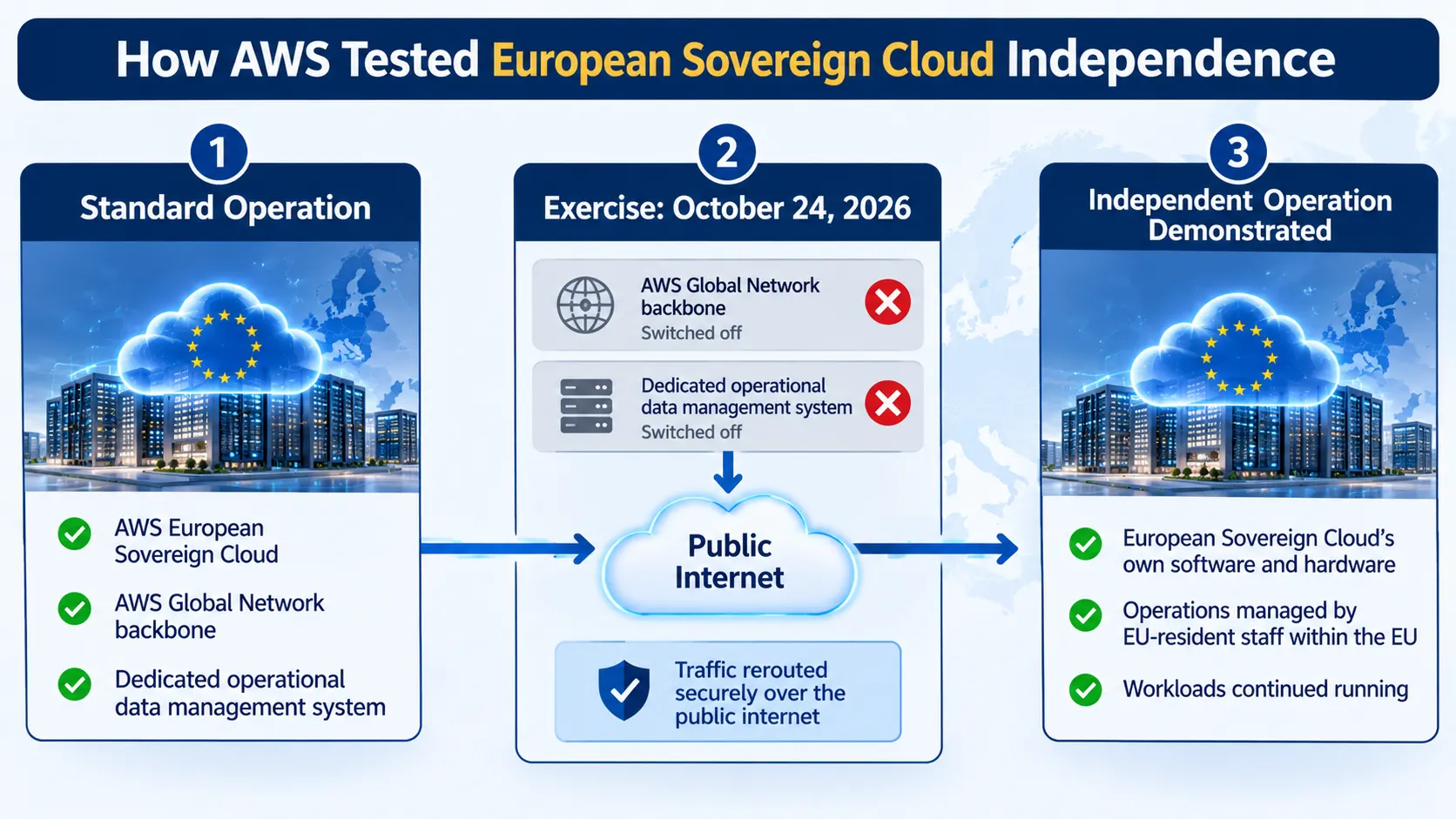
Under standard operating conditions, the AWS European Sovereign Cloud uses two global systems:
AWS Global Network backbone: The global network infrastructure used to carry traffic.
A dedicated operational data management system: A system operated by the local EU team to manage limited and controlled transfers of operational AWS data.
AWS had explained before the exercise that neither system was critical to operating the European Sovereign Cloud.
During the October 24 test, the team switched off both systems. Traffic that would normally travel across the AWS Global Network backbone was securely rerouted over the public internet.
This allowed AWS to demonstrate that the European Sovereign Cloud could continue operating using its own software and hardware resources, with operations managed by EU-resident staff located within the EU.
The exercise lasted several hours.
Customer Workloads Continued Running During the Test
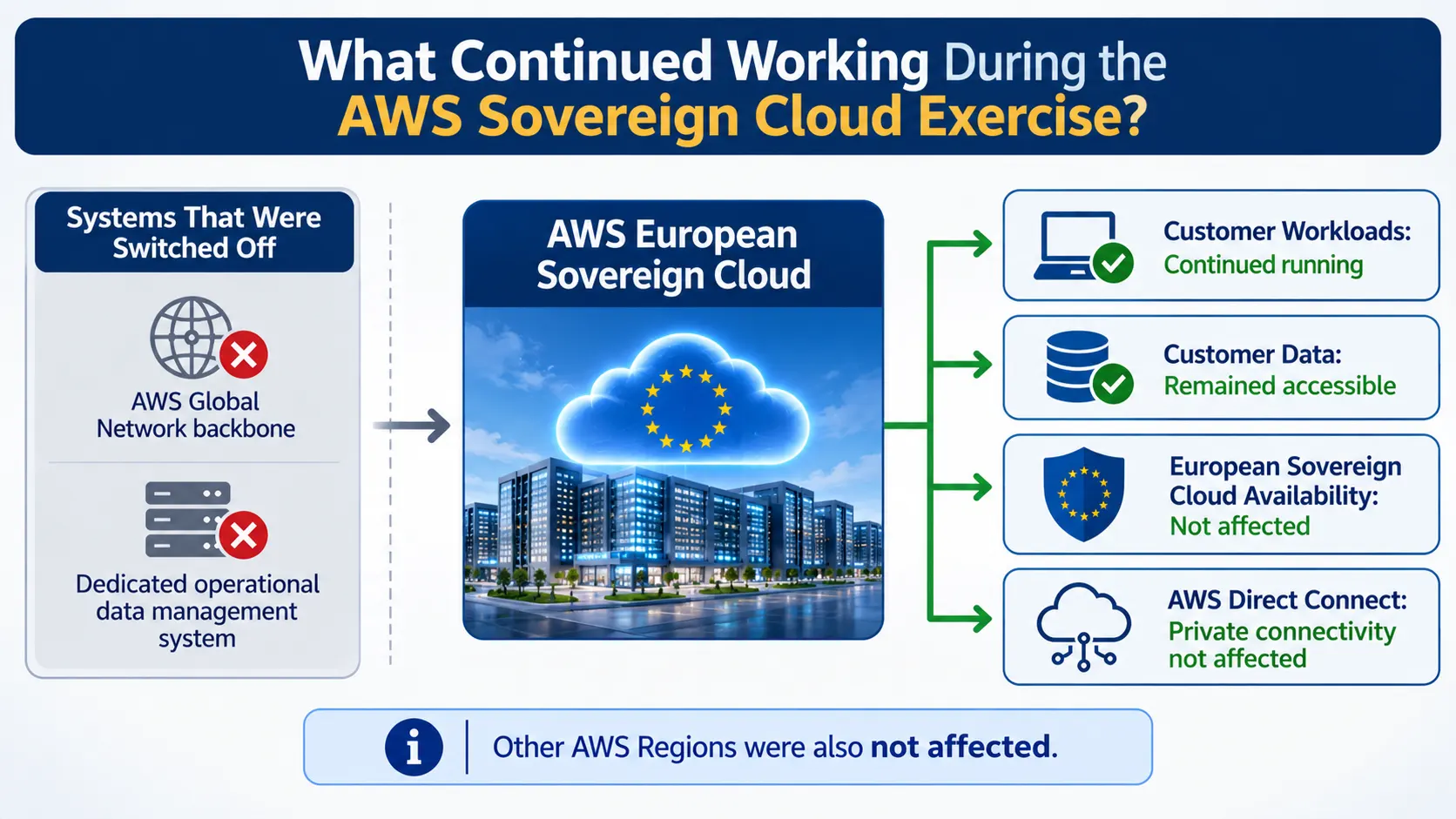
AWS reported that the exercise did not affect service availability within the European Sovereign Cloud.
Workloads continued running, and customers could still access their data while the two global systems were switched off.
The company also confirmed that the exercise did not affect other AWS Regions or private connectivity through AWS Direct Connect.
After the exercise ended, traffic returned to its normal path.
These results are central to AWS's demonstration. The company aimed to show that the European Sovereign Cloud could continue operating even when the two systems used during standard operations were unavailable.
AWS described the exercise as evidence that the environment can operate independently at any time, not only under normal operating conditions.
Why AWS Conducted the Exercise
AWS says transparency is central to its digital sovereignty commitment. The company therefore conducted the exercise openly and published the results.
The demonstration was intended to provide technical and operational evidence that the European Sovereign Cloud can continue operating independently within the EU.
This is relevant to organizations that must evaluate where their data is stored, who controls their cloud operations, and whether critical services can continue operating under specific regional requirements.
AWS says organizations in regulated industries and the public sector can use the results as supporting evidence for compliance and assurance documents presented to regulators and company boards.
However, the announcement describes the exercise as evidence of operational independence. It does not state that the exercise resulted in a new regulatory certification or an independent regulatory approval.
European Partners Highlight the Importance of Operational Sovereignty
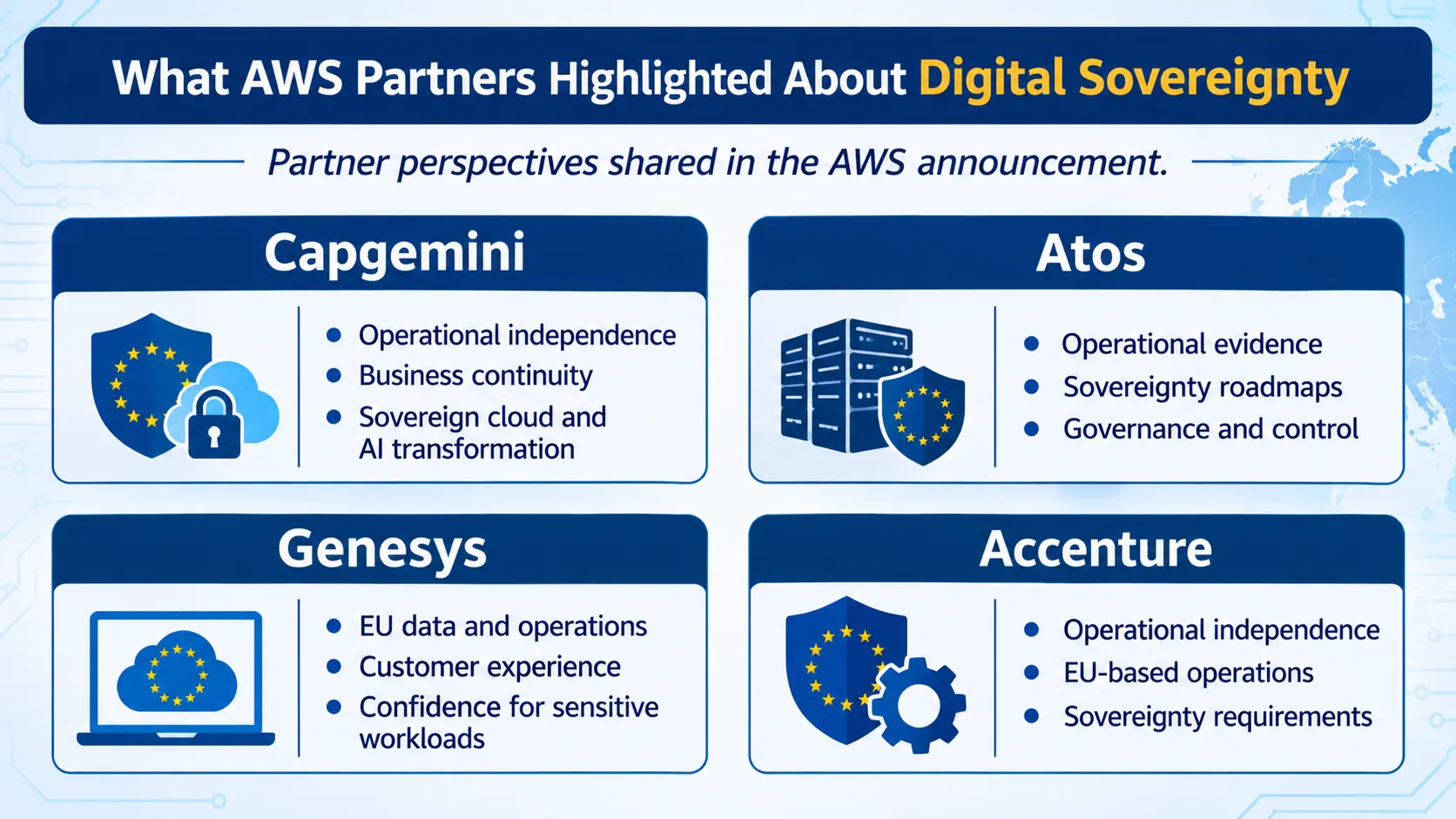
AWS included statements from four European partners, each highlighting the relevance of operational independence to digital sovereignty, business continuity, and regulated workloads.
Capgemini
Fernando Alvarez, Chief Strategy and Development Officer and Group Executive Board Member at Capgemini, described operational independence as an important proof point for European organizations with strict sovereignty requirements.
He also highlighted the role of Capgemini's European presence and AWS capabilities in supporting sovereign cloud and AI transformation while maintaining business continuity.
Atos
Michael Kollar, Digital Sovereignty Leader and Head of Cloud & Modern Infrastructure and Digital Workplace at Atos Group, emphasized that digital sovereignty requires operational evidence in addition to architecture.
He said the demonstration supports organizations working to move critical data and digital assets toward greater sovereign control. Atos also highlighted its role in helping customers define sovereignty roadmaps and govern their target operating models.
Genesys
Daniel Karadza, Senior Director of Partners and Alliances, EMEA Central and Benelux at Genesys, focused on the importance of meeting data and operational requirements without compromising customer experience.
He said the demonstration provides additional confidence for European organizations considering the European Sovereign Cloud for sensitive workloads.
Accenture
Emanuele Baldassarre, Managing Director at Accenture, described operational independence as a defining part of digital sovereignty.
He highlighted the cloud's ability to operate without reliance on infrastructure outside the EU and its operation by EU residents. Accenture also pointed to its collaboration with AWS before the cloud's launch and its work helping clients navigate sovereignty requirements.
What the Demonstration Means for European Organizations
The AWS exercise highlights a broader industry focus on digital sovereignty and the ability to maintain control over critical cloud operations within a defined geographic region.
For organizations in regulated industries and the public sector, data residency is only one part of the assessment. Operational control, access to infrastructure, service continuity, and the location of personnel responsible for support and management can also matter.
AWS's demonstration provides an example of how a cloud provider can test operational independence under conditions that deliberately remove selected dependencies.
For enterprises, this could provide useful supporting information when assessing cloud environments against internal governance requirements and regional obligations.
The announcement does not provide a detailed independent assessment, a list of participating customer workloads, or quantified performance results from the exercise. Additional details were not disclosed in the announcement.
Conclusion
AWS's October 24 exercise demonstrated that the European Sovereign Cloud continued operating for several hours after the company switched off the AWS Global Network backbone and its dedicated operational data management system.
Workloads remained active, customers retained access to their data, and AWS reported no impact on service availability within the European Sovereign Cloud, other AWS Regions, or AWS Direct Connect.
The exercise provides technical and operational evidence supporting AWS's claim of independent operation within the EU. For European organizations evaluating sovereign cloud environments, the demonstration adds an operational dimension to discussions about data residency, regional control, and business continuity.
Source: AWS Security Blog
About the Author