Microservices Architecture: A Beginner’s Guide to Modern Application Design
Microservices architecture is a modern approach to building applications as a collection of small, independent services. In this beginner-friendly guide, learn how microservices work, why companies use them, their advantages and challenges, and the best practices for designing reliable systems.
Modern applications can become extremely complex as they grow.
A simple application might begin with authentication, payments, products, orders, and notifications all inside one codebase. Over time, more developers, features, integrations, and users are added.
Eventually, changing one part of the application can affect several other parts.
This is where microservices architecture can become useful.
Instead of building one large application containing everything, microservices architecture divides an application into smaller, independently manageable services. Each service focuses on a specific business capability and communicates with other services through well-defined interfaces such as APIs.
But microservices aren't simply about "breaking a big application into small pieces."
They introduce a completely different way of thinking about development, deployment, communication, data, testing, monitoring, and scalability.
In this guide, we'll explore microservices architecture from the ground up.
What Is Microservices Architecture?
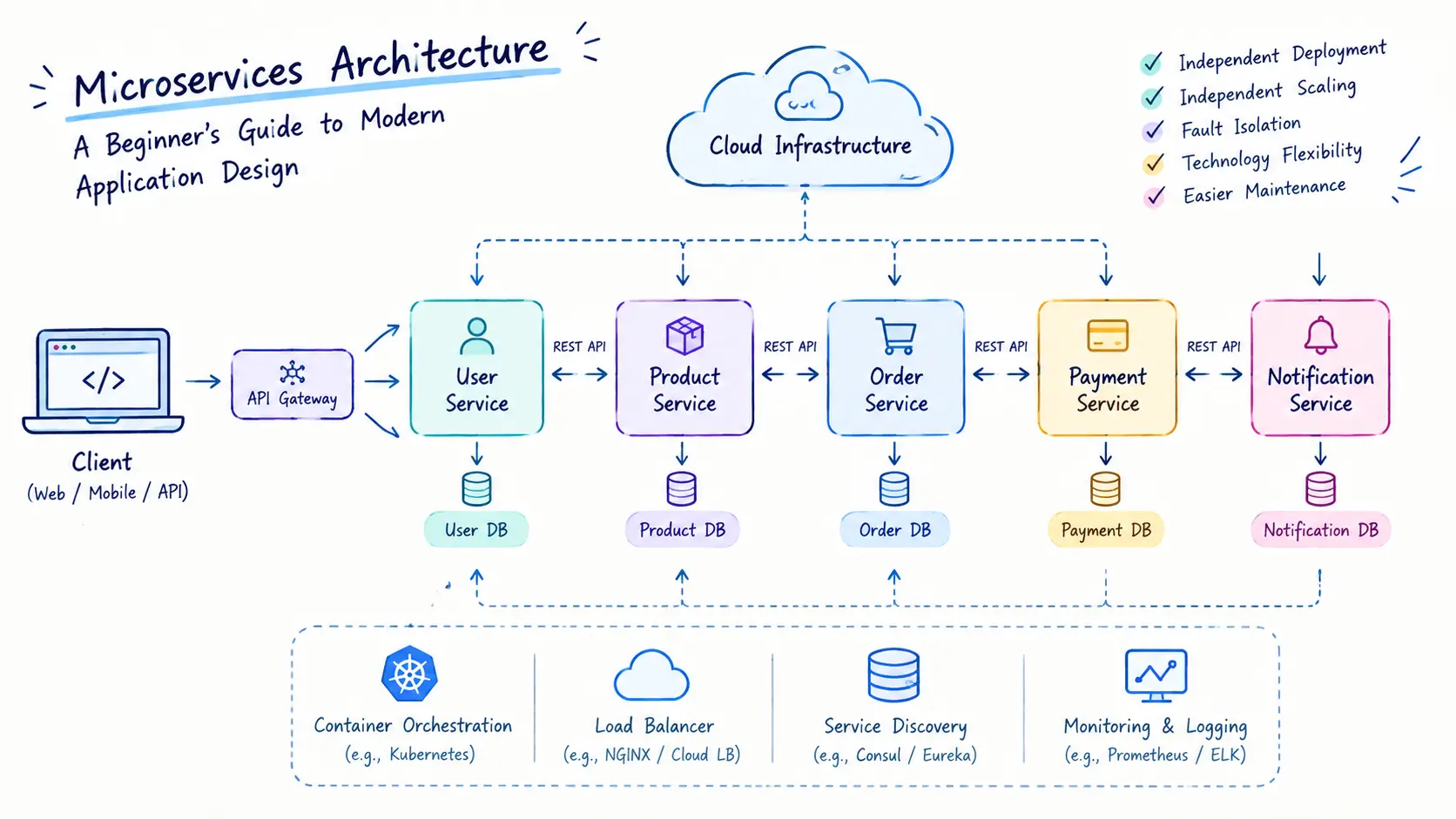
Microservices architecture is an architectural approach where an application is composed of small, loosely coupled services, with each service responsible for a specific business capability.
For example, consider an e-commerce application.
Instead of creating one application responsible for everything, you could divide it into services such as:
                    E-COMMERCE APPLICATION
                             │
        ┌────────────────────┼────────────────────┐
        │                    │                    │
   User Service        Product Service       Order Service
        │                    │                    │
   User data            Product data         Order data
        │                    │                    │
        └────────────────────┼────────────────────┘
                             │
                       Payment Service
                             │
                       Notification
                           Service
The User Service might handle registration and profiles.
The Product Service might manage products and inventory.
The Order Service might create and track orders.
The Payment Service could process payments.
The Notification Service could send emails or messages.
Each service has a clearly defined responsibility.
This separation allows teams to develop and deploy services independently when the architecture and interfaces are designed appropriately.
Microservices vs Monolithic Architecture
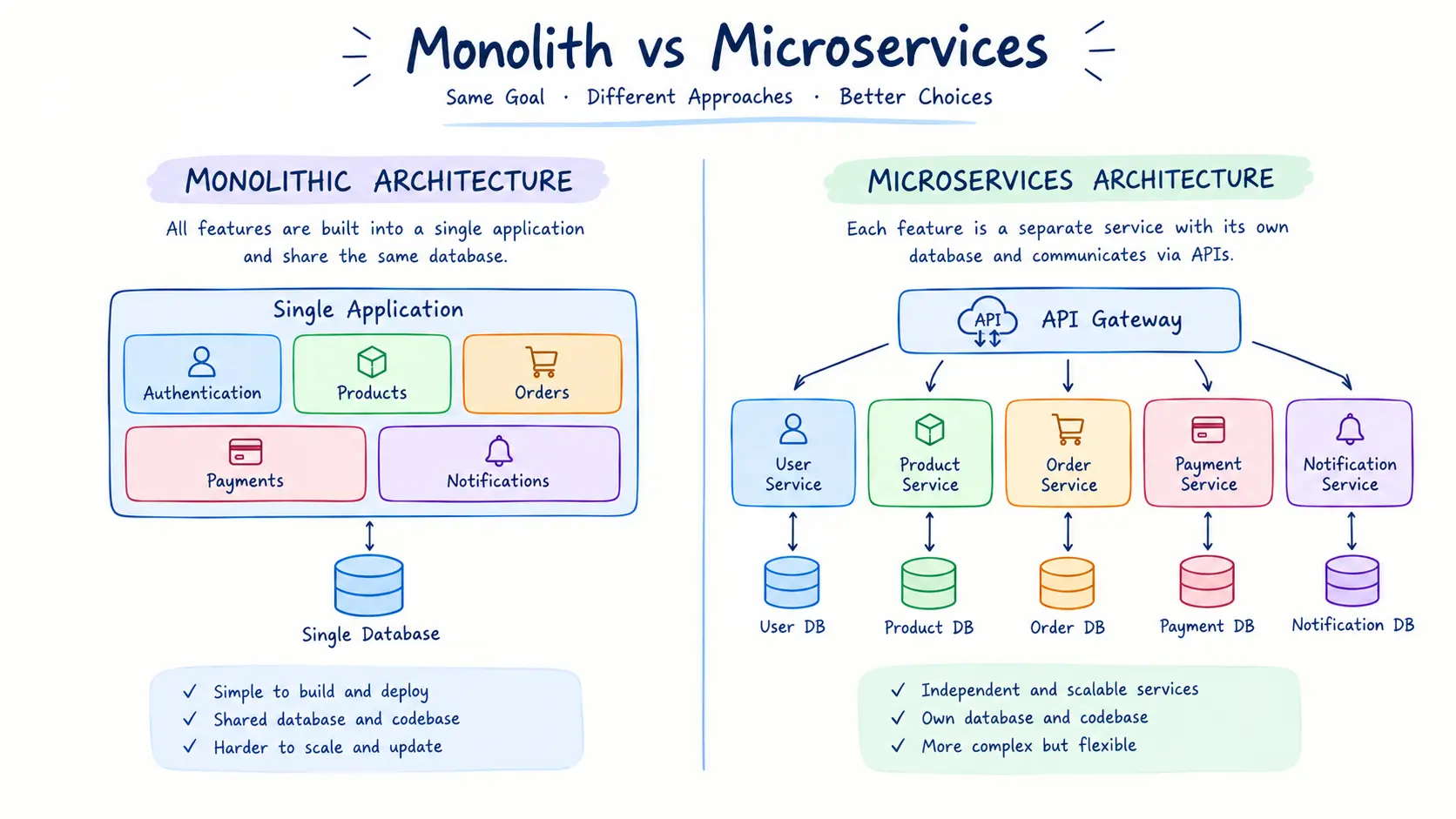
Before understanding microservices, it's useful to understand the traditional monolithic architecture.
In a monolithic application, most or all major application functionality is packaged as a single deployable application.
For example:
               MONOLITHIC APPLICATION

       ┌─────────────────────────────────┐
       │                                 │
       │   Authentication                │
       │   Products                      │
       │   Orders                        │
       │   Payments                      │
       │   Notifications                 │
       │   User Management               │
       │                                 │
       └─────────────────────────────────┘
                       │
                    Database
This approach isn't necessarily bad.
In fact, a monolith can be an excellent choice for a small application because it is relatively simple to develop, test, deploy, and operate.
The problem can appear when the application becomes very large.
A small change to one area may require rebuilding and deploying the entire application.
Microservices take a different approach:
                 MICROSERVICES

       ┌──────────┐     ┌──────────┐
       │  Users   │     │ Products │
       │ Service  │     │ Service  │
       └────┬─────┘     └────┬─────┘
            │                │
            └────────────────┘
                    ↓
              ┌───────────┐
              │   Orders  │
              │  Service  │
              └─────┬─────┘
                    │
          ┌─────────┴─────────┐
          ↓                   ↓
    Payment Service     Notification
                            Service
Each service can potentially be developed, tested, deployed, and scaled independently.
A simple comparison
Monolithic | Microservices |
|---|---|
Usually one main application | Multiple independent services |
Often one shared codebase | Separate codebases or service boundaries |
Deployment is typically centralized | Services can be deployed independently |
Scaling may involve the whole application | Individual services can be scaled |
Simpler operational model | More distributed-system complexity |
Internal modules often share data | Services ideally own their data |
The important point is that microservices don't automatically make an application better.
They trade some types of complexity for others.
How Does Microservices Architecture Work?
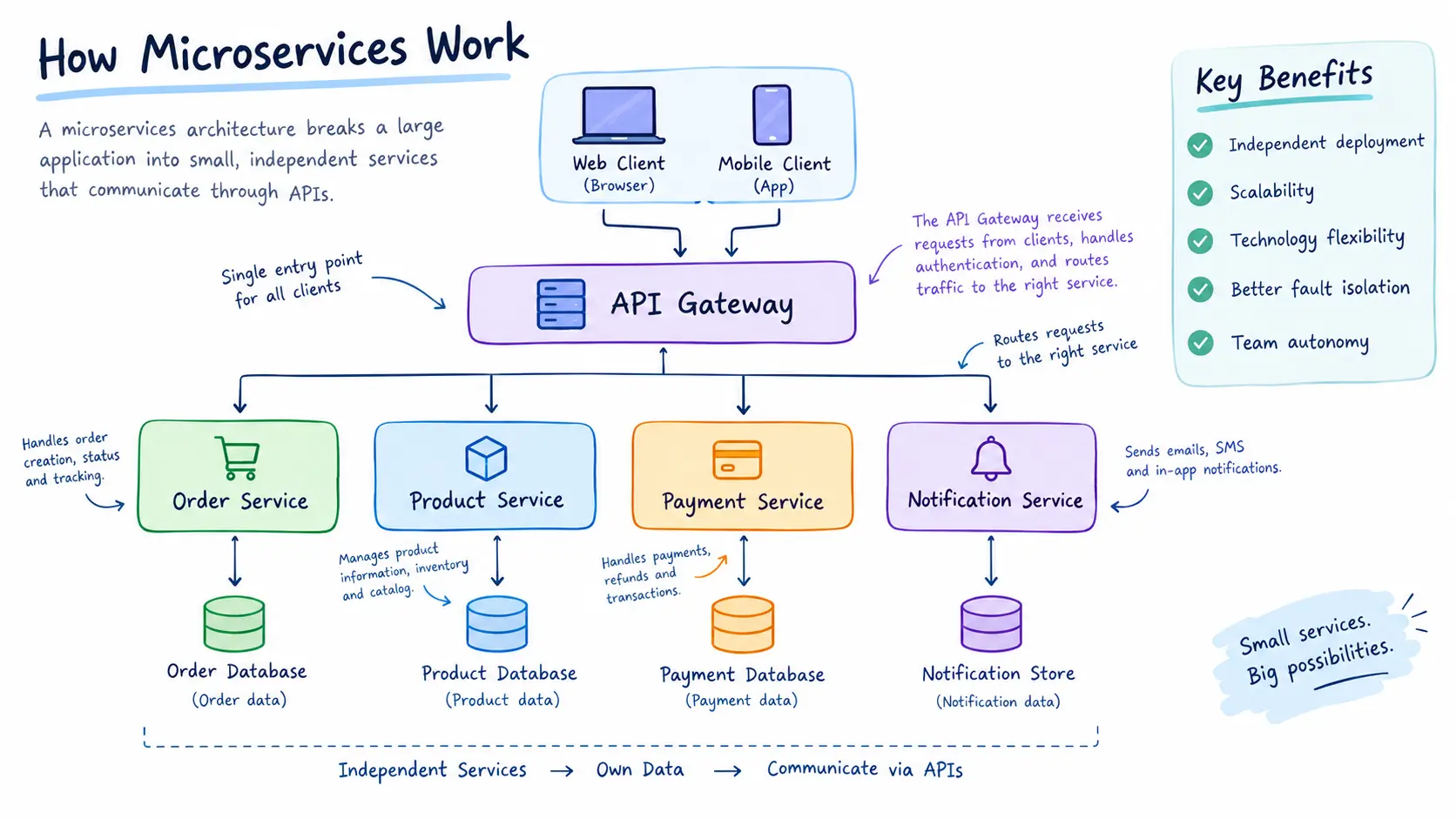
Let's look at a simplified request.
Imagine a customer places an order.
The process might look like this:
Customer
   ↓
API Gateway
   ↓
Order Service
   │
   ├──────────────► Product Service
   │                     ↓
   │               Check inventory
   │
   ├──────────────► Payment Service
   │                     ↓
   │               Process payment
   │
   └──────────────► Notification Service
                         ↓
                  Send confirmation
The customer doesn't necessarily need to know which internal services are involved.
The application exposes an interface, while the internal services handle their individual responsibilities.
Communication can happen through technologies such as:
HTTP/REST APIs
gRPC
Message queues
Event-driven communication
The right choice depends on the system's requirements.
Key Characteristics of Microservices
1. Independent Services
Each service should have a clear responsibility.
For example:
Payment Service
Responsible for payment-related operations.
It shouldn't also contain unrelated product catalog logic.
Clear boundaries make services easier to understand and maintain.
2. Loose Coupling
Services should avoid unnecessary dependencies on one another.
For example, if the Product Service changes its internal implementation, the Order Service shouldn't need to understand that implementation.
Instead, the Product Service exposes a stable API or event contract.
This principle helps teams evolve services independently.
3. Independent Deployment
One of the major advantages of microservices is the ability to deploy services separately.
Suppose you update the Notification Service.
With a well-designed microservices system, you shouldn't necessarily need to rebuild the entire application just to release that change.
This can enable faster feature delivery and easier rollback strategies.
4. Service-Owned Data
A common microservices principle is that each service should control its own data.
For example:
User Service
     ↓
User Database

Order Service
     ↓
Order Database

Payment Service
     ↓
Payment Database
This helps prevent services from becoming tightly coupled through a shared database schema.
However, distributed data introduces another challenge: maintaining consistency across services.
Benefits of Microservices Architecture
1. Independent Scaling
Imagine an e-commerce platform where the Product Service receives significantly more traffic than the Notification Service.
With microservices, you can scale the Product Service without necessarily scaling every other service.
Product Service
Instance 1
Instance 2
Instance 3
Instance 4

Notification Service
Instance 1
This can make resource usage more efficient.
2. Faster Development
Different teams can work on different services.
For example:
Team A → User Service
Team B → Order Service
Team C → Payment Service
Team D → Notification Service
Teams can work within their service boundaries instead of constantly modifying one huge codebase.
3. Fault Isolation
Microservices can help contain failures.
Suppose the recommendation service goes down.
The core shopping experience might continue to work if the rest of the architecture is designed to handle that failure.
However, fault isolation isn't automatic. Poorly designed dependencies can still allow one failing service to trigger wider problems.
4. Technology Flexibility
Different services can sometimes use different technologies when there is a genuine reason to do so.
For example:
User Service       → Node.js
Payment Service    → Java
Analytics Service  → Python
This flexibility can be useful, although using too many technologies can also increase operational complexity.
5. Easier Maintenance
Smaller services can be easier for developers to understand.
Instead of navigating through a massive application to find payment-related functionality, developers can focus on the Payment Service.
This can make onboarding and maintenance easier when service boundaries are well designed.
Challenges of Microservices Architecture
Microservices sound attractive, but there's an important catch:
Breaking an application apart doesn't remove complexity. It distributes it.
The overall system can actually become harder to operate.
1. Distributed-System Complexity
A monolith might make an in-memory function call:
Order → Payment()In a microservices environment, the same operation might involve:
Order Service
      ↓
Payment Service
      ↓
Payment Database
Now you have networks, timeouts, retries, failures, authentication, service discovery, and monitoring to consider.
2. Network Latency
Communication between services usually happens across a network.
For example:
Service A
   ↓
Service B
   ↓
Service C
   ↓
Service D
Every additional network call can introduce latency.
If services communicate excessively - sometimes called chatty communication - performance and reliability can suffer.
3. Data Consistency
With independent data stores, keeping information consistent can become more difficult.
Imagine an order involving:
Order Service
Payment Service
Inventory Service
A successful transaction may require changes across multiple services.
Unlike a simple single-database transaction, distributed workflows often require additional patterns and careful failure handling.
This is one reason eventual consistency and patterns such as the Saga pattern are important concepts in advanced microservices design.
4. Testing Becomes More Difficult
Testing one small service may be straightforward.
Testing an entire workflow is harder.
For example:
Order
  ↓
Payment
  ↓
Inventory
  ↓
Notification
What happens if Payment succeeds but Inventory fails?
What if Notification is temporarily unavailable?
Integration and end-to-end testing need to account for these scenarios.
5. Versioning
Services evolve independently.
Suppose:
Order Service → Payment API v1The Payment Service is upgraded to:
Payment API v2If the new API isn't compatible with existing consumers, other services can break.
That's why API contracts, compatibility, and versioning strategies are important in microservices systems.
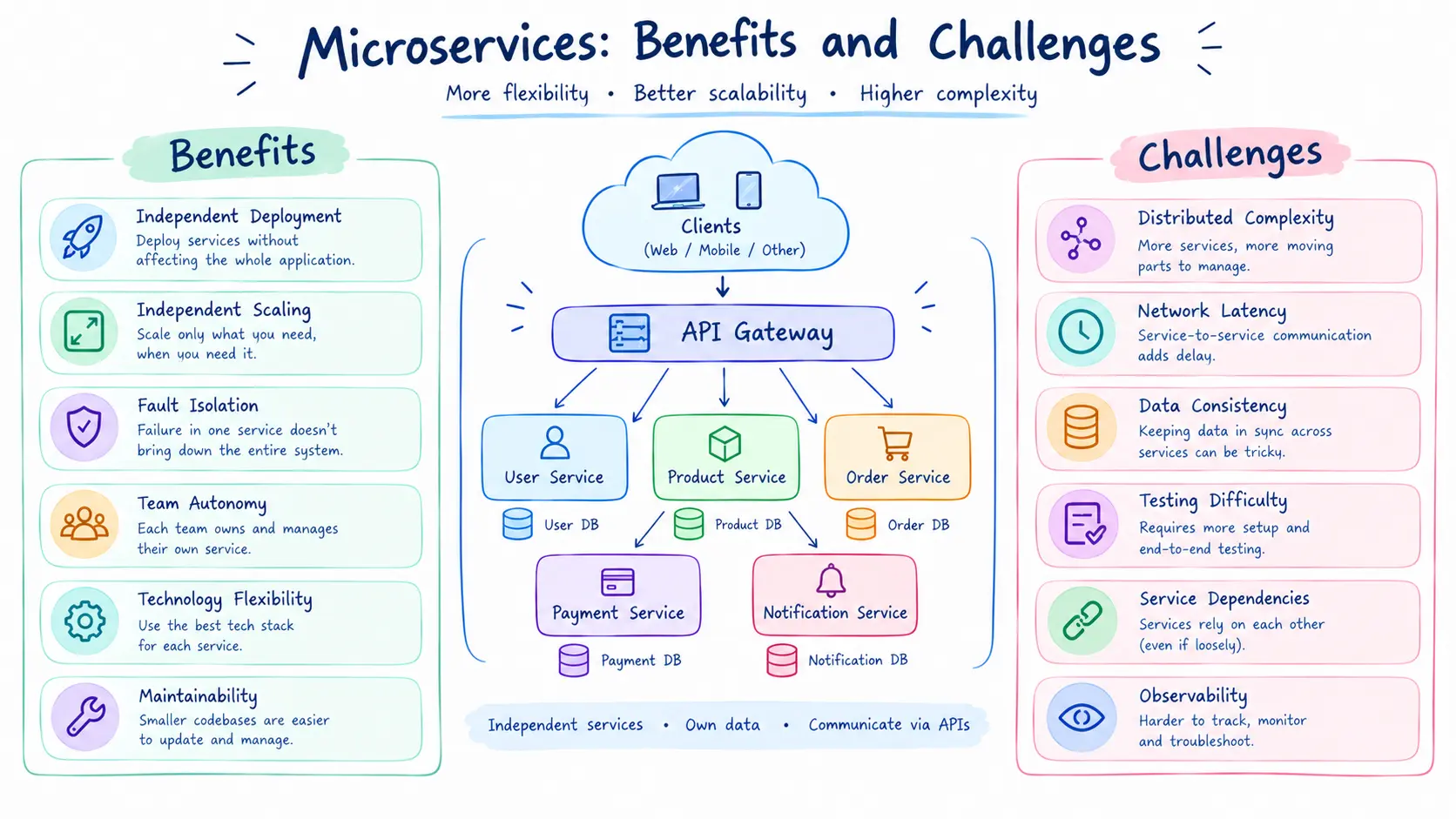
What Is an API Gateway?
An API Gateway can act as the entry point between clients and backend services.
Instead of a mobile application communicating directly with multiple services:
Mobile App
 ├── User Service
 ├── Order Service
 ├── Payment Service
 └── Product Service
you can introduce a gateway:
                 Mobile / Web
                      ↓
                API Gateway
                      ↓
       ┌────────────────────────────┐
       ↓              ↓             ↓
   User Service   Order Service   Product Service
The gateway can handle concerns such as routing, authentication, rate limiting, logging, and other cross-cutting responsibilities.
But the gateway shouldn't become a giant business-logic layer.
Its primary role should remain focused on handling the boundary between clients and backend services.
Microservices Design Patterns Beginners Should Know
As you move beyond the basics, several patterns become important.
API Gateway
Provides a common entry point for clients and routes requests to services.
Database per Service
Each service owns its data rather than relying on a shared database schema.
Service Discovery
Helps services locate one another dynamically in distributed environments.
Circuit Breaker
Helps prevent repeated calls to an unhealthy service from causing cascading failures.
Saga
Helps coordinate business transactions that span multiple services.
Event-Driven Architecture
Services communicate by producing and consuming events.
These patterns aren't requirements for every microservices application. They are tools that address specific architectural problems.
Best Practices for Microservices Architecture
1. Design Around Business Capabilities
Don't create services simply because you want a certain number of services.
Instead, identify meaningful business boundaries.
For example:
E-Commerce
│
├── Customer
├── Catalog
├── Orders
├── Payments
├── Inventory
└── Notifications
A service should have a clear reason to exist.
2. Keep Services Loosely Coupled
Avoid creating dependencies that require multiple services to change together.
The goal is:
High cohesion within a service and low coupling between services.
This makes independent development and deployment much easier.
3. Give Services Ownership of Their Data
Avoid allowing every service to directly modify another service's database.
Instead:
Order Service
     ↓
Order Data

Payment Service
     ↓
Payment Data
Services should communicate through APIs or events rather than directly manipulating another service's internal storage.
4. Design Stable APIs
APIs form contracts between services.
Good APIs should be:
Clear
Consistent
Well documented
Versioned when necessary
Backward-compatible where practical
Avoid exposing unnecessary implementation details.
5. Build for Failure
In distributed systems, failures are normal.
A service can experience:
Network problems
Timeouts
Database failures
Traffic spikes
Deployment issues
Techniques such as timeouts, retries with backoff, circuit breakers, bulkheads, and fallbacks can help services respond more gracefully.
6. Invest in Observability
When you have one application, finding a problem can be relatively straightforward.
With dozens of services, you need visibility across the system.
Important observability components include:
Logs
What happened?
Metrics
How is the system performing?
Traces
How did one request move across multiple services?
Without proper observability, debugging distributed applications can become extremely difficult.
7. Avoid Service Sprawl
More services don't automatically mean a better architecture.
If you split an application into hundreds of tiny services without meaningful boundaries, operational complexity can grow rapidly.
A useful question is:
Does this service represent a meaningful responsibility, or did we create it simply because we could?
When Should You Use Microservices?
Microservices can make sense when an organization has:
A large and complex application
Multiple development teams
Different scaling requirements
A need for independent deployments
Clearly identifiable business domains
Mature DevOps and monitoring practices
For a small application or early-stage project, a modular monolith may often be simpler.
For example:
Small Project
      ↓
Modular Monolith
      ↓ grow over time
Selected components extracted
      ↓
Microservices where justified
The goal shouldn't be:
"We need microservices."
The better question is:
"What architecture solves our actual problem with reasonable complexity?"
A Simple Real-World Example
Imagine you're building an online learning platform.
You could have:
                   ONLINE LEARNING PLATFORM
                             ↓
                      ┌─────────────┐
                      │ API Gateway │
                      └──────┬──────┘
                             │
       ┌───────────┬─────────┼───────────┬────────────┐
       ↓           ↓         ↓           ↓            ↓
    Users       Courses      Orders    Payments   Notifications
   Service      Service      Service   Service       Service
       ↓           ↓            ↓         ↓            ↓
    User DB     Course DB   Order DB   Payment DB    Message Queue
A learner logs in.
The User Service handles authentication-related user information.
They browse courses.
The Course Service handles course information.
They purchase a course.
The Order Service creates the order.
The Payment Service processes payment.
After successful payment, an event could trigger the Notification Service to send a confirmation.
Each service has a focused responsibility.
That's the basic idea behind microservices.
Common Microservices Mistakes
Beginners often assume that microservices mean:
❌ Every feature needs its own service
❌ Every service must use a different programming language
❌ A shared database is always fine
❌ More services automatically mean better scalability
❌ Kubernetes is required for every project
❌ Microservices eliminate failures
❌ APIs don't need versioning
❌ Monitoring can be added later
A better approach is to start with clear boundaries and business requirements.
Technology should support the architecture—not define it.
Microservices Architecture: The Bigger Picture
Microservices are ultimately about organizational and technical boundaries.
A successful architecture isn't simply a collection of small applications.
It is a system where:
Clear Responsibilities
        +
Loose Coupling
        +
Independent Deployment
        +
Data Ownership
        +
Reliable Communication
        +
Observability
        +
Automation
        ↓
Maintainable Distributed System
The architecture becomes particularly powerful when development teams can own services from development through deployment and operation.
But that flexibility comes with responsibility.
Teams must understand distributed systems, networking, APIs, security, data consistency, testing, deployment automation, and observability.
Conclusion
Microservices architecture provides a way to build large applications as a collection of smaller, independently manageable services.
Its biggest advantages include:
Independent deployment
Independent scaling
Clear service responsibilities
Team autonomy
Fault isolation
Technology flexibility
But these benefits come with real challenges:
Distributed-system complexity
Network latency
Data consistency
More complicated testing
Service dependencies
API versioning
Monitoring and operational overhead
That's why microservices should not be treated as a universal replacement for monolithic architecture.
For beginners, the most important concept to remember is simple:
A microservices architecture divides an application by meaningful business responsibilities, not merely by code size.
Once you understand that principle, concepts such as API gateways, service discovery, event-driven communication, distributed transactions, containers, Kubernetes, and resilience patterns become much easier to understand.
And that is the real foundation for learning modern backend architecture and system design.
Ready to go deeper?
Professional Training
Hands-on, mentor-led training aligned with industry certifications.
About the Author
Sharper every day
Daily tutorials, analysis, and career playbooks across all 12 Xcademia disciplines, straight to your inbox. No spam.