
Singapore Unveils Cybersecurity Strategy 2026 to Strengthen National Cyber Resilience
Singapore's Cybersecurity Strategy 2026 outlines a national plan to defend critical infrastructure, strengthen AI and quantum readiness, improve cybersecurity across the digital ecosystem, expand global partnerships and build a future-ready cyber workforce.
Xcademia Team
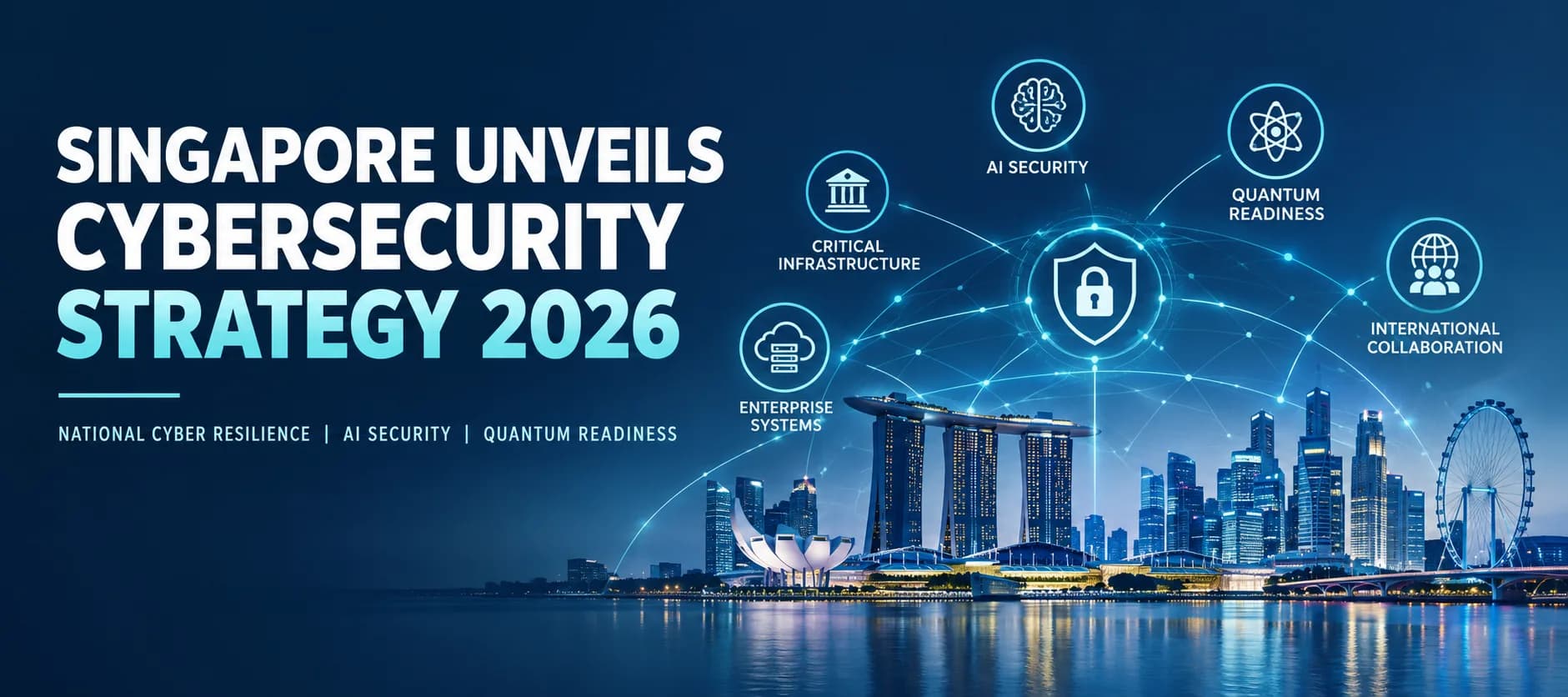
Singapore has launched its Cybersecurity Strategy 2026, setting out a whole-of-nation approach to protecting critical infrastructure, strengthening digital security and preparing for emerging cyber threats linked to artificial intelligence (AI) and quantum computing.
Announced on October 13, 2026, the strategy was launched by Senior Minister, Coordinating Minister for National Security and Minister for Home Affairs K. Shanmugam at the opening ceremony of the 11th Singapore International Cyber Week (SICW) at the Sands Expo and Convention Centre.
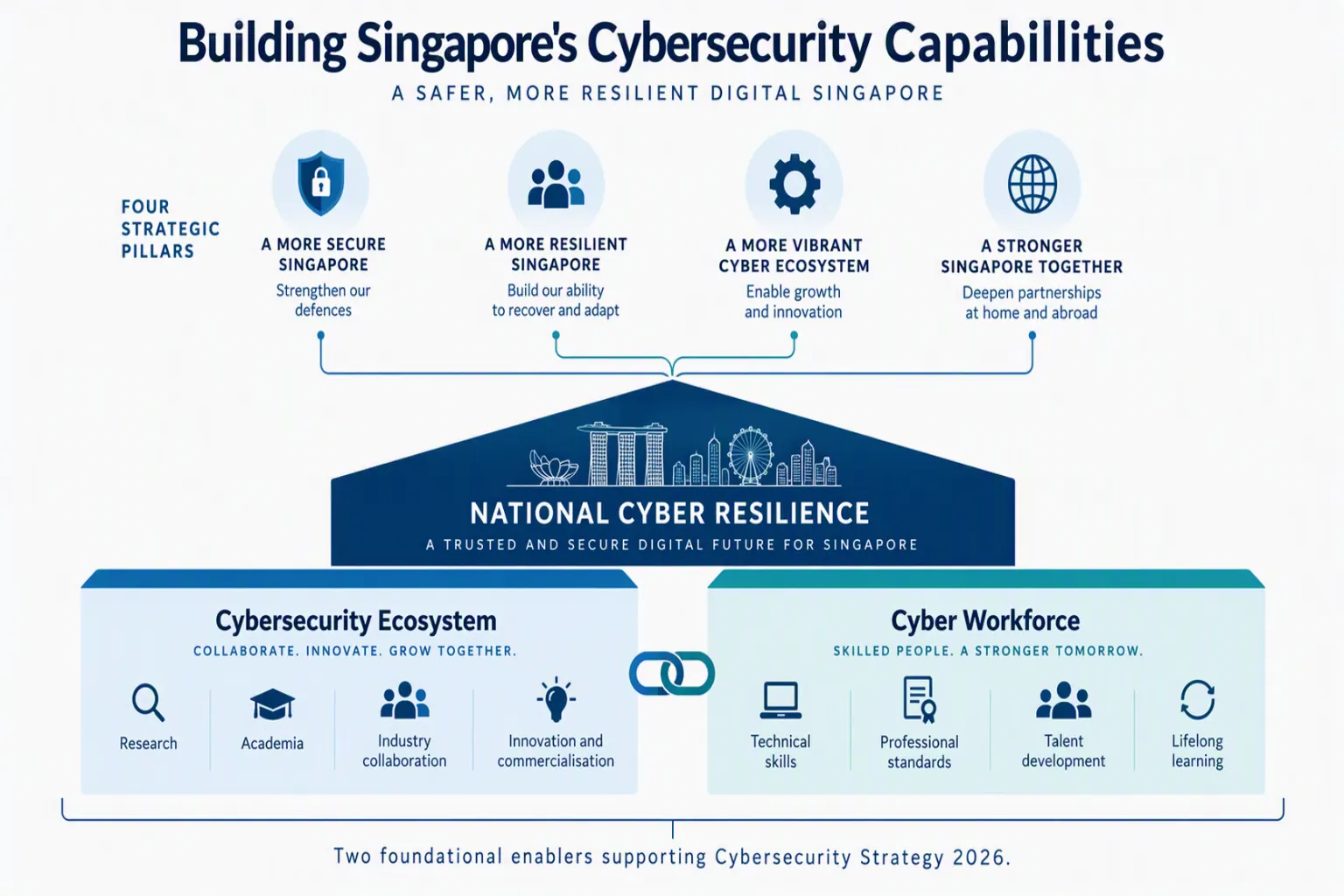
The updated strategy establishes four strategic pillars covering critical infrastructure defence, wider cybersecurity protection, AI and quantum readiness, and international cooperation. Two foundational enablers focus on developing Singapore's cybersecurity industry and strengthening its cyber workforce.
The government plans to work with stakeholders across government, industry, academia and the wider cybersecurity community over the next five years to implement the strategy's initiatives.
Singapore's Cybersecurity Strategy Responds to Evolving Threats
Singapore's Cybersecurity Strategy 2026 builds on earlier national strategies launched in 2016 and refreshed in 2021. The latest update reflects changes in the cyber threat landscape, growing digital interdependence and the security implications of emerging technologies.
According to the Cyber Security Agency of Singapore (CSA), advanced persistent threat (APT) actors are increasingly targeting critical infrastructure and preparing for potential disruption. The strategy also identifies frontier AI as a technology changing both cyber offence and defence, while advances in quantum computing could eventually undermine current encryption methods.
Digital interdependence adds another challenge. A vulnerability or disruption affecting one organisation or sector can have consequences for connected services, businesses and systems across borders.
Geopolitical tensions and technological competition are also making international cybersecurity cooperation more difficult.
Against this backdrop, Singapore's strategy aims to strengthen national cyber defence while raising security standards across the wider digital ecosystem.
The strategy's stated vision is a secure, trusted and resilient cyberspace that supports Singapore's digital way of life.
Four Strategic Pillars Define Singapore's Cybersecurity Priorities
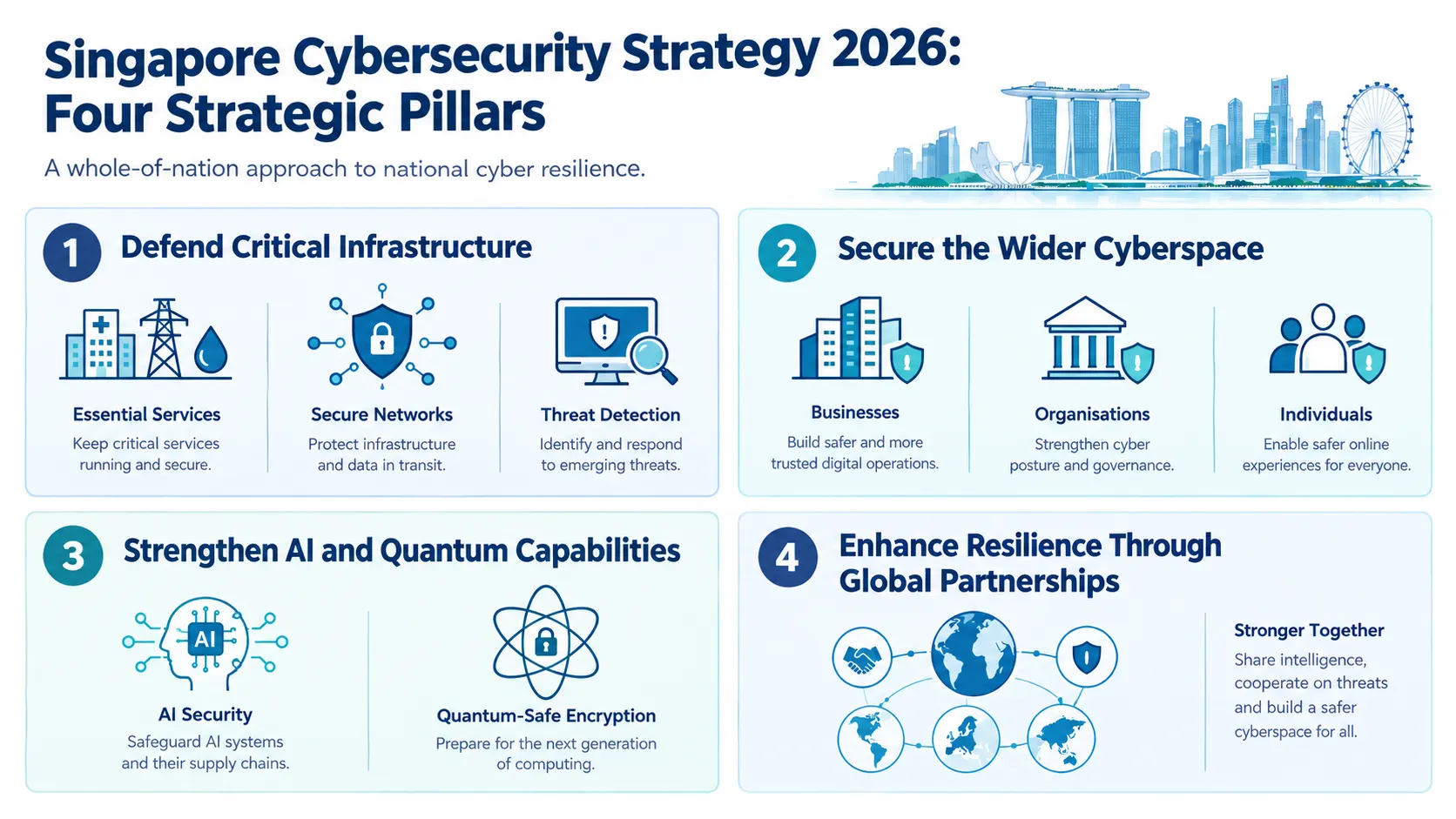
The strategy is organised around four pillars that address different aspects of national cybersecurity, from essential services and everyday digital activity to emerging technologies and international cooperation.
Pillar 1: Defend Critical Infrastructure
Singapore's Critical Information Infrastructure (CII) supports essential services relied upon by the population. A successful cyberattack against these systems could disrupt services or expose sensitive information that could threaten national security or public order.
Under the first pillar, the government plans to develop centralised capabilities to improve its ability to anticipate, detect and respond to sophisticated cyber threats.
It also intends to strengthen the capabilities of CII owners to defend their systems against advanced and AI-enabled attacks.
The focus extends beyond responding to incidents after they occur. The strategy emphasises improving national-level cyber defence and strengthening the ability of essential service operators to withstand increasingly sophisticated threats.
For organisations responsible for critical infrastructure, the direction is clear: cyber resilience must remain a priority as attack methods and the technologies used by adversaries evolve.
Pillar 2: Secure the Wider Digital Ecosystem
The second pillar expands the strategy beyond critical infrastructure operators.
Singapore aims to strengthen cybersecurity across businesses, organisations and individuals to reduce exposure to cyber threats throughout the wider digital ecosystem.
The government plans to strengthen upstream protection measures and encourage organisations to improve their cybersecurity posture. Public education and outreach will also continue, with the aim of helping Singaporeans develop the knowledge needed to protect themselves online.
This broader approach recognises that national cyber resilience depends on more than the security of a limited number of essential systems. Businesses, service providers and individuals also interact with the digital services that support the country's economy and daily activities.
The strategy does not specify individual cybersecurity standards, compliance deadlines or mandatory technical controls for every organisation in the announcement.
Instead, it establishes a direction for improving protection across the wider ecosystem and supporting organisations as they strengthen their security practices.
Pillar 3: Strengthen Capabilities for AI and Quantum
AI and quantum computing receive dedicated attention in the 2026 strategy because they present different but significant cybersecurity challenges.
AI-enabled cybersecurity
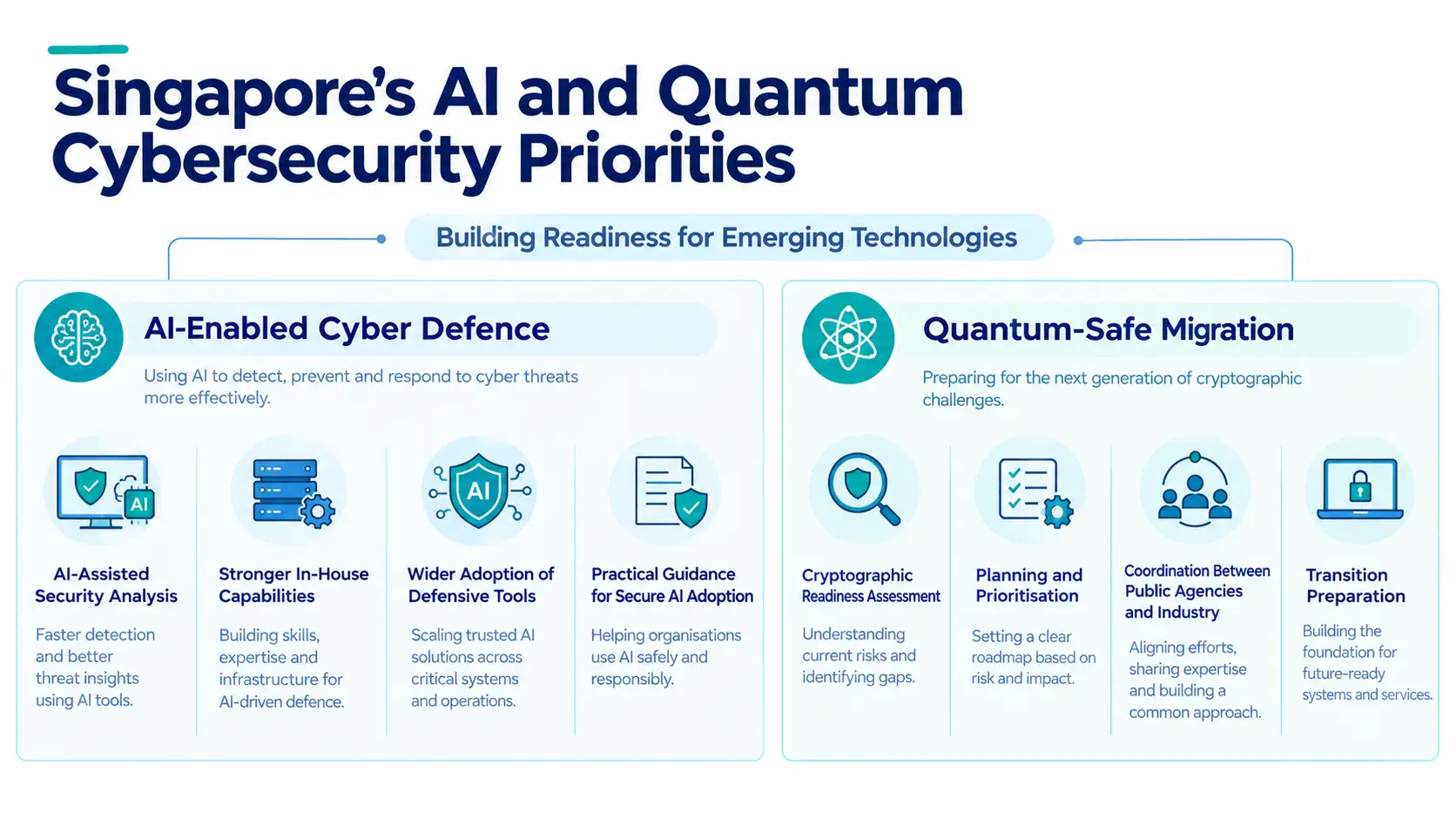
Singapore plans to use AI to strengthen cyber defence by building in-house capabilities and promoting wider adoption of AI-enabled cybersecurity tools.
The government also intends to support organisations in adopting AI systems securely. This includes developing practical implementation guidance and leading by example.
The strategy therefore addresses both sides of AI adoption: using the technology to improve defensive capabilities and helping organisations manage security risks associated with AI systems.
The announcement does not name specific AI security products, models or deployment timelines.
Preparing for quantum-related threats
Quantum computing presents a different long-term challenge. The strategy warns that future advances could undermine encryption methods used today.
Singapore plans to accelerate national quantum-safe migration by working with industry and public agencies to plan, prioritise and execute the transition. It will also develop and update practical resources to support this work.
Quantum-safe migration involves preparing systems and cryptographic protections for a future in which sufficiently capable quantum computers could threaten some existing cryptographic methods.
The government's approach emphasises early preparation, coordination and practical guidance rather than waiting until quantum-enabled threats become an immediate operational concern.
The announcement does not provide a final migration deadline, a list of cryptographic algorithms selected for replacement or a detailed schedule for individual sectors.
Pillar 4: Enhance Resilience Through Global Partnerships
Cyber threats frequently cross national borders, making international cooperation an important part of Singapore's strategy.
The government plans to deepen international cybersecurity cooperation despite geopolitical tensions and technological competition.
Singapore will seek to strengthen its role as a trusted convenor for international cybersecurity dialogue through platforms such as the Singapore International Cyber Week. The strategy also commits to advancing rules-based cooperation in cyberspace.
Another priority is collaboration with major technology companies to co-develop solutions in areas including AI-enabled cybersecurity, operational technology (OT) security and quantum-safe migration.
Operational technology includes systems used to monitor or control physical processes and equipment. Its security can be particularly important in environments where digital systems support essential services and industrial operations.
By combining international dialogue with practical collaboration, Singapore aims to strengthen collective resilience and support the development of cybersecurity solutions for shared challenges.
The announcement does not identify specific new technology partnerships or disclose individual projects, funding commitments or delivery schedules under this pillar.
Two Foundational Enablers Support the Strategy
Alongside the four strategic pillars, Cybersecurity Strategy 2026 identifies two foundational enablers: developing a world-class cybersecurity ecosystem and strengthening the national cyber workforce.
These enablers address the capabilities, expertise and industry development needed to support the strategy over time.
Enabler 1: Build a World-Class Cybersecurity Ecosystem
Singapore intends to strengthen its cybersecurity industry and innovation ecosystem to develop capabilities that support long-term national cyber resilience.
The government aims to establish Singapore as Asia's leading cybersecurity innovation hub, where trusted and globally competitive cybersecurity capabilities for critical infrastructure can be developed, validated and deployed.
The strategy identifies several areas of focus, including growing local capabilities from research through to commercialisation and accelerating the co-development of cybersecurity solutions with academia and industry.
International firms operating in Singapore are also included in the proposed collaboration model.
This approach links research and innovation with the practical needs of organisations responsible for securing critical infrastructure. It also places industry development and cooperation among research institutions, businesses and government within the wider national cybersecurity agenda.
The announcement does not provide a quantified target for the number of companies, research projects or commercial cybersecurity solutions expected to emerge from these efforts.
Enabler 2: Level Up the Cyber Workforce
Singapore's strategy also highlights the role of people in national cybersecurity.
As threats become more sophisticated and emerging technologies change the profession, the government says the country needs a workforce with deep technical expertise, strong professional standards and the ability to adapt.
The planned approach focuses on professionalising the cybersecurity workforce, deepening cybersecurity capabilities and broadening the national cyber talent pipeline.
This workforce priority supports the other parts of the strategy. Critical infrastructure defence, secure AI adoption, quantum-safe migration and international cybersecurity collaboration all depend on people with the relevant skills and expertise.
The strategy establishes workforce development as a national priority, although the announcement does not specify new training quotas, salary targets, certification requirements or a detailed workforce expansion schedule.
Implementation Over the Next Five Years
Singapore plans to work with relevant stakeholders over the next five years to implement the initiatives outlined in Cybersecurity Strategy 2026.
The government has invited participation from public agencies, industry, academia and the wider cybersecurity community.
This collaborative approach reflects the strategy's whole-of-nation framework. Government capabilities, private-sector security practices, research and innovation, and workforce development are intended to contribute to the country's broader cyber resilience objectives.
The strategy also builds on the foundations established through Singapore's earlier cybersecurity strategies, while placing greater emphasis on national-level defence, the wider digital ecosystem and preparation for emerging technological threats.
The October 13 announcement outlines the strategic direction and priority areas, but it does not provide a complete implementation timetable for every initiative, specific budget allocations or detailed progress indicators.
Further details on individual initiatives may be provided through subsequent government announcements and implementation activities.
Why Singapore's Cybersecurity Strategy 2026 Matters
The updated strategy reflects a broader shift in cybersecurity policy: national resilience increasingly depends on the security of connected systems, the readiness of organisations and the ability to adapt to emerging technologies.
Its four pillars address different but connected priorities. Critical infrastructure defence focuses on essential services, while wider ecosystem security extends attention to businesses, organisations and individuals. AI and quantum readiness address emerging technical challenges, and global partnerships support cooperation across borders.
The two foundational enablers recognise that these priorities require a capable cybersecurity industry and a workforce with the skills to implement and maintain effective protections.
For businesses operating in Singapore, the strategy signals continued government emphasis on stronger cybersecurity practices and preparedness for evolving threats. However, the announcement alone does not establish new compliance obligations or specific deadlines for every business.
For cybersecurity professionals, researchers and technology providers, the focus on AI-enabled defence, quantum-safe migration, innovation and workforce development identifies areas of strategic interest. The extent to which individual organisations will participate will depend on the initiatives and guidance introduced as implementation progresses.
Conclusion
Singapore's Cybersecurity Strategy 2026 sets out a national framework for strengthening cyber resilience through critical infrastructure protection, wider ecosystem security, AI and quantum readiness, and international cooperation.
Its two foundational enablers focus on building a stronger cybersecurity innovation ecosystem and developing a future-ready workforce.
The government plans to work with stakeholders over the next five years to advance these priorities. While the announcement establishes the strategic direction, detailed budgets, implementation deadlines and technical specifications for individual initiatives have not been disclosed.
The strategy's significance lies in its integrated approach. Rather than treating cybersecurity as the responsibility of individual agencies or infrastructure operators alone, Singapore is placing national defence, organisational security, technological readiness, international cooperation and talent development within a shared framework for a secure and resilient digital future.
About the Author