
Shadow AI Is Already Inside Your Organization: Why Visibility and Governance Matter
Shadow AI is spreading beyond IT as employees use AI tools, coding assistants and AI-powered workflows outside formal security controls. Here is why visibility, secure development and practical governance are becoming essential.
Xcademia Team
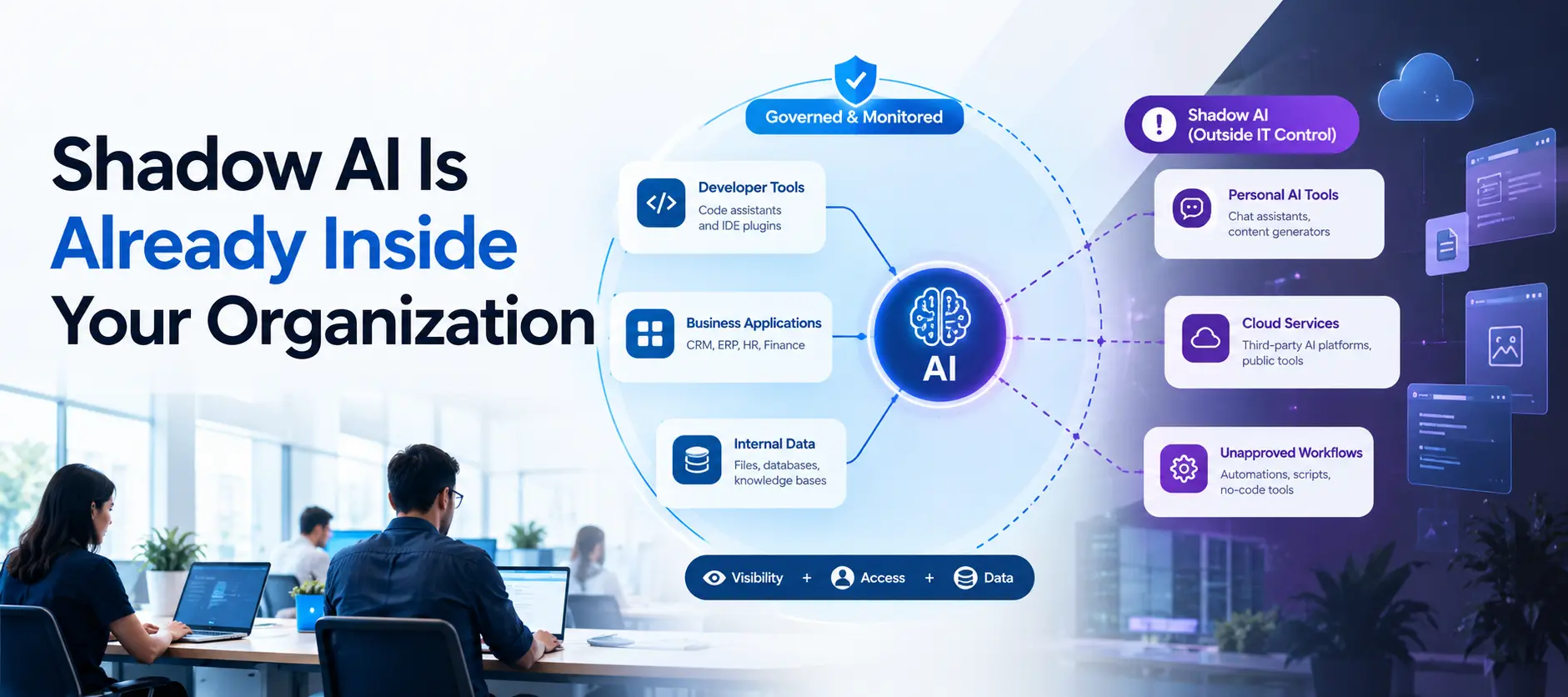
Artificial intelligence is becoming part of everyday work, but not all AI usage is being introduced through formal IT or security processes.
Employees can open an AI assistant in a browser, use an AI coding tool inside an IDE, connect an AI service to company data or create an automation without going through a traditional technology approval process.
This growing use of unapproved or unmonitored AI is commonly referred to as Shadow AI.
A recent Cybersecurity Insiders article by Jim Sherlock, VP of AI & Cybersecurity R&D at ProCircular, argues that AI is removing some of the technical barriers that historically limited Shadow IT. The result is a visibility challenge for organizations that cannot be addressed simply by banning AI tools.
For security teams, the issue is no longer only whether employees are using AI. The bigger questions are where AI is being used, what information it can access, what systems it connects to and whether those activities are covered by existing security controls.
What Is Shadow AI?
Shadow AI refers to employees using AI tools, creating AI-assisted workflows or connecting AI systems to company information and applications without normal IT or security oversight.
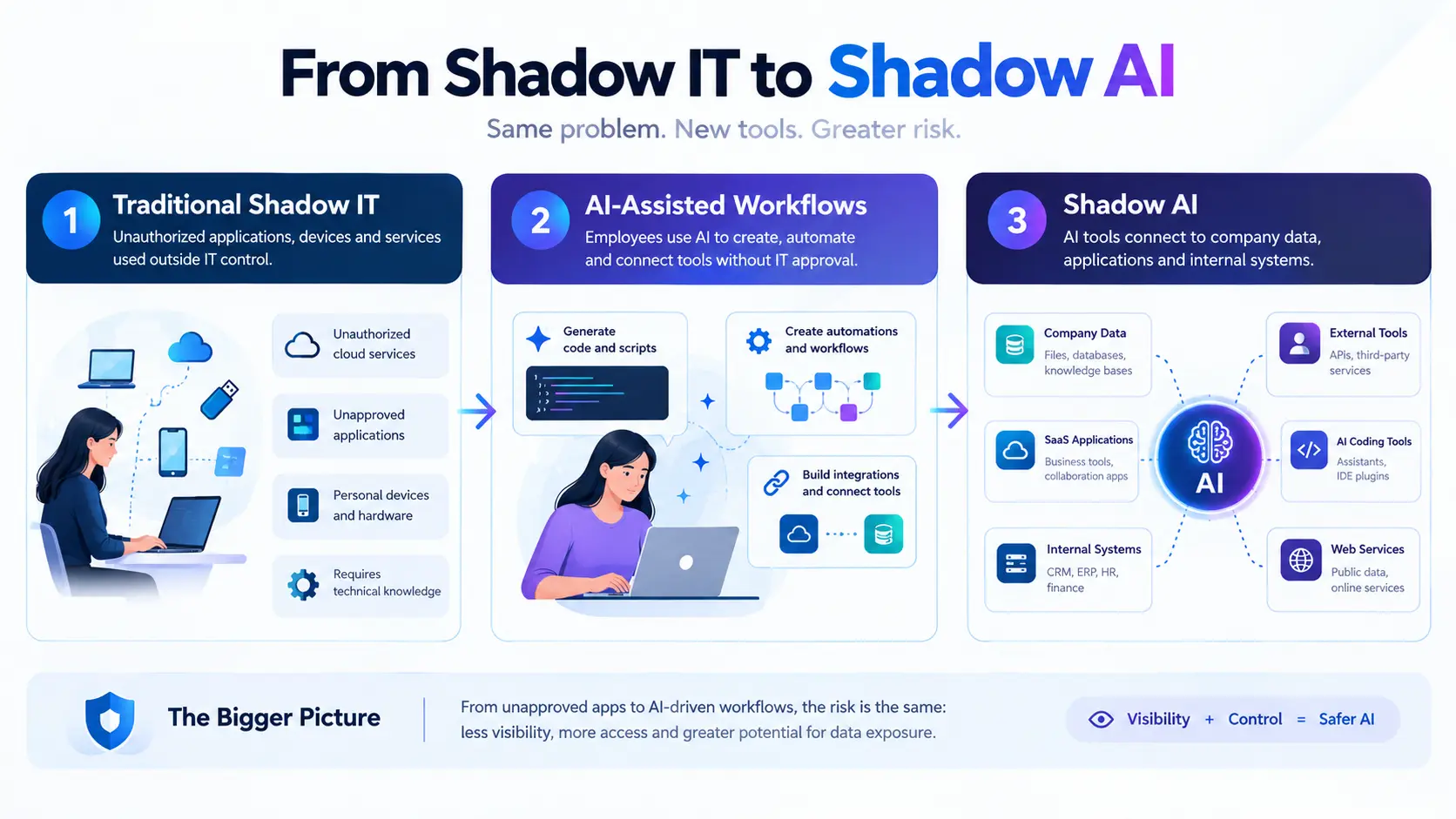
The concept is closely related to Shadow IT.
Traditionally, Shadow IT might involve an employee adopting an unauthorized application, cloud service or hardware device because an approved solution did not meet an immediate business need.
AI changes the equation because many AI services require little technical expertise.
An employee with a browser can use an AI assistant to draft documents, summarize information, generate code, create an automation or process business data.
That makes the barrier to creating an unofficial technology workflow much lower.
The Cybersecurity Insiders article describes this as an important difference between traditional Shadow IT and Shadow AI. Previously, employees often needed some technical knowledge to build systems outside IT. With AI, that requirement is becoming less significant.
AI Coding Assistants Create a New Security Challenge
One of the most visible examples of AI adoption is software development.
Tools such as GitHub Copilot, Cursor and Claude Code can help developers generate and modify code directly within their development environments. Cybersecurity Insiders highlights the productivity benefits while also pointing to a security concern: AI-generated code can appear correct while containing vulnerabilities.
This concern is supported by academic research.
A study published by Neil Perry, Megha Srivastava, Deepak Kumar and Dan Boneh examined how developers interacted with an AI coding assistant when completing security-related programming tasks. The researchers found that participants with access to the AI assistant produced less secure code in the study and were also more likely to believe their code was secure.
The important lesson is not that AI-generated code is automatically insecure.
Instead, organizations need to recognize that AI-generated code still requires the same security validation applied to human-written code.
That includes practices such as:
Code review
Secret scanning
Dependency management
Automated security testing
Vulnerability scanning
Secure development standards
CI/CD security controls
The Cybersecurity Insiders article specifically argues that polished-looking AI output should not be treated as equivalent to secure software.
AI Can Also Affect the Software Supply Chain
Another concern involves dependencies.
AI coding systems can sometimes suggest package names or dependencies that do not actually exist. The Cybersecurity Insiders article warns that attackers can register such names on public package registries and potentially use them to distribute malicious code if developers install the suggested package.
This means AI-assisted development introduces another reason to verify dependencies rather than automatically accepting generated recommendations.
For enterprises, the practical takeaway is simple: AI can accelerate development, but existing software supply-chain security controls remain necessary.
Shadow AI Is Not Limited to Developers
Perhaps the more significant change is that Shadow AI is no longer primarily a developer problem.
Employees in departments such as marketing, HR, finance and operations can use AI without needing to understand software development.
For example, an employee could use an AI service to:
Draft internal documents
Summarize business information
Create spreadsheets or formulas
Generate scripts
Build workflow automations
Process customer information
Connect different business applications
The resulting workflow might never pass through a traditional software development process.
The Cybersecurity Insiders article notes that AI-generated scripts and automations may exist in private repositories, low-code or no-code platforms, shared drives or scheduled tasks without formal ownership or security review.
That creates a different type of security challenge.
The organization may not even realize that a new application or workflow exists.
The Data Exposure Problem
One of the biggest concerns with Shadow AI is data movement.
Employees may submit information to AI services without fully understanding where the information is processed, how the service handles it or what organizational controls apply.
The risk can become particularly significant when sensitive information is involved.
The Cybersecurity Insiders article uses examples involving employee information and protected health information to illustrate the potential consequences of sending sensitive data through an AI service outside organizational control.
The underlying security question is:
What information is being sent to AI systems, and who controls the destination?
Organizations may already have established data classification and access-control policies, but those policies need to account for AI usage as well.
A policy that governs traditional SaaS applications may not automatically provide visibility into every AI service an employee can access from a browser.
AI Features Are Also Appearing Inside Existing Business Software
Shadow AI can become harder to identify when AI functionality is built directly into applications an organization already uses.
The Cybersecurity Insiders article points to AI capabilities appearing in categories such as HR systems, ERP platforms, CRM software and email applications.
This creates an important governance question.
An organization may have approved the underlying application years ago, but a newly introduced AI feature can change how information is processed or accessed.
That does not necessarily mean the feature is unsafe.
It means organizations may need to reassess how AI functionality fits into existing security, privacy and governance processes.
AI Agents Increase the Importance of Visibility
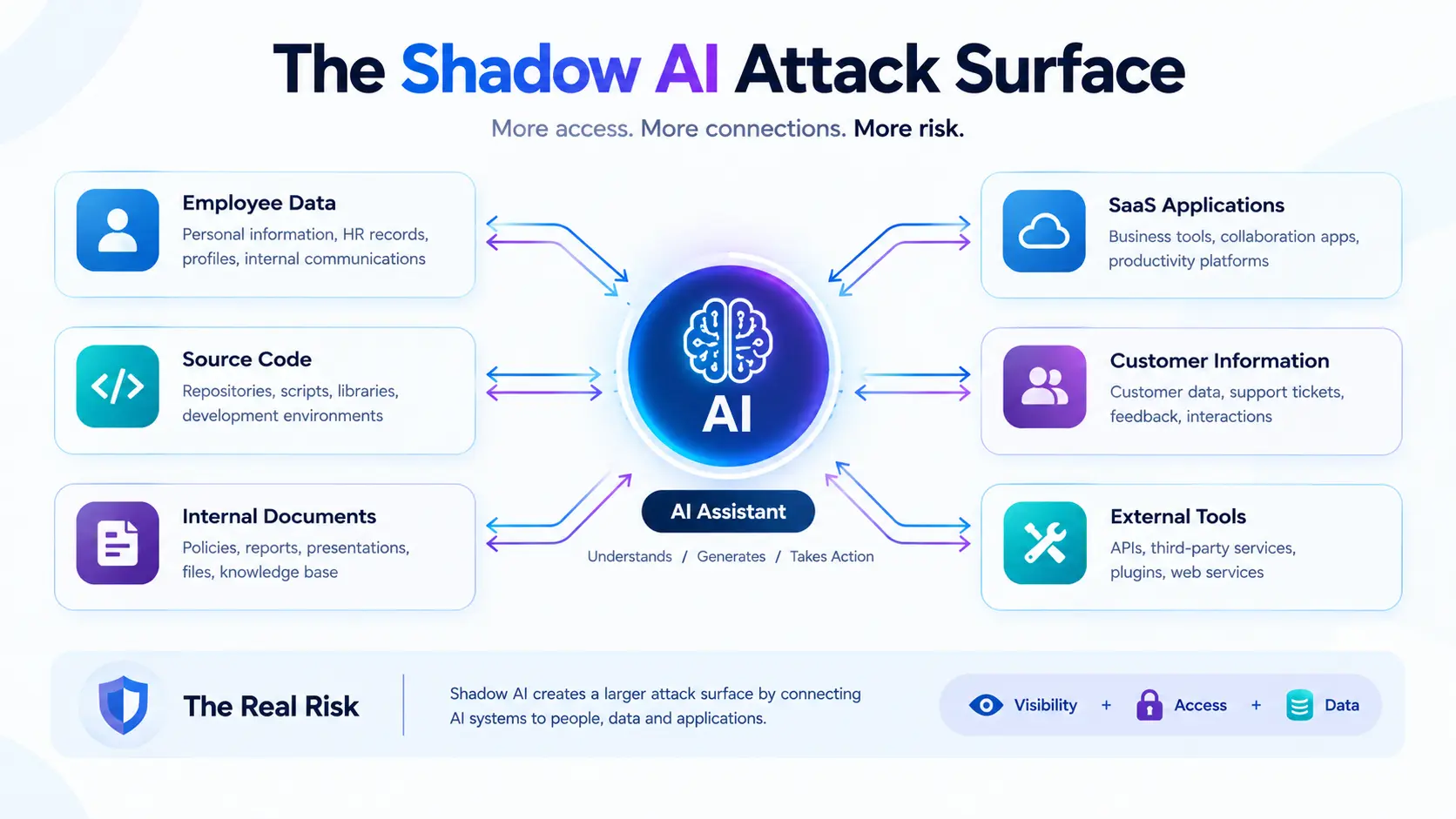
The issue becomes even more relevant as AI systems gain the ability to work with files, applications and external tools.
For example, Anthropic's current documentation describes Claude's Cowork capabilities as working across files and tools, with desktop capabilities that can interact with local files and browser workflows.
From a security perspective, the important concept is not the individual product.
It is the expanding relationship between an AI system and the organization's digital environment.
An AI assistant that only answers a question has a different security profile from an AI system that can access files, interact with applications or perform actions through connected tools.
As AI becomes more capable of acting on behalf of users, organizations need to understand:
Which AI systems are being used
Which users can access them
What information they can reach
Which applications they can connect to
What actions they can perform
What logs or audit information are available
Why Banning AI Is Not a Complete Solution
One of the central arguments in the Cybersecurity Insiders article is that organizations cannot realistically respond to Shadow AI simply by banning every AI tool.
A blanket prohibition can encourage employees to find alternative ways to accomplish the same tasks.
That can make visibility worse rather than better.
The article argues that organizations should approach AI more like they eventually approached cloud adoption: enable useful technology while establishing visibility and appropriate controls.
This is an important distinction.
The goal should not necessarily be to eliminate AI usage. The goal is to understand and govern it.
A mature approach can allow employees to use AI while establishing boundaries around sensitive data, applications and actions.
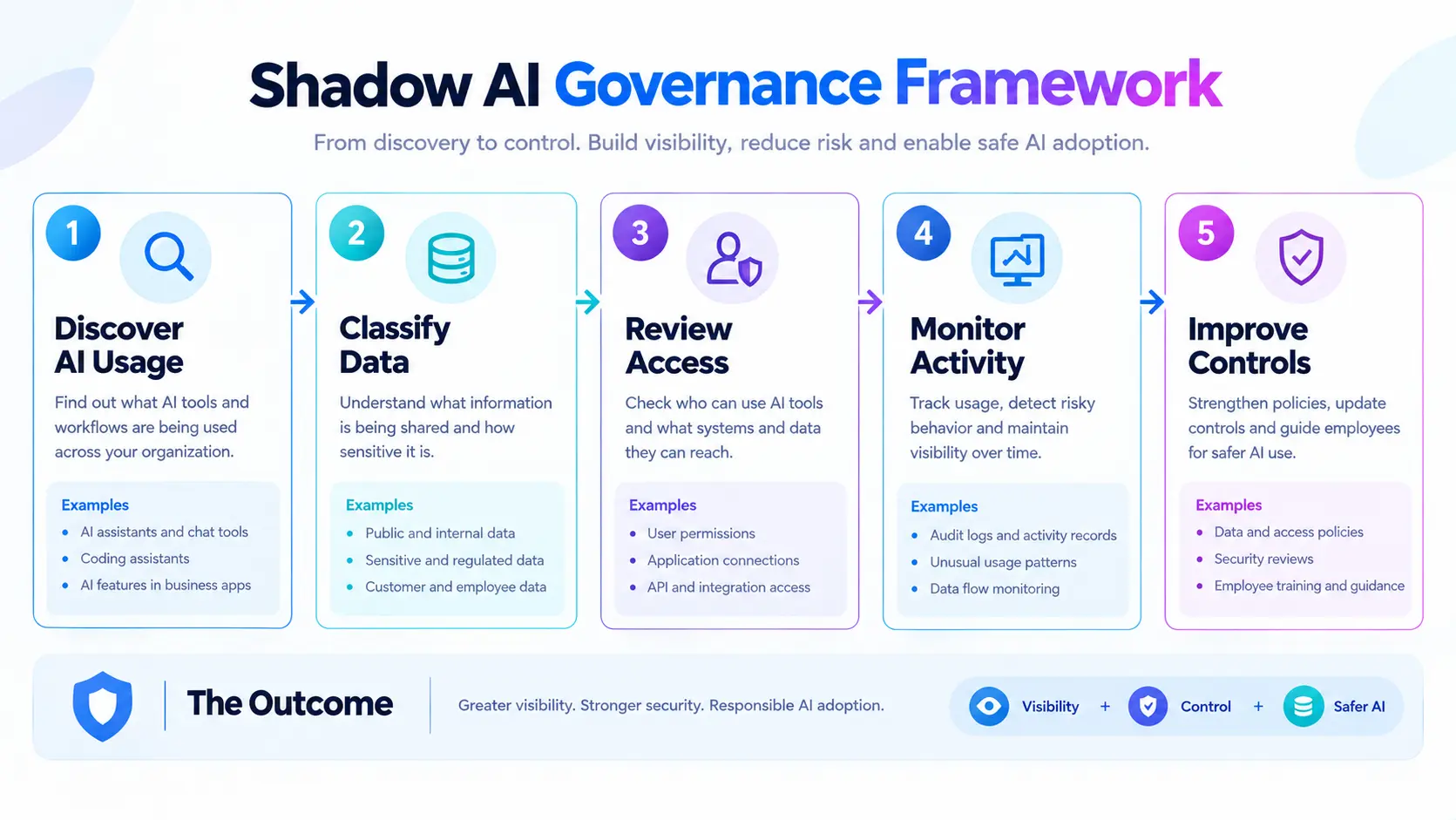
Discovery Comes Before Governance
Organizations cannot effectively govern AI systems they do not know exist.
The first step is therefore discovery.
Security and IT teams need to understand what AI services employees are using and how those services interact with organizational information.
This can include looking at:
Approved AI applications
Unapproved AI applications
AI browser services
AI coding assistants
AI-enabled SaaS features
API integrations
AI-generated workflows
Connected external tools
AI systems accessing company data
Discovery should not be treated as a one-time inventory exercise.
AI services and capabilities change quickly, and employees can introduce new tools without waiting for a formal technology deployment.
The Cybersecurity Insiders article therefore describes discovery as an ongoing discipline rather than a one-time project.
Secure AI Usage Requires Guardrails
Once organizations understand where AI is being used, the next step is establishing reasonable guardrails.
These controls can vary depending on the organization's risk profile and the type of information being processed.
Potential areas for governance include:
Data controls
Organizations can define what categories of information employees may submit to external AI services.
Sensitive information should receive stronger controls than publicly available information.
Access controls
AI systems connected to business applications should only receive the access necessary for their intended function.
Development controls
AI-generated code should pass through the same security processes as other software.
Dependency verification
AI-generated package recommendations should be verified before being added to production projects.
Monitoring and discovery
Organizations need ways to identify AI services and workflows operating within their environment.
Employee guidance
Employees should understand which AI tools are approved, what information they can use with them and when security review is required.
These controls do not need to prevent useful AI adoption.
Their purpose is to make AI usage more visible and manageable.
AI Security Must Extend Into the Software Development Lifecycle
Shadow AI also reinforces an existing principle in application security: security needs to be integrated into development rather than added only after software is complete.
When AI accelerates code generation, organizations can potentially produce more code in less time.
That makes automated security checks particularly important.
The Cybersecurity Insiders article recommends maintaining practices such as code review, secret scanning, dependency management and automated security scanning within the development lifecycle.
The broader lesson is straightforward:
AI-assisted development does not remove the need for secure development practices.
If anything, faster code generation makes consistent validation more important.
What Organizations Should Focus on Now
Based on the issues highlighted by the source, organizations can approach Shadow AI through several practical priorities.
1. Build an AI inventory
Identify the AI services employees and teams are already using.
2. Understand data flows
Determine what information is being submitted to AI systems and where that information goes.
3. Review AI-enabled applications
Look beyond standalone AI assistants and examine AI features embedded within existing enterprise software.
4. Secure AI-generated code
Apply code review, dependency verification, secret scanning and automated security testing.
5. Review connected permissions
Understand which AI systems can access internal applications, files, APIs or external services.
6. Give employees approved alternatives
If employees have legitimate business needs, providing approved AI options can reduce the incentive to create less visible workarounds.
7. Treat discovery as continuous
AI adoption changes quickly. An inventory created once may become outdated.
The Broader Industry Shift
The Shadow AI discussion reflects a broader change in enterprise security.
Technology adoption historically moved through recognizable channels. IT purchased or deployed an application, security reviewed it, administrators configured access and employees received instructions.
AI makes that process less centralized.
A browser can provide access to powerful capabilities without a traditional deployment process.
At the same time, AI is becoming embedded in the applications employees already use.
This means security teams increasingly need to understand AI as part of the organization's technology environment rather than as a separate category of software.
The announcement highlights a broader industry shift toward visibility-first AI governance. As organizations adopt AI across development and business operations, security teams need to understand not only which AI tools exist, but also how those tools interact with data, applications and users.
Shadow AI Is a Visibility Problem First
The most important point from the Cybersecurity Insiders article is not that employees are using AI.
It is that organizations may not know how AI is being used inside their environments.
An employee using an AI assistant to improve a document is different from an AI system accessing sensitive files or connected business applications.
Likewise, an AI coding assistant generating a small code snippet is different from an AI-enabled development workflow that can interact with repositories, dependencies and deployment systems.
The security response therefore needs context.
Organizations need to understand the combination of:
AI tool + user + data + permissions + connected systems + activity
Without that visibility, governance becomes difficult.
And without reasonable governance, organizations may find themselves responding to AI-related security problems only after an incident or data exposure occurs.
Final Thoughts
Shadow AI is becoming a natural consequence of rapid AI adoption.
Employees are using AI because it can help them complete work faster, automate repetitive tasks and solve problems that previously required specialized technical skills.
The security challenge is making that adoption visible and manageable.
The answer is unlikely to be a simple ban on AI.
Instead, organizations need to discover existing usage, understand data flows, control access, secure AI-assisted development and give employees clear guidance on responsible AI use.
As AI moves from simple chat interfaces toward tools that can interact with files, applications and business systems, the distinction between an AI assistant and an enterprise software component is becoming less clear.
For security teams, that makes one principle increasingly important:
You cannot effectively govern AI that you cannot see.
Source: Cybersecurity Insiders
About the Author