
OpenAI Disrupts Russian and Iranian AI-Enabled Influence Operations
OpenAI has banned two covert influence operations linked to Russia and Iran that used AI-generated content, fabricated identities and deceptive publishing tactics to spread geopolitical narratives. The cases highlight how AI can amplify traditional disinformation campaigns.
Xcademia Team
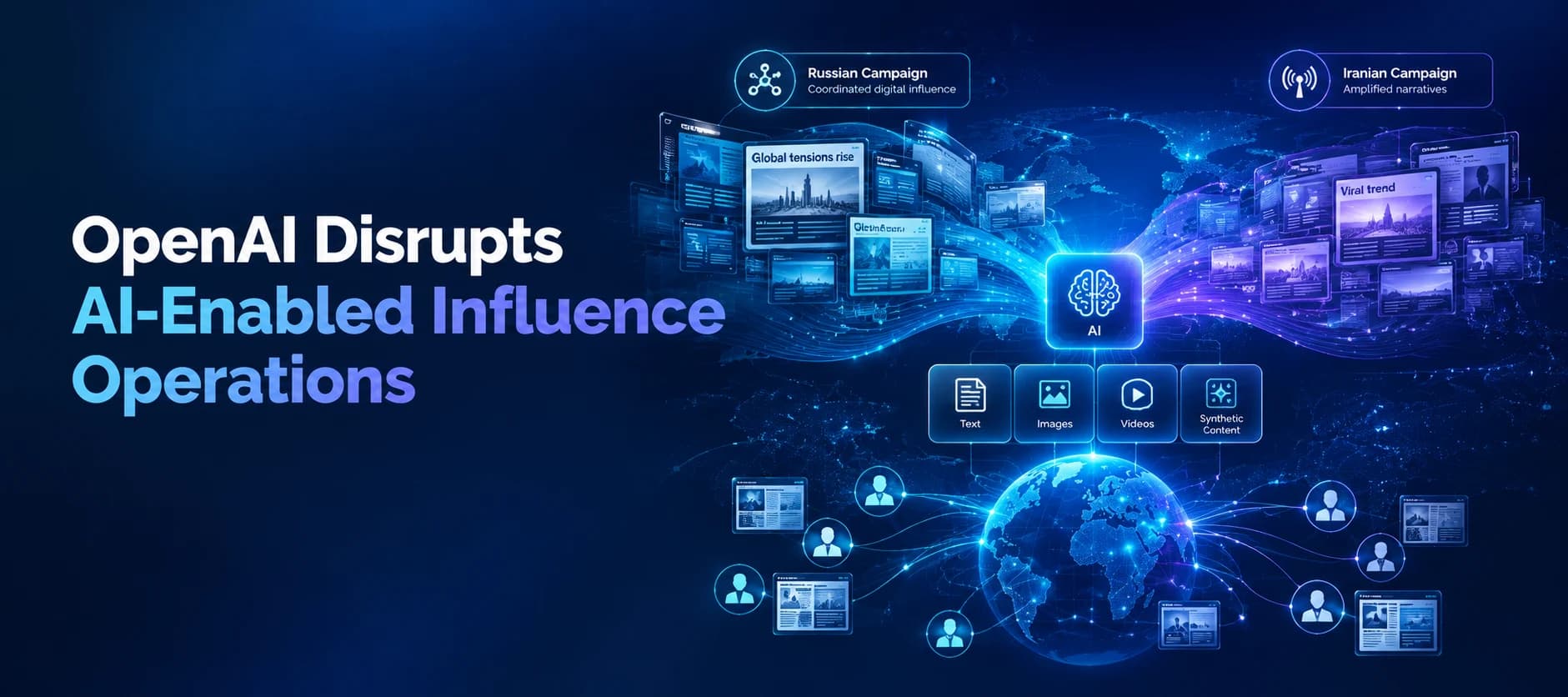
OpenAI has disrupted two covert influence operations linked to Russia and Iran that used its AI models to support deceptive information campaigns targeting audiences across multiple countries. The operations combined AI-assisted content creation with fabricated identities, misleading online publications and traditional influence tactics to conceal the origins of their messaging.
In a report published on 8 October 2026, OpenAI detailed how the two campaigns used its models to produce articles, social media comments, fabricated audio scripts and internal reports. The company said it banned the associated accounts and shared information about the investigations with relevant authorities.
The report highlights an important distinction: AI did not create an entirely new model for covert influence operations. Instead, it helped operators make established tactics easier to execute, from drafting persuasive material to managing apparently independent media identities.
What Are AI-Enabled False-Front Operations?
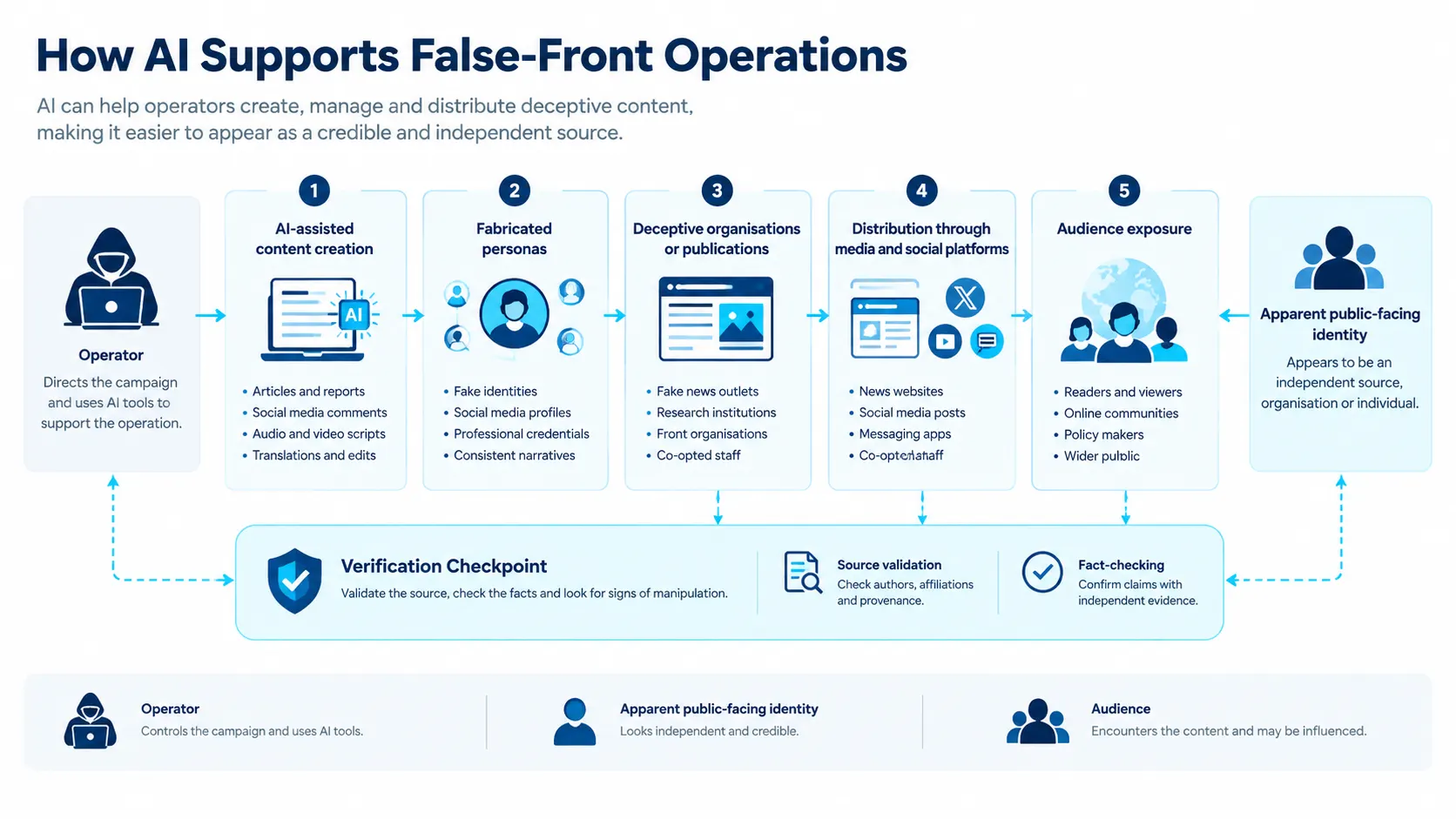
A false-front operation uses an apparently independent person, organisation, publication or research institution to conceal the interests and identity of the people directing it.
The visible entity may appear to be a legitimate news outlet, research centre or group of independent commentators. In reality, it may be used to distribute messaging that serves an undisclosed political or geopolitical objective.
AI can assist these campaigns by drafting articles, refining editorial pitches, generating comments, translating material and preparing internal documentation. These capabilities can reduce the effort required to produce content in different languages and maintain multiple identities.
According to OpenAI, the two campaigns it investigated followed patterns familiar from pre-AI influence operations. Their distinguishing feature was the use of AI to support parts of the existing workflow, rather than a complete replacement of traditional methods.
The central risk is not simply the volume of generated content. It is the possibility that audiences, editors and employees may encounter misleading information without knowing who commissioned it or what interests it serves.
Russia: Operation Dark Clark
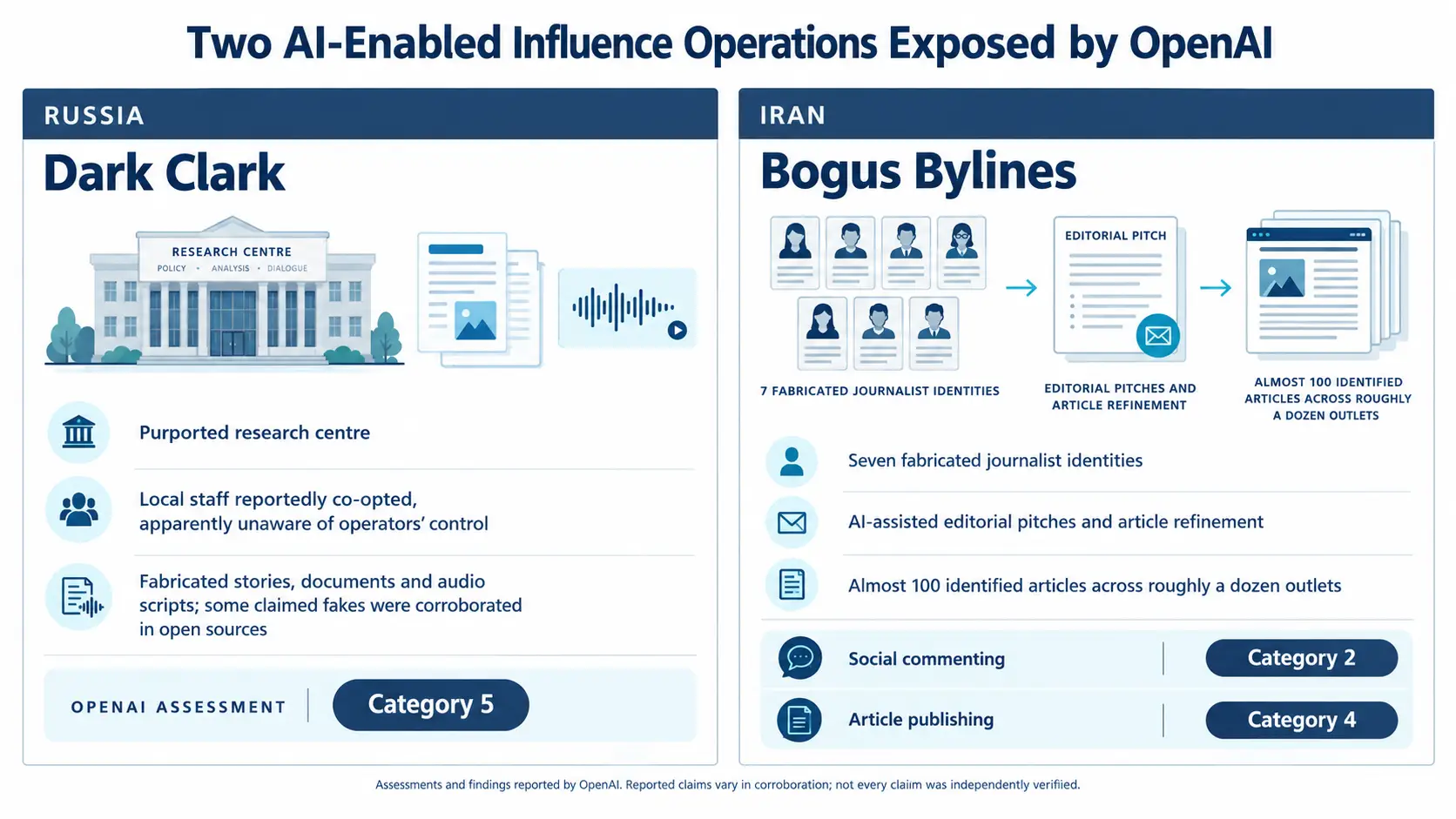
OpenAI described a Russia-origin influence operation that it nicknamed Dark Clark. The operation targeted audiences in Latin America, with much of its activity apparently intended to undermine Ukraine's reputation in the region. Some activity also appeared directed at local political developments.
OpenAI said it banned a cluster of ChatGPT accounts associated with the operation. The operators primarily used Russian-language prompts, while one individual used Spanish. According to the company, the accounts also used VPNs to access its services because access to its models from Russia was not permitted.
How the operation worked
The operators used AI for several related activities:
Preparing internal reports about the campaign and its claimed achievements.
Creating material intended for distribution across Latin America.
Drafting reports about the work of a purported social research centre, referred to as SRC.
Supporting the management and apparent performance reporting of that organisation.
OpenAI said the SRC appeared to be controlled through a fabricated persona named Mia Clark. The company's investigation found indications that the Russian operators made decisions concerning matters such as hiring, firing and pay scales.
The available evidence suggested that people working for the SRC in Latin America were not aware that they were working for a Russian group. OpenAI also said the organisation appeared to have produced much of its original content through these co-opted staff members.
This arrangement made the campaign more complex than an operation relying exclusively on fake social media accounts. It involved an apparently functioning organisation and individuals who may not have understood the identity of the people directing their work.
Fabricated audio and misleading narratives
OpenAI identified several examples of false content that the operators claimed to have distributed.
In Ecuador, one alleged campaign involved fabricated audio attributed to Ukraine's consul. The recording purported to contain disparaging comments about Ecuadorians. OpenAI's open-source investigation identified a TikTok post matching the claim, although the post appeared to have received limited engagement.
Another alleged campaign involved a fake video circulated on X and TikTok under the branding of a genuine news channel. The video claimed that Ecuador's government was recruiting young men to fight in Ukraine. OpenAI said the description matched a campaign reported by Ecuadorian fact-checkers in early April.
In Bolivia, operators described a fabricated audio recording attributed to a worker at the state water company EPSAS. The recording claimed that the government would shut off water to La Paz and declare a state of emergency. OpenAI identified a corresponding fact-check and an official denial from EPSAS.
The report also described claims involving fabricated stories about a Brazilian influencer and a purported warning from a Bolivian central bank employee. OpenAI could not independently corroborate all the content the operators claimed to have distributed.
What was the impact?
OpenAI assessed Dark Clark as a Category 5 operation on its Influence Operations Breakout Scale, which ranges from Category 1 to Category 6.
The company said some of the operation's claimed activities were supported by open-source evidence, including reports, fact-checks and official denials. One claimed false story involving a school event in Peru was also reported in Latin America and Europe and appeared to prompt comment from at least one Polish member of the European Parliament.
However, OpenAI cautioned that the operators' internal reports exaggerated or misrepresented their achievements. Their claims of impact therefore could not be accepted at face value.
The Category 5 assessment reflects OpenAI's evaluation of the operation, not independent confirmation of every claim made by its operators.
Iran: Operation Bogus Bylines
The second case, which OpenAI named Bogus Bylines, involved an Iran-origin cluster of accounts that used ChatGPT to support a campaign built around fabricated journalist identities.
The operation focused on geopolitical content, particularly the US-Iran conflict. Its operators generated material in Persian and English, refined long-form articles and prepared editorial pitches intended for online publications.
OpenAI said it banned the associated accounts and shared information about the case with relevant authorities. The company stated that it could not identify the specific actor responsible for the operation.
Seven fabricated journalist identities
The campaign used seven different bylines to pitch articles to small and medium-sized online outlets around the world.
The personas presented themselves as Western journalists, often claiming expertise in international politics, the Middle East, human rights or conflict. Some had supporting profiles across social media platforms, creating the appearance of established professional identities.
The operators used ChatGPT to review article drafts against the submission criteria of particular publications, suggest revisions and prepare emails pitching the revised material to editors.
OpenAI's investigation identified almost 100 articles published or syndicated across roughly a dozen online outlets under the campaign's bylines. The earliest identified article dated to July 2025, while the latest was published in October 2026. The frequency increased after the US-Iran conflict began.
Some articles were subsequently promoted through the social media accounts of the publications that carried them. This potentially gave the campaign access to audiences beyond those it could have reached through its own accounts.
The case illustrates why fabricated identities can be more difficult to identify when they operate through legitimate publishing channels rather than isolated, obviously suspicious websites.
Social media activity and misleading performance reports
The operation also generated batches of social media comments, primarily concerning the US-Iran conflict, alongside some commentary about US politics.
OpenAI found that the identifiable comments generally attracted low levels of engagement, with likes, views and replies typically in the single or double digits.
The company said the operators used deceptive calculations in their internal reports to exaggerate the apparent impact of this activity.
The article-publishing component had a different reach profile. OpenAI identified articles published across multiple outlets, including publications with substantial social media followings.
Using its Influence Operations Breakout Scale, OpenAI assessed the social media commenting activity at Category 2 and the article-publishing activity at Category 4.
These separate ratings show why the method of distribution matters. A campaign that places content in established publications may reach audiences that a campaign relying on low-engagement social media comments cannot.
How AI Changes the Disinformation Threat
The two cases demonstrate several ways AI can support existing influence techniques.
1. Faster content production
AI can help operators draft and revise articles, prepare pitches and generate comments. This can reduce the manual work involved in maintaining a content operation.
2. More convincing fabricated identities
AI-assisted writing can help maintain consistent language and professional presentation across multiple fictional personas. However, convincing writing alone does not establish that an identity is genuine.
3. Access to legitimate publishing channels
A fabricated identity may attempt to pass through normal editorial processes. If an article is published by a legitimate outlet, audiences may encounter it without knowing the identity or interests of the original source.
4. Misleading assessments of campaign performance
The Dark Clark and Bogus Bylines cases also highlight the need to distinguish between an operator's claimed results and independently corroborated evidence. Internal reports may exaggerate reach, attribute unrelated activity to the campaign or use misleading calculations.
These risks are not exclusive to AI. The technology can, however, make established techniques easier to execute across different formats and languages.
What Organisations and Publishers Should Do
OpenAI's findings have practical implications for newsrooms, businesses, research organisations and public institutions.
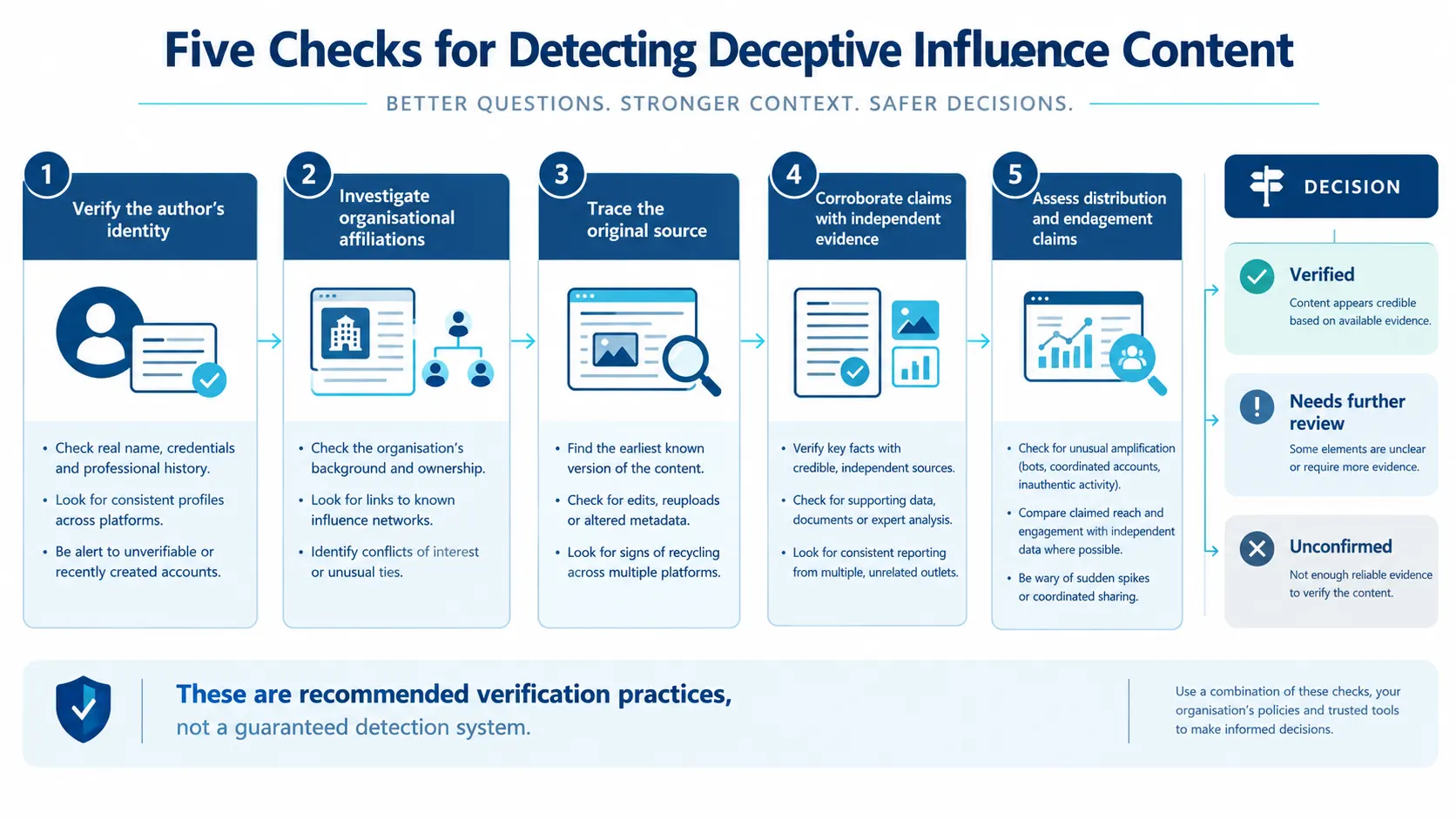
Verify identity and provenance. Editors should assess contributor histories, contact details, affiliations and the origin of submitted material, particularly when a new contributor pitches politically sensitive content.
Corroborate important claims. Organisations should seek independent confirmation before repeating allegations, recordings or purported leaked documents. A polished article or convincing audio clip is not sufficient evidence of authenticity.
Review suspicious publishing patterns. Repeated pitches from apparently unrelated contributors, inconsistent biographies and coordinated messaging across accounts may warrant additional scrutiny. None of these indicators alone proves malicious activity.
Separate reach from credibility. Publication in a recognised outlet can expand the audience for a claim, but it does not independently establish that the claim is accurate or that the original author disclosed relevant affiliations.
Use multiple sources for verification. Fact-checking organisations, official statements, primary documents and independent reporting can help establish whether a claim has been corroborated, disputed or disproved.
Train staff to recognise manipulation. Employees who handle communications, media relations and editorial submissions should understand how deceptive identities and AI-assisted content can be used to exploit ordinary workflows.
These are practical recommendations based on the risks described in the report. They should not be interpreted as a list of security controls announced or provided by OpenAI.
OpenAI's Response and the Broader Security Implications
OpenAI said it banned the accounts associated with both operations and shared information about the cases with relevant authorities. The report also aims to help researchers and other organisations understand the tactics involved and make future operations easier to investigate and disrupt.
The company highlighted a wider lesson from its investigations: covert influence campaigns are vulnerable to responsible disclosure because their effectiveness depends in part on concealing who is directing them.
Exposure can allow publishers, researchers and audiences to reassess content that was presented under misleading identities. However, disclosure does not guarantee that all copies of false content will disappear or that every audience reached by a campaign will see a correction.
OpenAI's report also places the two cases within a wider record of investigations. The company said it had exposed 30 influence operations since early 2024 and presented an overview of their distribution methods and assessed breakout levels.
The findings reinforce the importance of investigating not only how misleading content is generated, but also how it moves through organisations, publications and social networks.
Conclusion
OpenAI's disruption of Dark Clark and Bogus Bylines illustrates how AI can support covert influence campaigns without fundamentally changing their underlying objectives. Fabricated identities, deceptive editorial practices and misleading narratives remain central to these operations, while AI helps streamline parts of the process.
For organisations, the challenge extends beyond identifying AI-generated text or audio. It requires stronger verification of sources, careful assessment of claims and an understanding of how apparently independent entities can be used to conceal the interests behind a message.
The broader lesson is that content authenticity depends on more than how credible a message appears. Understanding who created it, how it was distributed and whether its claims can be independently verified remains essential to defending the integrity of online information.
Source: OpenAI
About the Author