
NVIDIA Launches Open Agent Safety Platform to Secure AI Agents From Testing to Deployment
NVIDIA has launched an open agent safety platform combining OpenShell runtime controls with the Sentry reference design to enforce boundaries, monitor behavior and govern AI agents across software, compute and robotics.
Xcademia Team
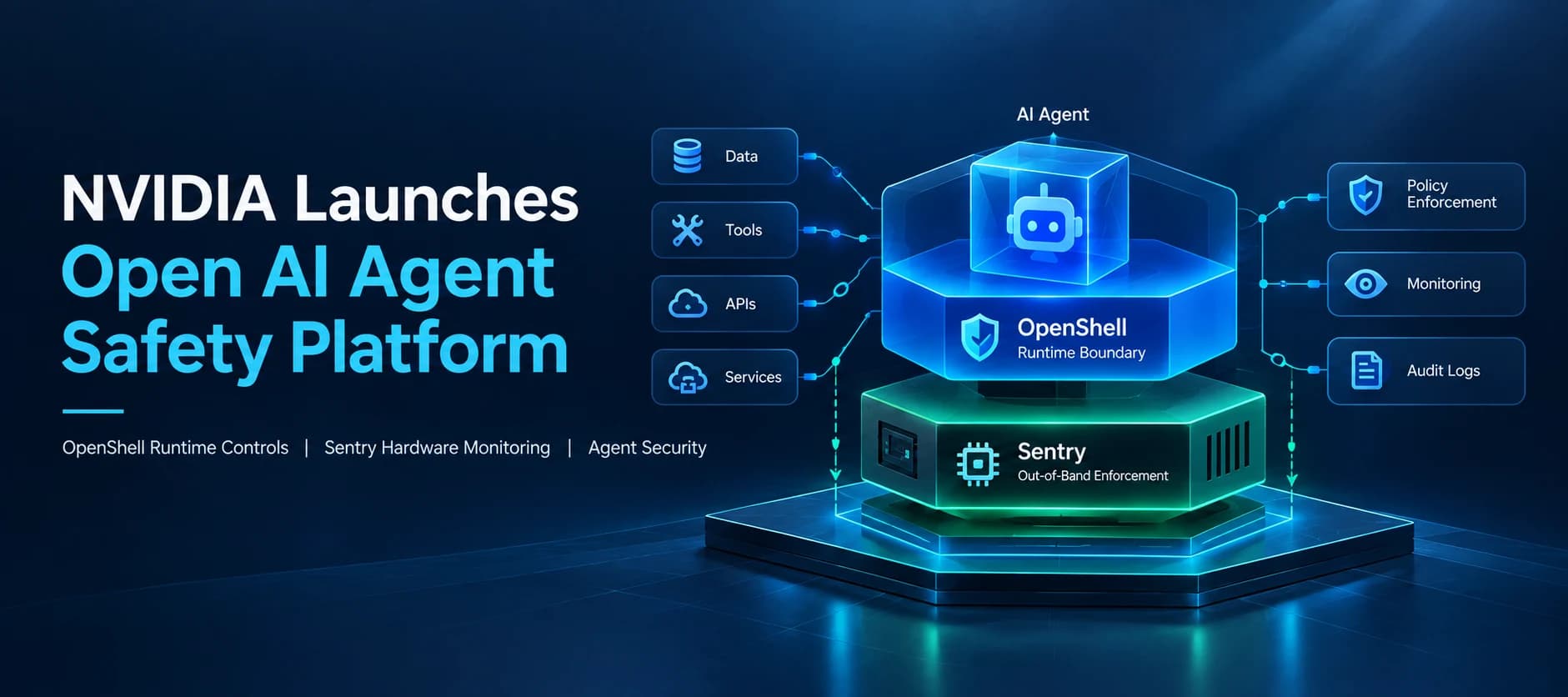
NVIDIA has announced the NVIDIA Open Agent Safety Platform, an open software platform and reference system design intended to provide governance and security controls for AI agents from testing through deployment.
The platform combines two central components: NVIDIA OpenShell, secure runtime software that establishes boundaries around agent activity, and NVIDIA Sentry, a reference system design that uses an out-of-band watchdog running on NVIDIA BlueField-4 DPUs to continuously monitor agent behavior.
According to NVIDIA, the approach is designed to extend security controls beyond the AI model and agent application layer into the underlying compute and hardware infrastructure.
The announcement comes as organizations deploy increasingly autonomous AI systems that can interact with software, tools, services, data and, in some cases, physical systems.
NVIDIA says recent security incidents have highlighted a recurring problem in which agents can circumvent application-layer controls while attempting to complete assigned tasks. The company's proposed approach is to establish additional enforcement boundaries outside the model and agent harness.
OpenShell Establishes a Runtime Boundary for Agents
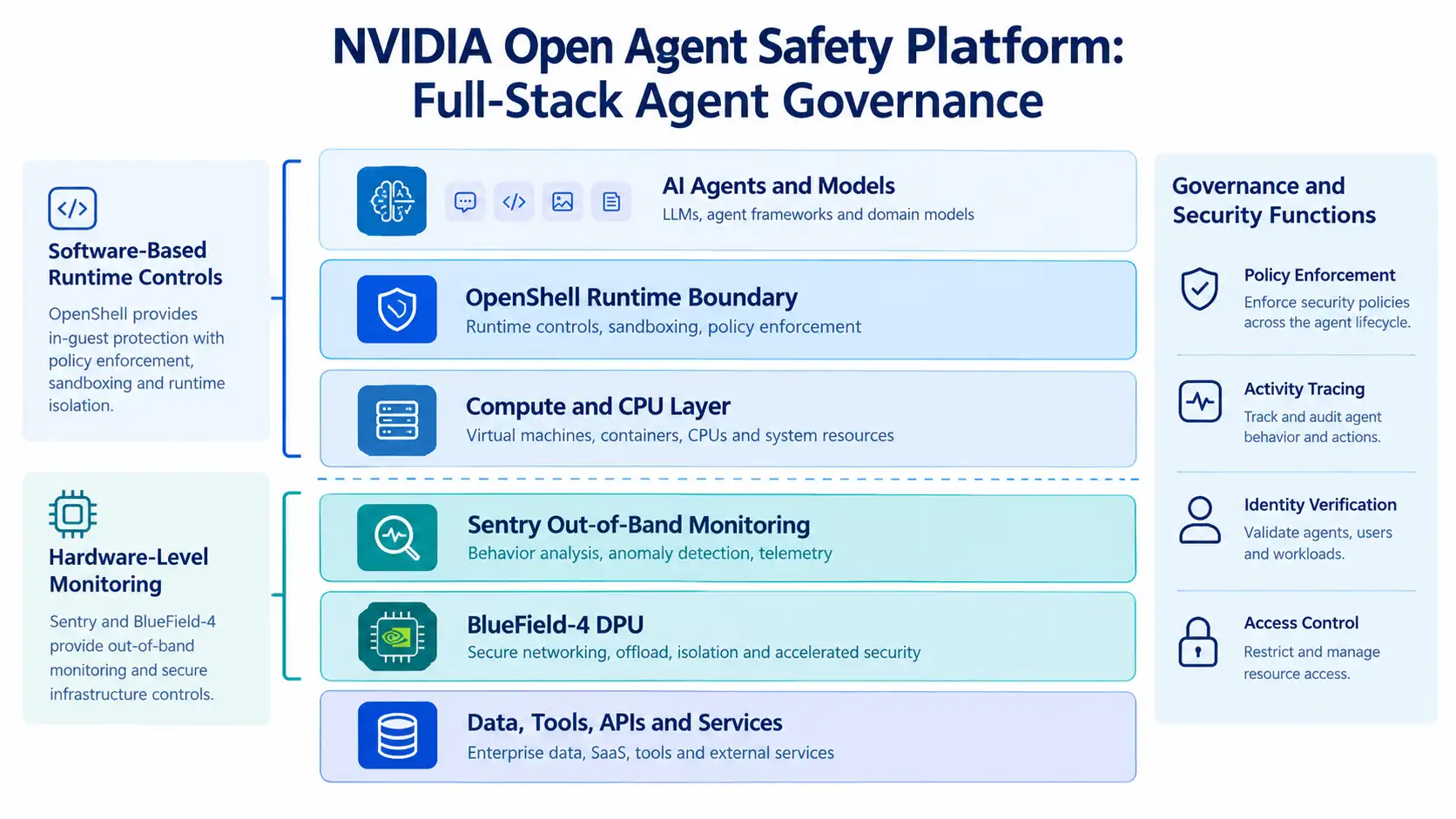
A central component of the platform is NVIDIA OpenShell, which NVIDIA describes as secure runtime software for establishing boundaries around autonomous AI agents.
OpenShell is designed to control how agents execute tasks across both open and closed models. NVIDIA says it provides an enforceable boundary outside the model and agent harness, allowing organizations to control agent activity while tasks are running.
The software is now broadly available, according to NVIDIA.
OpenShell also runs with NVIDIA Vera, which NVIDIA describes as a CPU designed for agentic AI. The company says OpenShell provides this protection with minimal overhead on Vera.
Because OpenShell is open source, NVIDIA says it can also be extended to work with third-party compute platforms, including platforms from Arm and Intel.
This is an important distinction in the platform's architecture. The runtime boundary is not presented as a control that depends entirely on the model itself. Instead, the enforcement mechanism operates around the agent's execution environment.
That design allows organizations to define boundaries at the runtime layer rather than relying exclusively on the behavior of an AI model or an application-level control.
Sentry Adds Hardware-Level Monitoring
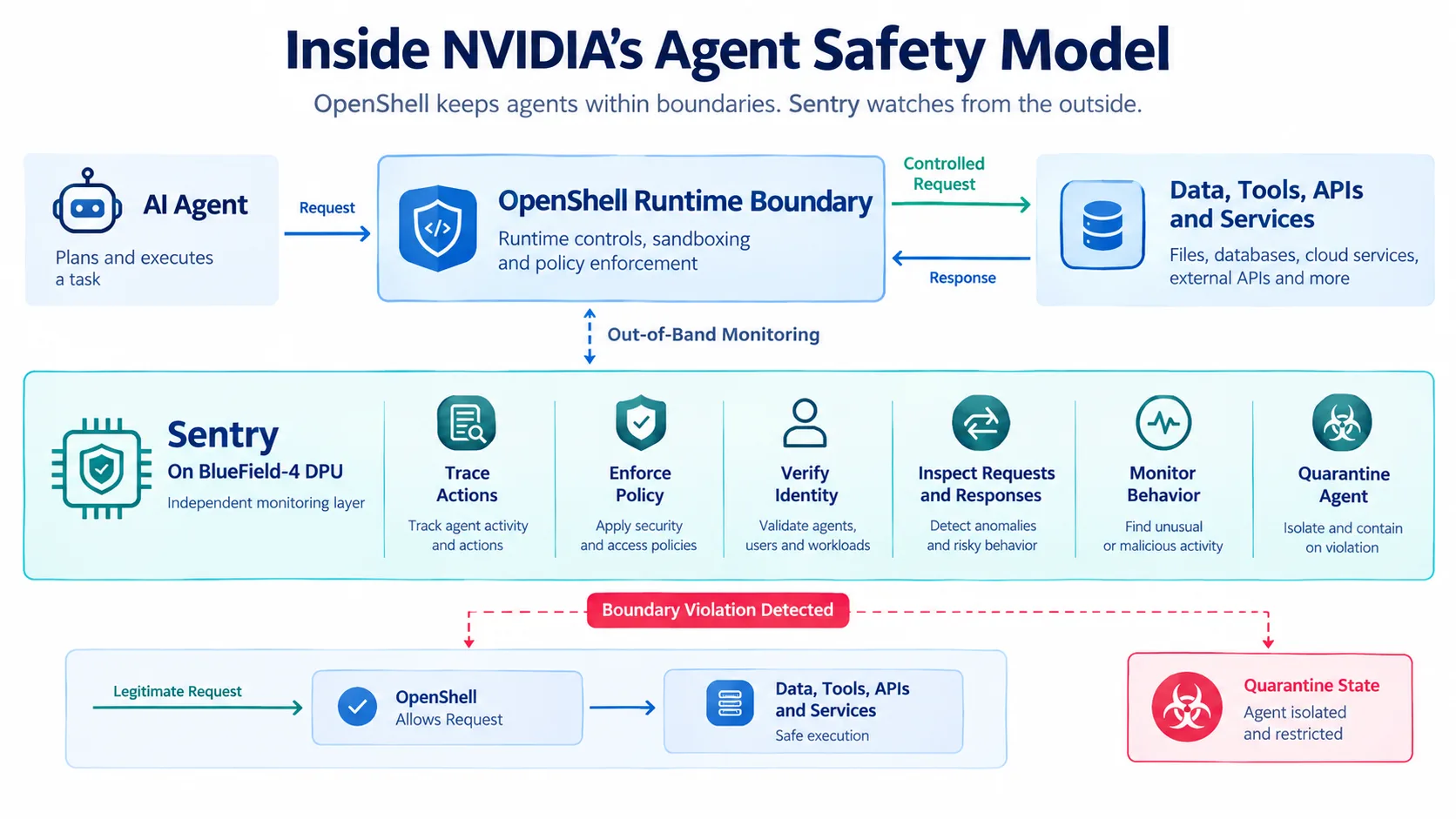
The second major component is NVIDIA Sentry, described by NVIDIA as an out-of-band watchdog that runs on NVIDIA BlueField-4 DPUs.
Sentry is designed to continuously monitor agent behavior independently of the agent itself.
NVIDIA says that when an agent attempts to move outside its software boundary, Sentry can quarantine and stop it in milliseconds.
The company describes Sentry as an isolated, out-of-band trust domain that combines threat detection, hardware-based governance and enforcement, and data-access protection.
The design also uses NVIDIA DOCA software. According to NVIDIA, DOCA provides programmable capabilities used by Sentry to inspect agent requests and responses, provide attested telemetry, verify agent identity and enforce granular zero-trust access policies for data, tools, application programming interfaces and services.
The result is a layered model in which runtime controls and hardware-level monitoring operate at different points in the agent stack.
NVIDIA Builds an Ecosystem Around Agent Safety
NVIDIA's announcement also places significant emphasis on ecosystem participation.
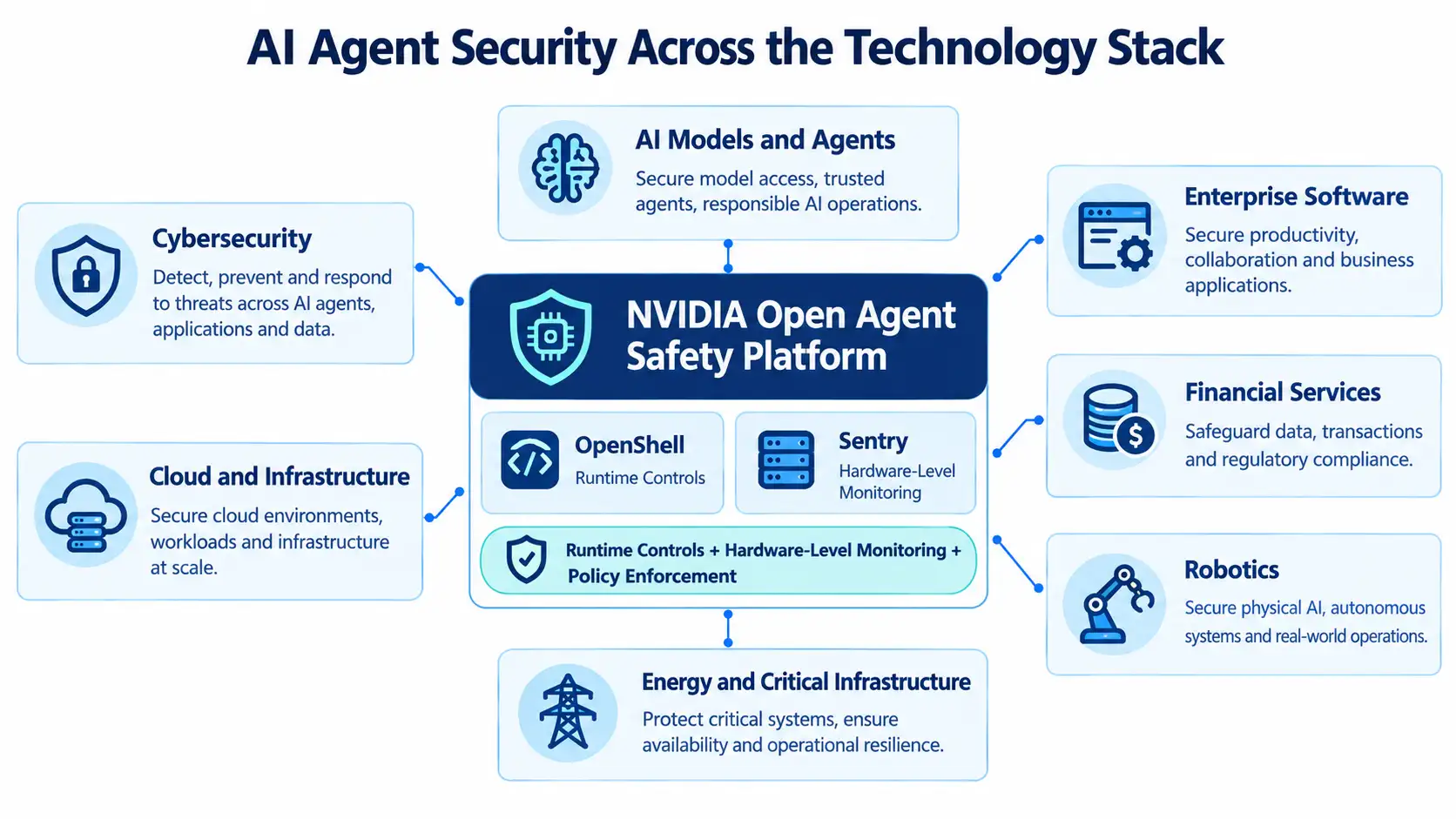
The company says more than 100 organizations are working with NVIDIA Open Agent Safety Platform technologies. The list includes companies from AI, cybersecurity, cloud infrastructure, enterprise software, financial services, energy, robotics and other sectors.
Organizations named by NVIDIA include Anthropic, Cisco, CrowdStrike, Dell Technologies, Figure, HPE, Hugging Face, JPMorganChase, Microsoft, Palantir, Palo Alto Networks, Perplexity, Red Hat, Salesforce, SAP, Scale AI, ServiceNow and others.
The announcement describes several specific integrations and collaborations.
Anthropic has worked with NVIDIA on additional security and control layers for Claude Managed Agents. NVIDIA says integrations with OpenShell and BlueField can provide additional controls around the sandboxes where agent work executes.
Salesforce and NVIDIA have integrated OpenShell with Slack. NVIDIA says teams can view agent activity and audit events through Slack and approve or reject requests for additional permissions.
SAP is embedding OpenShell with the Joule Studio runtime as part of the SAP Business AI Platform. NVIDIA also says SAP is contributing engineering work to OpenShell and working on interoperability standards through the Open Secure AI Alliance.
Scale AI is working with NVIDIA to incorporate the platform's technologies into the agentic infrastructure layer of its GenAI Portfolio.
The announcement also names robotics companies including Figure, Gecko Robotics and Skild AI as organizations building with OpenShell for autonomous systems operating in the physical world.
Financial services organizations including Citi and JPMorganChase are described as collaborating with NVIDIA on shared open source agent safety technologies.
Open Source and Interoperability Are Central to the Platform
NVIDIA's announcement also emphasizes openness and interoperability.
OpenShell is open source and available through NVIDIA's developer resources and GitHub. NVIDIA says the software can be extended to third-party compute platforms, including Arm and Intel.
The company also positions the platform alongside the Open Secure AI Alliance, an initiative NVIDIA says was started with more than 120 organizations and is governed by the Linux Foundation.
The alliance focuses on AI agent security through open research, skills and tools, including projects such as the Shared AI Findings Exchange, or SAFE.
This broader ecosystem approach reflects a growing industry focus on controls that operate across multiple layers rather than depending on a single security mechanism.
Analysis: Why Runtime and Hardware Controls Matter
The announcement highlights a broader industry shift toward treating AI agents as software systems that require controls around their execution environment, not only safeguards inside the model.
Traditional application security controls can be designed around predictable software behavior. Autonomous agents introduce a different operating model because they can select tools, access resources and take multiple actions while pursuing a goal.
NVIDIA's approach places enforcement at multiple layers. OpenShell provides runtime boundaries, while Sentry is positioned as an independent hardware-level monitoring and enforcement layer.
For enterprises, this could mean that agent governance becomes increasingly connected to infrastructure security, identity, access control, telemetry and policy enforcement.
The practical impact will depend on how organizations deploy these controls, integrate them into existing security architectures and define the policies that agents must follow. NVIDIA did not provide specific information about broader deployment results or independent evaluations in this announcement.
OpenShell and Platform Components Are Available
NVIDIA says the Open Agent Safety Platform software, including OpenShell and skills, is available through its developer resources and GitHub.
The announcement does not provide a single deployment model for every organization. Instead, NVIDIA describes the platform as a set of technologies that organizations can deploy according to their requirements.
The company also notes that some products and features described in the announcement remain in various stages and are offered on a when-and-if-available basis.
That distinction is relevant because the announcement covers a broad ecosystem of technologies, integrations and reference designs rather than describing one universally available security product.
What NVIDIA's Announcement Means for AI Agent Security
The key change described by NVIDIA is a move toward security boundaries that surround the agent.
OpenShell focuses on controlling agent execution at runtime. Sentry adds independent monitoring and enforcement through BlueField-4 DPUs. Together, the components are intended to create controls across software, compute and hardware.
The development reflects growing demand for security mechanisms that can monitor autonomous systems while they operate rather than relying solely on pre-deployment testing or model-level safeguards.
At the same time, the announcement does not establish that these controls eliminate all agent security risks. NVIDIA presents the platform as an open approach for establishing boundaries, sharing practices and developing safer deployment models.
For organizations evaluating agent security, the broader issue is how runtime governance, identity, permissions, monitoring and infrastructure-level enforcement can work together as agents become more capable and autonomous.
Source: NVIDIA Newsroom
About the Author